From the free course AP Environmental Science on Lykke
5.15 Sustainable Agriculture · 5.16 Aquaculture
Key concepts: Sustainable agriculture · Aquaculture · Sustainable farming techniques · Soil integrity · Land degradation · Plant agriculture · Livestock agriculture · Interactions
Agriculture is sustainable when it produces food while maintaining the soil, water, and ecological systems that future production depends on. The central question is practical: How can farming supply food without exhausting the land that grows it?
5.15 Sustainable Agriculture · 5.16 Aquaculture
Agriculture is sustainable when it produces food while maintaining the soil, water, and ecological systems that future production depends on. The central question is practical: How can farming supply food without exhausting the land that grows it?
Sustainable agriculture: farming without spending the soil
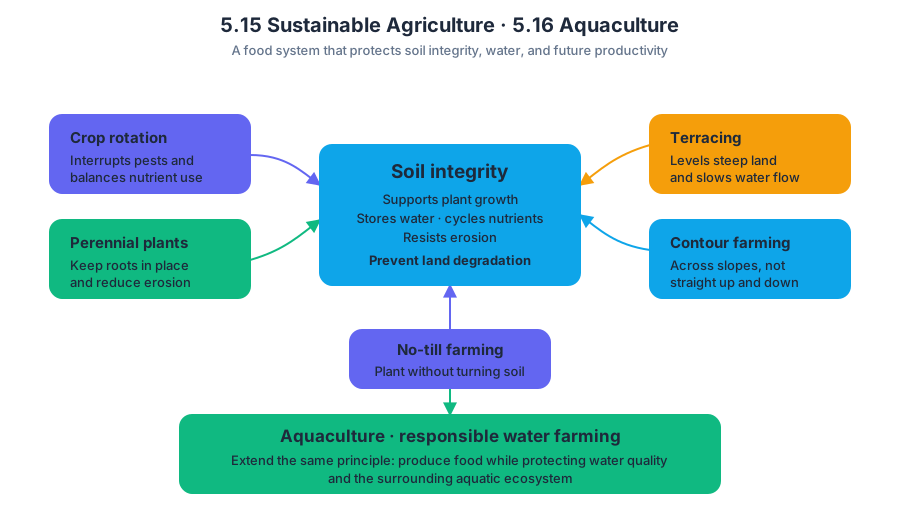
Sustainable agriculture uses farming methods that maintain soil integrity—the soil’s ability to support plant growth, store water, cycle nutrients, and resist erosion—and prevent land degradation, the long-term decline of land quality. A farm may produce a large harvest in one year yet be unsustainable if it removes topsoil, depletes nutrients, increases erosion, or contaminates nearby water.
For plant agriculture, standard sustainable techniques include:
- Crop rotation: changing the crop grown in a field across seasons can interrupt pest cycles and prevent repeated depletion of the same nutrients.
- Perennial plants: plants that live for multiple years keep roots in the soil longer, reducing erosion and improving soil structure.
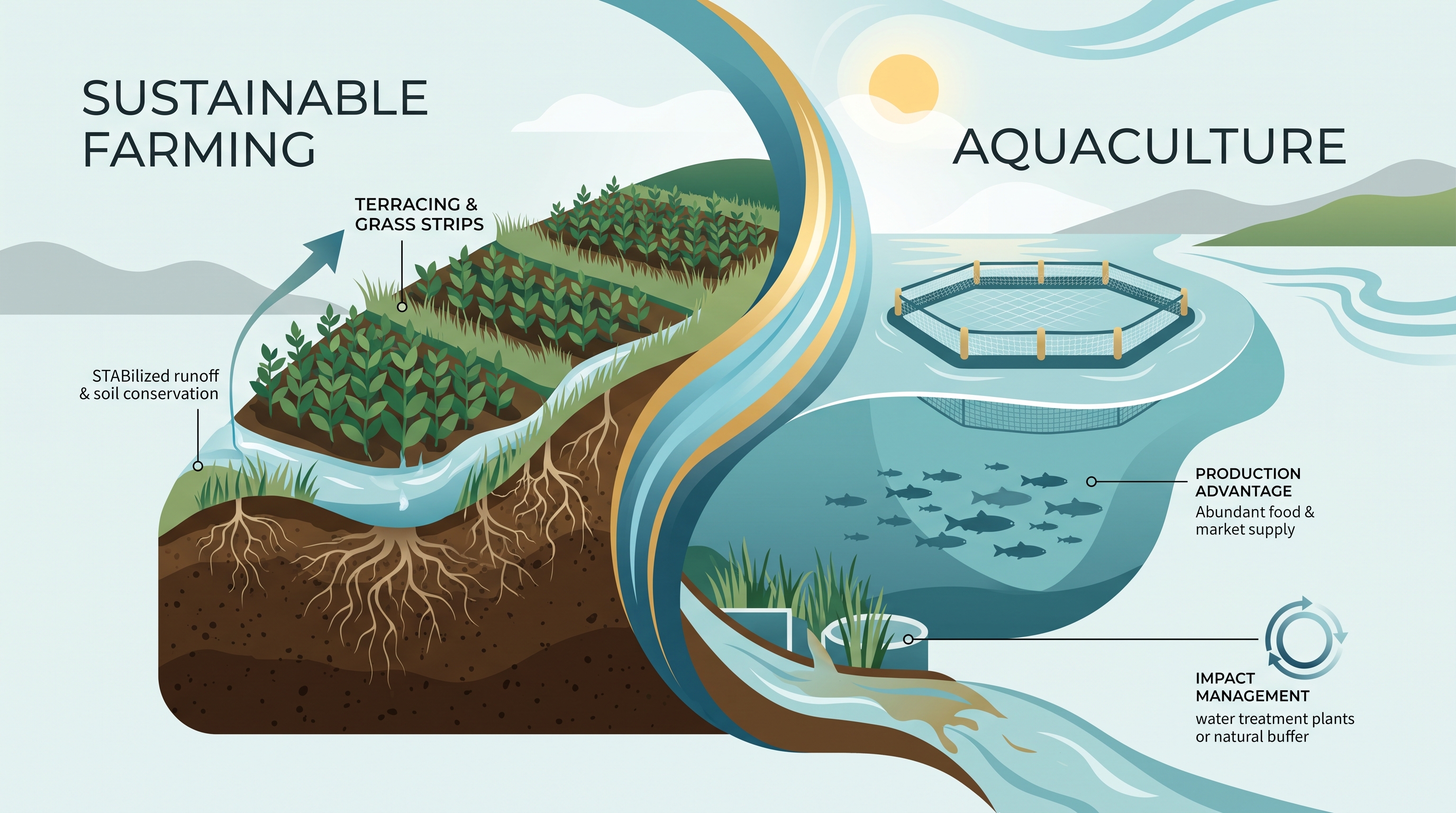
- Terracing: shaping steep land into level steps slows water flow and reduces soil loss.
- Contour plowing or contour farming: plowing across a slope rather than straight up and down creates ridges that slow runoff.
- No-till farming: planting without repeatedly turning the soil leaves residues and soil structure in place, reducing erosion.
- Cover crops: crops planted between harvests protect bare soil, absorb nutrients, and add organic matter when they decompose.
These techniques are not simply “natural” alternatives to conventional farming. Their environmental value comes from the mechanism they change: slower runoff, stronger root systems, less exposed soil, improved nutrient retention, or reduced disturbance.
Livestock and soil integrity
Livestock agriculture can also be managed sustainably. Rotational grazing moves animals among pasture areas so vegetation has time to recover; this limits overgrazing, protects plant roots, and reduces soil compaction and erosion. Responsible manure management stores or applies manure in ways that prevent nutrient-rich runoff from entering streams, where nitrogen and phosphorus can contribute to eutrophication.
Livestock therefore connects soil management to ecosystem interactions: poorly managed animals can remove vegetation, compact soil, increase sedimentation, and add nutrients or biological contaminants to water, while well-managed grazing and manure systems can reduce those pressures.
Worked example: choosing a soil-conservation solution
A farmer cultivates a steep field where heavy rain carries muddy water into a stream. The farmer wants to maintain crop production while preventing land degradation. Contour farming is a defensible solution because furrows that follow the land’s contour interrupt the downhill movement of water, reducing runoff speed and soil erosion. Terracing or switching some acreage to perennial plants could serve the same goal through different mechanisms.
A strong environmental-solution claim follows the chain:
Practice → environmental mechanism → desired outcome
For example: The farmer should use contour farming because the horizontal furrows slow water moving downslope, reducing topsoil loss and sediment entering the stream.
AP Science Practice 7.E — Make a claim that proposes a solution to an environmental problem in an applied context. A claim earns strength when it names a specific practice and explains why that practice addresses the stated environmental problem.
5.16 Aquaculture
Aquaculture is the controlled cultivation of aquatic organisms, such as fish, shellfish, or aquatic plants, for food or other uses. It can reduce pressure on some wild populations by producing organisms in ponds, tanks, cages, or managed coastal areas, but its environmental outcome depends on how the system is designed and operated.
Potential advantages include a more predictable food supply and reduced harvesting of wild organisms. Potential disadvantages include waste and excess nutrients released into surrounding water, disease transmission, escape of farmed organisms, habitat damage, and resource use for feed or energy. A closed or carefully monitored system can limit some impacts; poorly managed aquaculture can concentrate them.
AP Science Practice 7.C — Describe advantages, disadvantages, or trade-offs of environmental solutions. For aquaculture, avoid labeling the practice automatically “good” or “bad.” Compare the benefit of producing food with the possible costs to water quality, biodiversity, habitat, and nearby ecosystems.
Misconception check
Misconception: “Any farming technique called sustainable prevents every environmental problem.” Correction: sustainability is context-dependent. No-till farming may reduce erosion, but a farm can still face nutrient loss or water scarcity. Aquaculture may reduce pressure on wild fisheries, but it can still create localized pollution or disease risks. The correct answer identifies the specific environmental pressure and the mechanism that addresses it.
Retrieval check
A field on a steep slope is losing topsoil, while an aquaculture facility is releasing nutrient-rich water. Name one sustainable farming technique for the field and explain its soil-conservation mechanism. Then state one advantage and one disadvantage of aquaculture, identifying the ecosystem affected in each case.
Source Materials
- AP Environmental Science Course and Exam Description
- Review the Clarifications (.pdf)
- AP Environmental Science Course Overview
- AP Environmental Science Course at a Glance
- AP Environmental Science Course at a Glance Poster
- AP Environmental Science
- AP Environmental Science
- AP Environmental Science Sample Syllabus 1