From the free course AP Environmental Science on Lykke
6.5 Fossil Fuels · 6.6 Nuclear Power
Key concepts: Fossil-fuel combustion for electricity generation · Environmental impacts of fossil-fuel extraction and use · Surface mining and land-use changes · Fracking-related groundwater contamination and volatile organic compounds · Thermal pollution from power plants · Nuclear power and uranium-235 fuel · Electricity-generation calculations using percentages · Environmental impacts of burning fossil fuels · Ocean acidification · Coal and U.S. energy-consumption trends
Fossil-fuel power plants convert the chemical energy of coal, oil, or natural gas into electricity by burning the fuel, while nuclear plants release energy by splitting atomic nuclei.
6.5 Fossil Fuels · 6.6 Nuclear Power
Fossil-fuel power plants convert the chemical energy of coal, oil, or natural gas into electricity by burning the fuel, while nuclear plants release energy by splitting atomic nuclei. Both systems ultimately use heat to make steam, but their environmental impacts begin with very different fuel sources and processes.
Fossil-fuel combustion: from fuel to electricity
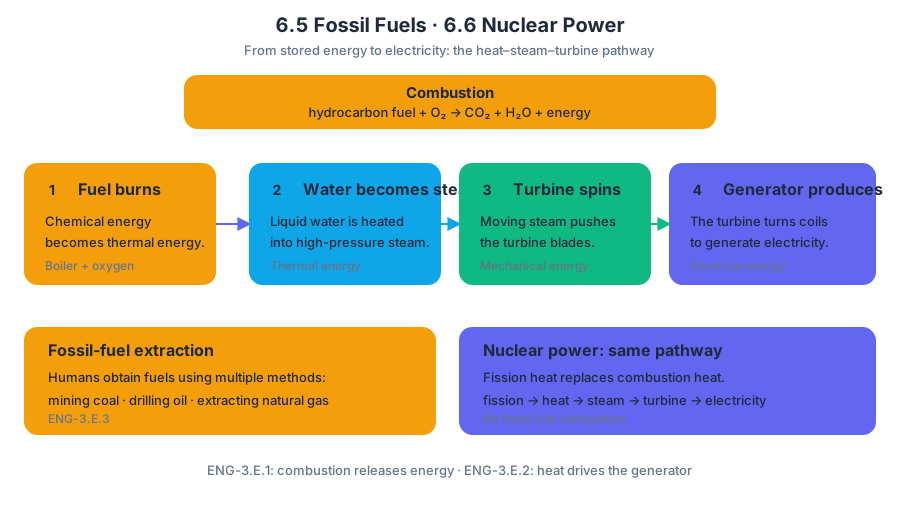
Combustion is a chemical reaction in which a fuel reacts with oxygen and releases energy. For a hydrocarbon fuel, the products include carbon dioxide and water. A simplified example is:
$$ \text{hydrocarbon fuel} + O_2 \rightarrow CO_2 + H_2O + \text{energy} $$
In a fossil-fuel power plant, the released energy follows a four-step pathway:
$$ \text{chemical energy} \rightarrow \text{thermal energy} \rightarrow \text{mechanical energy} \rightarrow \text{electrical energy} $$
- Fossil fuel burns in a boiler.
- The heat converts liquid water into high-pressure steam.
- The steam spins a turbine.
- The turbine turns a generator, producing electricity.
This required mechanism is identified by ENG-3.E.1, which describes combustion as a reaction between fossil fuel and oxygen that yields carbon dioxide and water while releasing energy. ENG-3.E.2 identifies the heat–steam–turbine–generator sequence, and ENG-3.E.3 emphasizes that humans use multiple extraction methods to obtain fossil fuels.
Environmental costs occur before, during, and after combustion
The environmental impact of fossil fuels is not limited to smoke from a power plant. Extraction can disturb land and pollute water; processing and transport can release pollutants; and combustion can produce air pollution and greenhouse-gas emissions.
| Stage | Environmental problem | Mechanism |
|---|---|---|
| Extraction | Land disturbance and deforestation | Mining, drilling, and access roads remove or fragment habitat |
| Hydraulic fracturing | Groundwater contamination | Fluids, methane, or chemicals may enter groundwater through faulty wells or pathways |
| Oil and gas production | Volatile organic compounds (VOCs) | Vapors escape during drilling, processing, storage, or transport |
| Combustion | Air pollution | Burning produces pollutants in addition to carbon dioxide |
| Combustion | Greenhouse-gas emissions | Carbon dioxide strengthens the greenhouse effect |
| Combustion | Ocean acidification | Atmospheric carbon dioxide dissolves into seawater and forms acids |
ENG-3.F, the learning objective for this topic, requires describing the effects of fossil fuels on the environment. ENG-3.F.1 specifically identifies hydraulic fracturing, or fracking, as a process that can cause groundwater contamination and release VOCs. A strong explanation names both the pollutant and the pathway by which it reaches an environmental system.
Surface mining and land-use change
Surface mining removes soil and rock above a shallow fossil-fuel deposit. This can strip vegetation, destroy habitat, compact soil, increase erosion, and expose pollutants that enter nearby streams. The central environmental issue is land disturbance: the landscape is physically altered before the fuel ever reaches a furnace.
Worked example: A coal mine removes vegetation from a hillside. Without roots to hold soil in place, rainfall carries sediment into a stream. The sediment increases turbidity, reduces light penetration, and may cover aquatic habitat. The complete evidence chain is:
$$ \text{surface mining} \rightarrow \text{vegetation removal} \rightarrow \text{erosion} \rightarrow \text{sediment in water} \rightarrow \text{reduced water quality} $$
Thermal pollution
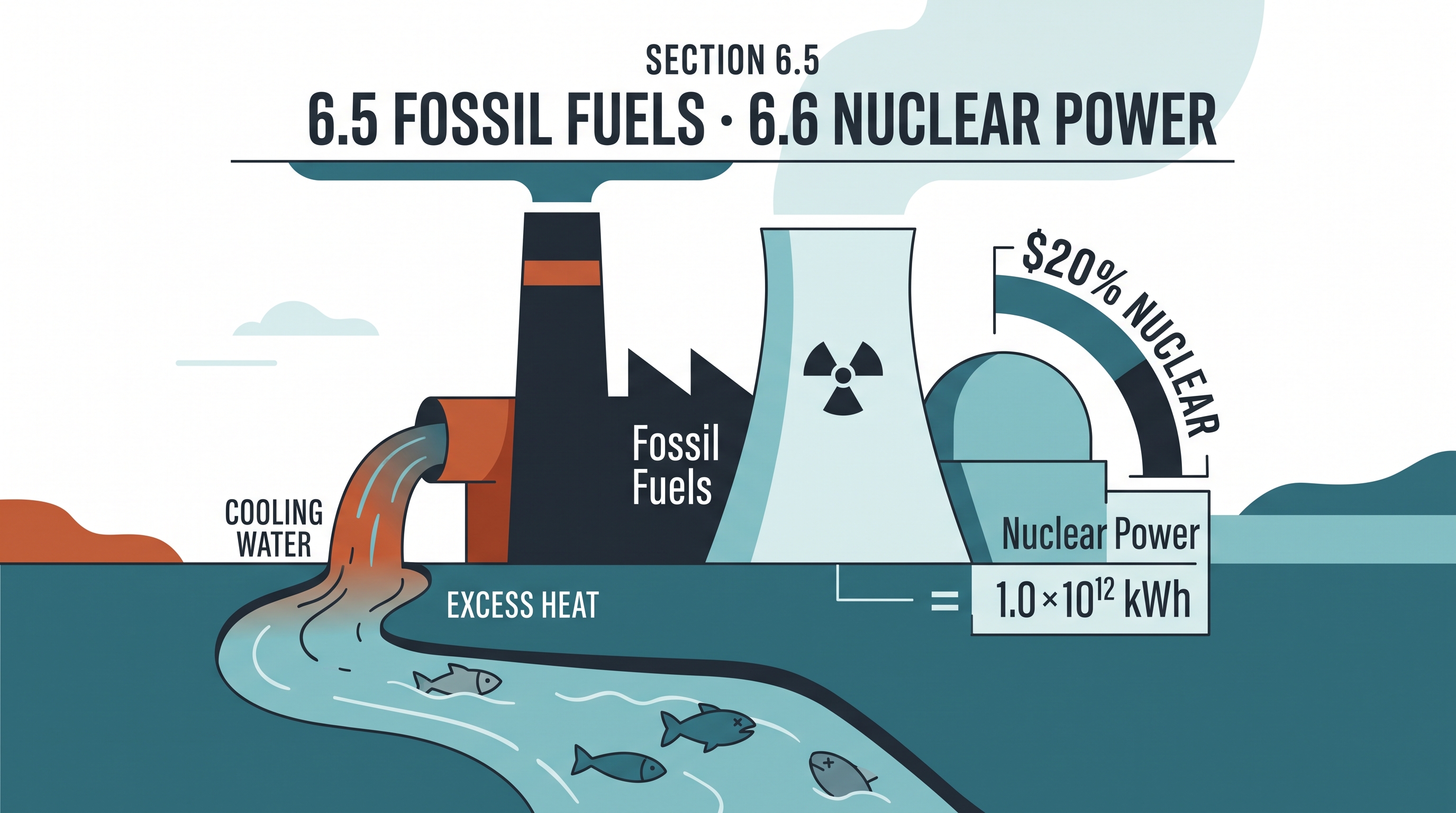
Thermal pollution occurs when a power plant releases heated cooling water into a river, lake, or coastal waterway. Warmer water holds less dissolved oxygen, so aquatic organisms may experience oxygen stress even when no toxic chemical has been added.
A complete explanation connects temperature, oxygen, and organisms: heated discharge raises water temperature; warmer water has lower dissolved-oxygen capacity; fish and aquatic invertebrates have less oxygen available for respiration; and sensitive organisms may be harmed or killed. Thermal pollution therefore lowers water quality through a physical change in temperature.
Misconception check: Thermal pollution is not “hot water poisoning organisms directly” only. Its major AP mechanism is that warmer water contains less dissolved oxygen, while organisms may also experience increased metabolic oxygen demand.
Nuclear power and uranium-235
Nuclear power plants use a fissile isotope such as uranium-235 rather than a fossil fuel such as methane. In fission, uranium-235 nuclei split into smaller nuclei and release energy. Uranium fuel is stored in fuel rods; the heat produced by fission boils water, and the resulting steam turns a turbine connected to a generator.
Nuclear power avoids direct carbon dioxide emissions from combustion during electricity generation, but it has environmental concerns of its own. These include radioactive waste requiring secure long-term storage, the possibility of radioactive release after an accident, uranium mining impacts, and thermal pollution from cooling-water discharge.
Nuclear-electricity calculation
To calculate electricity generated by nuclear power, multiply total commercial electricity generation by the nuclear percentage:
$$\left(4.1 \times 10^{12}\ \text{kWh}\right)(18.9%)$$
Convert the percentage to a decimal:
$$18.9% = 0.189$$
Then multiply:
$$\left(4.1 \times 10^{12}\right)(0.189)=7.749 \times 10^{11}\ \text{kWh}$$
The answer is therefore $7.749 \times 10^{11}\ \text{kWh}$. The most common error is multiplying by $18.9$ instead of $0.189$, which makes the result $100$ times too large.
Reading energy-consumption evidence
When interpreting an energy graph, first identify the largest source at the requested year by comparing the plotted values. For coal, describe the pattern over the entire interval rather than naming only the starting and ending values: note whether consumption rises, falls, fluctuates, or changes most sharply during a particular period.
A data-based explanation for declining coal use might connect the graph to increased use of natural gas, renewable technologies, energy-efficiency improvements, or air-pollution controls. The graph establishes the pattern; environmental knowledge supplies a plausible mechanism. Do not claim that a trend proves one cause unless the data directly support that conclusion.
AP science practices in action
This topic most directly exercises Science Practice 1: Concept Explanation, when explaining combustion, fission, or thermal pollution; Science Practice 5: Data Analysis, when identifying the highest energy source or describing coal-consumption trends; Science Practice 6: Mathematical Routines, when calculating nuclear electricity; and Science Practice 7: Environmental Solutions, when proposing controls such as wastewater cooling systems, mine reclamation, or reduced fossil-fuel combustion.
Retrieval check
A coal plant releases cooling water into a river, and fish mortality increases downstream. Identify the pollutant, explain the mechanism, and name one likely water-quality change. Then calculate the nuclear generation from $5.0 \times 10^{12}\ \text{kWh}$ of total electricity if nuclear power supplies $20%$.
Answer: The pollutant is excess heat. Heated water lowers dissolved-oxygen concentration, stressing or killing fish; water quality decreases. The nuclear generation is:
$$\left(5.0 \times 10^{12}\ \text{kWh}\right)(0.20)=1.0 \times 10^{12}\ \text{kWh}$$
Source Materials
- AP Environmental Science Course and Exam Description
- Review the Clarifications (.pdf)
- AP Environmental Science Course Overview
- AP Environmental Science Course at a Glance
- AP Environmental Science Course at a Glance Poster
- AP Environmental Science
- AP Environmental Science
- AP Environmental Science Sample Syllabus 1
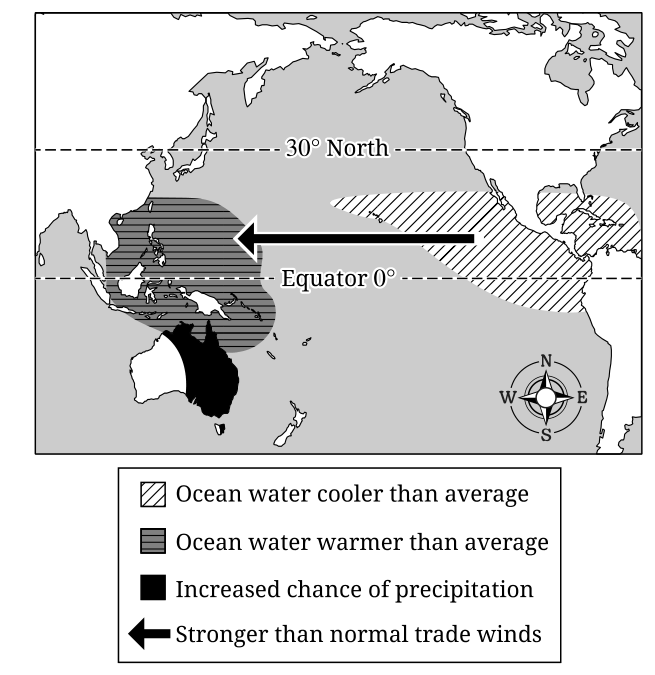
- Figure 1. Effects of Changes in Sea Surface Conditions in Equatorial Pacific Ocean