From the free course AP Environmental Science on Lykke
5.17 Sustainable Forestry
Key concepts: Sustainable forestry · Sustainability
A forest can produce timber indefinitely only when harvesting does not permanently reduce the forest’s ability to regenerate, support biodiversity, protect soil, and regulate water.
5.17 Sustainable Forestry
A forest can produce timber indefinitely only when harvesting does not permanently reduce the forest’s ability to regenerate, support biodiversity, protect soil, and regulate water. Sustainable forestry is the management of forest resources so that present use does not compromise the ecological functions and resource availability needed by future generations.
Sustainability means meeting human needs while maintaining the long-term health and functioning of environmental systems.
From forest harvest to forest management
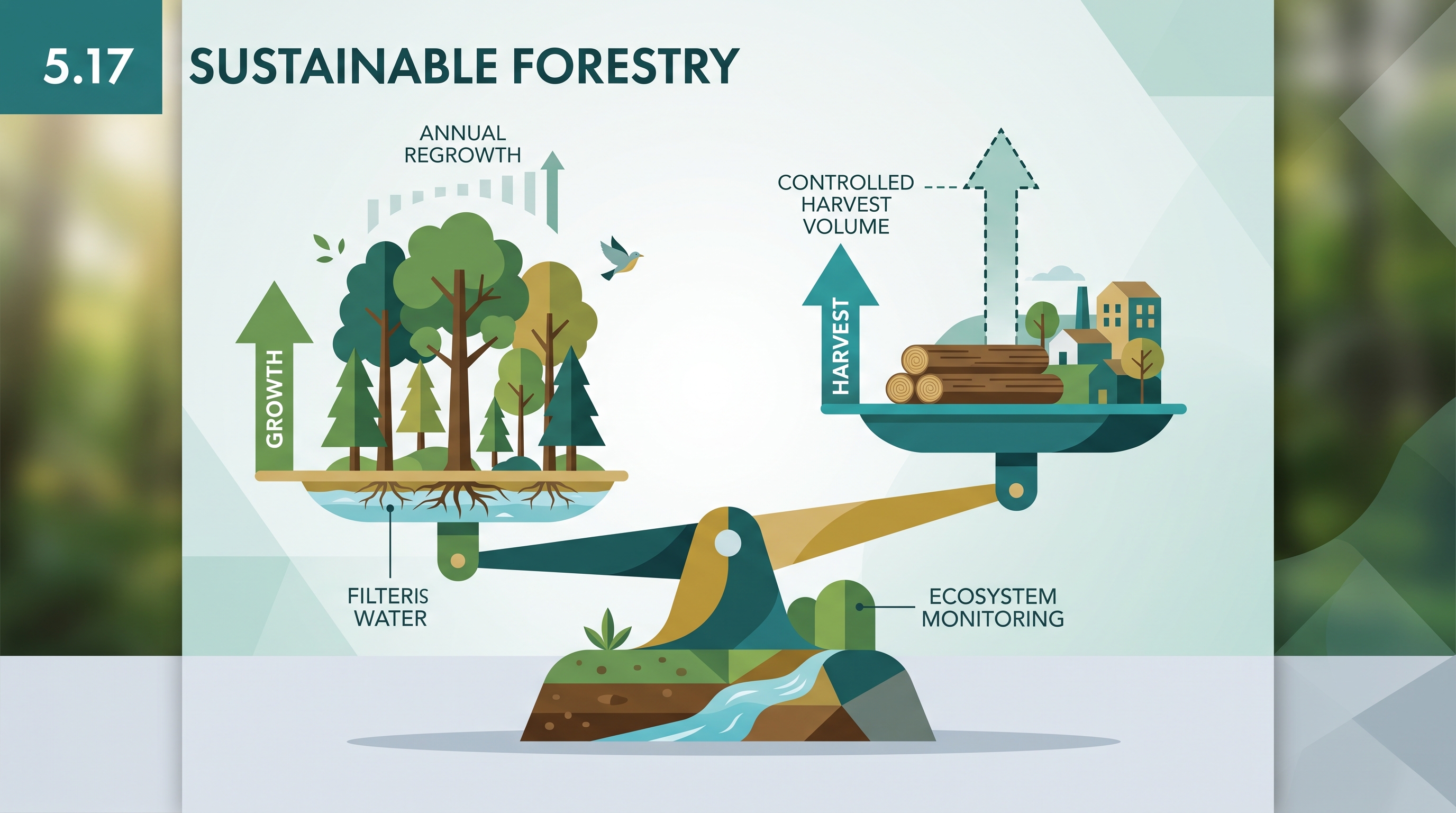
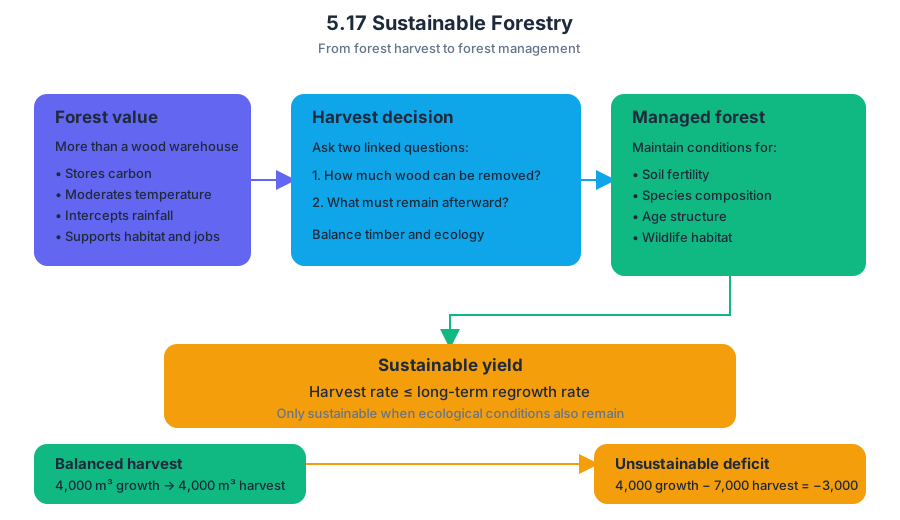
A forest is more than a warehouse of wood. It stores carbon, moderates local temperature, intercepts rainfall, reduces soil erosion, provides wildlife habitat, and supports economic activity. Sustainable forestry therefore asks two linked questions: How much wood can be removed? and What ecological conditions must remain afterward?
A useful management target is sustainable yield: harvesting wood at a rate that does not exceed the forest’s long-term rate of regrowth. If a forest grows an average of $4{,}000\ \text{m}^3$ of usable timber per year, a harvest of approximately $4{,}000\ \text{m}^3\text{ year}^{-1}$ could be sustainable only if soil fertility, species composition, age structure, and habitat conditions are also maintained. Harvesting $7{,}000\ \text{m}^3\text{ year}^{-1}$ would create a deficit of $3{,}000\ \text{m}^3$ each year.
Misconception check — “Sustainable yield means the harvest can equal average growth everywhere.” Average growth is not enough. A forest may regrow timber rapidly while losing old-growth habitat, increasing erosion, or becoming dominated by a few commercially valuable species. Sustainable forestry evaluates both production and ecosystem health.
Management practices and their trade-offs
Different harvesting methods create different ecological effects. Selective cutting removes individual trees or small groups, leaving much of the canopy intact. It can reduce visual disturbance and preserve habitat structure, but repeated removal of the largest trees may alter species composition and damage remaining trees during logging.
Clearcutting removes most or all trees from an area. It is efficient and can promote an even-aged forest of shade-intolerant species, but it exposes soil, increases runoff and erosion, releases stored carbon, and removes habitat. Its effects depend on the size of the cut, slope, soil conditions, buffer zones, and whether the area is successfully regenerated.
Reforestation replaces trees after harvest or disturbance. Afforestation establishes trees where forest has not recently existed. Both can restore carbon storage and habitat, but planting a single fast-growing species does not automatically recreate the biodiversity or ecological functions of a natural forest.
Forest managers may retain riparian buffers, which are strips of vegetation beside streams. These buffers stabilize stream banks, filter sediment and nutrients, shade water to maintain cooler temperatures, and provide movement corridors for organisms. Leaving standing dead trees and fallen logs can also preserve nesting sites, decomposer habitat, and nutrient cycling.
Disturbance, fire, and forest resilience
Fire is a natural disturbance in many forest ecosystems. Some fires remove accumulated leaf litter and dense undergrowth without killing mature, fire-adapted trees. Prescribed burns—carefully planned fires set under controlled conditions—can reduce fuel loads and lower the intensity of later wildfires.
Brush removal can serve a similar purpose by reducing small trees, shrubs, and other combustible vegetation. These practices can protect communities and maintain fire-dependent ecosystems, but poorly timed or excessively intense burning can increase particulate pollution, damage soil organisms, and destroy habitat.
After a wildfire, secondary succession usually occurs because soil, nutrients, seeds, roots, or surviving organisms remain. Grasses and herbaceous plants often colonize first, followed by shrubs and young trees. The speed and direction of recovery depend on fire intensity, moisture, seed sources, temperature, and subsequent human disturbance.
Worked example: choosing a sustainable plan
A watershed contains a mature forest on steep slopes above a drinking-water reservoir. Managers propose either a large clearcut or smaller selective harvests with riparian buffers, replanting, and prescribed burns. The second plan better protects the reservoir because maintaining canopy cover and streamside vegetation reduces erosion and sediment delivery, while prescribed burns reduce the accumulation of combustible material.
The strongest justification connects the practice to a mechanism: riparian buffers reduce sediment runoff; lower sediment inputs maintain reservoir capacity and water quality. A complete evaluation would also monitor tree regeneration, species diversity, stream turbidity, wildfire risk, and timber yield over time rather than judging success from the number of trees planted immediately after harvest.
This reasoning uses Learning Objective 5.17.A and the associated Essential Knowledge statements for Topic 5.17: forest management must balance resource use with the maintenance of ecosystem processes and long-term sustainability. It also connects to the sustainability Big Idea because a forestry decision affects energy and carbon storage, Earth-system processes, and species–environment interactions simultaneously.
AP science practices in action
- Science Practice 1: Concept Application — Apply sustainable-yield and succession concepts to explain why a management practice changes erosion, habitat, or regeneration.
- Science Practice 2: Visual Representations — Interpret a map showing harvest areas, slopes, streams, and buffers; use the spatial pattern to predict runoff or habitat fragmentation.
- Science Practice 3: Questions and Methods — Design an investigation comparing turbidity upstream and downstream of a logged area, identifying the independent variable, dependent variable, controls, and repeated trials.
- Science Practice 4: Representing and Describing Data — Graph annual timber growth, harvest volume, or post-fire vegetation recovery and describe trends accurately.
- Science Practice 5: Statistical Tests and Data Analysis — Compare mean turbidity or seedling survival between managed and unmanaged plots while considering variation and sample size.
- Science Practice 6: Mathematical Routines — Calculate percent change, growth–harvest differences, or timber yield using clearly labeled units.
- Science Practice 7: Environmental Solutions — Propose a forestry plan and justify how it reduces environmental harm while meeting a human need.
Retrieval check: A forest grows $500\ \text{m}^3\text{ year}^{-1}$, but logging removes $650\ \text{m}^3\text{ year}^{-1}$. Is the harvest sustainable based on yield alone? Name one additional ecological indicator that should be monitored. Answer: No; the harvest exceeds measured regrowth by $150\ \text{m}^3\text{ year}^{-1}$. Possible indicators include soil erosion, stream turbidity, tree-species diversity, regeneration success, carbon storage, or wildlife habitat.
Source Materials
- AP Environmental Science Course and Exam Description
- Review the Clarifications (.pdf)
- AP Environmental Science Course Overview
- AP Environmental Science Course at a Glance
- AP Environmental Science Course at a Glance Poster
- AP Environmental Science
- AP Environmental Science
- AP Environmental Science Sample Syllabus 1