From the free course AP Environmental Science on Lykke
7.3 Thermal Inversion · 7.4 Atmospheric CO₂ and Particulates
Key concepts: Thermal inversion · Normal atmospheric temperature gradient · Air pollution trapping near Earth’s surface · Photochemical smog · Particulates · Nitrogen oxides (NOx) · Volatile organic compounds (VOCs) · Natural gas versus coal power generation · Air-quality improvement through pollutant reduction · Visual interpretation of environmental processes
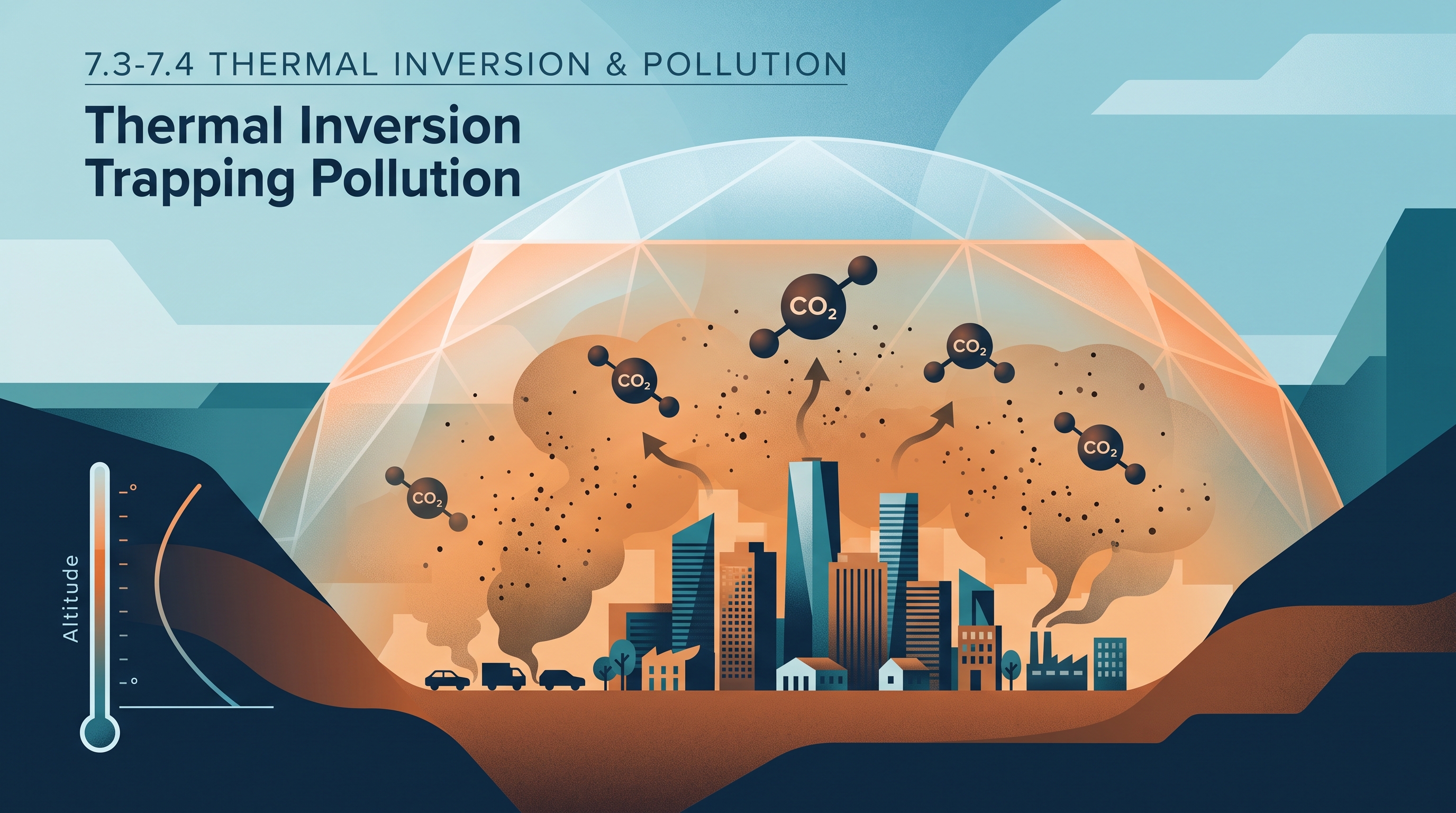
A thermal inversion occurs when the usual atmospheric temperature pattern reverses: air near Earth’s surface becomes cooler than air above it. The result is like placing a lid over a shallow bowl of smoke—the pollutants cannot mix upward easily, so concentrations increase where people live and breathe.
7.3 Thermal Inversion · 7.4 Atmospheric CO₂ and Particulates
A thermal inversion occurs when the usual atmospheric temperature pattern reverses: air near Earth’s surface becomes cooler than air above it. The result is like placing a lid over a shallow bowl of smoke—the pollutants cannot mix upward easily, so concentrations increase where people live and breathe.
Thermal inversion: when the atmosphere stops mixing
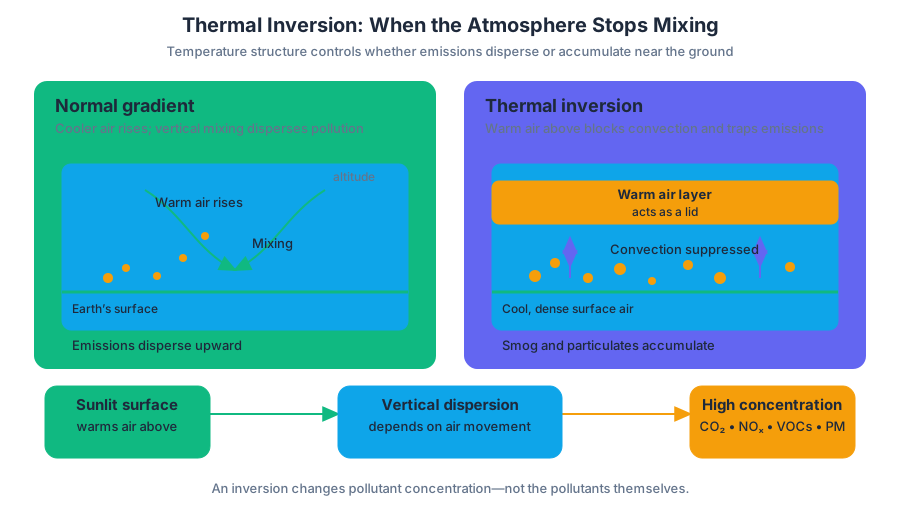
Under the normal atmospheric temperature gradient, air temperature generally decreases with increasing altitude. Sunlight warms Earth’s surface, and the surface warms the air immediately above it. Because warm air is less dense, it rises; cooler air descends, creating vertical mixing that disperses pollutants.
During an inversion, the normal gradient is altered: relatively cold, dense air remains at the surface while warmer air sits above it. This warmer layer prevents the colder surface air from rising, suppressing convection and trapping emissions close to the ground.
STB-2.C.1 — During a thermal inversion, the normal temperature gradient in the atmosphere is altered as the air temperature at Earth’s surface is cooler than the air at higher altitudes.
The inversion itself does not necessarily create new pollutants. Instead, it changes their concentration by reducing vertical dispersion. Vehicle exhaust, industrial emissions, smoke, nitrogen oxides, volatile organic compounds, and particulate matter accumulate within the shallow layer of air beneath the inversion.
STB-2.C.2 — Thermal inversion traps pollution close to the ground, especially smog and particulates.
Normal conditions versus inversion conditions
| Atmospheric condition | Temperature pattern | Air movement | Pollution outcome |
|---|---|---|---|
| Normal gradient | Surface air is warmer than air above | Warm air rises and mixes | Pollutants disperse more effectively |
| Thermal inversion | Surface air is cooler than air above | Warm upper air acts as a cap | Smog and particulates accumulate near the surface |
Thermal inversions are especially effective in valleys or basins, where dense cool air settles near the ground and surrounding mountains limit horizontal movement. Calm winds can intensify the effect because there is little mechanical mixing to break apart the stagnant air layer.
Worked example: a trapped urban plume
Imagine a city that emits $100$ units of particulate pollution during a calm winter morning. Under ordinary mixing, the emissions spread through a deep atmospheric layer. During an inversion, the same $100$ units remain concentrated in a much shallower layer, so the pollutant concentration near the surface rises even though the emission rate has not changed.
As established for photochemical smog, nitrogen oxides, written collectively as $NO_x$, and volatile organic compounds, or VOCs, react in sunlight. During an inversion, the resulting pollutants and unreacted precursors remain concentrated near the surface because vertical mixing is suppressed. Therefore, an inversion is associated with increased concentrations of smog and particulates and can worsen respiratory problems and eye irritation.
Misconception check — “An inversion causes smog.”
An inversion does not supply the chemical ingredients for smog. It is a meteorological condition that traps pollutants and can make smog episodes more severe. Reducing $NO_x$ and VOC emissions addresses the source, while changing weather conditions may eventually restore mixing.
Atmospheric CO₂ and particulates
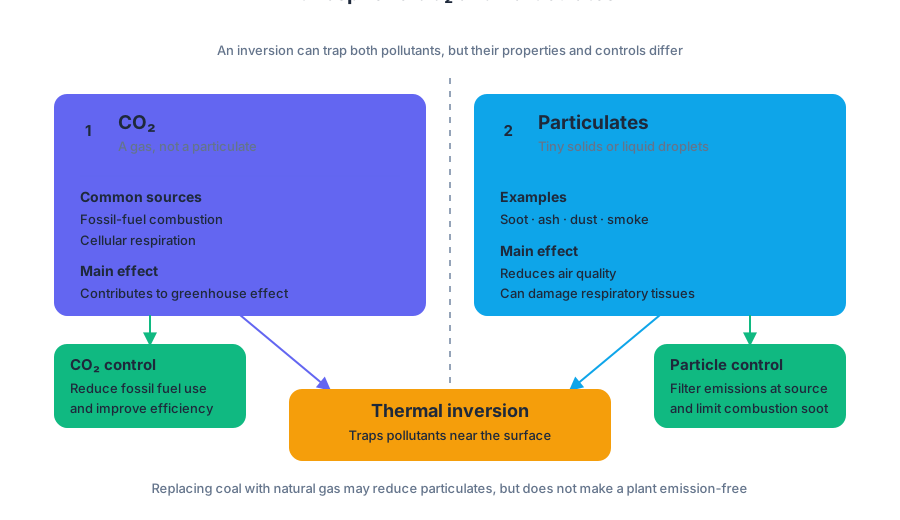
Atmospheric carbon dioxide, $CO_2$, is a gas released by processes such as fossil-fuel combustion and cellular respiration. It is not a particulate. Particulates are tiny solid particles or liquid droplets suspended in air, including soot, ash, dust, and smoke. Their small size allows them to remain airborne and, when inhaled, reach sensitive parts of the respiratory system.
The distinction matters because the pollutants behave differently. Atmospheric $CO_2$ is a gas that contributes to the greenhouse effect, whereas particulates directly reduce air quality and can irritate or damage respiratory tissues. An inversion can trap both near the surface, but the control strategy depends on the pollutant’s source and properties.
For example, replacing coal with natural gas in a power plant can improve air quality because natural gas produces fewer particulates during combustion. This change does not eliminate all air pollution or make the plant emission-free, but it can reduce the amount of particulate matter entering the atmosphere.
AP science practices in context
This topic most directly exercises Science Practice 1.A, Describe environmental concepts and processes, when identifying the altered temperature gradient; Science Practice 2.A, Describe characteristics of a model or representation, when interpreting a temperature-versus-altitude diagram; Science Practice 3.B, Describe relationships in data, when linking inversion events with increased particulate concentrations; and Science Practice 7.A, Describe environmental problems, when explaining why a city experiences degraded air quality.
Retrieval check: A monitoring station records unusually high particulate concentrations during a calm morning. Temperature measurements show that air at the surface is colder than air above it. What mechanism explains the observation, and why would reducing $NO_x$ and VOC emissions help?
Answer: The temperature pattern identifies a thermal inversion, which suppresses vertical mixing and traps pollution near the ground. Reducing $NO_x$ and VOC emissions lowers the precursors available for photochemical smog formation.
Source Materials
- AP Environmental Science Course and Exam Description
- Review the Clarifications (.pdf)
- AP Environmental Science Course Overview
- AP Environmental Science Course at a Glance
- AP Environmental Science Course at a Glance Poster
- AP Environmental Science
- AP Environmental Science
- AP Environmental Science Sample Syllabus 1