AP Chemistry
95 study materials · 56 sections
AP Chemistry students working the current College Board Course and Exam Description, including first-time students with no prior background, plus teachers reviewing the page for CED alignment.; Teach every official CED unit and every numbered topic at topic granularity.; Develop every AP skill / science-practice code explicitly and by name.; Replace description with teaching: worked contextual examples, named misconceptions, and in-flow retrieval checks.; Build an exam-practice unit covering every task type on the current exam.
Course Sections
Course Framework, Skills and Reasoning Processes
Key concepts: Purpose of AP Chemistry as a college-level general chemistry course · Development of robust conceptual understanding applicable to future coursework and phenomena · Viewing chemical phenomena through macroscopic, microscopic, and symbolic levels · Using chemical models to analyze, explain, and predict phenomena · Supporting claims and conclusions with evidence · School-created curricula aligned with AP Chemistry content and skills · AP Course Audit requirements for schools offering AP courses · Organization of course content into commonly taught units · Science practices including questioning, data representation, and argumentation · Atomic structure as the foundation of the course
AP Chemistry asks a deceptively large question: How can observations of matter become explanations and predictions about invisible particles, energy, and change? A solution may fizz, a metal may conduct, or a spectrum may show separate lines; chemistry connects each visible event to a microscopic model and a…
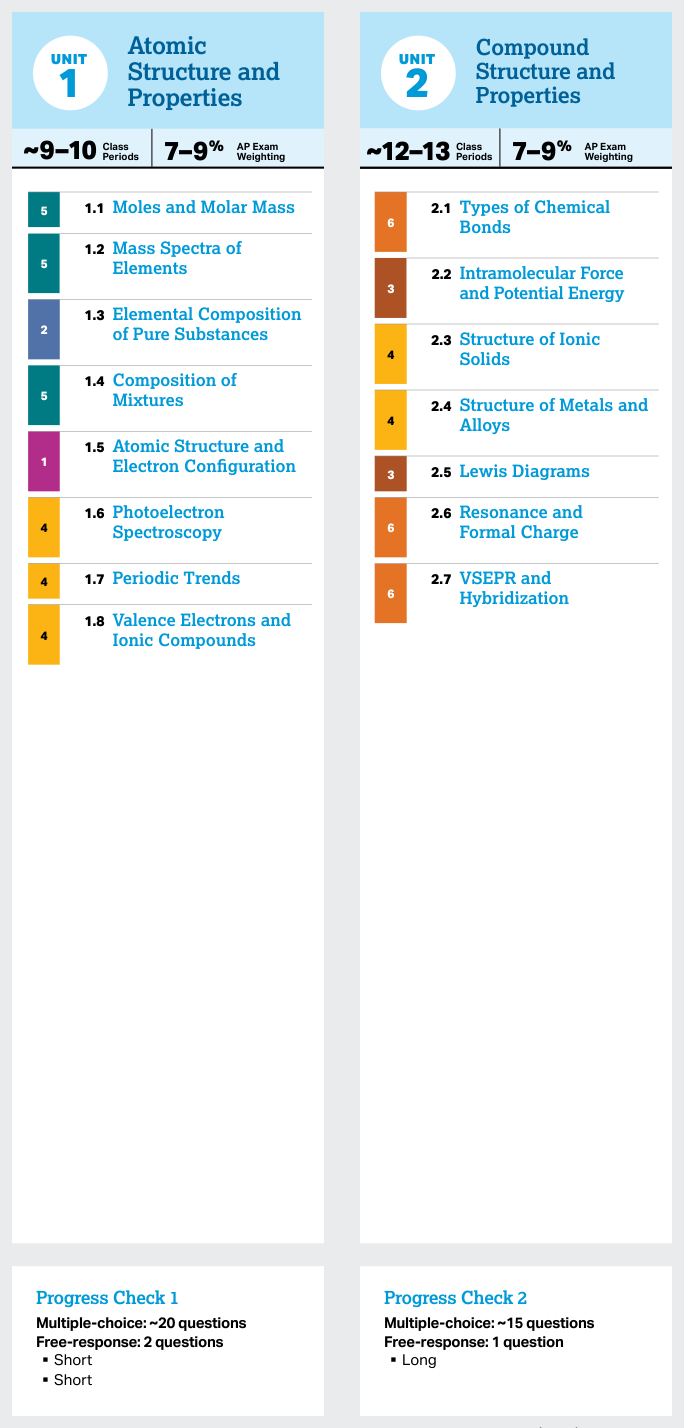
1.1 Moles and Molar Mass · 1.2 Mass Spectra of Elements
Key concepts: Mole concept · Avogadro’s number · Molar mass · Converting between mass and amount of substance · Mass spectra of elements · Quantitative relationship between a mass spectrum and isotope masses · Quantitative relationship between a mass spectrum and isotope abundances · Learning objective 1.2.A · Mathematical routines (5.B) · Atomic Structure and Properties unit content
A mole is chemistry’s counting unit: just as a dozen means $12$ objects, one mole means $6.022\times10^{23}$ specified particles.
1.3 Elemental Composition of Pure Substances · 1.4 Composition of Mixtures
Key concepts: Pure substances · Elemental composition by mass · Empirical formulas · Fixed mass ratios in compounds · Mixtures · Variable relative proportions in mixtures · Elemental analysis · Homogeneous solutions · Heterogeneous mixtures · Macroscopic properties of mixtures
A pure compound has a chemical identity that does not change from sample to sample: the elements occur in a fixed ratio, so the mass ratio of those elements is constant.
1.5 Atomic Structure and Electron Configuration · 1.6 Photoelectron Spectroscopy
Key concepts: Atomic structure · Electron configuration · Periodic trends as a function of atomic number · Valence electrons · Quantum mechanics · Aufbau principle · Photoelectron spectroscopy (PES) · Interpreting graphical data · Models and representations of particulate-level properties · Connecting macroscopic and particulate scales
An atom’s chemical behavior depends strongly on how its electrons are distributed among allowed energy levels, and photoelectron spectroscopy (PES) provides experimental evidence for that distribution.
1.7 Periodic Trends · 1.8 Valence Electrons and Ionic Compounds
Key concepts: Periodic trends in atomic and molecular properties · Valence electrons and their relationship to an element’s location on the periodic table · Typical ionic charges of atoms · Formation and bonding in binary ionic compounds · Coulomb’s law as a basis for periodic trends · Shell model of atomic structure · Electron shielding and effective nuclear charge · Exceptions to expected periodic trends · Connecting particulate-level structure to macroscopic properties using models and representations
The periodic table is not merely an index of elements: its position predicts how strongly an atom holds electrons, how large it is, and what ions it tends to form.
2.1 Types of Chemical Bonds · 2.2 Intramolecular Force and Potential Energy
Key concepts: Types of chemical bonds · Intramolecular forces · Potential energy versus internuclear distance · Equilibrium bond length · Bond energy · Covalent bond strength · Bond order · Sigma (σ) and pi (π) bonds · Coulombic forces · van der Waals forces
A chemical bond forms when attractive forces between particles outweigh repulsive forces at a particular separation. The result is not simply “atoms sticking together”: bond type, bond length, bond energy, and molecular behavior all emerge from the balance of electrostatic forces.
2.3 Structure of Ionic Solids · 2.4 Structure of Metals and Alloys
Key concepts: Structure of ionic solids · Structure of metals and alloys · Using visual models of atoms and ions to explain macroscopic properties · Relationship between particle structure and substance properties · Metallic bonding and the sea of mobile electrons · Electrical conductivity of metals and alloys · Alloys as mixtures of metals · Composition and properties of sterling silver · Tarnishing of metal alloys · Electrochemical cell voltage calculations
A crystal of table salt and a piece of copper can both look like ordinary solids, yet their particles are organized in fundamentally different ways: an ionic solid locks oppositely charged ions into a repeating lattice, while a metal places positive metal ions in a lattice surrounded by mobile, delocalized electrons.
2.5 Lewis Diagrams · 2.6 Resonance and Formal Charge
Key concepts: Lewis diagrams · Resonance and formal charge · Octet rule · Formal charge as a structure-selection criterion · Limitations of the Lewis structure model · VSEPR theory · Bond orders · Bond polarities · Molecular structure and properties · Valence electrons
A Lewis diagram represents valence electrons as bonding pairs and nonbonding pairs, turning invisible electron arrangements into a model that can predict molecular structure and properties.
2.7 VSEPR and Hybridization
Key concepts: VSEPR theory and its use in explaining molecular shapes · Hybridization nomenclature: sp, sp2, and sp3 · Approximate bond angles associated with molecular geometries · Dimensional analysis as a self-correction tool in calculations · Checking that final units match the requested units, such as kJ
A molecule’s shape is not decoration: it determines which atoms can approach one another, how bonds are oriented, and often how the substance reacts. VSEPR theory—Valence Shell Electron-Pair Repulsion theory—explains molecular shape by treating electron domains around a central atom as charged regions that spread…
3.1 Intermolecular and Interparticle Forces · 3.2 Properties of Solids
Key concepts: Intermolecular forces and macroscopic properties · London dispersion forces · Dipole-induced dipole interactions · Molecular polarity and polarizability · Relative strength of intermolecular forces · Solubility and intermolecular interactions · Covalent network solids · Three-dimensional and two-dimensional covalent networks · Macroscopic properties of solids · Chromatography as evidence of polarity
A liquid’s boiling point, a dye’s movement through paper, and graphite’s surprising softness all arise from how particles attract one another. Intermolecular forces are attractions between separate molecules; interparticle forces is the broader term, including attractions between atoms, ions, and molecules.
3.3 Solids, Liquids, and Gases · 3.4 Ideal Gas Law
Key concepts: Particulate-level differences among solids, liquids, and gases · Noncovalent interparticle interactions · Macroscopic properties of ideal gases · The ideal gas law · Relationships among pressure, volume, amount, and temperature · Gas mixtures and partial pressures · Non-ideal gas behavior · Interparticle attractions in real gases · Particle volumes and deviations from ideal behavior · High-pressure effects on gases
A gas can fill an entire room, while a solid keeps its own shape and a liquid keeps nearly the same volume but flows around its container.
3.5 Kinetic Molecular Theory · 3.6 Deviation from Ideal Gas Law
Key concepts: Kinetic Molecular Theory (KMT) · Temperature as a macroscopic measure of the average kinetic energy of gas particles · Kinetic energy of moving particles · Particle models of gases · Maxwell–Boltzmann kinetic-energy distribution curves · Ideal-gas assumptions as a simplification · Deviation of real gases from ideal behavior · Interparticle attractions in real gases · Finite particle volume in real gases · Connections between particulate and macroscopic scales
A gas’s pressure and temperature are macroscopic clues to what its particles are doing at the microscopic scale: moving continuously, randomly, and with a range of kinetic energies.
3.7 Solutions and Mixtures · 3.8 Representations of Solutions
Key concepts: Solutions · Mixtures · Representations of solutions · Learning objectives · Essential knowledge
A solution is a homogeneous mixture: its composition and macroscopic properties are uniform throughout the sample. A glass of saltwater looks uniform because the dissolved particles are distributed throughout the water, not because the salt has disappeared.
3.9 Separation of Solutions and Mixtures · 3.10 Solubility
Key concepts: Separation of solutions and mixtures · Chromatography · Chromatograms and relative polarity · Distillation · Differential intermolecular attractions · Solubility · Saturated solutions · Ion stoichiometry in dissolved compounds · Molar enthalpy of solution (ΔHsoln) · Temperature changes during dissolution
A dissolved substance cannot be removed from a true solution by ordinary filtration because its particles are distributed at the molecular or ionic scale. Separation becomes possible when a method exploits a difference in intermolecular attractions, volatility, or solubility.
3.11 Spectroscopy and the Electromagnetic Spectrum · 3.12 Properties of Photons
Key concepts: Spectroscopy and the electromagnetic spectrum · Photons and their properties · Molecular motion associated with different spectral regions · Electronic transitions in atoms or molecules · Energy changes during electronic transitions · Relationship between photon energy and an electronic transition · Using models to explain atomic or molecular phenomena · Calculating an unknown quantity from known quantities using mathematical routines
A molecule can rotate, vibrate, or rearrange its electrons only by changing its energy. Spectroscopy studies how matter absorbs or emits electromagnetic radiation to reveal those energy changes.
3.13 Beer-Lambert Law
Key concepts: Beer-Lambert Law · Linear relationship between absorbance and concentration · Effect of concentration on light absorption · Effect of path length on light absorption · Molar absorptivity · Calibration curves · Dilution calculations · Determining concentration from absorbance · Experimental error in absorbance measurements · V²⁺(aq) solution analysis
A solution looks transparent because some light passes through it—but even a faintly colored solution removes a measurable fraction of the light beam. The Beer-Lambert law connects that absorbed light to the number of absorbing particles in the beam, the distance the light travels through the solution, and the…
4.1 Introduction to Reactions · 4.2 Net Ionic Equations
Key concepts: Representing physical and chemical processes with chemical equations · Balanced molecular equations · Complete ionic equations · Net ionic equations · Conservation of mass in chemical reactions · Conservation of charge in chemical reactions · Writing equations for physical changes · Writing equations from the identities of reactants and products · Writing ionic equations for a given chemical reaction · Determining the limiting reactant and product yield
A chemical equation is a compact model of what happens when matter changes: it identifies the substances involved, shows how particles are rearranged, and records the numerical relationships required by conservation laws.
4.3 Representations of Reactions · 4.4 Physical and Chemical Changes
Key concepts: Representing chemical phenomena using data from laboratory setups or experimental results · Using evidence to explain changes and interactions of chemical substances · Distinguishing physical changes from chemical changes · Physical changes involve rearrangement of interactions without changing the substances · Melting as an example of a physical change · Formation and separation of mixtures as common physical changes · Chemical changes alter substances and produce different chemical species · Using representations of atoms or molecules to interpret chemical phenomena · Identifying potential sources of experimental error · Justifying claims about chemical phenomena with evidence and chemical principles
A substance can melt, mix, react, or separate while the visible result changes dramatically; the decisive question is whether the particles themselves remain the same.
4.5 Stoichiometry · 4.6 Introduction to Titration
Key concepts: Advanced stoichiometry · Gas laws · The ideal gas law · Aqueous solution chemistry · Molarity · Introduction to titration · Practical laboratory applications · Investigation 7 · Purification applications
A chemical equation becomes experimentally useful only when its coefficients are treated as a quantitative recipe: they connect particles, moles, masses, gas volumes, and solution concentrations.
4.7 Types of Chemical Reactions · 4.8 Introduction to Acid-Base Reactions
Key concepts: Types of chemical reactions · Acid-base reactions · Oxidation-reduction reactions · Precipitation reactions · Identifying and representing chemical reactions · Balancing chemical equations · Solubility of salts in water · Justifying reaction classifications using chemical principles
A chemical equation is more than a recipe: it is a compact model of particles rearranging, electrons moving, or protons transferring. The central diagnostic question is: what changes between reactants and products?
4.9 Oxidation-Reduction Reactions
Key concepts: Oxidation and reduction half-reactions · Electrochemical cells and thermodynamic favorability · Standard reduction and oxidation potentials · Calculating standard cell potential · Balancing redox equations and electron transfer · Anodes, cathodes, and galvanic cells · Gibbs free energy and electrochemical cells · Alkaline battery redox chemistry · Electroplating and oxidation of water · Rhodium plating of silver
Oxidation-reduction reactions, or redox reactions, transfer electrons from one chemical species to another: oxidation is electron loss, while reduction is electron gain. The memory aid LEO says GER captures the bookkeeping: Loss of Electrons is Oxidation; Gain of Electrons is Reduction.
5.1 Reaction Rates · 5.2 Introduction to Rate Law
Key concepts: Reaction rates as changes in reactant or product concentrations over time · Rate law expressions for chemical reactions · Reaction order with respect to an individual reactant · Overall reaction order · Rate constant (k) · Temperature dependence of the rate constant · Units of the rate constant based on overall reaction order · Determining reactant orders by comparing initial rates · First-order kinetics and linear plots of ln(reactant concentration) versus time · Using radioactive decay and crystal violet fading as examples of kinetics
A chemical reaction can be fast enough to inflate a balloon in seconds or slow enough to preserve a radioactive isotope for thousands of years.
5.3 Concentration Changes Over Time · 5.4 Elementary Reactions
Key concepts: Concentration changes over time · Integrated rate laws for zeroth-, first-, and second-order reactions · Reaction order and rate constant · Slopes of concentration-versus-time data · Beer’s Law and spectrophotometry · Fading of crystal violet as a kinetics investigation · Determining rate laws from experimental evidence · Reaction mechanisms and intermediates · Catalysts and the rate-determining step · Energy profiles for chemical reactions
A reaction’s changing concentration is a chemical clock: the shape of the data reveals the reaction order, the slope reveals the rate constant, and the mechanism explains which molecular event controls the observed rate.
5.5 Collision Model · 5.6 Reaction Energy Profile
Key concepts: Collision model · Successful collisions · Activation energy (Ea) · Bond breaking and bond making · Reaction energy profile · Energy changes along a reaction pathway · Enthalpy change (ΔH) · Connection between particulate and macroscopic scales · Scientific argumentation (6.E) · Reaction rates and kinetics
A chemical reaction begins when reactant particles collide in a way that allows old bonds to break and new bonds to form—but most collisions fail.
5.7 Introduction to Reaction Mechanisms · 5.8 Reaction Mechanism and Rate Law
Key concepts: Reaction mechanisms as sequences of elementary reactions · Relating experimental rate data, rate laws, and proposed mechanisms · Identifying a rate law from a mechanism when the first elementary step is rate limiting · Rate-limiting steps and their effect on the overall rate law · Evaluating whether a proposed mechanism is consistent with an observed rate law · Catalysts changing reaction mechanisms · Catalysts providing an alternative pathway with lower activation energy · Effective collisions and activation energy · Mathematical routines for identifying appropriate rate laws and relationships · Acid-base equilibrium constants in reaction examples
A reaction mechanism is a sequence of elementary reactions that shows how reactant particles are transformed into products one molecular event at a time. The experimentally measured rate law is a powerful test of whether that proposed sequence is chemically credible.
5.9 Pre-Equilibrium Approximation · 5.10 Multistep Reaction Energy Profile
Key concepts: Pre-equilibrium approximation · Multistep reaction energy profiles · Activation energy · Overall energy change · Elementary reactions · Reaction mechanisms · Energetics of elementary reactions · Reaction energy profiles · Unit 5: Kinetics
A reaction can move quickly through a reversible first step, briefly building an intermediate, and then proceed slowly through a later step. The pre-equilibrium approximation uses that temporary equilibrium to express the concentration of the intermediate in terms of measurable reactant concentrations.
5.11 Catalysis
A catalyst increases the rate of a chemical reaction by providing an alternative reaction pathway with a lower activation energy, $E_a$. It changes how fast a reaction reaches equilibrium, not the final equilibrium composition or the overall energy change of the reaction.
6.1 Endothermic and Exothermic Processes · 6.2 Energy Diagrams
Key concepts: Endothermic processes · Exothermic processes · Energy changes in a system · Energy transfer between a system and its surroundings · Heating and cooling of substances · Phase changes · Chemical transformations and reactions · Energy changes during bond formation · Dissolution and solution formation · Energy diagrams for physical and chemical transformations
A hand warmer becomes hot because its reacting system loses energy to its surroundings; an instant cold pack becomes cold because its dissolving system gains energy from its surroundings.
6.3 Heat Transfer and Thermal Equilibrium · 6.4 Heat Capacity and Calorimetry
Key concepts: Heat transfer between bodies in thermal contact · Thermal equilibrium · Particle collisions and transfer of thermal energy · Average kinetic energy and temperature · Specific heat capacity · Heat capacity · The heat-transfer equation · Calorimetry and energy conservation · Temperature change dependence on mass · Units of specific heat capacity
When a hot metal cube is dropped into cooler water, the metal cools while the water warms because microscopic collisions transfer thermal energy from faster-moving particles to slower-moving particles.
6.5 Energy of Phase Changes · 6.6 Introduction to Enthalpy of Reaction
Key concepts: Energy changes during phase changes · Constant temperature during a phase change · Enthalpy relationships for opposite phase changes · Heat and amount of reacting substance · Enthalpy of reaction at constant pressure · Multi-step thermochemical calculations with units and significant figures
A pure substance can absorb or release energy during a phase change without changing temperature because the energy changes particle arrangement rather than average kinetic energy.
6.7 Bond Enthalpies · 6.8 Enthalpy of Formation
Key concepts: Bond enthalpy and the relationship between bond formation and energy · Standard enthalpy of formation (ΔH°f) · Hess’s law and manipulating formation reactions · Calculating an unknown quantity from known quantities using a logical computational pathway · Standard states and elemental reference values · Enthalpy change for synthesizing a compound from its elements · Sign conventions for energy released and absorbed · Dimensional analysis and significant figures in thermochemical calculations · Lattice enthalpy data for ionic compounds · Using tables of standard enthalpies of formation
A chemical bond forms when atomic orbitals overlap and the resulting attraction lowers the system’s potential energy; breaking that bond requires energy, while forming it releases energy.
6.9 Hess’s Law
Key concepts: Hess’s law · Enthalpy of formation · Adding enthalpy-change values · Manipulating thermochemical equations · Using tabulated data · Molecular mass of Cl(g)
A reaction’s enthalpy change depends only on the starting substances and final substances, not on the route taken between them. Hess’s law turns that fact into a calculation method: if a target reaction can be built by adding known thermochemical equations, its overall enthalpy change is the sum of the…
7.1 Introduction to Equilibrium · 7.2 Direction of Reversible Reactions
Key concepts: Equilibrium · Introduction to equilibrium · Direction of reversible reactions · Le Châtelier’s principle · Particulate representations of equilibrium systems · Model analysis · Required course content for AP Chemistry Unit 7
A reversible reaction does not simply “run forward until the reactants disappear.” In a closed system, products can react to reform reactants while reactants continue forming products.
7.3 Reaction Quotient and Equilibrium Constant · 7.4 Calculating the Equilibrium Constant
Key concepts: Reaction quotient Qc · Reaction quotient Qp · Equilibrium constant Kc · Equilibrium constant Kp · Law of mass action · Equilibrium mixtures and reversible reactions · Equilibrium concentrations · Equilibrium partial pressures · Comparing Q with K to determine equilibrium status
A reversible reaction can be treated like a molecular tug-of-war: the mixture may begin with mostly reactants, mostly products, or something in between, but its composition can be measured at any instant.
7.5 Magnitude of the Equilibrium Constant · 7.6 Properties of the Equilibrium Constant
Key concepts: Meaning of the equilibrium constant K · Relationship between the magnitude of K and the extent of a reaction · Large K (K ≫ 1) indicates products predominate at equilibrium · Small K indicates reactants predominate at equilibrium · Using equilibrium concentrations to explain concentration relationships · Equilibrium between an un-ionized weak base and its conjugate acid · Equilibrium constant Kp for reactions involving gases · Calculating an equilibrium constant from equilibrium data
At equilibrium, the value of $K$ answers a composition question: which side of the reaction contains more chemical species? It does not answer how quickly the system reaches equilibrium.
7.7 Calculating Equilibrium Concentrations · 7.8 Representations of Equilibrium
Key concepts: Writing equilibrium constant expressions from balanced chemical equations · Calculating equilibrium concentrations using stoichiometry and equilibrium relationships · Distinguishing equilibrium concentrations from initial concentrations · Calculating and interpreting the reaction quotient Q · Comparing Q with K to predict the direction of equilibrium shift · Applying Le Châtelier’s principle to stress an equilibrium system · Representing equilibrium at the particulate level · Using stoichiometric coefficients to determine ion ratios in solution · Calculating solubility equilibria with Ksp · Recognizing common student errors in equilibrium calculations and diagrams
At equilibrium, a reaction mixture is not “finished”: particles continue colliding and reacting in both directions, while the macroscopic concentrations remain constant. The central calculation is therefore to connect a balanced equation, concentration changes, and the equilibrium constant.
7.9 Introduction to Le Châtelier’s Principle · 7.10 Reaction Quotient and Le Châtelier’s Principle
Key concepts: Le Châtelier’s principle · Dynamic chemical equilibrium · Reaction quotient (Q) and equilibrium constant (K) · Effects of concentration disturbances on equilibrium · Effects of pressure and volume changes on gaseous equilibria · Redistribution of species to restore equilibrium · Equilibrium shifts in response to removing a species · Solubility equilibria · Interpreting macroscopic and particle-level changes · Using equilibrium reasoning to explain changes in amount and concentration
A chemical equilibrium is not frozen: particles continue reacting in both directions, but the forward and reverse reaction rates are equal. The system appears unchanged because its composition is dynamically maintained.
7.11 Introduction to Solubility Equilibria · 7.12 Common-Ion Effect
Key concepts: Solubility equilibria · Solubility product constant (Ksp) · Molar solubility · Relationship between Ksp and molar solubility · Common-ion effect · Le Châtelier’s principle · Dissolution equilibria · Qualitative solubility rules · Calculating solubility from Ksp · Effect of modifying solution composition on experimental results
A sparingly soluble salt does not simply “stop dissolving”; it reaches a dynamic balance in which solid dissolves and dissolved ions recombine at equal rates.
8.1 Introduction to Acids and Bases · 8.2 pH and pOH of Strong Acids and Bases
Key concepts: Definitions and introductory concepts of acids and bases · Strong acids and strong bases · Ionization/dissociation of strong bases in aqueous solution · pH and pOH · The water ionization constant, Kw · Neutral aqueous solutions · Concentrations of all species in a neutral solution of water · Group 1 hydroxides as strong bases · Group 2 hydroxides as strong bases · Use of indicators to distinguish acidic and basic solutions
Acids and bases are distinguished by which ions they create or consume in water: an acid increases hydronium ions, while a base increases hydroxide ions or accepts protons.
8.3 Weak Acid and Base Equilibria · 8.4 Acid-Base Reactions and Buffers
Key concepts: Weak acid equilibria and acid ionization constant (Ka) · Weak base equilibria and base ionization constant (Kb) · pKa and pKb as logarithmic measures of Ka and Kb · Percent ionization of weak acids and bases · Equilibrium concentrations of major species in acid-base solutions · Quantitative acid-base reactions and limiting/excess reagents · Buffer solutions composed of a weak acid/base and its conjugate partner · pH determination after mixing weak acids or bases with strong reagents · Equimolar weak base–strong acid mixtures and the acidic conjugate-acid equilibrium · Buffer capacity for added acid versus added base
A solution’s pH depends not only on which acid is present, but also on how extensively that acid transfers protons to water. Equal-concentration solutions of hydrochloric acid, carbonic acid, $H_2CO_3$, and acetic acid, $HC_2H_3O_2$, do not produce equal hydronium concentrations because strong acids ionize…
8.5 Acid-Base Titrations · 8.6 Molecular Structure of Acids and Bases
Key concepts: Acid-base reactions in aqueous solution and the role of water · Acid-base titrations of monoprotic and polyprotic acids or bases · Partial ionization and dynamic equilibrium of weak acids and bases · Hydronium and hydroxide concentrations in weak-acid and weak-base equilibria · Conjugate-base stabilization and its effect on acid strength · Electronegativity, inductive effects, and resonance in acid strength · Strong acids and their weak conjugate bases · Resonance stabilization of carboxylate ions
An acid-base titration determines an unknown concentration by measuring how much solution of known concentration is required to react with it. The same chemistry also explains why one molecule donates a proton readily while another barely ionizes: acid strength depends on the stability of the conjugate base left…
8.7 pH and pKₐ · 8.8 Properties of Buffers
Key concepts: pH · pKₐ · Properties of buffers
A buffer can absorb a small dose of acid or base while keeping its pH nearly steady because it contains a weak acid and the base formed when that acid loses a proton.
8.9 Henderson-Hasselbalch Equation · 8.10 Buffer Capacity
Key concepts: Henderson–Hasselbalch equation · Using the acid/conjugate-base concentration ratio to calculate pH · Determining pKa from the half-equivalence point · Interpreting titration curves · Identifying the buffer region · Recognizing the equivalence point · Calculating moles and molarity from titration data · Buffer capacity and the effect of buffer components
A buffer’s pH is controlled mainly by the ratio of conjugate base to weak acid, not by the absolute amount of solution. For a weak acid $\mathrm{HA}$ and its conjugate base $\mathrm{A^-}$:
8.11 pH and Solubility
A solid can become more soluble simply because the solution contains acid or base. The key is that pH changes the concentration of ions already involved in a solubility equilibrium, pulling the equilibrium toward additional dissolving.
9.1 Introduction to Entropy · 9.2 Absolute Entropy and Entropy Change
Key concepts: Entropy · Introduction to entropy · Absolute entropy · Entropy change · Standard entropy change · Entropy change in chemical processes · Entropy change in physical processes · Temperature dependence of entropy · Calculating entropy change from absolute entropies · AP Chemistry science practice 6.C
Entropy measures how widely energy and matter can be distributed among the possible microscopic arrangements of a system. A warm gas in a large container has more possible molecular arrangements than a cool gas in a small container, so its entropy is greater.
9.3 Gibbs Free Energy and Thermodynamic Favorability · 9.4 Thermodynamic and Kinetic Control
Key concepts: Gibbs free energy (ΔG°) · Thermodynamic favorability · The relationship between enthalpy, entropy, temperature, and free energy · Thermodynamic control · Kinetic control · Activation energy · Reaction rate · Chemical equilibrium · Distinguishing equilibrium from kinetic inhibition · The relationship between ΔG° and the equilibrium constant K
A reaction can be energetically favorable yet appear to do nothing: a thermodynamically favored process may be trapped behind a large activation-energy barrier. Gibbs free energy answers whether products are favored, while kinetics answers how quickly the system can get there.
9.5 Free Energy and Equilibrium · 9.6 Free Energy of Dissolution
Key concepts: Gibbs free energy change (ΔG°) as a criterion for spontaneity and equilibrium · The relationship ΔG° = ΔH° − TΔS° · The relationship between ΔG° and the equilibrium constant K · How enthalpy and entropy changes affect the solubility of a salt · The three energetic factors in dissolution: breaking solute–solute interactions, breaking solvent–solvent interactions, and forming solute–solvent interactions · Why determining the total free-energy change of dissolution can be challenging because contributions may cancel · How favorable solvent–solute interactions influence dissolution · How changes in temperature can affect the free energy and solubility of a substance · Using calorimetry and temperature change to investigate the enthalpy of dissolution, such as dissolving KCl in water · The dissolution of magnesium hydroxide as an example of a sparingly soluble ionic compound
A salt can dissolve even when the solution becomes colder because spontaneity is controlled by free energy, not enthalpy alone. The decisive quantity is the standard free-energy change for dissolution, $\Delta G^\circ_{\mathrm{dissolution}}$: the Gibbs free-energy change when a specified amount of a substance…
9.7 Coupled Reactions · 9.8 Galvanic (Voltaic) and Electrolytic Cells
Key concepts: Coupled reactions and using an external energy source to drive thermodynamically unfavorable processes · Galvanic ( voltaic) cells · Electrolytic cells · Physical components and operational principles of electrochemical cells · Roles of electrodes, half-cell solutions, salt bridges, and voltage/current measuring devices · Oxidation and reduction at electrodes · Identifying the anode and cathode from electrode mass changes · Standard reduction potentials and electrochemical cell voltage · Stoichiometric relationships governing electrode mass changes · Relating cell descriptions and half-reactions to overall cell behavior
A redox reaction can either release usable electrical energy or consume electrical energy to force an otherwise unfavorable chemical change. The difference is the direction of energy conversion: a galvanic cell converts chemical energy into electrical energy, while an electrolytic cell uses an external energy…
9.9 Cell Potential and Free Energy · 9.10 Cell Potential Under Nonstandard Conditions
Key concepts: Standard cell potential (E°cell) · Cell potential under nonstandard conditions · Relationship between cell potential and Gibbs free energy · Relationship among E°, ΔG°, K, and temperature · Standard reduction potentials · Oxidation and reduction half-reactions · Reaction quotient (Q) · Nernst equation · Spontaneity and equilibrium in electrochemical cells · Effects of deviations from standard conditions
A cell voltage is more than a meter reading: it reveals whether a redox reaction is thermodynamically favored and how strongly the reaction is being driven.
9.11 Electrolysis and Faraday’s Law
Key concepts: Electrolysis · Faraday’s law · Nonspontaneous redox reactions · Thermodynamic spontaneity · External power sources · Stoichiometric calculations · Moles of electrons and electric charge · Current, charge, and time · Standard reduction potentials · Cell potential under nonstandard conditions
Electrolysis uses an external power source to force a redox reaction that would not proceed spontaneously. In an electrolytic cell, electrical energy becomes chemical change: metal ions may be reduced and deposited onto an electrode, or a solid electrode may be oxidized and removed.
AP Practice 1
Key concepts: AP principles of clarity and transparency through publicly available course frameworks and sample exam questions · AP opposition to indoctrination and emphasis on analyzing multiple perspectives · Evidence-based discussion in which students evaluate arguments rather than one another · Respect for diversity in students’ backgrounds, experiences, and viewpoints · AP Chemistry course organization into units on properties of substances and mixtures, chemical reactions, kinetics, thermochemistry, equilibrium, acids and bases, and thermodynamics and electrochemistry · Laboratory investigation practices, including experimental design, prediction, data collection and analysis, mathematical routines, explanation, and communication · Use of formative assessment, such as Progress Checks, to identify and address student misunderstandings · Mass spectrometry as a tool for analyzing isotopic abundance and identifying elements in mixtures
A mass spectrum can turn an invisible isotope mixture into measurable evidence: peak position identifies isotope mass, while peak intensity reveals relative abundance. That same reasoning appears in forensic science, where isotope patterns can help distinguish substances, identify an element in a mixture, or…
AP Practice 2
Key concepts: Prerequisites for AP Chemistry · Laboratory instruction and hands-on investigations · Mole concept and dimensional analysis · Graphing experimental data with correct scales and units · Solubility product constants (Ksp) and ionic factors · Electrolysis · Stoichiometry involving changing or limiting/excess reactants · Particulate representations of matter · Chemical polarity and polarizability · Acid-base titration curves
A single laboratory investigation can force several kinds of chemical reasoning at once: converting masses with the mole concept, plotting data with defensible scales, interpreting particulate models, predicting precipitation with $K_{sp}$, and explaining electrolysis through electron transfer.
AP Practice 3
A strong chemistry argument does more than announce an answer: it connects a claim to chemical evidence and explains why the evidence supports that claim.
AP Practice 4
A strong long free-response answer does more than produce a number: it connects an observable result to a chemical model, supports a claim with evidence, and explains why the evidence supports the claim.
AP Practice 5
A short free-response question rewards selective precision: identify the chemical relationship, show the essential calculation or representation, and connect the result to a defensible explanation.
AP Practice 6
A strong chemistry answer does more than state a number: it connects a representation, a measurement, a calculation, and a defensible scientific claim. This original, unofficial practice set uses a short free-response task built around that chain.
Source Materials
- AP Chemistry Course and Exam Description
- AP Chemistry Course and Exam Description Clarifications and Corrections
- AP Chemistry Course Overview
- AP Chemistry Course at a Glance
- AP Chemistry Course at a Glance Poster
- Adopt AP Chemistry
- AP Chemistry
- AP Chemistry
- Figure — AP Chemistry Course and Exam Description (p. 1)
- Figure — AP Chemistry Course and Exam Description (p. 15)
- continued on next page
- continued on next page



Study AP Chemistry on Lykke
This course page is free to open: signed out, you can read its first two sections, and signing in, on any plan, opens the rest. The free Lykke Chrome extension syncs your own Canvas courses, so ChatGPT, Claude and Muse can answer from your classes and deadlines. It only reads Canvas.
Add the free extensionSign in to open every section