From the free course AP Chemistry on Lykke
8.5 Acid-Base Titrations · 8.6 Molecular Structure of Acids and Bases
Key concepts: Acid-base reactions in aqueous solution and the role of water · Acid-base titrations of monoprotic and polyprotic acids or bases · Partial ionization and dynamic equilibrium of weak acids and bases · Hydronium and hydroxide concentrations in weak-acid and weak-base equilibria · Conjugate-base stabilization and its effect on acid strength · Electronegativity, inductive effects, and resonance in acid strength · Strong acids and their weak conjugate bases · Resonance stabilization of carboxylate ions
An acid-base titration determines an unknown concentration by measuring how much solution of known concentration is required to react with it. The same chemistry also explains why one molecule donates a proton readily while another barely ionizes: acid strength depends on the stability of the conjugate base left…
8.5 Acid-Base Titrations · 8.6 Molecular Structure of Acids and Bases
An acid-base titration determines an unknown concentration by measuring how much solution of known concentration is required to react with it. The same chemistry also explains why one molecule donates a proton readily while another barely ionizes: acid strength depends on the stability of the conjugate base left behind.
8.5 Acid-Base Titrations
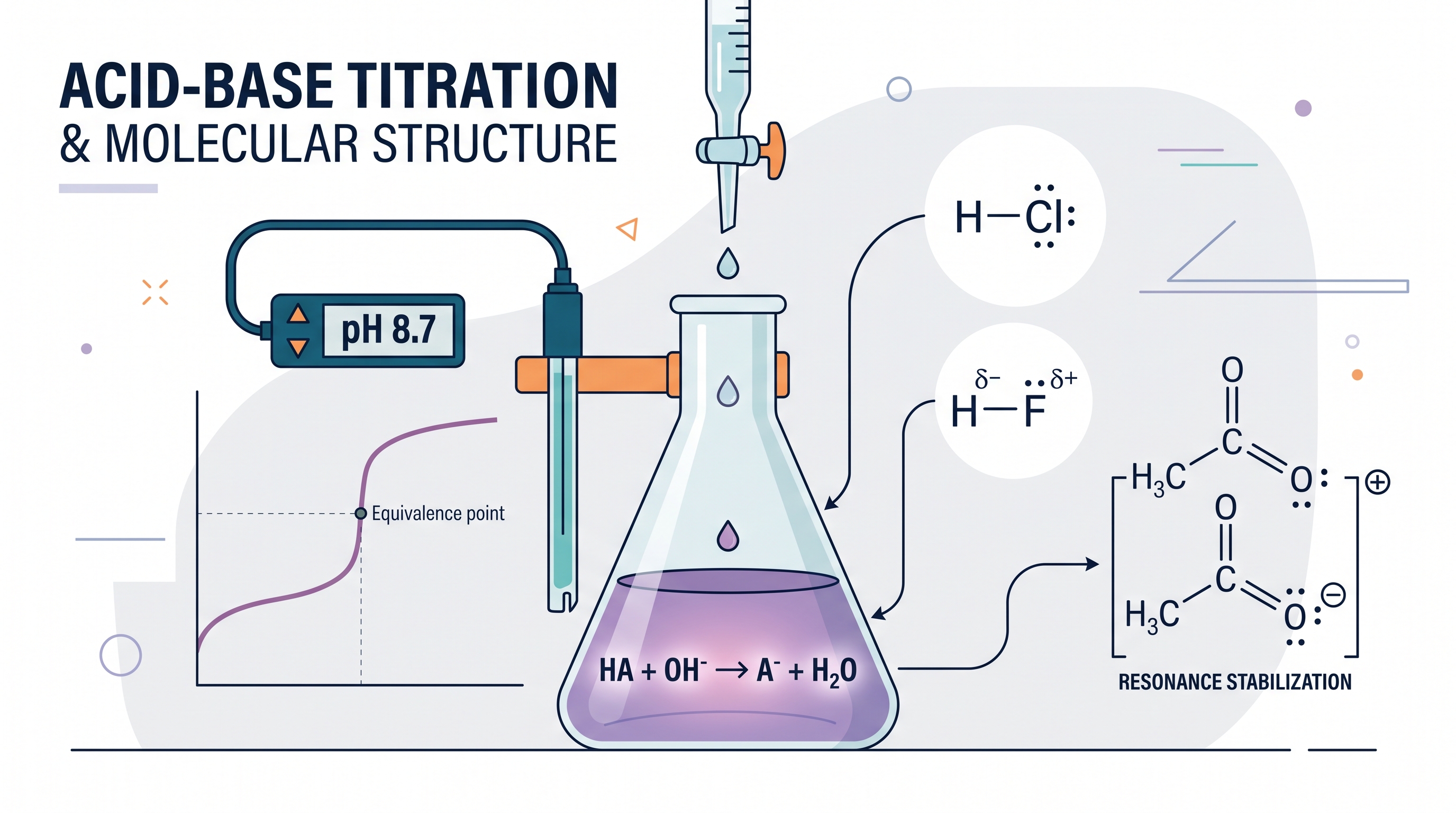
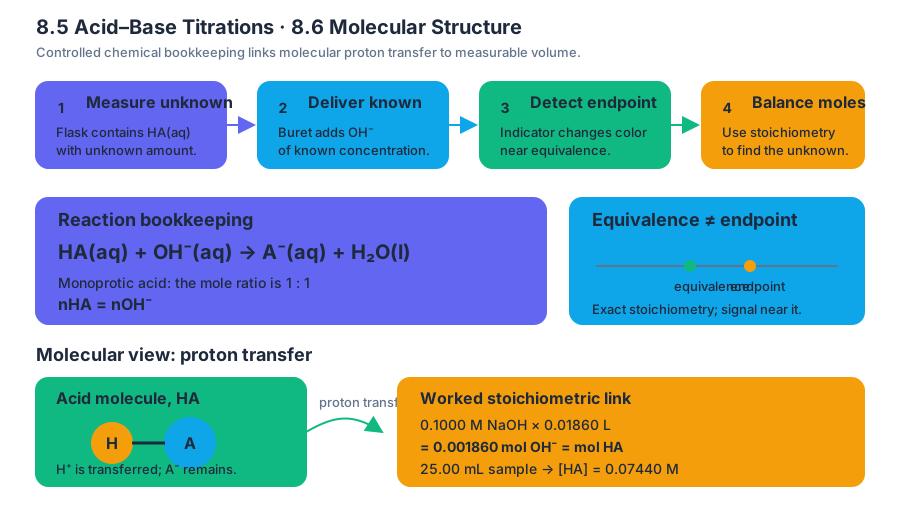
A titration is best pictured as controlled chemical bookkeeping. A buret delivers a known amount of one reactant into a flask containing an unknown amount of another until the reacting species have been supplied in the exact stoichiometric ratio.
At the equivalence point, the moles of acid and base have reacted according to the balanced equation. The equivalence point is not automatically the same as the point where an indicator changes color; the indicator’s endpoint is an experimental signal chosen to occur very near equivalence.
For a monoprotic acid reacting with hydroxide,
$$ HA(aq)+OH^-(aq)\rightarrow A^-(aq)+H_2O(l) $$
the mole relationship is $1:1$. Therefore,
$$n_{HA}=n_{OH^-}$$
If a $0.1000\ \mathrm{M}$ sodium hydroxide solution requires $18.60\ \mathrm{mL}$ to reach the equivalence point when titrating $25.00\ \mathrm{mL}$ of an acid solution, then
$$n_{OH^-}=(0.1000\ \mathrm{mol,L^{-1}})(0.01860\ \mathrm{L})=1.860\times10^{-3}\ \mathrm{mol}$$
Because the acid is monoprotic, $n_{HA}=1.860\times10^{-3}\ \mathrm{mol}$. Its concentration is
$$[HA]=\frac{1.860\times10^{-3}\ \mathrm{mol}}{0.02500\ \mathrm{L}}=0.07440\ \mathrm{M}$$
For a polyprotic acid, one molecule can donate more than one proton. For example, complete neutralization of sulfuric acid can be represented overall as
$$ H_2SO_4(aq)+2OH^-(aq)\rightarrow SO_4^{2-}(aq)+2H_2O(l) $$
Thus, at complete neutralization, one mole of $H_2SO_4$ corresponds to two moles of $OH^-$. The balanced equation—not the volume alone—determines the mole ratio. Polyprotic titration curves can show more than one equivalence region when the successive proton-donation steps are sufficiently separated.
The species present at each stage control the solution’s properties. Before equivalence, excess acid may determine the hydronium concentration; at equivalence, the conjugate base or conjugate acid may react with water; after equivalence, excess strong titrant usually dominates the pH. A weak acid’s equivalence solution is often basic because its conjugate base reacts with water to form $OH^-$, whereas a weak base titrated with strong acid can produce an acidic equivalence solution because its conjugate acid forms $H_3O^+$.
Misconception check: Equivalence does not mean “the solution has pH $7.00$.” Neutral pH at equivalence is characteristic of a strong-acid/strong-base combination at approximately $25^\circ\mathrm{C}$, not a universal rule.
For weak acid–weak base titrations, the reaction may not proceed essentially to completion. Instead, the acid and base can establish an equilibrium, so interpretation must identify the reacting and remaining species rather than blindly applying a strong-neutralization shortcut.
8.6 Molecular Structure of Acids and Bases
Learning Objective 8.6.A: Explain the relationship between the strength of an acid or base and the structure of the molecule or ion.
Essential Knowledge 8.6.A.1: The protons on a molecule that will participate in acid-base reactions, and the relative strength of these protons, can be inferred from molecular structure. The central question is simple: after a proton leaves, how stable is the conjugate base?
A strong acid has a very weak conjugate base. In water, strong acids such as $HCl$, $HBr$, $HI$, $HClO_4$, $H_2SO_4$, and $HNO_3$ transfer protons readily because their conjugate bases are strongly stabilized by electronegativity, inductive effects, resonance, or a combination of these factors.
Electronegativity describes how strongly an atom attracts bonding electrons. If the negative charge of a conjugate base is located on a more electronegative atom, that charge is generally stabilized more effectively. For example, an electronegative halogen can support negative charge after the hydrogen in a hydrogen halide is removed.
An inductive effect is an electron-withdrawing or electron-donating influence transmitted through single bonds. Electronegative atoms near an acidic proton pull electron density away from the conjugate base, reducing the concentration of negative charge and increasing acid strength. The effect weakens as the electronegative atom becomes farther from the acidic site.
Resonance stabilization spreads charge over multiple atoms rather than confining it to one location. This is especially important for carboxylate ions. When a carboxylic acid loses its proton,
RCOOH\rightleftharpoons H^+ + RCOO^-
the negative charge in $RCOO^-$ is delocalized across both oxygen atoms. The two major resonance contributors give the two carbon–oxygen bonds equivalent character, making the conjugate base unusually stable for a weak acid. Carboxylic acids are therefore a common class of weak acids.
Common weak bases include nitrogenous bases such as ammonia and carboxylate ions. Strong bases, including group I and group II hydroxides, have very weak conjugate acids. In every case, basicity reflects the ion’s ability to accept a proton, while acid strength reflects the stability gained when the proton is removed.
AP Science Practices in Context
This topic most directly engages Science Practice 1: Models and Representations—especially 1.A: Describe and explain chemical representations and 1.B: Represent chemical phenomena using models—when students connect a titration curve, particle diagram, Lewis structure, and net ionic equation.
It also uses Science Practice 5: Mathematical Routines, including 5.A: Identify and describe the mathematical routines required to solve a problem and 5.B: Apply mathematical routines to solve problems, for mole ratios, molarity, and total-volume calculations. Science Practice 6: Argumentation, particularly 6.A: Make a claim and 6.B: Support a claim with evidence and reasoning, appears when students justify why resonance or electronegativity changes acid strength.
Retrieval check: A weak base has an initial concentration of $0.200\ \mathrm{M}$. Is $[OH^-]$ necessarily $0.200\ \mathrm{M}$? Explain. Then compare the conjugate bases of two acids: the acid whose conjugate base is more stabilized will be the stronger acid, because proton loss is more favorable.