From the free course AP Chemistry on Lykke
AP Practice 5
A short free-response question rewards selective precision: identify the chemical relationship, show the essential calculation or representation, and connect the result to a defensible explanation.
AP Practice 5
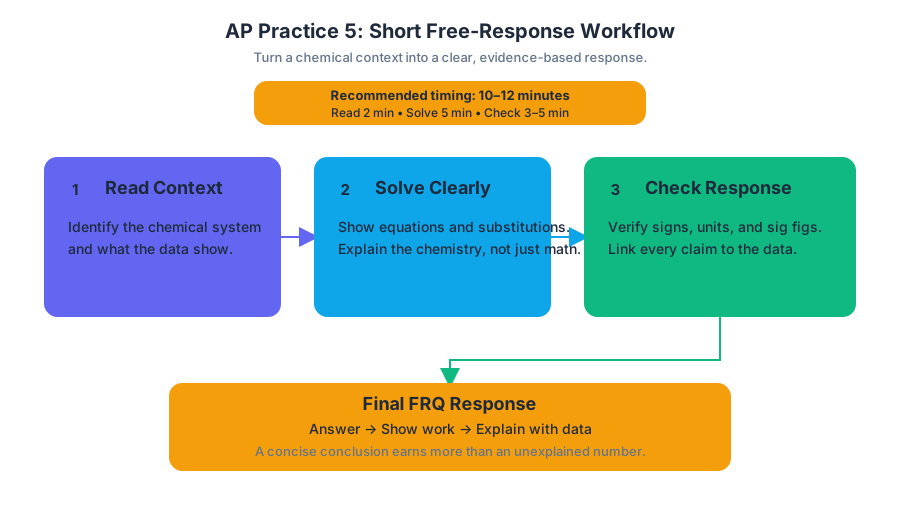
A short free-response question rewards selective precision: identify the chemical relationship, show the essential calculation or representation, and connect the result to a defensible explanation. This practice uses an original equilibrium scenario and emphasizes Science Practice 4: Model Analysis, Science Practice 5: Mathematical Routines, and Science Practice 6: Argumentation.
Task type: Short free-response question
Recommended timing: about $10$–$12$ minutes. Spend approximately $2$ minutes reading the chemical context, $5$ minutes solving, and $3$–$5$ minutes checking units, signs, significant figures, and whether each explanation actually refers to the data.
Original practice prompt
A sealed container holds the gases $A_2$, $B_2$, and $AB$ at constant temperature. They establish the equilibrium
A_2(g)+B_2(g)\rightleftharpoons 2AB(g)
At equilibrium, the concentrations are
$$ [A_2]=0.40\ \mathrm{M},\qquad [B_2]=0.25\ \mathrm{M},\qquad [AB]=0.60\ \mathrm{M}. $$
(a) Write the equilibrium-constant expression, $K_c$, for the reaction.
(b) Calculate the value of $K_c$.
(c) A quantity of $AB(g)$ is injected into the container. Predict the direction in which the reaction initially proceeds. Justify the prediction using the reaction quotient, $Q_c$, rather than only a verbal statement of Le Châtelier’s principle.
(d) After the system reestablishes equilibrium, is the final value of $K_c$ greater than, less than, or equal to the initial value? Explain.
Worked solution
(a) Constructing the model
For a reaction
aA+bB\rightleftharpoons cC,
the equilibrium expression contains each aqueous or gaseous species raised to the power of its stoichiometric coefficient. Pure solids and pure liquids are omitted; all three species here are gases, so all appear.
$$ K_c=\frac{[AB]^2}{[A_2][B_2]} $$
Rubric-aligned checkpoint: The response must use the correct species, place products over reactants, and apply the coefficient $2$ as an exponent on $[AB]$. Writing $[AB]/([A_2][B_2])$ loses the stoichiometric-power relationship.
(b) Calculating $K_c$
Substitute the equilibrium concentrations:
$$ K_c=\frac{(0.60)^2}{(0.40)(0.25)} $$
$$ K_c=\frac{0.36}{0.10}=3.6 $$
Thus,
$$ \boxed{K_c=3.6} $$
Because the concentrations are measured in $\mathrm{M}$ and the reaction has equal total gaseous stoichiometric amounts on both sides, the numerical value is commonly reported without emphasizing a remaining concentration unit in introductory equilibrium work. The critical AP reasoning is the correct expression and substitution.
Rubric-aligned checkpoint: Earn the calculation credit by showing the expression, substituting the data, and obtaining a numerically consistent result. A bare answer of $3.6$ does not demonstrate whether the equilibrium expression was constructed correctly.
(c) Using $Q_c$ after a disturbance
Immediately after $AB$ is injected, the concentration of $AB$ increases, while the concentrations of $A_2$ and $B_2$ have not yet changed. The system is therefore no longer at equilibrium. Suppose, for illustration, that $[AB]$ temporarily rises to $0.80\ \mathrm{M}$:
$$ Q_c=\frac{(0.80)^2}{(0.40)(0.25)} =\frac{0.64}{0.10}=6.4 $$
The comparison is
$$ Q_c=6.4>K_c=3.6 $$
A value of $Q_c$ greater than $K_c$ means that the mixture contains too much product relative to the equilibrium ratio. The reaction proceeds to the left, consuming $AB$ and forming $A_2$ and $B_2$, until $Q_c$ returns to $K_c$.
$$ \boxed{\text{The reaction initially proceeds toward the reactants.}} $$
Rubric-aligned checkpoint: A complete justification contains both the comparison $Q_c>K_c$ and the chemical consequence: the reverse reaction occurs. “The system shifts left because of Le Châtelier’s principle” identifies the direction but does not use the requested quantitative model.
(d) What happens to $K_c$?
The final value of $K_c$ is equal to the initial value, provided the temperature remains constant:
$$ \boxed{K_{c,\mathrm{final}}=K_{c,\mathrm{initial}}} $$
Adding $AB$ changes the concentrations and therefore changes $Q_c$, but it does not change the equilibrium constant. For this reaction, temperature is the condition that determines $K_c$. The reaction shifts until the concentrations once again satisfy the same value of $K_c$.
This distinction is central:
| Quantity | Changes when $AB$ is added? | Meaning |
|---|---|---|
| $Q_c$ | Yes | Ratio calculated from the current, possibly nonequilibrium concentrations |
| $K_c$ | No, if temperature is constant | Ratio required at equilibrium |
Common misconception check
Misconception: “If the reaction shifts left, $K_c$ decreases.” The shift changes the concentrations, not the temperature. Therefore the system changes $Q_c$ until it matches the unchanged $K_c$.
Misconception: “A larger $Q_c$ means a faster reaction.” $Q_c$ indicates the reaction’s direction relative to equilibrium; it does not by itself provide a rate. Kinetics and equilibrium answer different questions: how fast? versus which composition is favored?
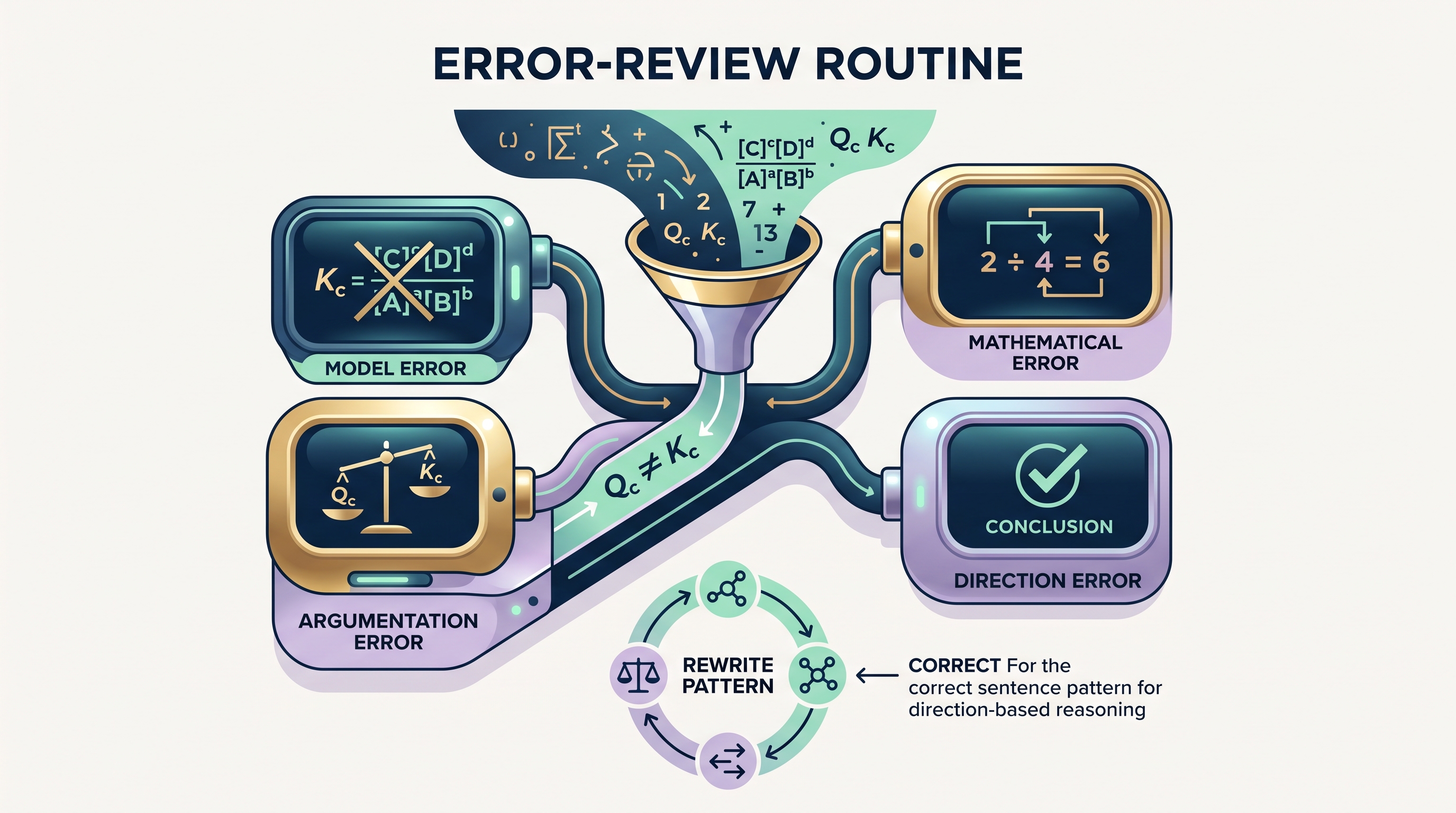
Error-review routine
After completing the response, mark each error as one of four types:
- Model error: incorrect species, exponents, or placement in the $K_c$ expression.
- Mathematical error: substitution, arithmetic, or algebra mistake.
- Direction error: incorrect interpretation of $Q_c$ compared with $K_c$.
- Argumentation error: a conclusion is stated without chemical evidence.
Rewrite only the missed part, using the sentence pattern:
“Because $Q_c$ is [greater than/equal to/less than] $K_c$, the reaction proceeds [left/right/no net direction] to [consume/form] ________, restoring the equilibrium ratio.”
Retrieval check: If a reaction mixture has $Q_c<K_c$, which side is initially favored, and what happens to $Q_c as equilibrium is restored?
Source Materials
- AP Chemistry Course and Exam Description
- AP Chemistry Course and Exam Description Clarifications and Corrections
- AP Chemistry Course Overview
- AP Chemistry Course at a Glance
- AP Chemistry Course at a Glance Poster
- Adopt AP Chemistry
- AP Chemistry
- AP Chemistry
- AP Chemistry-AP Students
- AP/College Chemistry-Khan Academy
- Guide to the AP Chemistry Exam-The Princeton Review
- AP Chemistry-Wikipedia