From the free course AP Chemistry on Lykke
1.5 Atomic Structure and Electron Configuration · 1.6 Photoelectron Spectroscopy
Key concepts: Atomic structure · Electron configuration · Periodic trends as a function of atomic number · Valence electrons · Quantum mechanics · Aufbau principle · Photoelectron spectroscopy (PES) · Interpreting graphical data · Models and representations of particulate-level properties · Connecting macroscopic and particulate scales
An atom’s chemical behavior depends strongly on how its electrons are distributed among allowed energy levels, and photoelectron spectroscopy (PES) provides experimental evidence for that distribution.
1.5 Atomic Structure and Electron Configuration · 1.6 Photoelectron Spectroscopy
An atom’s chemical behavior depends strongly on how its electrons are distributed among allowed energy levels, and photoelectron spectroscopy (PES) provides experimental evidence for that distribution.
From atomic number to electron configuration
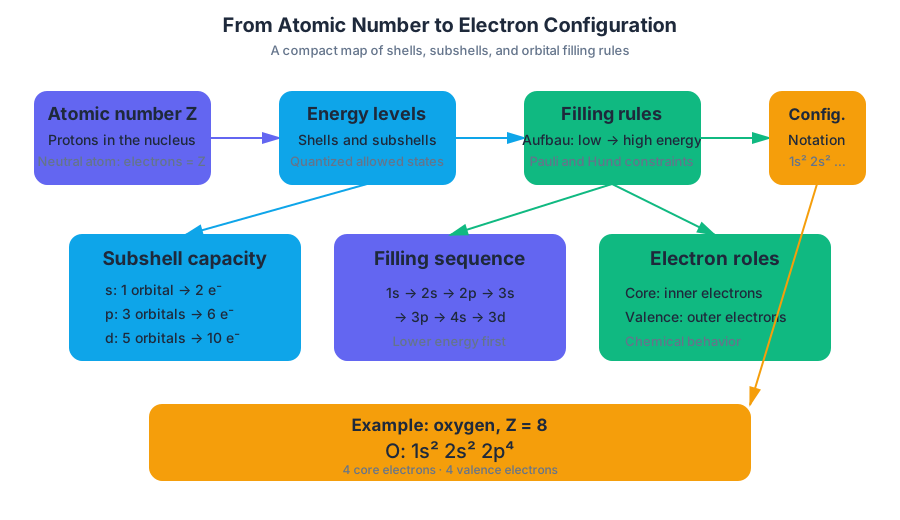
The atomic number, $Z$, gives the number of protons in an atom and, for a neutral atom, also the number of electrons. Because electrons occupy quantized energy states rather than arbitrary locations, an atom can be represented by an electron configuration: a notation showing how its electrons are distributed among shells and subshells.
Essential Knowledge 1.5.A.3: Electrons can be viewed as occupying “shells,” or energy levels, and “subshells,” or sublevels. Inner electrons are core electrons; outer electrons are valence electrons. The electron configuration is explained by quantum mechanics, the Aufbau principle, and the organization of the periodic table.
Quantum mechanics predicts the allowed electron states. The Aufbau principle provides the filling order: electrons occupy available orbitals from lower energy to higher energy. The Pauli exclusion principle limits each orbital to two electrons with opposite spins, while Hund’s rule places electrons singly into equal-energy orbitals before pairing them.
A compact filling sequence is:
$$ 1s,\ 2s,\ 2p,\ 3s,\ 3p,\ 4s,\ 3d,\ 4p,\ 5s,\ldots $$
The superscript gives the number of electrons in that subshell. For example, oxygen has $Z=8$ and therefore eight electrons:
$$ \mathrm{O}: 1s^2 2s^2 2p^4 $$
The first four electrons are core electrons, while the electrons in the outermost occupied shell, $n=2$, are valence electrons. Electron configurations therefore connect the particulate scale to measurable chemical behavior; one mole of oxygen atoms contains $6.022\times10^{23}$ copies of this electron arrangement.
Reading configurations as models
An electron configuration is a model—a symbolic representation of a particulate-level structure, not a literal photograph of electrons traveling along fixed circular paths. The periodic table reflects the periodicity of element properties as a function of atomic number because elements in related positions develop related outer-electron patterns.
For ions, adjust the electron count using the charge. A magnesium atom has twelve electrons:
$$ \mathrm{Mg}: 1s^2 2s^2 2p^6 3s^2 $$
A magnesium ion, $\mathrm{Mg^{2+}}$, has lost two electrons:
$$ \mathrm{Mg^{2+}}: 1s^2 2s^2 2p^6 $$
A common misconception is that the charge changes the number of protons. It does not: ion formation changes the number of electrons, while the proton count—and therefore the element’s identity—remains fixed.
Scope boundary: “The assignment of quantum numbers to electrons in subshells of an atom will not be assessed on the AP Exam.” The required reasoning is the use and interpretation of electron configurations, not the assignment of individual quantum-number sets.
Photoelectron spectroscopy: turning peaks into electrons
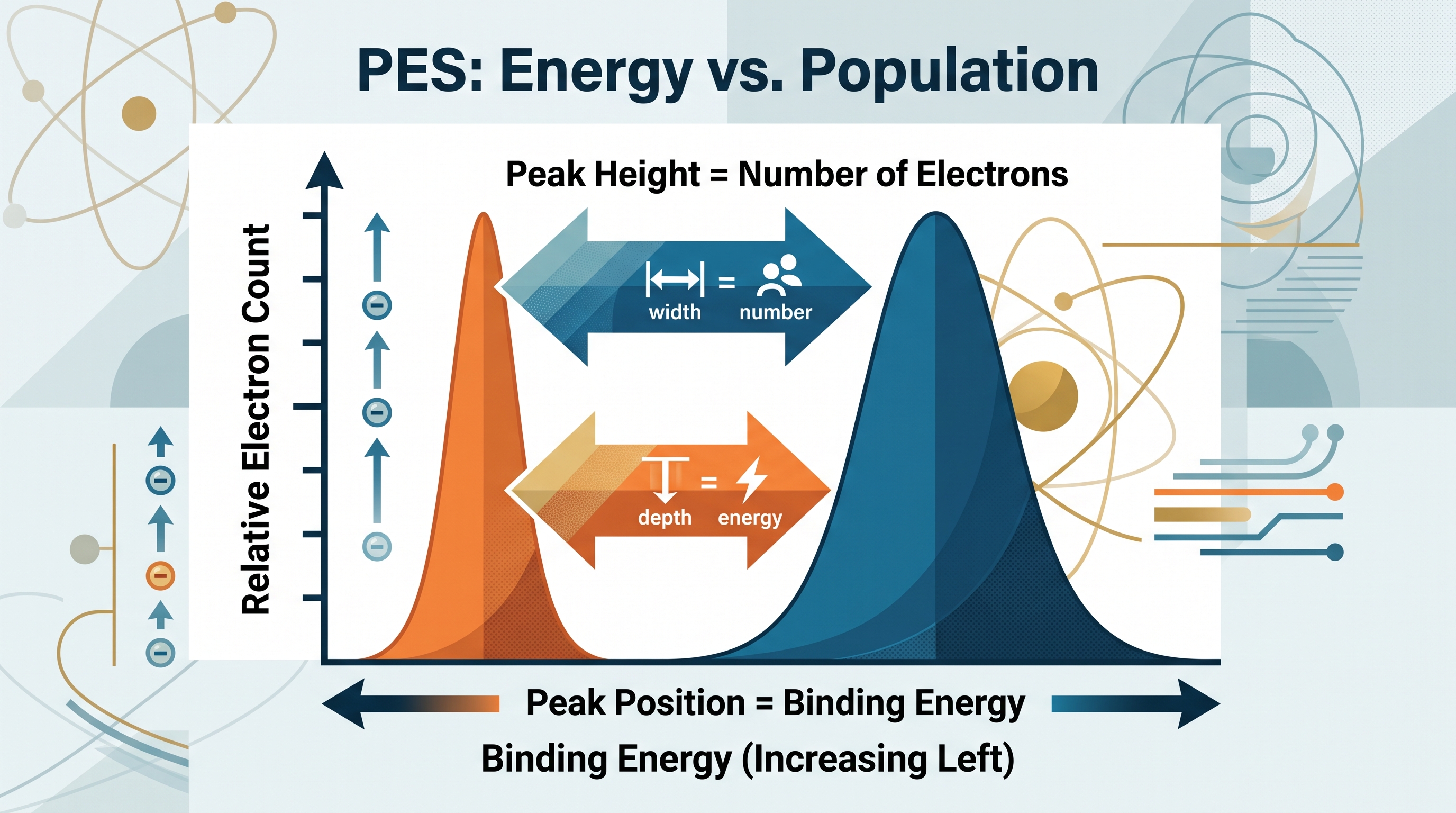
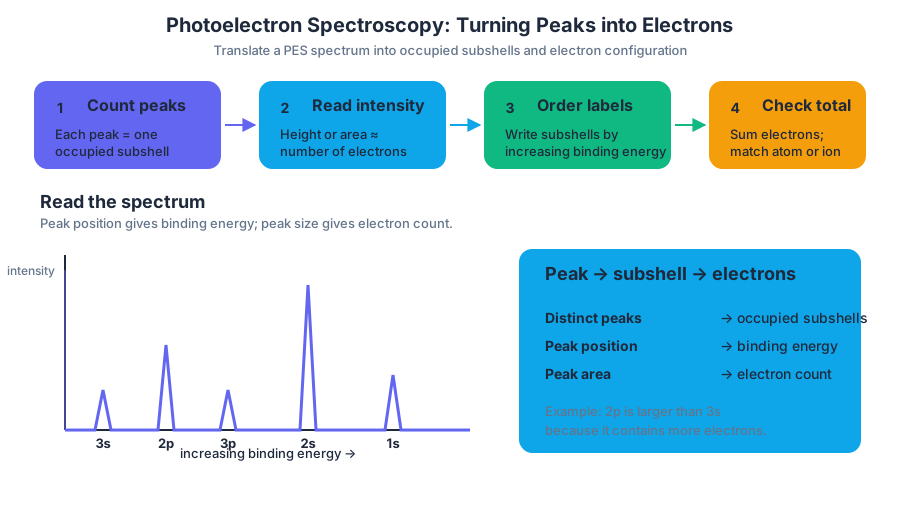
Photoelectron spectroscopy measures the energy required to remove electrons from an atom. Each peak corresponds to a subshell, and the peak’s position indicates the electron-binding energy. A peak representing more electrons is ideally taller or has greater area.
Essential Knowledge 1.6.A.1: The energy required to remove an electron from a subshell is related to the location of its peak in a PES spectrum, while the relative height of a peak is ideally proportional to the number of electrons in that subshell.
The interpretation is easiest when treated as a translation problem:
- Count the distinct peaks to identify occupied subshells.
- Read relative peak intensities to determine how many electrons occupy each subshell.
- Write the subshell labels in order of increasing binding energy.
- Check that the total electron count matches the element or ion.
Worked example: reconstructing an atom
Suppose a PES spectrum shows four subshell peaks with relative electron populations of $2$, $2$, $6$, and $1$. The total is:
$$ 2+2+6+1=11\ \text{electrons} $$
The configuration is therefore:
$$ 1s^2 2s^2 2p^6 3s^1 $$
An atom with eleven electrons is sodium, $\mathrm{Na}$. The single $3s$ electron is a valence electron, while the other ten are core electrons.
The reverse reasoning also works. Given $\mathrm{Al}$, with $Z=13$:
$$ \mathrm{Al}: 1s^2 2s^2 2p^6 3s^2 3p^1 $$
its PES spectrum should contain five occupied-subshell peaks, with relative populations $2:2:6:2:1$. The $1s$ electrons generally require the greatest energy to remove because they are closest to the nucleus and experience strong attraction.
AP Science Practices in action
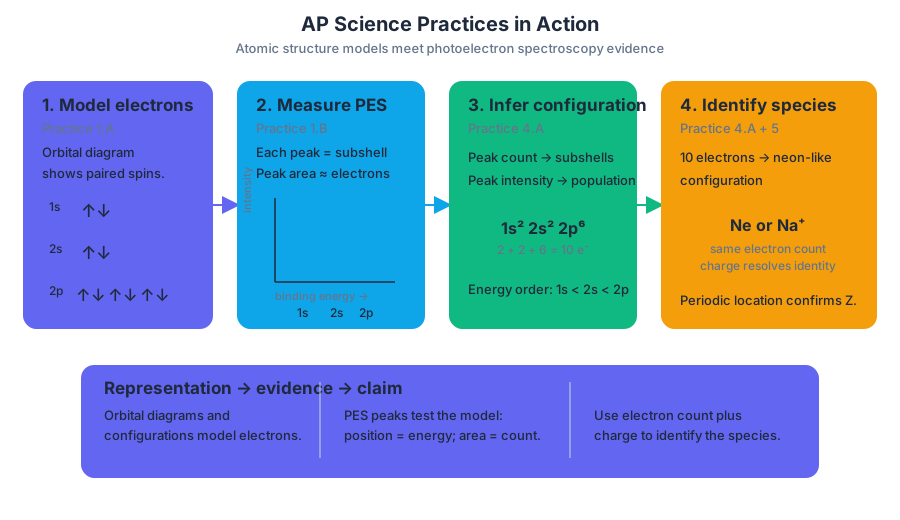
- Science Practice 1: Models and Representations — Skill 1.A, “Describe representations and models of natural phenomena.” Use orbital diagrams, electron configurations, and periodic-table locations to represent electron distributions.
- Science Practice 1: Models and Representations — Skill 1.B, “Explain models and representations.” Explain why a peak corresponds to a subshell and why peak intensity reflects electron population.
- Science Practice 4: Model Analysis — Skill 4.A, “Explain how models or representations describe chemical phenomena.” Infer an electron configuration from a PES graph, then use that configuration to identify the element or ion.
- Science Practice 5: Mathematical Routines — Skill 5.A, “Identify and describe the components of a scientific problem.” Track electron counts, ionic charge, peak populations, and mole-to-particle conversions without losing the scale being used.
Misconception check
A taller PES peak does not mean that the electrons in that subshell have higher energy. Peak position represents the energy required to remove electrons; peak height or area represents how many electrons are present. Ask yourself: Am I reading the horizontal axis for binding energy and the vertical dimension for population?
Retrieval check: A species has the configuration $1s^2 2s^2 2p^6 3s^2 3p^5$. How many core electrons, valence electrons, and total electrons does it contain? The answer is $10$ core electrons, $7$ valence electrons, and $17$ total electrons.
Source Materials
- AP Chemistry Course and Exam Description
- AP Chemistry Course and Exam Description Clarifications and Corrections
- AP Chemistry Course Overview
- AP Chemistry Course at a Glance
- AP Chemistry Course at a Glance Poster
- Adopt AP Chemistry
- AP Chemistry
- AP Chemistry
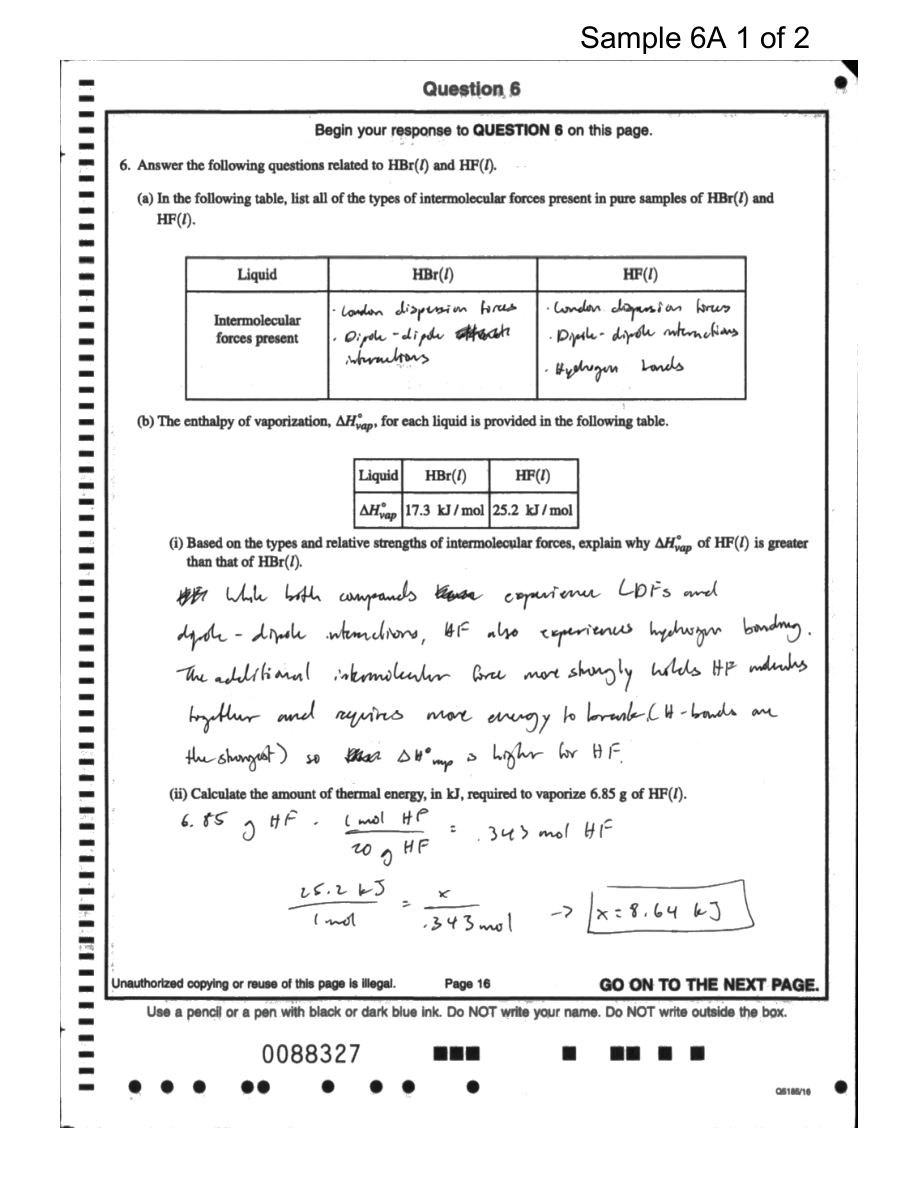
- Figure — Sample Responses Q6 (p. 3)
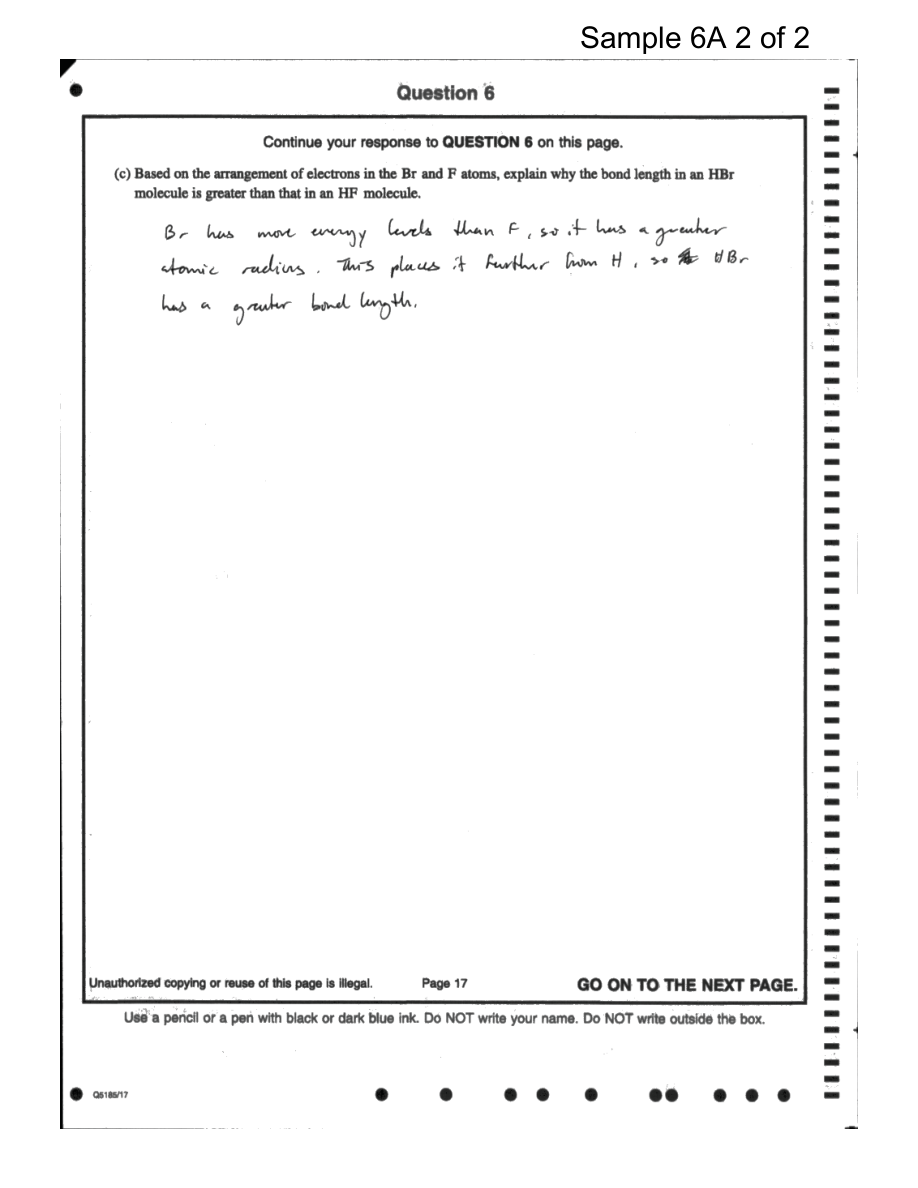
- Figure — Sample Responses Q6 (p. 4)
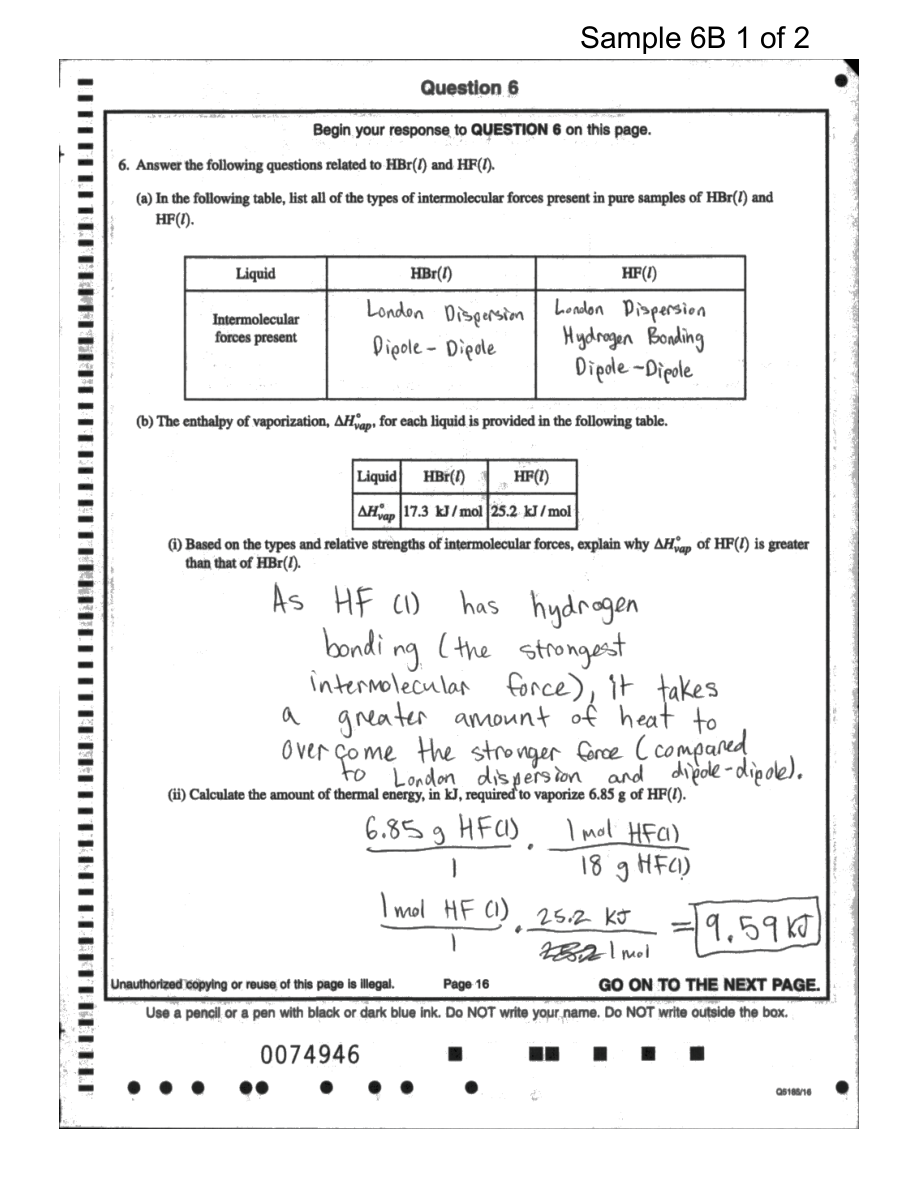
- Figure — Sample Responses Q6 (p. 5)
- Figure — Sample Responses Q6 (p. 6)