From the free course AP Chemistry on Lykke
7.3 Reaction Quotient and Equilibrium Constant · 7.4 Calculating the Equilibrium Constant
Key concepts: Reaction quotient Qc · Reaction quotient Qp · Equilibrium constant Kc · Equilibrium constant Kp · Law of mass action · Equilibrium mixtures and reversible reactions · Equilibrium concentrations · Equilibrium partial pressures · Comparing Q with K to determine equilibrium status
A reversible reaction can be treated like a molecular tug-of-war: the mixture may begin with mostly reactants, mostly products, or something in between, but its composition can be measured at any instant.
7.3 Reaction Quotient and Equilibrium Constant · 7.4 Calculating the Equilibrium Constant
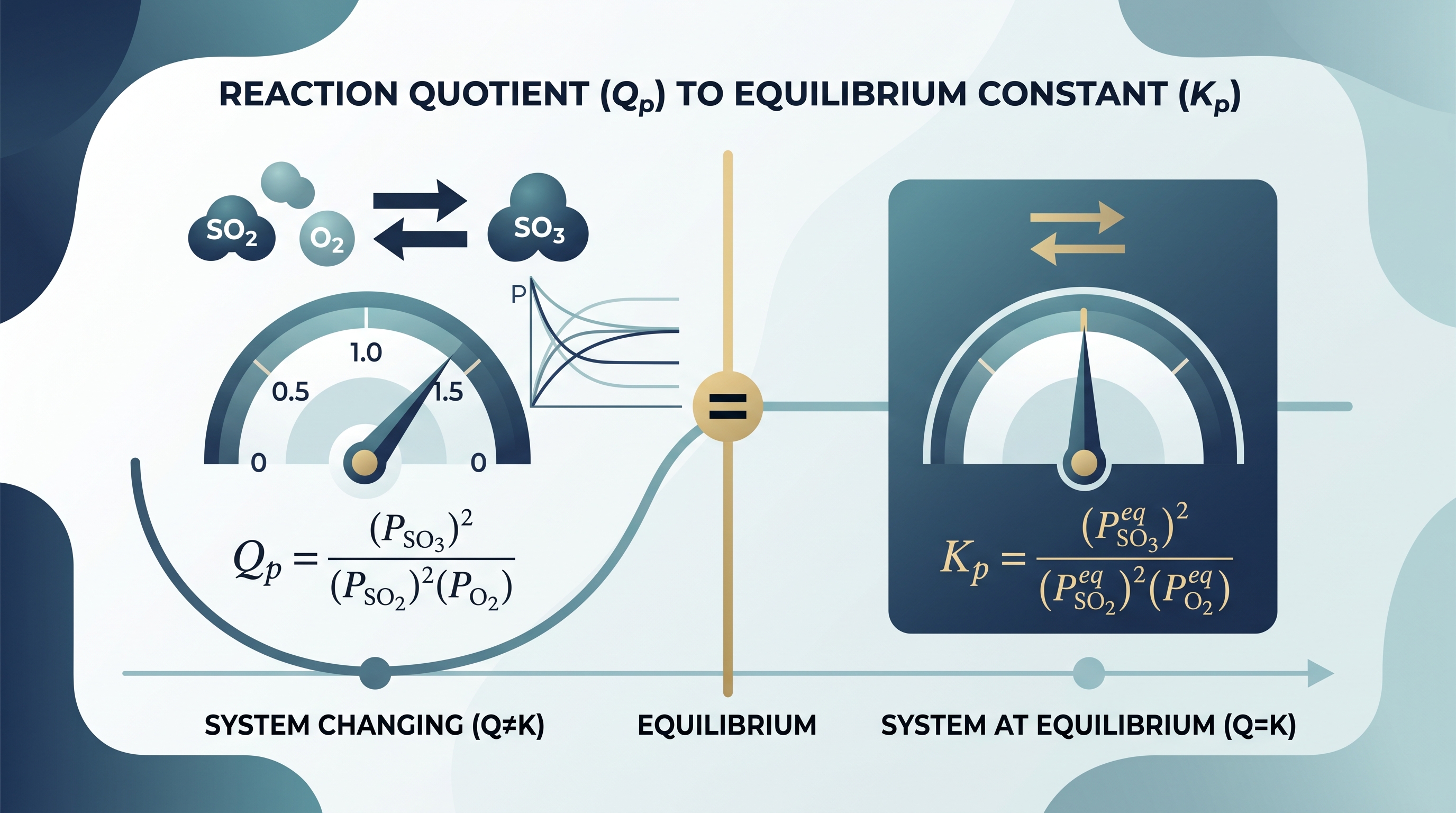
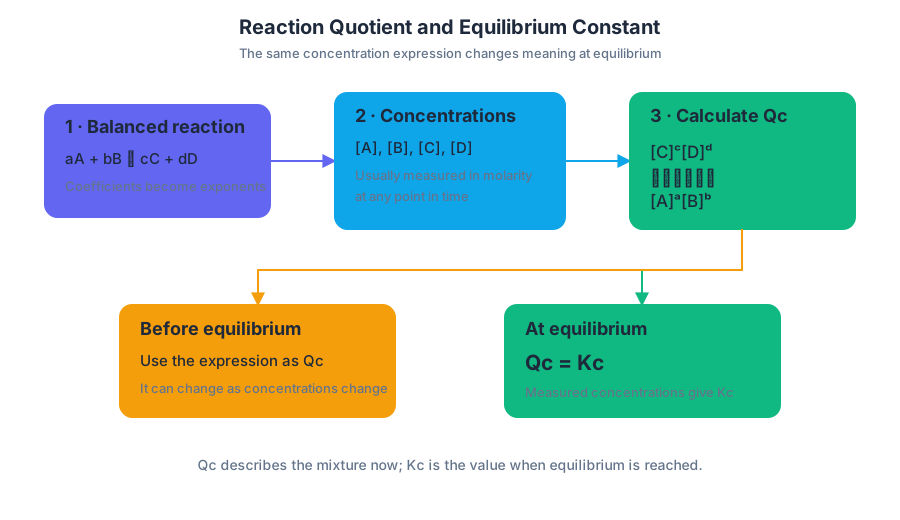
A reversible reaction can be treated like a molecular tug-of-war: the mixture may begin with mostly reactants, mostly products, or something in between, but its composition can be measured at any instant. The reaction quotient, $Q$, measures the mixture’s current product-to-reactant relationship; the equilibrium constant, $K$, is that same relationship specifically when the system has reached equilibrium.
From a reversible equation to an equilibrium expression
For the general reversible reaction
aA+bB\rightleftharpoons cC+dD
the lowercase letters are stoichiometric coefficients, and the uppercase letters represent chemical species. The law of mass action says that the reaction expression places product terms in the numerator, reactant terms in the denominator, and raises every concentration or pressure to the power of its coefficient.
Concentration form: $Q_c$ and $K_c$
The concentration reaction quotient, $Q_c$, describes the relative concentrations of reaction species at any point in time:
$$Q_c=\frac{[C]^c[D]^d}{[A]^a[B]^b}$$
Square brackets, such as $[A]$, represent concentration, usually molarity. If the mixture is at equilibrium, the measured concentrations produce the equilibrium constant:
$$Q_c=K_c$$
Before equilibrium, the same expression is called $Q_c$, not $K_c$.
Pressure form: $Q_p$ and $K_p$
For a gas-phase reaction, the expression may use partial pressures instead:
$$Q_p=\frac{(P_C)^c(P_D)^d}{(P_A)^a(P_B)^b}$$
Here, $P_A$, $P_B$, $P_C$, and $P_D$ are the partial pressures of the species. At equilibrium,
$$Q_p=K_p$$
The structure of the expression does not change; only the measured quantity changes from concentration to partial pressure.
| Quantity | What it describes | Values used | At equilibrium |
|---|---|---|---|
| $Q_c$ | Current composition of a mixture | Concentrations | $Q_c=K_c$ |
| $Q_p$ | Current composition of a gas mixture | Partial pressures | $Q_p=K_p$ |
| $K_c$ | Equilibrium composition relationship | Equilibrium concentrations | Constant at a specified temperature |
| $K_p$ | Equilibrium composition relationship for gases | Equilibrium partial pressures | Constant at a specified temperature |
Worked example: calculating $K_c$
Consider the reversible synthesis reaction
N_2(g)+3H_2(g)\rightleftharpoons 2NH_3(g)
At equilibrium, suppose
$$[N_2]=0.50\ \mathrm{M},\qquad [H_2]=0.20\ \mathrm{M},\qquad [NH_3]=0.80\ \mathrm{M}$$
Apply the coefficients directly:
$$K_c=\frac{[NH_3]^2}{[N_2][H_2]^3}$$
Substitute the equilibrium concentrations:
$$K_c=\frac{(0.80)^2}{(0.50)(0.20)^3}$$
$$K_c=\frac{0.64}{0.0040}=160$$
Thus,
$$K_c=1.6\times10^2$$
The exponent $2$ on $[NH_3]$ and exponent $3$ on $[H_2]$ come from the balanced equation. They are not optional mathematical decorations: changing them changes the chemical relationship being measured.
Worked example: calculating $K_p$
For the same reaction, suppose an equilibrium mixture has
$$P_{N_2}=0.40\ \mathrm{atm},\qquad P_{H_2}=0.60\ \mathrm{atm},\qquad P_{NH_3}=0.20\ \mathrm{atm}$$
The pressure-based expression is
$$K_p=\frac{(P_{NH_3})^2}{(P_{N_2})(P_{H_2})^3}$$
Therefore,
$$K_p=\frac{(0.20)^2}{(0.40)(0.60)^3} =\frac{0.040}{0.0864} =0.463$$
So,
$$K_p\approx0.46$$
Do not combine concentration data with pressure data in one expression. If the problem provides molarities, construct $Q_c$ or $K_c$; if it provides partial pressures for gases, construct $Q_p$ or $K_p$.
Particle representations: why $Q$ changes but $K$ does not
Imagine beads representing particles in the reversible synthesis
A+B\rightleftharpoons C
A container with many $A$ and $B$ beads but few $C$ beads has
$$Q_c=\frac{[C]}{[A][B]}$$
with a relatively small numerator. A container with many $C$ beads has a larger $Q_c$. As the reaction proceeds toward equilibrium, particles are rearranged until the quotient reaches the equilibrium value:
$$Q_c=K_c$$
The initial arrangement can vary, so $Q_c$ can vary. At a fixed temperature, however, every equilibrium mixture for the same reaction has the same $K_c$.
Misconception check
Misconception: $Q$ and $K$ are different formulas.
Correction: They use the same law-of-mass-action expression. $Q$ uses concentrations or pressures from the mixture’s current state; $K$ uses values measured at equilibrium.
Skill connection: Skill 3.A: Representing Data and Phenomena
For Skill 3.A: Representing Data and Phenomena, represent a reversible reaction with a balanced equation, a particle model, or a correctly scaled graph. A strong representation labels whether values are concentrations or partial pressures and shows the transition from a changing $Q$ to the equilibrium condition $Q=K$. The representation must preserve stoichiometric coefficients because those coefficients determine the exponents in the equilibrium expression.
Retrieval check: For
2SO_2(g)+O_2(g)\rightleftharpoons 2SO_3(g)
write $Q_p$. Then identify the single change that converts the expression into $K_p$.
Answer:
$$Q_p=\frac{(P_{SO_3})^2}{(P_{SO_2})^2(P_{O_2})}$$
The expression becomes $K_p$ when the partial pressures are measured for a mixture at equilibrium.
Source Materials
- AP Chemistry Course and Exam Description
- AP Chemistry Course and Exam Description Clarifications and Corrections
- AP Chemistry Course Overview
- AP Chemistry Course at a Glance
- AP Chemistry Course at a Glance Poster
- Adopt AP Chemistry
- AP Chemistry
- AP Chemistry
- Figure — Sample Responses Q3 (p. 4)
- Figure — Sample Responses Q3 (p. 5)
- Figure — Sample Responses Q3 (p. 6)
- Figure — Sample Responses Q3 (p. 7)