From the free course AP Chemistry on Lykke
3.3 Solids, Liquids, and Gases · 3.4 Ideal Gas Law
Key concepts: Particulate-level differences among solids, liquids, and gases · Noncovalent interparticle interactions · Macroscopic properties of ideal gases · The ideal gas law · Relationships among pressure, volume, amount, and temperature · Gas mixtures and partial pressures · Non-ideal gas behavior · Interparticle attractions in real gases · Particle volumes and deviations from ideal behavior · High-pressure effects on gases
A gas can fill an entire room, while a solid keeps its own shape and a liquid keeps nearly the same volume but flows around its container.
3.3 Solids, Liquids, and Gases · 3.4 Ideal Gas Law
A gas can fill an entire room, while a solid keeps its own shape and a liquid keeps nearly the same volume but flows around its container. The difference is not that the particles themselves become “larger” or “smaller”; it is how closely they are packed, how freely they move, and how strongly noncovalent interactions organize them.
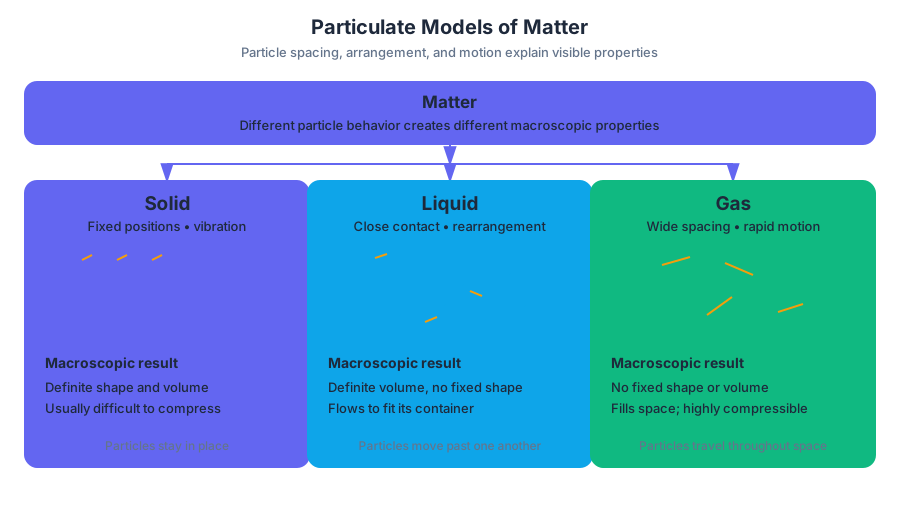
Particulate models of the three phases
3.3.A Represent the differences between solid, liquid, and gas phases using a particulate-level model. A particulate-level model explains a visible property by showing particles, their spacing, their arrangement, and their motion.
| Phase | Particle arrangement and motion | Macroscopic consequence |
|---|---|---|
| Solid | Particles are closely packed; they vibrate around relatively fixed positions. Translation through the sample is limited. | Definite shape and definite volume; usually difficult to compress. |
| Liquid | Particles remain in close contact but continually move, rearrange, and collide. | Definite volume but no definite shape; flows to fit its container. |
| Gas | Particles are widely separated and move throughout the available space. | No definite shape or volume; highly compressible and able to fill a container. |
In 3.3.A.1, solids may be crystalline, with a regular three-dimensional arrangement, or amorphous, with an irregular arrangement. In either case, particle motion is restricted compared with a liquid or gas. Packing ability and interparticle interactions help determine the structure.
In 3.3.A.2, liquid particles are close together but are not locked into fixed positions. Their arrangement depends on the nature and strength of interactions—including polarity and hydrogen bonding—as well as temperature. Because particles in solids and liquids are both generally in close contact, 3.3.A.3 indicates that their molar volumes are typically similar.
Misconception check — “Gas particles expand.” Gas samples expand because the particles move farther apart and occupy more space; the particles themselves do not expand. Similarly, heating a liquid does not automatically make each molecule larger: it changes the particles’ motion and the balance between motion and attractions.
The ideal-gas relationship
The macroscopic properties of an ideal gas are connected by 3.4.A Explain the relationship between the macroscopic properties of a sample of gas or mixture of gases using the ideal gas law. The ideal gas law is
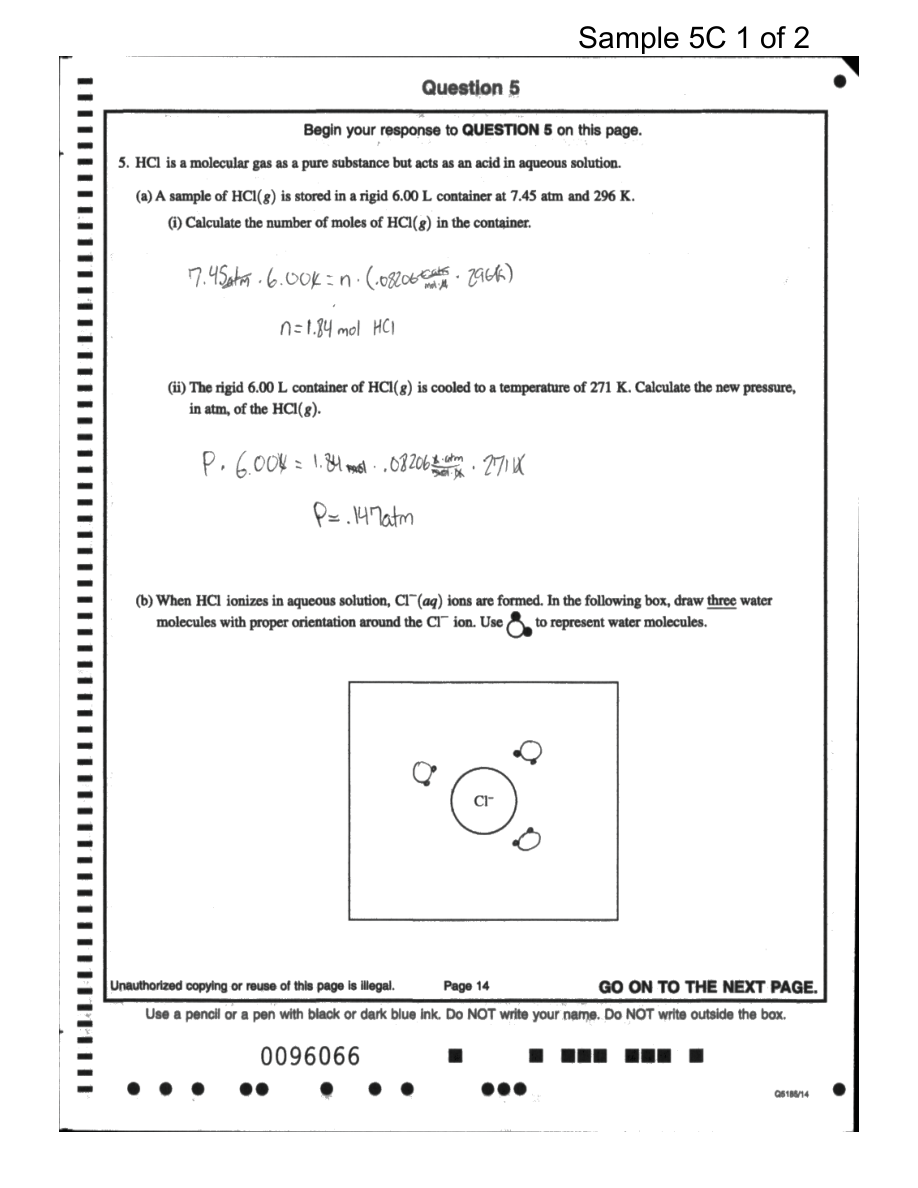
$$ PV=nRT $$
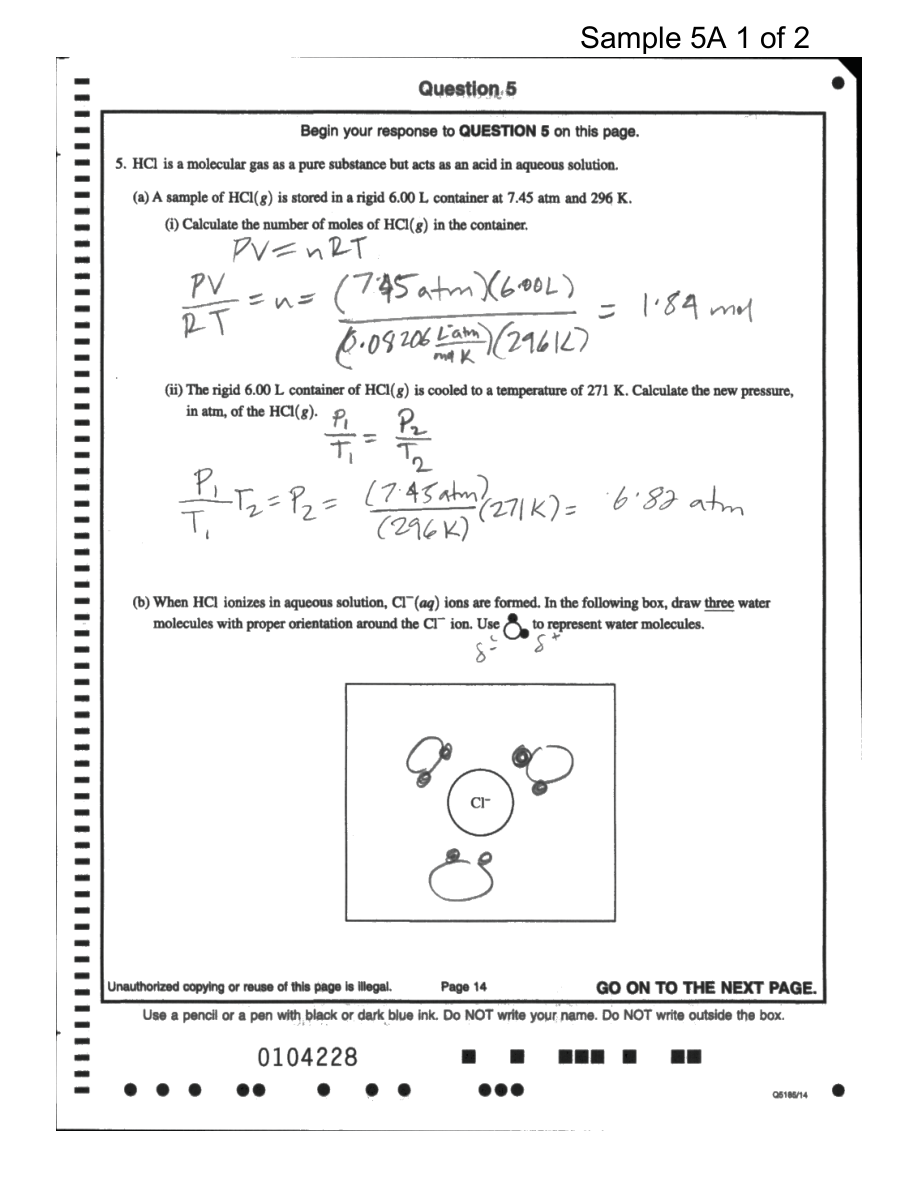
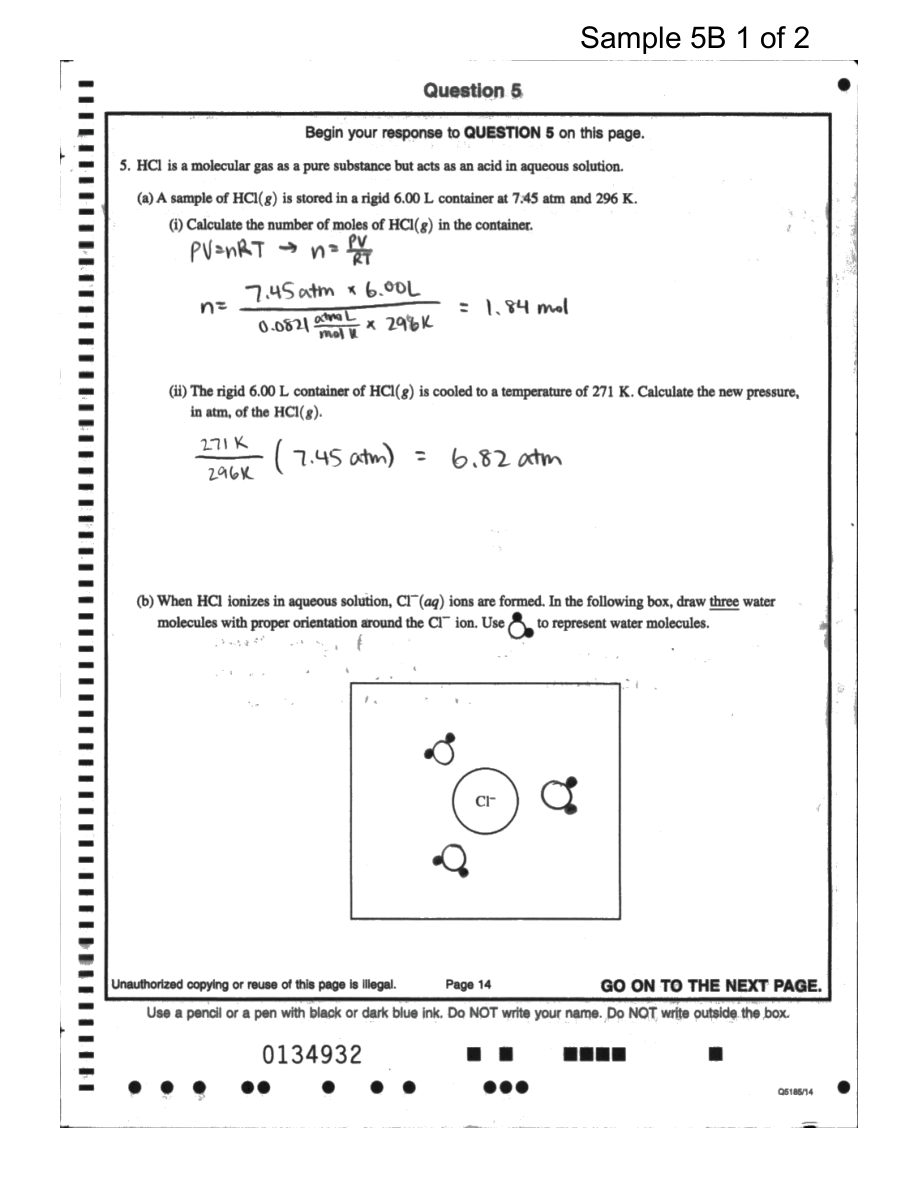
Here, $P$ is pressure, $V$ is volume, $n$ is the amount of gas in moles, $R$ is the ideal gas constant, and $T$ is absolute temperature in kelvins. The equation is useful because it links what can be measured at the container level to the amount of matter represented at the particle level.
5.C — Mathematical Routines: Explain the relationship between variables within an equation when one variable changes. Rearranging the equation makes the dependencies visible:
$$ P=\frac{nRT}{V} \qquad V=\frac{nRT}{P} \qquad T=\frac{PV}{nR} $$
When all other variables remain constant, pressure and volume are inversely related: increasing $V$ decreases $P$. At constant $P$ and $T$, increasing $n$ requires a proportional increase in $V$. At constant $n$ and $V$, increasing $T$ increases $P$. Temperature must be measured in kelvins; using degrees Celsius directly destroys the proportional relationship.
Worked example. A sample contains $0.250\ \mathrm{mol}$ of gas at $300\ \mathrm{K$}$ in a $5.00\ \mathrm{L}$ container. Using $R=0.08206\ \mathrm{L\ atm\ mol^{-1}\ K^{-1}}$:
$$ P=\frac{nRT}{V} =\frac{(0.250)(0.08206)(300)}{5.00} =1.23\ \mathrm{atm} $$
If the container volume is doubled while $n$ and $T$ remain fixed, the pressure becomes approximately $0.615\ \mathrm{atm}$. The safest reasoning is not merely “use a new formula”; identify which variables are held constant, then inspect how the equation responds.
Gas mixtures and partial pressures
In an ideal-gas mixture, each gas contributes a partial pressure: the pressure that component would exert under the same container conditions if considered independently. This independence is an idealization, but it makes mixtures such as air mathematically manageable.
For gas $A$, its partial pressure is proportional to its mole fraction:
$$ P_A=P_{\text{total}}X_A $$
where
$$ X_A=\frac{\text{moles of }A}{\text{total moles}} $$
Dalton’s law states that the total pressure is the sum of the component pressures:
$$ P_{\text{total}}=P_A+P_B+P_C+\cdots $$
Worked example. A mixture contains $2.0\ \mathrm{mol}$ of nitrogen and $1.0\ \mathrm{mol}$ of oxygen at a total pressure of $0.900\ \mathrm{atm}$. The mole fraction of oxygen is
$$ X_{O_2}=\frac{1.0}{2.0+1.0}=\frac{1}{3} $$
so
$$ P_{O_2}=(0.900)\left(\frac{1}{3}\right)=0.300\ \mathrm{atm} $$
The nitrogen partial pressure is therefore $0.600\ \mathrm{atm}$.
Where the ideal model breaks
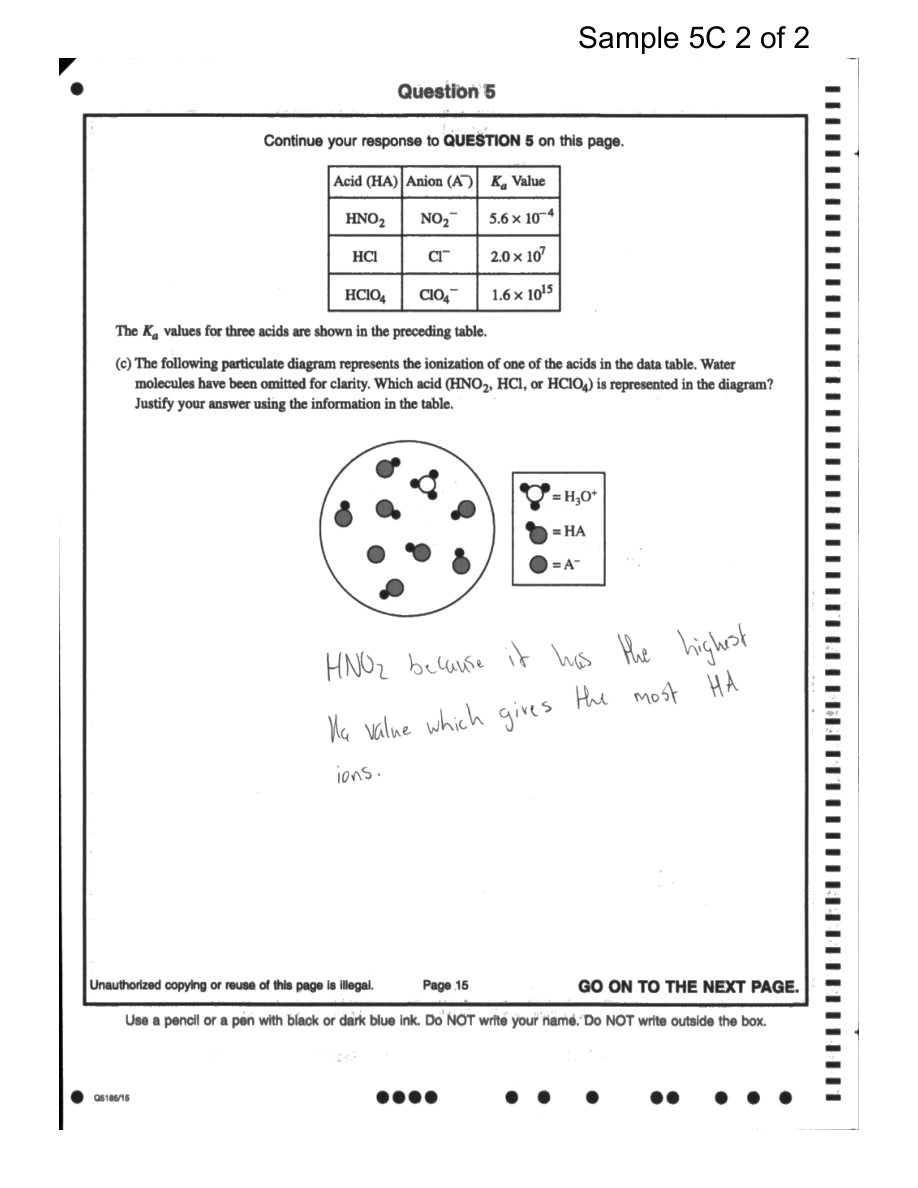
The ideal gas law does not explain the exact behavior of real gases. Real particles attract one another, especially under conditions approaching condensation, and their own volumes become important at extremely high pressures. Attractions can reduce the observed pressure because particles pull one another inward instead of striking the container walls as independently; particle volume can reduce the free space available for motion.
Misconception check — “Ideal means real gases have no forces.” “Ideal” describes a model, not a special substance. Real gases approximate ideal behavior when particles are sufficiently far apart that attractions and particle volumes are negligible. Interpreting a deviation requires connecting the macroscopic error in $P$, $V$, or $T$ to the microscopic cause.
Retrieval check: A rigid container holds a gas mixture. If the amount of one component doubles while $T$ and $V$ remain constant, what happens to its partial pressure, and what happens to the total pressure? Explain using $PV=nRT$ and Dalton’s law rather than a memorized slogan.

Source Materials
- AP Chemistry Course and Exam Description
- AP Chemistry Course and Exam Description Clarifications and Corrections
- AP Chemistry Course Overview
- AP Chemistry Course at a Glance
- AP Chemistry Course at a Glance Poster
- Adopt AP Chemistry
- AP Chemistry
- AP Chemistry
- Figure — Sample Responses Q5 (p. 3)
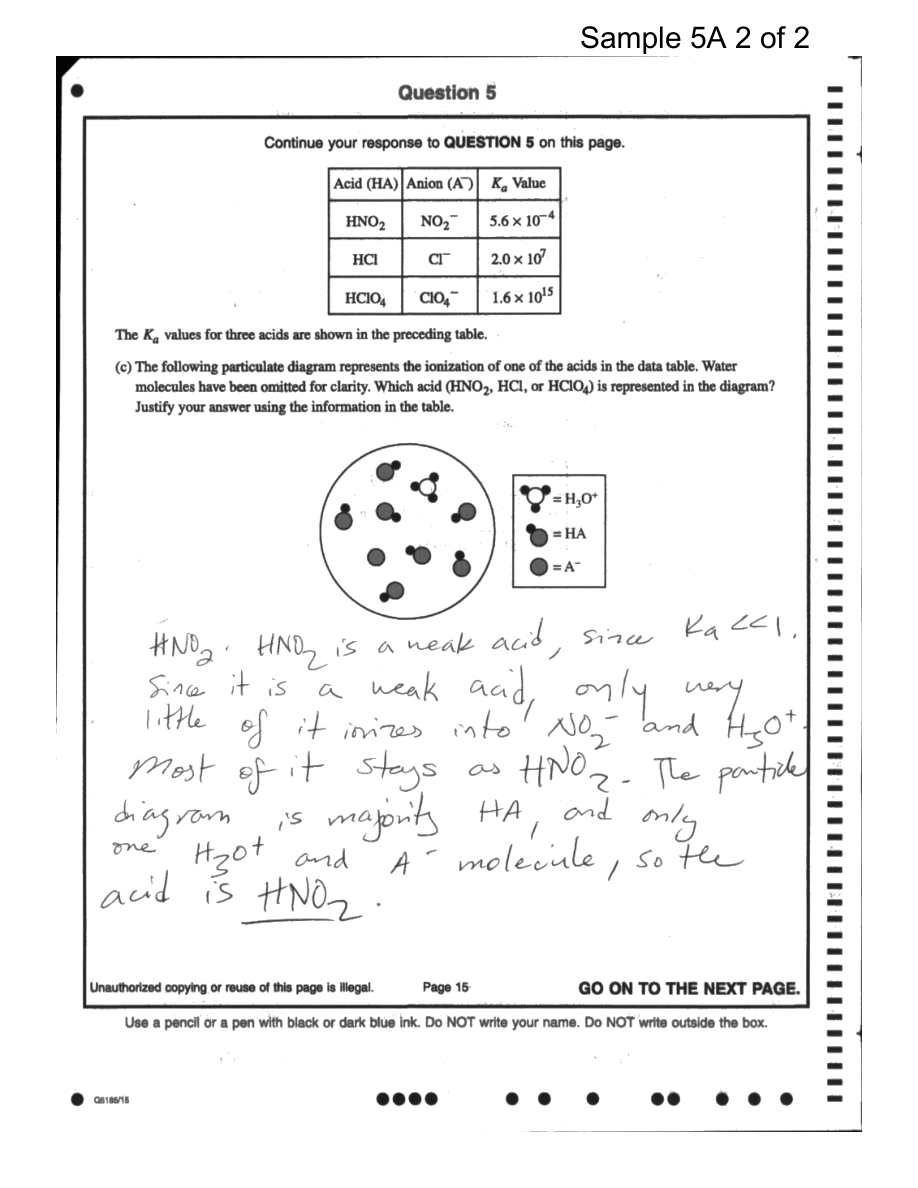
- Figure — Sample Responses Q5 (p. 4)
- Figure — Sample Responses Q5 (p. 5)
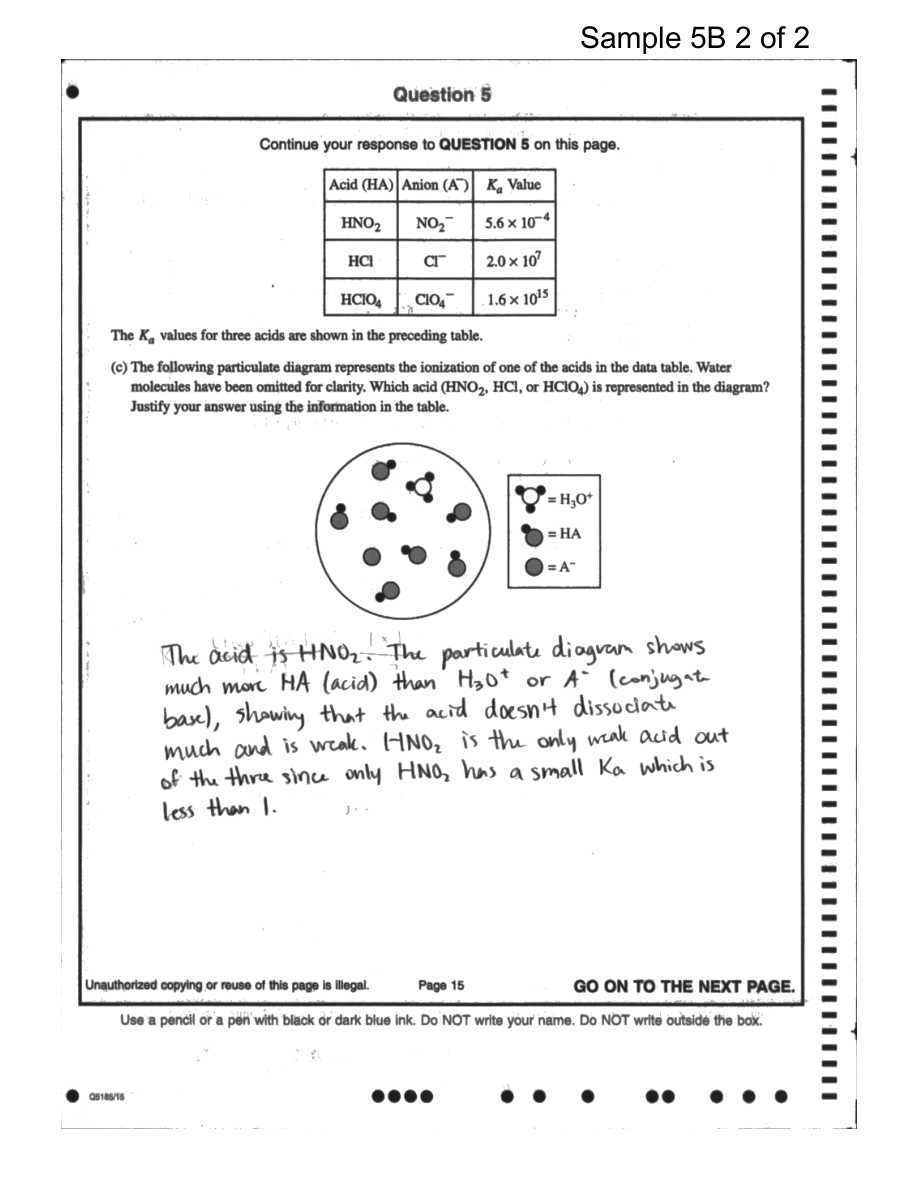
- Figure — Sample Responses Q5 (p. 6)