From the free course AP Chemistry on Lykke
AP Practice 3
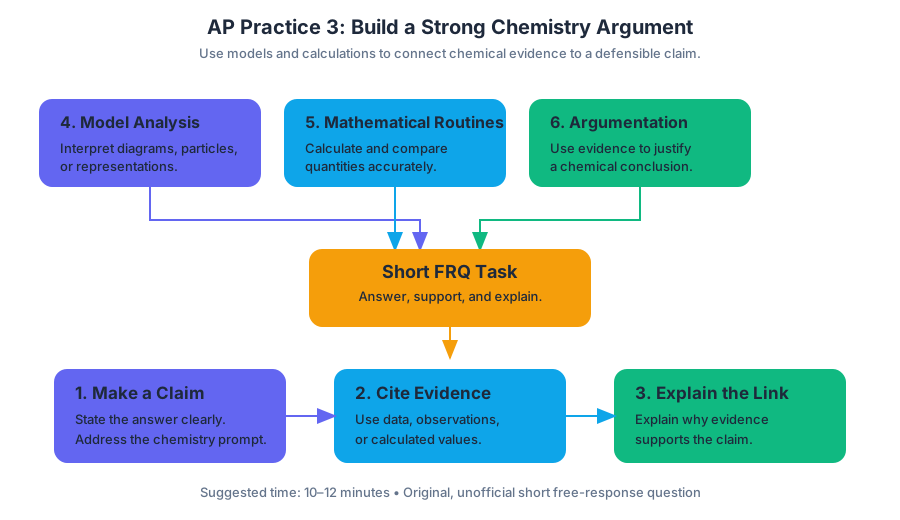
A strong chemistry argument does more than announce an answer: it connects a claim to chemical evidence and explains why the evidence supports that claim.
AP Practice 3
A strong chemistry argument does more than announce an answer: it connects a claim to chemical evidence and explains why the evidence supports that claim. This original short free-response question (FRQ) practices that exam task type through Science Practice 6: Argumentation, while also requiring Science Practice 4: Model Analysis and Science Practice 5: Mathematical Routines.
Task type: Original, unofficial short free-response question
Suggested time: $10$–$12$ minutes
Primary science practice: 6. Argumentation
Supporting science practices: 4. Model Analysis and 5. Mathematical Routines
The investigation: Which antacid neutralizes more acid?
Two powdered antacids, $A$ and $B$, are tested by adding separate samples to excess hydrochloric acid. The remaining acid is then measured by titration with $0.100\ \mathrm{M}$ sodium hydroxide. Because any acid left over requires sodium hydroxide to neutralize, a smaller volume of sodium hydroxide indicates that the antacid consumed more hydrochloric acid.
The balanced neutralization reaction is
$$ \mathrm{HCl}(aq)+\mathrm{NaOH}(aq)\rightarrow \mathrm{NaCl}(aq)+\mathrm{H_2O}(l) $$
Each antacid sample has a mass of $0.500\ \mathrm{g}$. The initial hydrochloric acid contains $0.0500\ \mathrm{mol}$ of $\mathrm{HCl}$. The titration results are shown below.
| Sample | Volume of $0.100\ \mathrm{M}$ $\mathrm{NaOH}$ used to titrate remaining $\mathrm{HCl}$ |
|---|---|
| Antacid $A$ | $18.0\ \mathrm{mL}$ |
| Antacid $B$ | $31.0\ \mathrm{mL}$ |
(a) Calculate the amount, in moles, of $\mathrm{HCl}$ remaining after reaction with antacid $A$.
(b) Determine which antacid consumed more $\mathrm{HCl}$ and support the conclusion with a quantitative argument using the data.
(c) A student claims that antacid $B$ must be more effective because it required a larger volume of $\mathrm{NaOH}$ during the titration. Evaluate the claim.
Worked reasoning
Part (a): Convert the titration measurement into chemical amount
The reaction ratio between $\mathrm{NaOH}$ and $\mathrm{HCl}$ is $1:1$. First convert the volume to liters:
$$ 18.0\ \mathrm{mL}=0.0180\ \mathrm{L} $$
Then use the molarity relationship:
$$ n=MV $$
$$ n_{\mathrm{NaOH}}=(0.100\ \mathrm{mol\ L^{-1}})(0.0180\ \mathrm{L}) =1.80\times10^{-3}\ \mathrm{mol} $$
Because the stoichiometric ratio is $1:1$,
$$ n_{\mathrm{HCl,\ remaining}}=1.80\times10^{-3}\ \mathrm{mol} $$
Point-worthy reasoning: The response must connect the measured sodium hydroxide volume to moles of sodium hydroxide, then use the balanced equation to identify the equal amount of remaining hydrochloric acid. A volume by itself is not yet a chemical amount.
Part (b): Build an evidence-based comparison
The initial amount of hydrochloric acid was
$$ n_{\mathrm{HCl,\ initial}}=0.0500\ \mathrm{mol} $$
For antacid $A$,
$$ n_{\mathrm{HCl,\ consumed}}
0.0500-0.00180
0.0482\ \mathrm{mol} $$
For antacid $B$, the amount of sodium hydroxide used is
$$ n_{\mathrm{NaOH}}
(0.100)(0.0310)
3.10\times10^{-3}\ \mathrm{mol} $$
Thus,
$$ n_{\mathrm{HCl,\ remaining}}=0.00310\ \mathrm{mol} $$
and
$$ n_{\mathrm{HCl,\ consumed}}
0.0500-0.00310
0.0469\ \mathrm{mol} $$
Antacid $A$ consumed more hydrochloric acid:
$$ 0.0482\ \mathrm{mol}>0.0469\ \mathrm{mol} $$
A complete argument is therefore: Antacid $A$ is more effective under these experimental conditions because less hydrochloric acid remained after treatment with $A$, so $A$ consumed $0.0482\ \mathrm{mol}$ of $\mathrm{HCl}$ compared with $0.0469\ \mathrm{mol}$ consumed by $B$.
Point-worthy reasoning: A high-scoring argument contains three linked parts: a clear claim, numerical evidence, and a chemical explanation connecting the evidence to the claim. Merely stating that $A$ is better does not establish the argument.
Part (c): Test the student’s interpretation
The student’s claim is incorrect. A larger volume of sodium hydroxide means that more hydrochloric acid remained to be titrated. Since antacid $B$ left $0.00310\ \mathrm{mol}$ of $\mathrm{HCl}$ while antacid $A$ left only $0.00180\ \mathrm{mol}$, $B$ neutralized less of the original acid.
Misconception check — “More titrant means more reacting power.”
In a back-titration, the titrant measures what is left over, not what the original substance consumed. A larger titrant volume can therefore indicate weaker performance by the tested material.
How the examiner sees the reasoning
| Response feature | What it demonstrates |
|---|---|
| Correctly uses $n=MV$ | 5. Mathematical Routines |
| Uses the $1:1$ reaction ratio | Chemical interpretation of a representation |
| Subtracts remaining acid from initial acid | Quantitative model analysis |
| Identifies antacid $A$ | Correct claim |
| Cites $0.0482\ \mathrm{mol}$ and $0.0469\ \mathrm{mol}$ | Relevant evidence |
| Explains why lower leftover acid means greater neutralization | 6. Argumentation |
A frequent weak response compares $18.0\ \mathrm{mL}$ and $31.0\ \mathrm{mL}$ without explaining what those volumes represent. The stronger response analyzes the experimental model: titration measures residual $\mathrm{HCl}$, and residual acid is inversely related to acid consumed when the initial amount is fixed.
Error-review routine
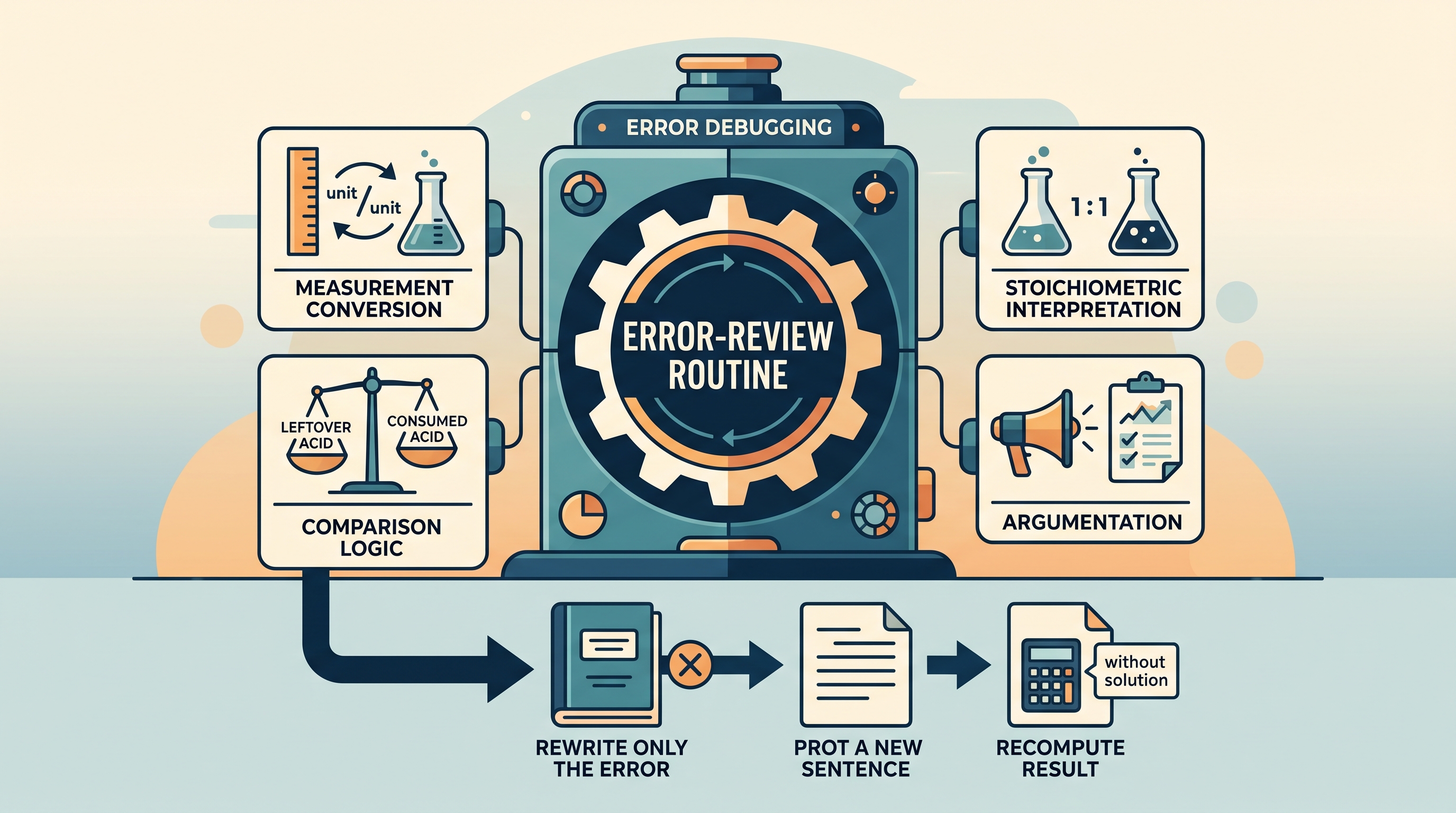
After completing the question, classify any error as one of four types: measurement conversion—forgetting $\mathrm{mL}$ to $\mathrm{L}$; stoichiometric interpretation—missing the $1:1$ ratio; comparison logic—confusing leftover acid with consumed acid; or argumentation—giving a claim without numerical evidence and chemical reasoning. Rewrite only the sentence containing the error, then recompute the result without looking at the solution.
Retrieval check: If the initial acid amount were identical but Sample $C$ required $10.0\ \mathrm{mL}$ of the same sodium hydroxide solution, would $C$ have consumed more or less hydrochloric acid than $A$? Explain using the meaning of the titration volume.
Source Materials
- AP Chemistry Course and Exam Description
- AP Chemistry Course and Exam Description Clarifications and Corrections
- AP Chemistry Course Overview
- AP Chemistry Course at a Glance
- AP Chemistry Course at a Glance Poster
- Adopt AP Chemistry
- AP Chemistry
- AP Chemistry
- AP Chemistry-AP Students
- AP/College Chemistry-Khan Academy
- Guide to the AP Chemistry Exam-The Princeton Review
- AP Chemistry-Wikipedia