From the free course AP Chemistry on Lykke
8.3 Weak Acid and Base Equilibria · 8.4 Acid-Base Reactions and Buffers
Key concepts: Weak acid equilibria and acid ionization constant (Ka) · Weak base equilibria and base ionization constant (Kb) · pKa and pKb as logarithmic measures of Ka and Kb · Percent ionization of weak acids and bases · Equilibrium concentrations of major species in acid-base solutions · Quantitative acid-base reactions and limiting/excess reagents · Buffer solutions composed of a weak acid/base and its conjugate partner · pH determination after mixing weak acids or bases with strong reagents · Equimolar weak base–strong acid mixtures and the acidic conjugate-acid equilibrium · Buffer capacity for added acid versus added base
A solution’s pH depends not only on which acid is present, but also on how extensively that acid transfers protons to water. Equal-concentration solutions of hydrochloric acid, carbonic acid, $H_2CO_3$, and acetic acid, $HC_2H_3O_2$, do not produce equal hydronium concentrations because strong acids ionize…
8.3 Weak Acid and Base Equilibria · 8.4 Acid-Base Reactions and Buffers
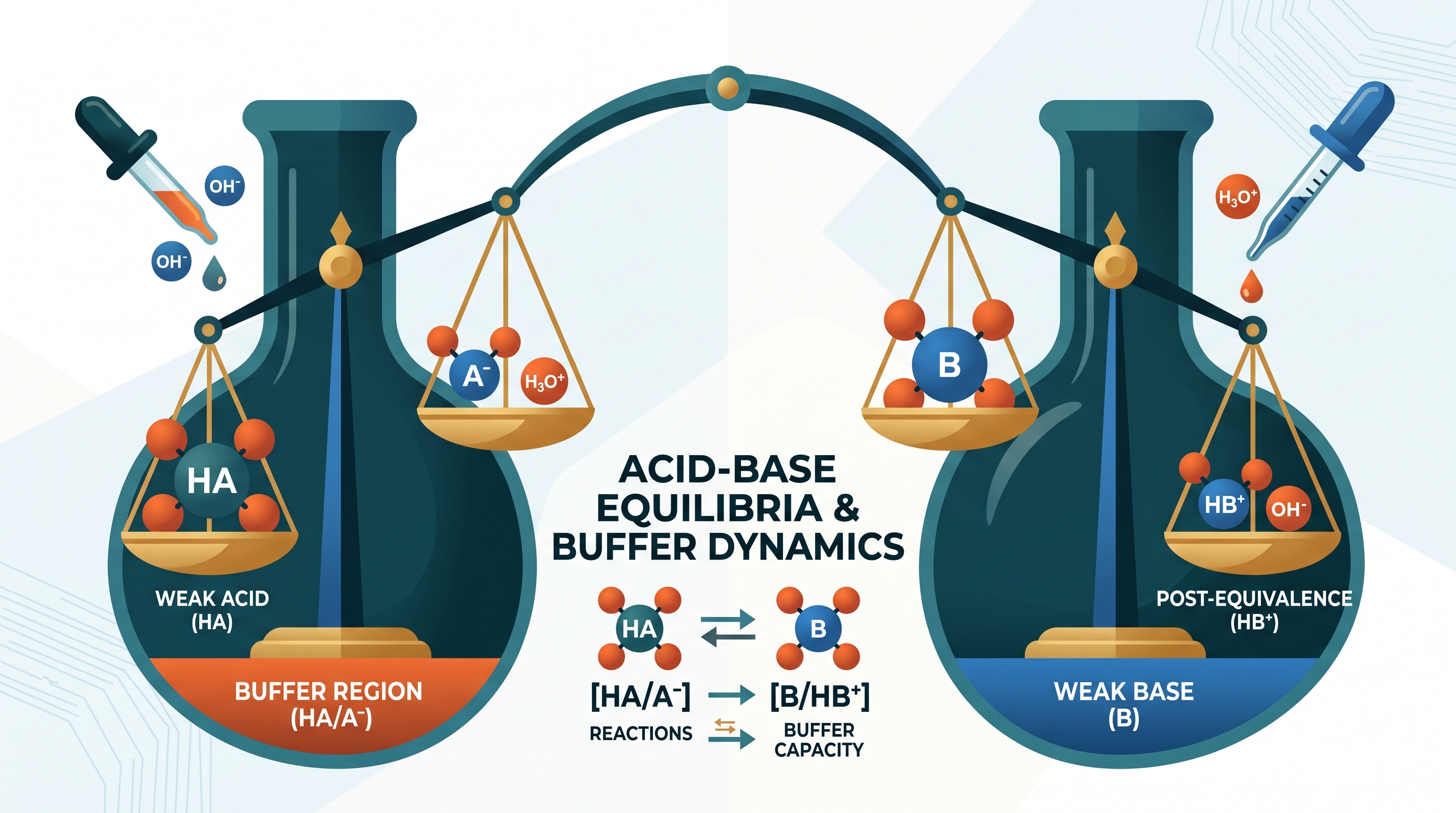
A solution’s pH depends not only on which acid is present, but also on how extensively that acid transfers protons to water. Equal-concentration solutions of hydrochloric acid, carbonic acid, $H_2CO_3$, and acetic acid, $HC_2H_3O_2$, do not produce equal hydronium concentrations because strong acids ionize essentially completely while weak acids ionize only partially.
Weak-acid equilibrium: partial ionization, not incomplete reaction
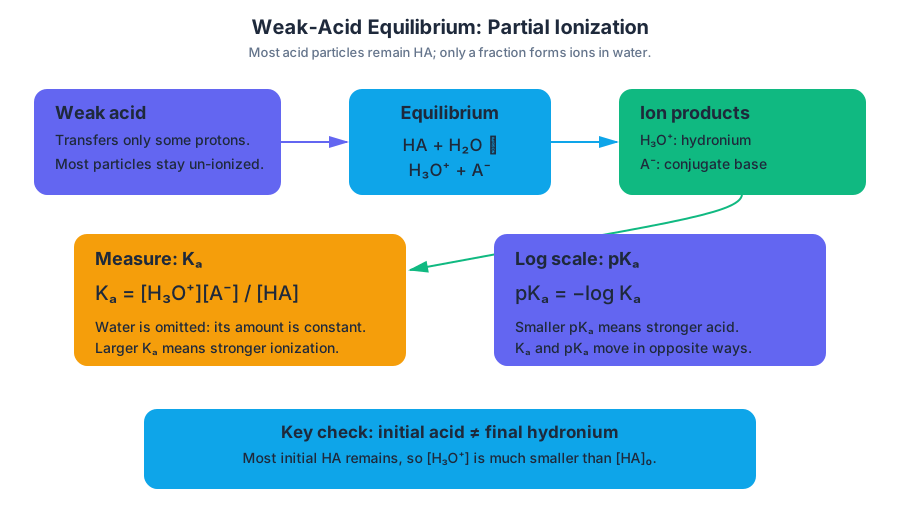
A weak acid is an acid that transfers only a fraction of its available protons to water. Most particles remain as un-ionized $HA$, while smaller amounts become hydronium, $H_3O^+$, and the conjugate base, $A^-$.
The equilibrium is represented by
HA(aq) + H_2O(l) \rightleftharpoons H_3O^+(aq) + A^-(aq)
The acid ionization constant, $K_a$, measures the extent of this ionization:
$$ K_a=\frac{[H_3O^+][A^-]}{[HA]} $$
Liquid water is omitted because its concentration is effectively constant. A larger $K_a$ means a greater equilibrium tendency to form $H_3O^+$ and $A^-$, so the acid is stronger. The logarithmic measure is
$$ pK_a=-\log K_a $$
Because of the negative sign, smaller $pK_a$ means stronger acid. The common mistake is to use the initial acid concentration as the final hydronium concentration. For a weak acid, most of the initial acid remains $HA$, so $[H_3O^+]$ is significantly smaller than the initial $[HA]$.
Worked example: percent ionization of a weak acid
Suppose $0.100\ \mathrm{M}$ acetic acid has $K_a=1.8\times10^{-5}$. Let $x$ represent the amount of acid that ionizes.
At equilibrium:
$$ [H_3O^+]=x,\qquad [C_2H_3O_2^-]=x,\qquad [HC_2H_3O_2]=0.100-x $$
Substitution into the $K_a$ expression gives
$$ 1.8\times10^{-5}=\frac{x^2}{0.100-x} $$
Because $K_a$ is small, $x$ is much smaller than $0.100$, so $0.100-x\approx0.100$:
$$ x\approx\sqrt{(1.8\times10^{-5})(0.100)} =1.34\times10^{-3}\ \mathrm{M} $$
Thus,
$$ %\ \mathrm{ionization} =\frac{[H_3O^+]{\mathrm{eq}}}{[HA]{\mathrm{initial}}}\times100 =\frac{1.34\times10^{-3}}{0.100}\times100 =1.34% $$
Only about $1.34%$ of the acid ionizes, even though the solution is acidic. Misconception check: “Weak” does not mean “dilute,” and it does not mean “harmless.” It describes the fraction ionized at equilibrium.
Weak-base equilibrium and conjugate-acid behavior
A weak base accepts protons from water only partially. Its equilibrium is
B(aq)+H_2O(l)\rightleftharpoons HB^+(aq)+OH^-(aq)
The base ionization constant, $K_b$, is
$$ K_b=\frac{[HB^+][OH^-]}{[B]} $$
For a weak base, the equilibrium concentration of $OH^-$ does not equal the initial concentration of $B$. Most base particles remain un-ionized, so only a fraction generates $OH^-$.
$$ pK_b=-\log K_b $$
A larger $K_b$ and smaller $pK_b$ indicate a stronger base. The conjugate acid of a weak base can itself donate a proton:
HB^+(aq)+H_2O(l)\rightleftharpoons B(aq)+H_3O^+(aq)
This explains why an equimolar mixture of a weak base and a strong acid is slightly acidic: the strong acid converts $B$ into $HB^+$, and $HB^+$ then produces some $H_3O^+$.
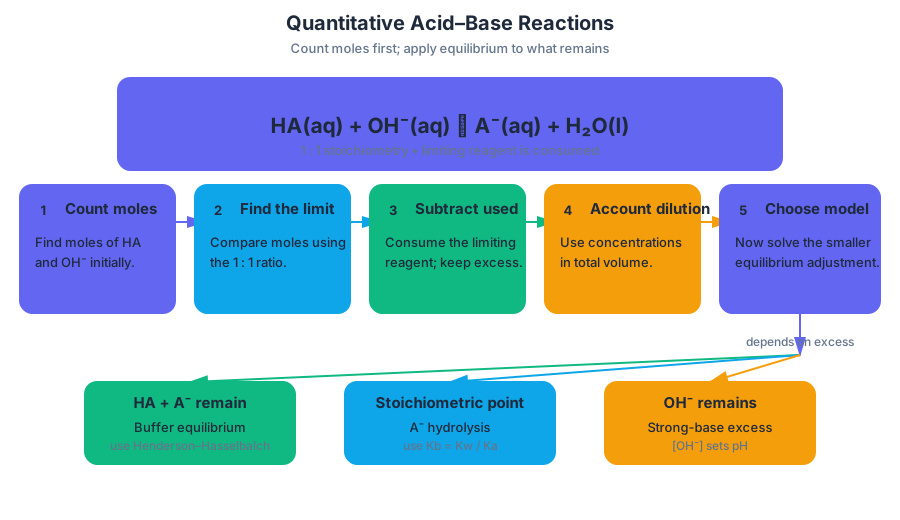
Quantitative acid-base reactions: first count moles, then apply equilibrium
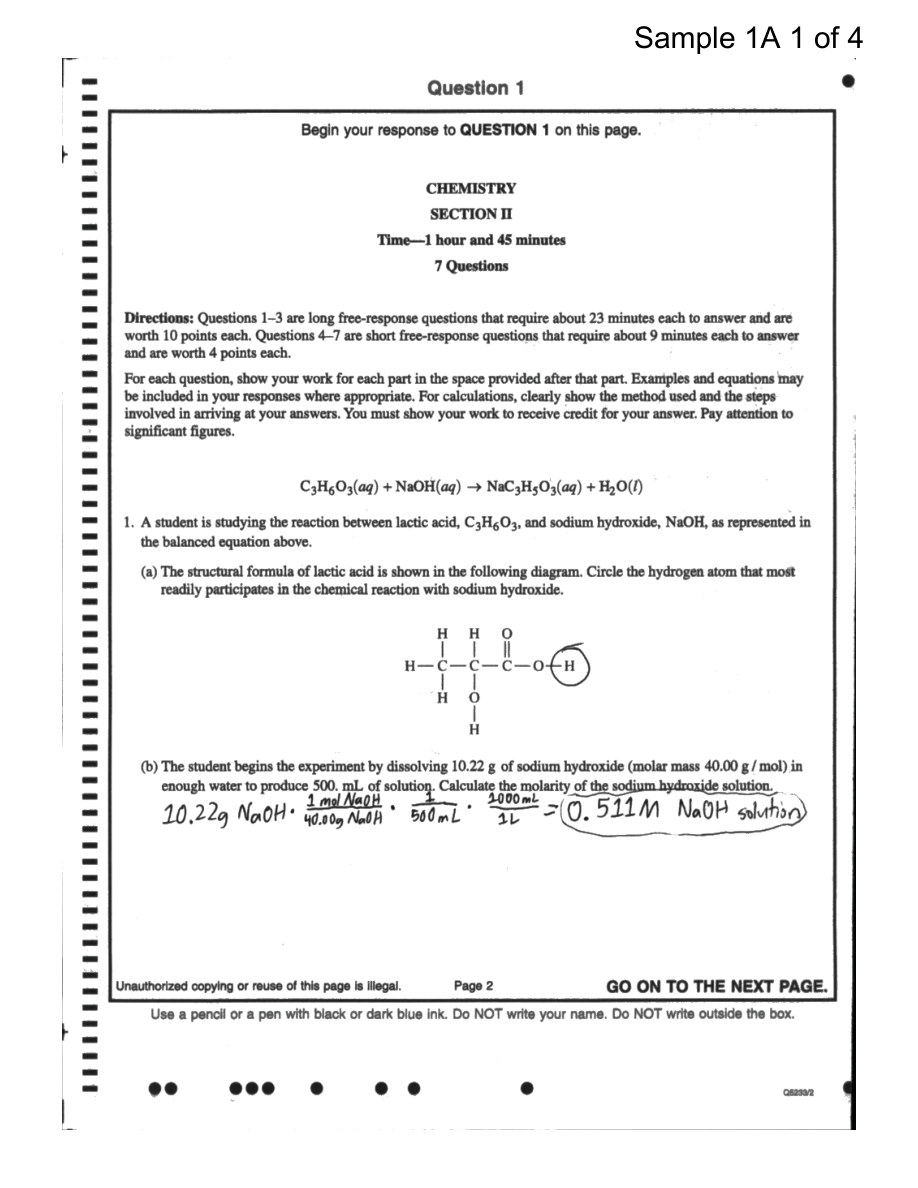
When acid and base solutions are mixed, the proton-transfer reaction occurs quantitatively before the smaller equilibrium adjustment is considered. The limiting reagent is consumed; any excess reagent remains.
For a weak acid and strong hydroxide,
HA(aq)+OH^-(aq)\rightleftharpoons A^-(aq)+H_2O(l)
The practical sequence is:
- Calculate initial moles of $HA$ and $OH^-$.
- Use the $1:1$ stoichiometry to identify the limiting reagent.
- Subtract consumed moles and determine what remains.
- Include dilution using the total mixed volume.
- Apply the appropriate equilibrium model.
Three outcomes for weak acid plus strong base
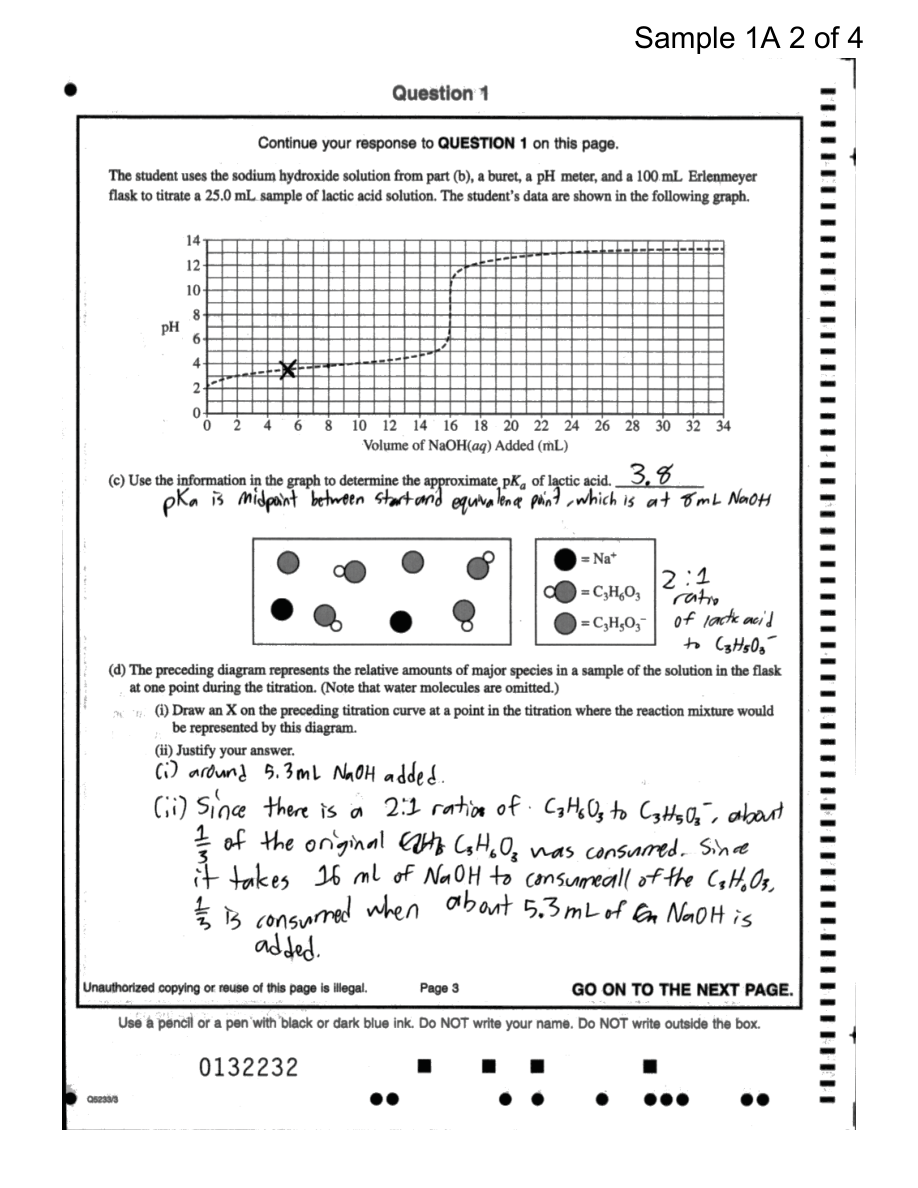
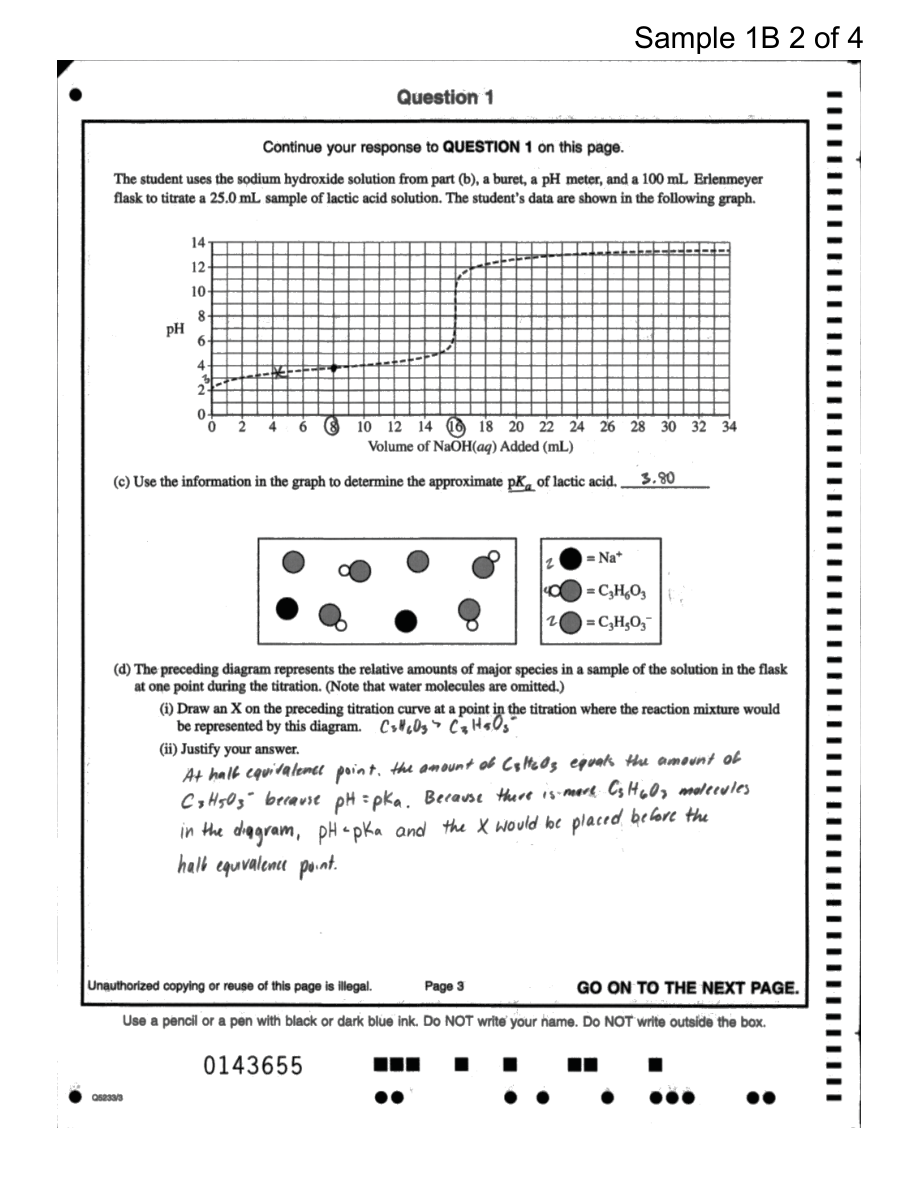
If $HA$ is in excess, both $HA$ and newly produced $A^-$ remain. The solution is a buffer, a mixture that resists pH change because it contains a weak acid and its conjugate base. Its pH is determined from their mole ratio:
$$ \mathrm{pH}=pK_a+\log\left(\frac{n_{A^-}}{n_{HA}}\right) $$
For example, mixing $0.0200\ \mathrm{mol}$ of $HA$ with $0.0120\ \mathrm{mol}$ of $OH^-$ leaves $0.0080\ \mathrm{mol}$ of $HA$ and produces $0.0120\ \mathrm{mol}$ of $A^-$. If $pK_a=4.76$,
$$ \mathrm{pH}=4.76+\log\left(\frac{0.0120}{0.0080}\right)=4.94 $$
The total volume is unnecessary in this ratio because both species occupy the same final volume. If $OH^-$ is in excess, no buffer approximation applies: calculate
$$ [OH^-]=\frac{n_{OH^-,\mathrm{excess}}}{V_{\mathrm{total}}} $$
If the amounts are equimolar, all $HA$ becomes $A^-$. The resulting solution is slightly basic because $A^-$ hydrolyzes:
A^-(aq)+H_2O(l)\rightleftharpoons HA(aq)+OH^-(aq)
Weak base plus strong acid and buffer capacity
For a weak base and strong acid,
B(aq)+H_3O^+(aq)\rightleftharpoons HB^+(aq)+H_2O(l)
Excess $B$ produces a buffer containing $B$ and $HB^+$. Excess acid is handled from the remaining moles of $H_3O^+$ divided by total volume. Equimolar quantities convert all $B$ into $HB^+$, whose reaction with water makes the solution slightly acidic.
A buffer does not neutralize unlimited added acid or base. If it contains much more $A^-$ than $HA$, it can absorb more added acid than base: added $H_3O^+$ consumes $A^-$, whereas added $OH^-$ consumes the smaller supply of $HA$. Misconception check: buffer capacity depends on the amounts of both components, not merely on having a pH near $pK_a$.
AP skill connections and retrieval check
These problems most directly develop Science Practice 5: Mathematical Routines, especially selecting a logical computational pathway, using stoichiometry, tracking units, and attending to precision. They also require Science Practice 4: Model Analysis when deciding whether a solution is dominated by excess strong reagent, a buffer, or conjugate-ion equilibrium, and Science Practice 6: Argumentation when justifying why a weak-base mixture is acidic or a weak-acid equivalence mixture is basic.
Retrieval check: A mixture contains equal moles of a weak acid $HA$ and $NaOH$. Which major species remains after the quantitative reaction, and why is the final solution basic? Answer: $A^-$ remains, and it reacts with water to produce $OH^-$. A mixture containing equal moles of a weak base $B$ and strong acid instead leaves $HB^+$ and is slightly acidic because $HB^+$ produces $H_3O^+$.
Source Materials
- AP Chemistry Course and Exam Description
- AP Chemistry Course and Exam Description Clarifications and Corrections
- AP Chemistry Course Overview
- AP Chemistry Course at a Glance
- AP Chemistry Course at a Glance Poster
- Adopt AP Chemistry
- AP Chemistry
- AP Chemistry
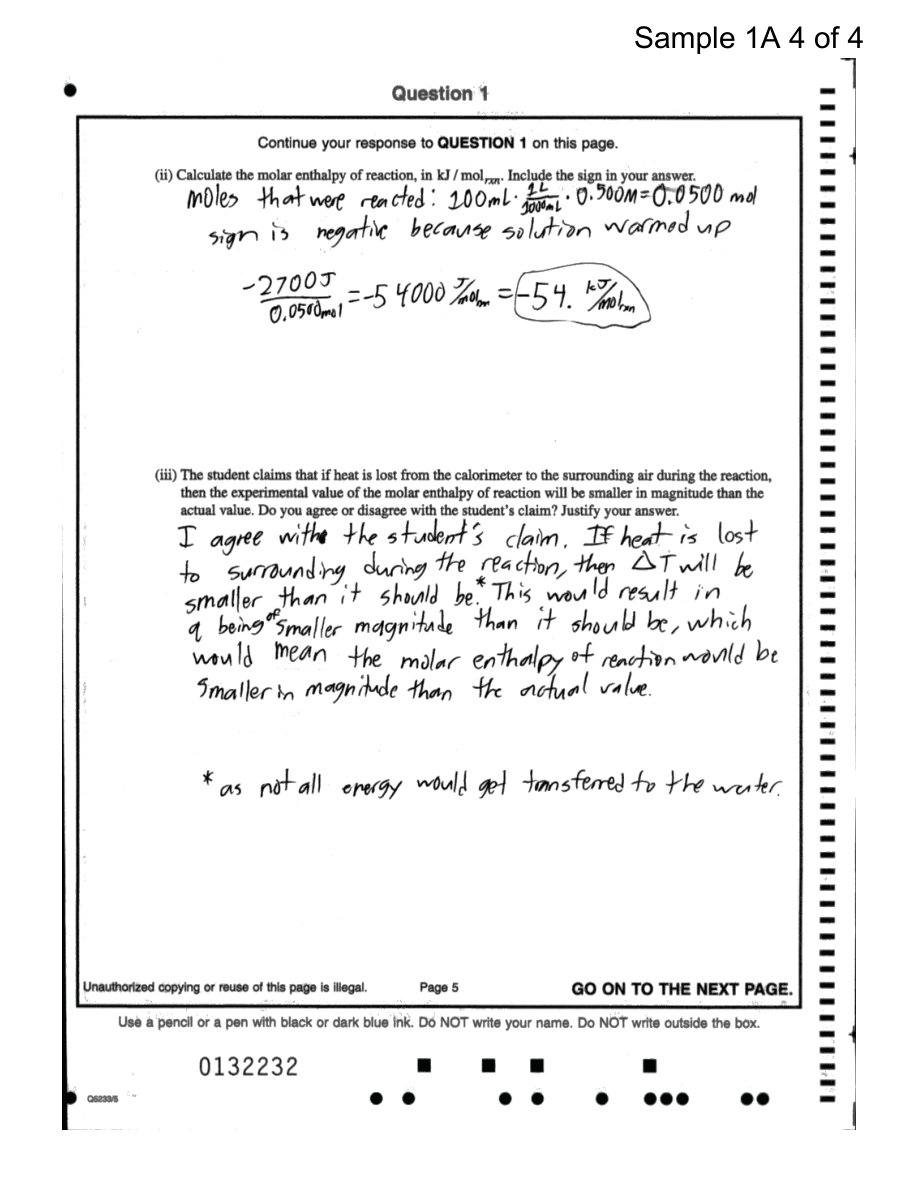
- Figure — Sample Responses Q1 (p. 4)
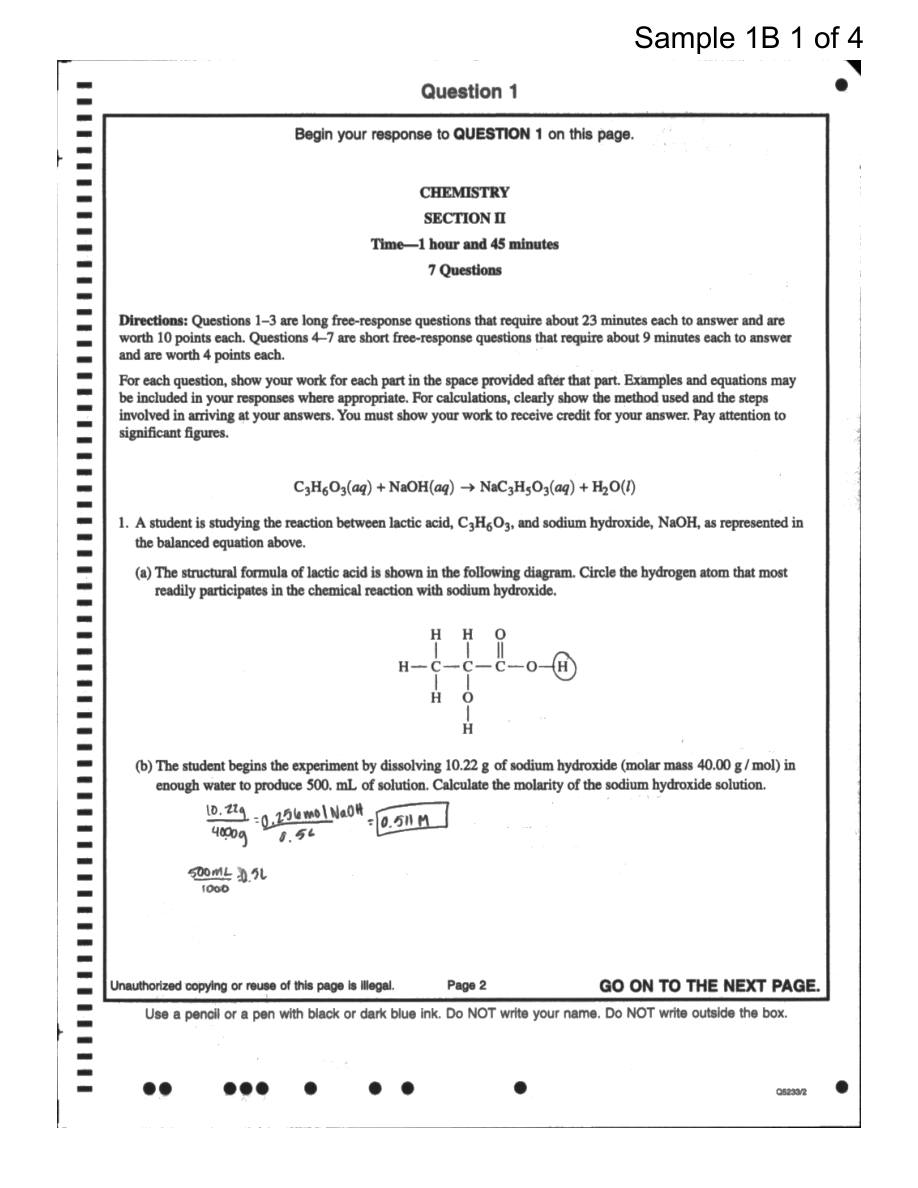
- Figure — Sample Responses Q1 (p. 5)
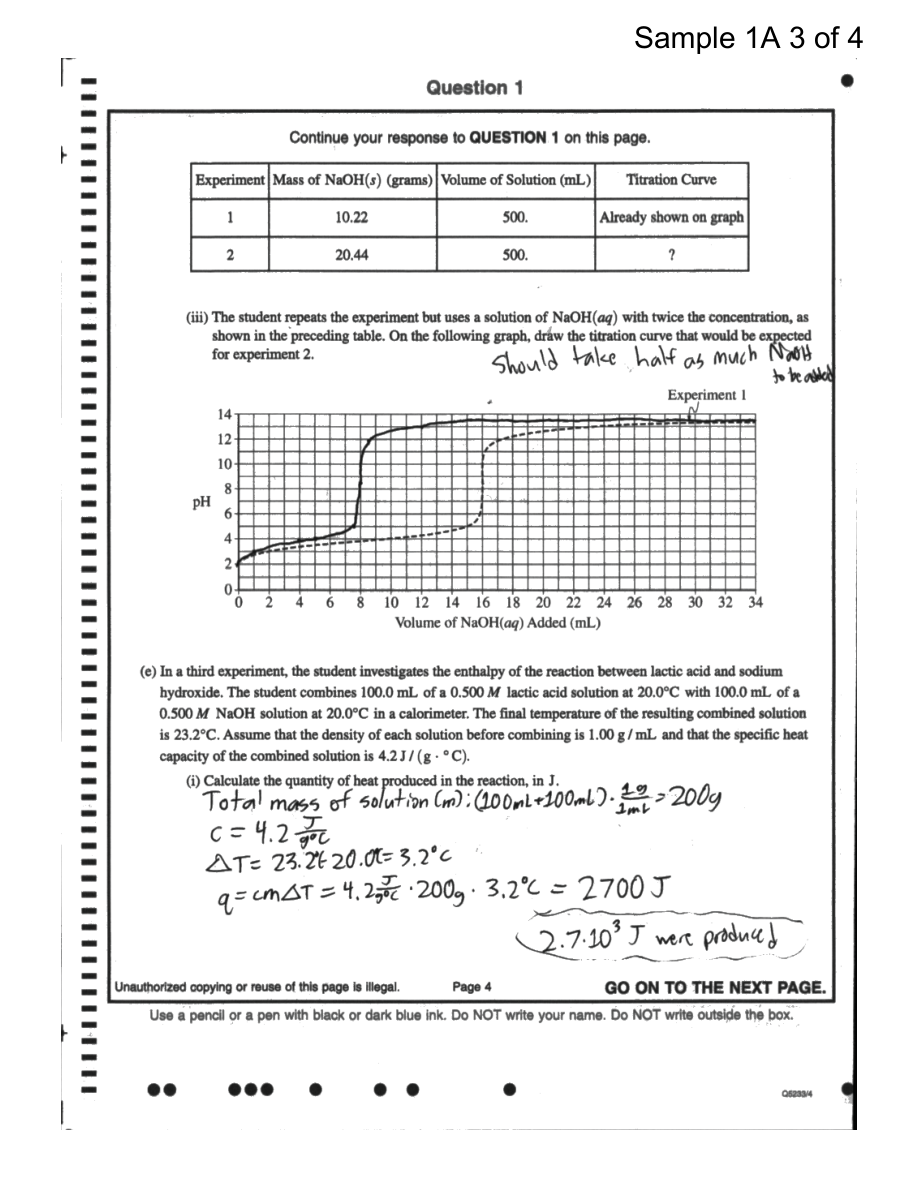
- Figure — Sample Responses Q1 (p. 6)
- Figure — Sample Responses Q1 (p. 7)