From the free course AP Chemistry on Lykke
1.3 Elemental Composition of Pure Substances · 1.4 Composition of Mixtures
Key concepts: Pure substances · Elemental composition by mass · Empirical formulas · Fixed mass ratios in compounds · Mixtures · Variable relative proportions in mixtures · Elemental analysis · Homogeneous solutions · Heterogeneous mixtures · Macroscopic properties of mixtures
A pure compound has a chemical identity that does not change from sample to sample: the elements occur in a fixed ratio, so the mass ratio of those elements is constant.
1.3 Elemental Composition of Pure Substances · 1.4 Composition of Mixtures
A pure compound has a chemical identity that does not change from sample to sample: the elements occur in a fixed ratio, so the mass ratio of those elements is constant. A mixture is different—its components may be present in almost any relative proportions. This distinction lets chemists identify substances, determine purity, and calculate how much of a desired component is present.
Pure substances and fixed composition
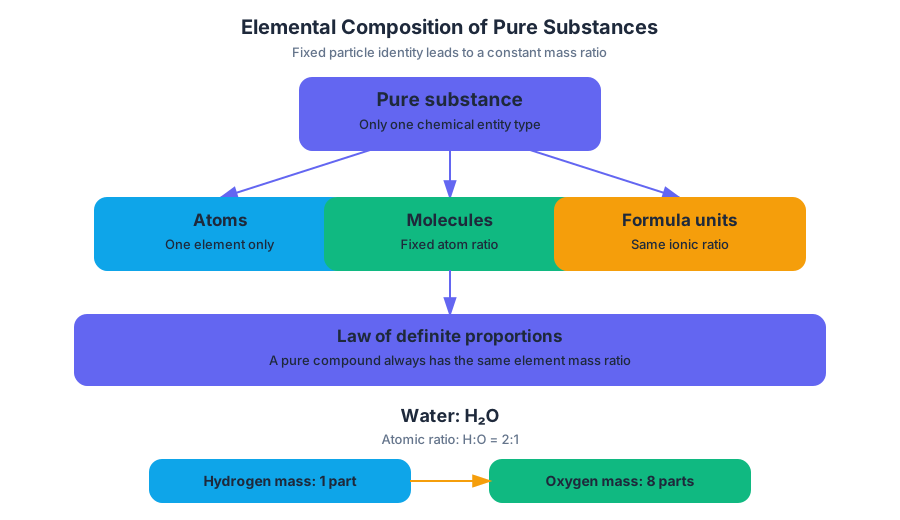
A pure substance contains only one type of chemical entity: individual atoms, molecules, or formula units. A sample of pure water contains only $H_2O$ molecules; a sample of pure sodium chloride contains formula units with the same $Na:Cl$ ratio. The particles may be too small to see, but their composition is not arbitrary.
Law of definite proportions: In any pure sample of a particular compound, the ratio of the masses of its constituent elements is always the same.
For example, every pure sample of water has hydrogen and oxygen atoms in a $2:1$ ratio. Because oxygen atoms are much more massive than hydrogen atoms, the mass ratio is not $2:1$; it is approximately $1:8$. A small drop and a large lake differ in total mass, but not in the relative mass contributions of hydrogen and oxygen.
From mass composition to an empirical formula
The elemental composition by mass is the percentage of a compound’s total mass contributed by each element:
$$ % \text{ element}= \frac{\text{mass of element}}{\text{total mass of compound}}\times 100% $$
The empirical formula gives the lowest whole-number ratio of atoms in a compound. Elemental analysis connects the two: measured masses become moles, mole amounts become a ratio, and that ratio becomes the empirical formula. This uses the molar-mass conversions established earlier, but the goal here is different: determining the atom ratio that defines the substance.
Worked example: finding an empirical formula
A compound contains $40.0%$ carbon, $6.7%$ hydrogen, and $53.3%$ oxygen by mass. Assume a $100.0\text{-g}$ sample, so the percentages become convenient masses:
$$ 40.0\text{ g C},\qquad 6.7\text{ g H},\qquad 53.3\text{ g O} $$
Convert each mass to moles:
$$ n_C=\frac{40.0\text{ g}}{12.01\text{ g mol}^{-1}}=3.33\text{ mol} $$
$$ n_H=\frac{6.7\text{ g}}{1.008\text{ g mol}^{-1}}=6.65\text{ mol} $$
$$ n_O=\frac{53.3\text{ g}}{16.00\text{ g mol}^{-1}}=3.33\text{ mol} $$
Divide every mole amount by the smallest amount, $3.33\text{ mol}$:
$$ C:H:O=1.00:2.00:1.00 $$
Therefore, the empirical formula is
$$ \boxed{CH_2O} $$
The formula need not describe a molecule containing only three atoms. For an ionic substance, it represents the lowest ratio in a formula unit; for a molecular substance, the actual molecular formula may be a whole-number multiple of the empirical formula.
Misconception check: Percent composition does not directly give subscripts. A percentage describes mass, whereas a formula describes numbers of atoms. Always convert mass to moles before finding the ratio.
Mixtures: composition can vary
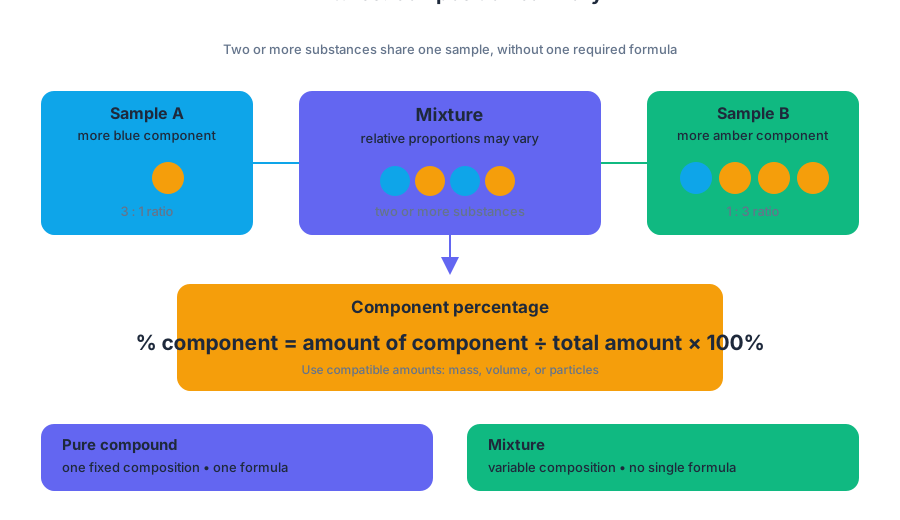
A mixture contains two or more types of atoms, molecules, or formula units whose relative proportions can vary. Salt water, soil, air, and a solid containing sodium bicarbonate mixed with another compound are mixtures. Unlike a pure compound, a mixture does not have one required chemical formula.
The composition of a mixture can be reported using amounts or percentages:
$$ % \text{ component}= \frac{\text{amount of component}}{\text{total amount of mixture}}\times100% $$
The “amount” might be mass, volume, number of particles, or another clearly specified quantity. The denominator and numerator must use compatible quantities.
Homogeneous and heterogeneous mixtures
In a solution, a homogeneous mixture, macroscopic properties do not vary throughout the sample. A thoroughly mixed salt solution has the same concentration and appearance in every location, even though the particles are distributed among solvent particles.
In a heterogeneous mixture, macroscopic properties depend on location. A scoop of soil may contain different amounts of sand, clay, organic matter, and water depending on where the scoop is taken. Sampling location therefore matters when estimating composition.
Misconception check: “Uniform-looking” and “pure” do not mean the same thing. A solution can be uniform throughout while still containing several substances.
Quantitative analysis: percentage of $NaHCO_3$
Suppose a $5.00\text{-g}$ mixture contains sodium bicarbonate, $NaHCO_3$, along with an inert solid. If quantitative analysis determines that the mixture contains $2.00\text{ g}$ of $NaHCO_3$, then
$$ %NaHCO_3= \frac{2.00\text{ g}}{5.00\text{ g}}\times100%=40.0% $$
This calculation describes the mixture’s composition, not the empirical formula of sodium bicarbonate. The formula $NaHCO_3$ describes a pure compound with fixed elemental proportions; $40.0%$ describes how much of that compound is present in a particular mixture.
AP skill in action
This topic develops Science Practice 5: Mathematical Routines, especially 5.A: Identify quantities needed to solve a problem from given information (e.g., text, mathematical expressions, graphs, or tables). In an empirical-formula problem, identify element masses or percentages, molar masses, and mole ratios. In a mixture problem, identify the component amount and the total mixture amount before selecting the percentage relationship.
Retrieval check
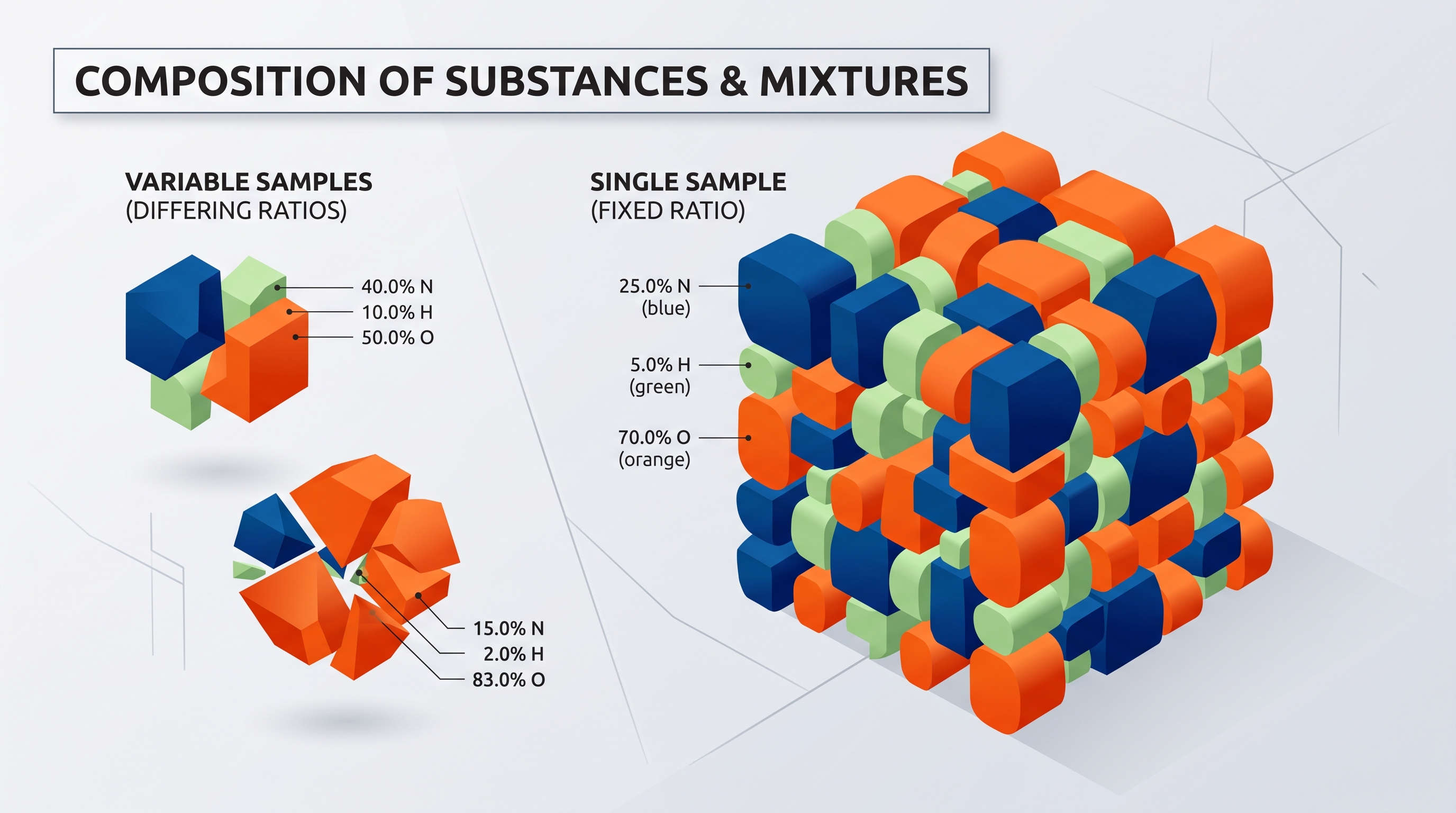
A sample is reported as $25.0%$ nitrogen, $5.0%$ hydrogen, and $70.0%$ oxygen by mass. Is it necessarily a mixture? No. Those data could describe a pure compound if the percentages correspond to a fixed empirical formula. By contrast, if two samples of the same material have different component percentages, the material is behaving as a mixture rather than as one pure compound.