From the free course AP Chemistry on Lykke
6.7 Bond Enthalpies · 6.8 Enthalpy of Formation
Key concepts: Bond enthalpy and the relationship between bond formation and energy · Standard enthalpy of formation (ΔH°f) · Hess’s law and manipulating formation reactions · Calculating an unknown quantity from known quantities using a logical computational pathway · Standard states and elemental reference values · Enthalpy change for synthesizing a compound from its elements · Sign conventions for energy released and absorbed · Dimensional analysis and significant figures in thermochemical calculations · Lattice enthalpy data for ionic compounds · Using tables of standard enthalpies of formation
A chemical bond forms when atomic orbitals overlap and the resulting attraction lowers the system’s potential energy; breaking that bond requires energy, while forming it releases energy.
6.7 Bond Enthalpies · 6.8 Enthalpy of Formation
A chemical bond forms when atomic orbitals overlap and the resulting attraction lowers the system’s potential energy; breaking that bond requires energy, while forming it releases energy. These two opposite energy changes connect molecular structure to reaction enthalpy.
Bond enthalpies: an energy estimate from bonds
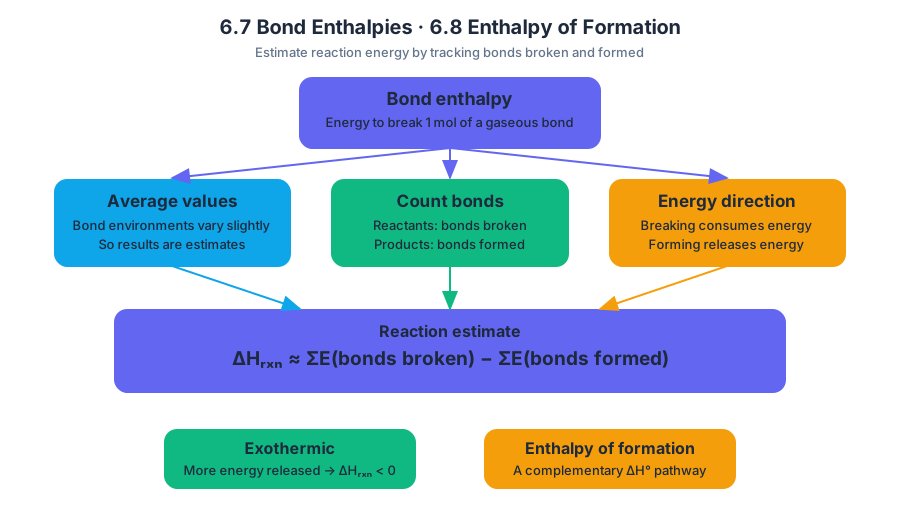
A bond enthalpy is the energy required to break one mole of a particular bond in gaseous molecules. Because the same type of bond can exist in slightly different molecular environments, tabulated bond enthalpies are average values, so calculations based on them estimate rather than exactly determine $\Delta H^\circ_{\mathrm{rxn}}$.
For a reaction, count the bonds broken in reactants and the bonds formed in products:
$$ \Delta H_{\mathrm{rxn}} \approx \sum E(\text{bonds broken})
\sum E(\text{bonds formed}) $$
The subtraction reflects the energy direction: breaking bonds consumes energy and forming bonds releases energy. If the newly formed bonds release more energy than the reactant bonds required to break, the reaction is exothermic and $\Delta H_{\mathrm{rxn}}<0$.
Worked pathway: estimating a reaction enthalpy
Suppose a gaseous reaction breaks two bonds with enthalpies $400.\ \mathrm{kJ,mol^{-1}}$ and $500.\ \mathrm{kJ,mol^{-1}}$, then forms three bonds with enthalpies $300.\ \mathrm{kJ,mol^{-1}}$ each:
$$ \Delta H_{\mathrm{rxn}} \approx (400.+500.)- 3(300.) $$
$$ \Delta H_{\mathrm{rxn}} \approx 900.-900.
0.\ \mathrm{kJ,mol^{-1}_{rxn}} $$
The explicit decimal points communicate that $400.$ and $500.$ are measured to the ones place, not ambiguous values with unknown precision. Bond-enthalpy estimates are especially useful for comparing reactions, but a standard enthalpy of formation or calorimetric value is preferred when an exact tabulated value is available. Molecular orbital theory is not a recommended deeper method for explaining multiple bonds here; the required reasoning is based on bond energies and orbital overlap.
Misconception check: A strong bond does not release energy when it is broken. Bond breaking always requires energy; bond formation releases energy because the bonded arrangement is lower in potential energy.
Standard enthalpy of formation
The standard enthalpy of formation, $\Delta H_f^\circ$, is the enthalpy change for forming exactly one mole of a compound from its constituent elements in their specified standard states. The standard state is the reference form of a substance at a specified standard pressure, commonly $1\ \mathrm{bar}$, and a stated temperature, commonly $298.15\ \mathrm{K}$; therefore, a quoted $\Delta H_f^\circ$ is tied to that temperature.
Every element in its standard state has $\Delta H_f^\circ=0\ \mathrm{kJ,mol^{-1}}$. Relevant reference forms include $\mathrm{Na(s)}$, $\frac{1}{2}\mathrm{O_2(g)}$, $\frac{1}{4}\mathrm{P_4(s)}$, and $\frac{3}{2}\mathrm{Cl_2(g)}$. The fractional coefficients are necessary when the formation reaction produces exactly one mole of compound.
| Substance in standard state | $\Delta H_f^\circ$ |
|---|---|
| $\mathrm{Na(s)}$ | $0\ \mathrm{kJ,mol^{-1}}$ |
| $\mathrm{O_2(g)}$ | $0\ \mathrm{kJ,mol^{-1}}$ |
| $\mathrm{P_4(s)}$ | $0\ \mathrm{kJ,mol^{-1}}$ |
| $\mathrm{Cl_2(g)}$ | $0\ \mathrm{kJ,mol^{-1}}$ |
Worked example: forming $\mathrm{Na_2O(s)}$
The synthesis reaction is
$$ 2\mathrm{Na(s)}+\frac{1}{2}\mathrm{O_2(g)} \rightarrow \mathrm{Na_2O(s)} $$
with
$$ \Delta H^\circ_{\mathrm{rxn}}
-828\ \mathrm{kJ,mol^{-1}_{rxn}} $$
Because the reactants are elements in their standard states,
$$ \Delta H^\circ_{\mathrm{rxn}}
\Delta H_f^\circ[\mathrm{Na_2O(s)}]
\left[ 2\Delta H_f^\circ[\mathrm{Na(s)}] + \frac{1}{2}\Delta H_f^\circ[\mathrm{O_2(g)}] \right] $$
$$ -828
\Delta H_f^\circ[\mathrm{Na_2O(s)}]
[2(0)+\tfrac{1}{2}(0)] $$
$$ \boxed{\Delta H_f^\circ[\mathrm{Na_2O(s)}]
-828\ \mathrm{kJ,mol^{-1}}} $$
The unit $\mathrm{kJ,mol^{-1}_{rxn}}$ means $828\ \mathrm{kJ}$ is released per mole of reaction as written—not per mole of sodium atoms or per mole of oxygen molecules.
Manipulating formation reactions
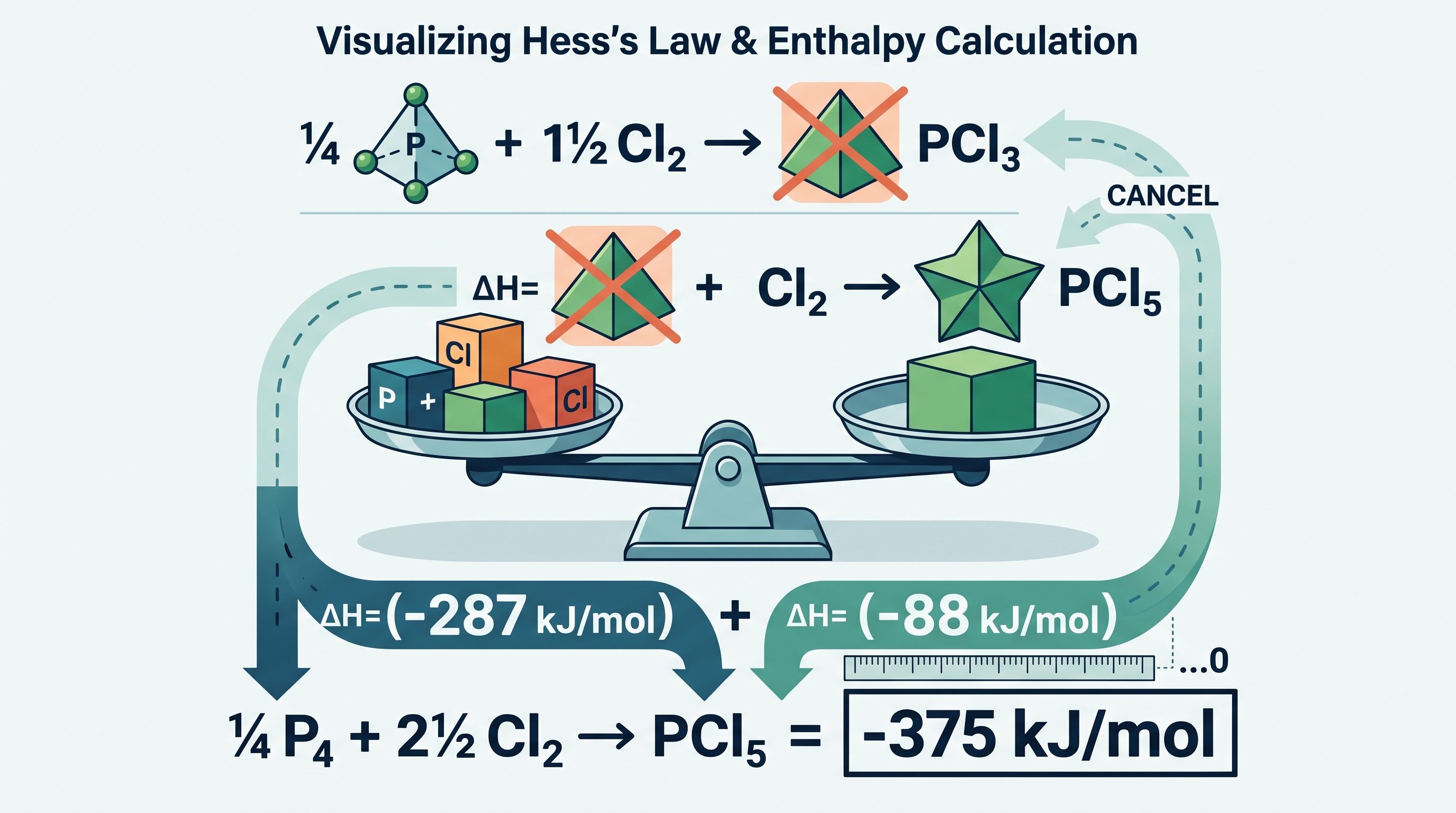
Known formation reactions can be combined through Hess’s law. Reverse a reaction and change the sign of $\Delta H$; multiply every coefficient by a factor and multiply $\Delta H$ by that same factor. The intermediate species must cancel when the equations are added.
For phosphorus pentachloride, first scale the phosphorus trichloride formation reaction:
$$ \frac14\mathrm{P_4(s)}+\frac32\mathrm{Cl_2(g)} \rightarrow \mathrm{PCl_3(g)} \qquad \Delta H_1^\circ=-287\ \mathrm{kJ,mol^{-1}_{rxn}} $$
Then add
$$ \mathrm{PCl_3(g)}+\mathrm{Cl_2(g)} \rightarrow \mathrm{PCl_5(g)} \qquad \Delta H_2^\circ=-88\ \mathrm{kJ,mol^{-1}_{rxn}} $$
Cancel $\mathrm{PCl_3(g)}$:
$$ \frac14\mathrm{P_4(s)}+\frac52\mathrm{Cl_2(g)} \rightarrow \mathrm{PCl_5(g)} $$
$$ \Delta H_f^\circ[\mathrm{PCl_5(g)}]
-287+(-88)
\boxed{-375\ \mathrm{kJ,mol^{-1}}} $$
Precision rule: Carry units and guard digits through intermediate steps. For addition or subtraction, round according to decimal places; for multiplication or division, round according to significant figures. Round the final result only to the precision justified by the given data.
AP Skill 5.F — “Calculate, estimate, or predict an unknown quantity from known quantities by selecting and following a logical computational pathway and attending to precision.” Show the reaction manipulation, cancellation, units, and final precision—not merely the numerical answer.
Source Materials
- AP Chemistry Course and Exam Description
- AP Chemistry Course and Exam Description Clarifications and Corrections
- AP Chemistry Course Overview
- AP Chemistry Course at a Glance
- AP Chemistry Course at a Glance Poster
- Adopt AP Chemistry
- AP Chemistry
- AP Chemistry
- Part (a) was an accessible point for a slight majority of students. Student responses successfully integrated the skills required, using dimensional analysis, to obtain the correct value; however, man
- Parts (a)(i) and (a)(ii) were accessible points for the majority of students. Student responses successfully integrated the skills required, using the ideal gas law with correct dimensional analysis t