From the free course AP Chemistry on Lykke
8.1 Introduction to Acids and Bases · 8.2 pH and pOH of Strong Acids and Bases
Key concepts: Definitions and introductory concepts of acids and bases · Strong acids and strong bases · Ionization/dissociation of strong bases in aqueous solution · pH and pOH · The water ionization constant, Kw · Neutral aqueous solutions · Concentrations of all species in a neutral solution of water · Group 1 hydroxides as strong bases · Group 2 hydroxides as strong bases · Use of indicators to distinguish acidic and basic solutions
Acids and bases are distinguished by which ions they create or consume in water: an acid increases hydronium ions, while a base increases hydroxide ions or accepts protons.
8.1 Introduction to Acids and Bases · 8.2 pH and pOH of Strong Acids and Bases
Acids and bases are distinguished by which ions they create or consume in water: an acid increases hydronium ions, while a base increases hydroxide ions or accepts protons. Those tiny ion-concentration changes control everything from the sharpness of citrus juice to the cleaning power of drain products.
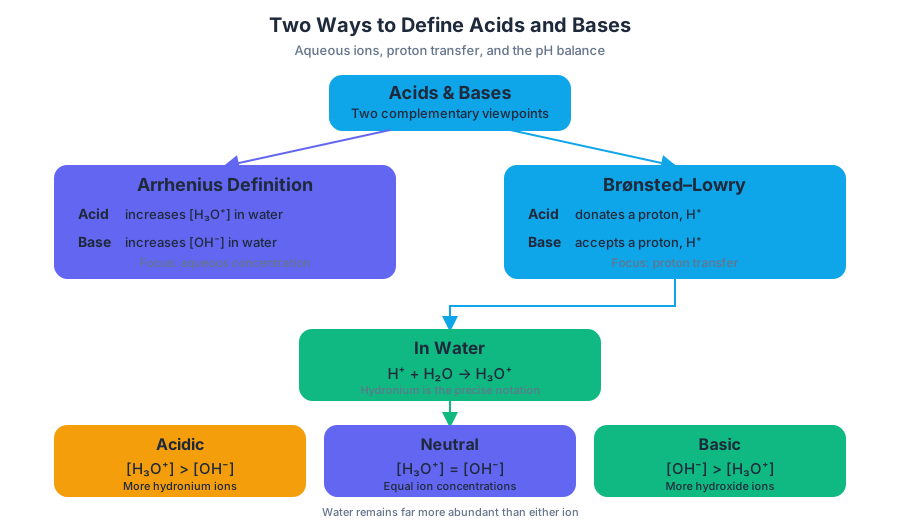
Two ways to define acids and bases
The Arrhenius definition describes aqueous solutions directly:
- An Arrhenius acid increases the concentration of hydronium, $H_3O^+$, in water.
- An Arrhenius base increases the concentration of hydroxide, $OH^-$, in water.
The Brønsted–Lowry definition focuses on proton transfer:
- A Brønsted–Lowry acid donates a proton, $H^+$.
- A Brønsted–Lowry base accepts a proton, $H^+$.
In aqueous solution, a donated proton does not normally float alone. It attaches to a water molecule:
$$ H^+ + H_2O \rightarrow H_3O^+ $$
Thus, “hydrogen ion” and “hydronium ion” are used interchangeably for AP Chemistry calculations, although $H_3O^+$ is the more chemically precise notation.
A solution is acidic when $[H_3O^+] > [OH^-]$, basic when $[OH^-] > [H_3O^+]$, and neutral when the two concentrations are equal. The solvent water itself remains overwhelmingly more abundant than either ion.
Water autoionization and neutrality
Water molecules continuously exchange protons in a reversible process called autoionization:
2H_2O \rightleftharpoons H_3O^+ + OH^-
The equilibrium relationship is the water ionization constant, $K_w$:
$$ K_w = [H_3O^+][OH^-] $$
At $25^\circ\text{C}$,
$$ K_w = 1.0 \times 10^{-14} $$
For pure neutral water at this temperature,
$$ [H_3O^+] = [OH^-] = 1.0 \times 10^{-7}\ \text{M} $$
The concentration of un-ionized water is approximately
$$ [H_2O] \approx 55.5\ \text{M} $$
Because $55.5\ \text{M}$ is vastly larger than $1.0 \times 10^{-7}\ \text{M}$, the solvent-water concentration is treated as effectively constant in aqueous equilibrium calculations. Neutral does not mean that no ions are present; it means equal concentrations of hydronium and hydroxide.
8.1.A.1: Hydronium and hydroxide concentrations are expressed using the logarithmic scales pH and pOH.
8.1.A.2: At $25^\circ\text{C}$, $K_w = [H_3O^+][OH^-] = 1.0 \times 10^{-14}$.
Taking negative logarithms gives the useful relationship
$$ \text{pH} = -\log[H_3O^+] $$
$$ \text{pOH} = -\log[OH^-] $$
At $25^\circ\text{C}$,
$$ \text{pH} + \text{pOH} = \text{p}K_w = 14.00 $$
The value $14.00$ is temperature-specific: do not assume that neutral water has pH $7.00$ at every temperature.
Strong acids: complete ionization
A strong acid ionizes essentially completely in water. Common examples include $HCl$, $HBr$, $HI$, $HClO_4$, $H_2SO_4$, and $HNO_3$. For a monoprotic strong acid such as hydrochloric acid,
$$ HCl + H_2O \rightarrow H_3O^+ + Cl^- $$
A $0.010\ \text{M}$ solution of $HCl$ therefore has
$$ [H_3O^+] \approx 0.010\ \text{M} $$
and
$$ \text{pH} = -\log(1.0 \times 10^{-2}) = 2.00 $$
The concentration of the conjugate base, $[Cl^-]$, is also approximately $0.010\ \text{M}$.
8.2.A.1: Molecules of a strong acid completely ionize in aqueous solution, so the hydronium concentration is related directly to the initial strong-acid concentration.
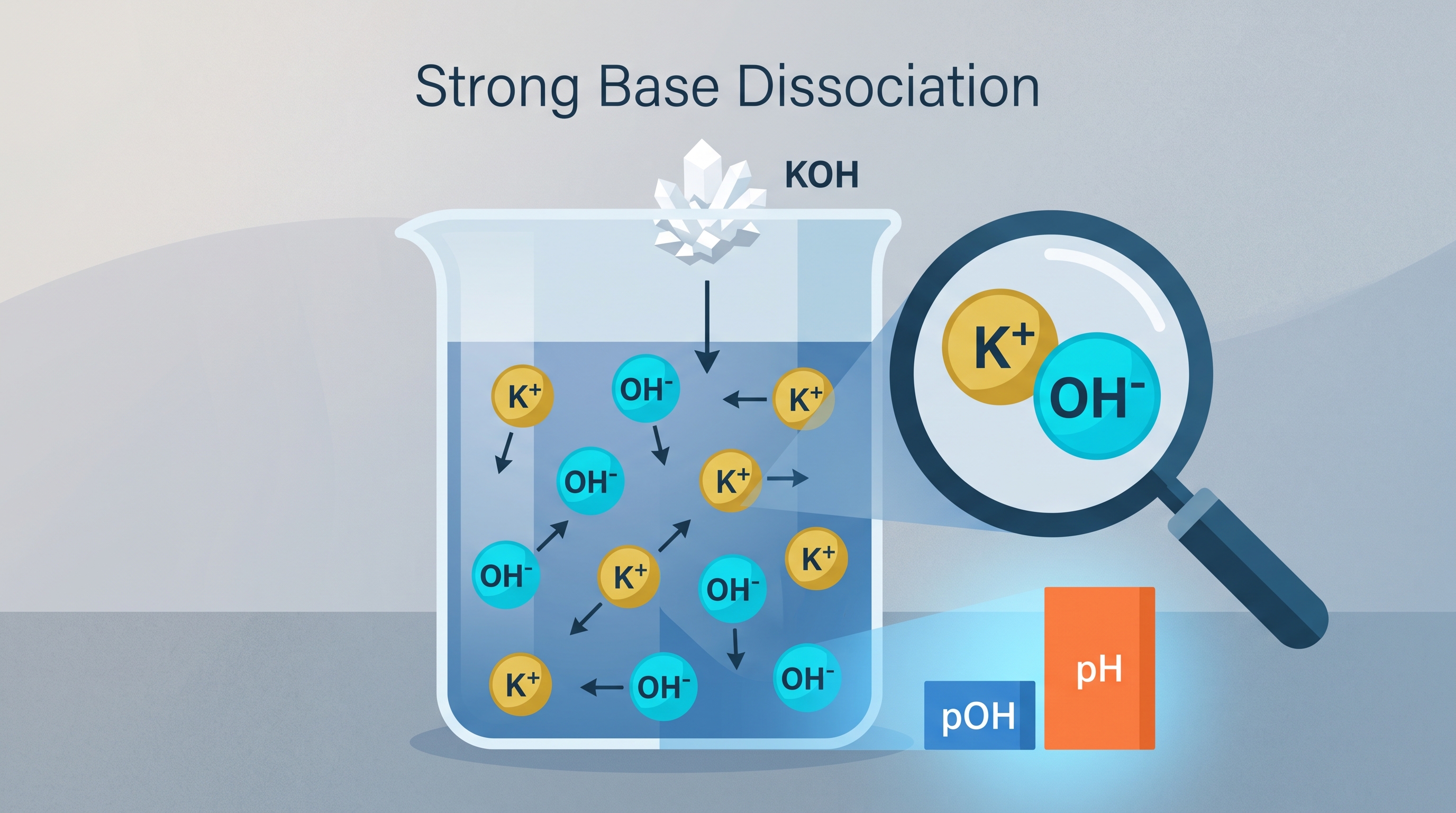
Strong bases: complete dissociation
Strong bases such as Group $1$ and Group $2$ hydroxides dissociate essentially completely. The subscript on the hydroxide compound determines how many hydroxide ions each formula unit produces.
For a Group $1$ hydroxide:
$$ NaOH \rightarrow Na^+ + OH^- $$
Thus, a $0.020\ \text{M}$ $NaOH$ solution has
$$ [OH^-] = 0.020\ \text{M} $$
$$ \text{pOH} = -\log(2.0 \times 10^{-2}) = 1.70 $$
$$ \text{pH} = 14.00 - 1.70 = 12.30 $$
For a Group $2$ hydroxide:
$$ Ca(OH)_2 \rightarrow Ca^{2+} + 2OH^- $$
A $0.020\ \text{M}$ $Ca(OH)_2$ solution produces twice as many hydroxide ions:
$$ [OH^-] = 2(0.020) = 0.040\ \text{M} $$
Then
$$ \text{pOH} = -\log(0.040) = 1.40 $$
and
$$ \text{pH} = 14.00 - 1.40 = 12.60 $$
8.2.A.2: Strong bases completely dissociate to produce hydroxide ions; for a Group $1$ hydroxide, $[OH^-]$ equals the initial compound concentration, while for a Group $2$ hydroxide, $[OH^-]$ is twice that concentration.
Indicator evidence and a logarithmic misconception
Universal indicator provides a visible particle-level clue: acidic solutions tend toward red or orange, basic solutions toward blue or purple, and a buffered solution shows a color corresponding to its pH while resisting rapid color change when small amounts of acid or base are added. The color is evidence of relative hydronium and hydroxide concentrations, not a direct measurement of molarity.
Misconception check: If $\text{pH}=3.00$, the solution does not contain $3.00\ \text{M}$ hydronium. Instead,
$$ [H_3O^+] = 10^{-3.00}\ \text{M} = 1.0 \times 10^{-3}\ \text{M} $$
pH is a logarithmic measure, so a one-unit decrease in pH means a tenfold increase in hydronium concentration.
Retrieval check
A solution contains $0.0050\ \text{M}$ $KOH$. Identify $[OH^-]$, pOH, and pH. Because $KOH$ is a Group $1$ strong base, $[OH^-]=0.0050\ \text{M}$; therefore $\text{pOH}=2.30$ and, at $25^\circ\text{C}$, $\text{pH}=11.70$.
Source Materials
- AP Chemistry Course and Exam Description
- AP Chemistry Course and Exam Description Clarifications and Corrections
- AP Chemistry Course Overview
- AP Chemistry Course at a Glance
- AP Chemistry Course at a Glance Poster
- Adopt AP Chemistry
- AP Chemistry
- AP Chemistry
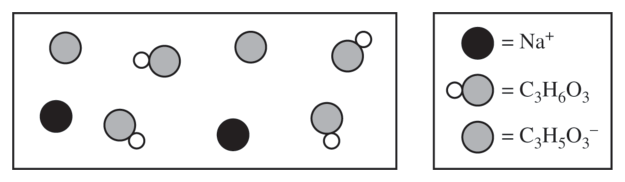
- (d) The preceding diagram represents the relative amounts of major species in a sample of the solution in the flask at one point during the titration. (Note that water molecules are omitted.)
- AP Chemistry-AP Students
- AP/College Chemistry-Khan Academy
- Guide to the AP Chemistry Exam-The Princeton Review