From the free course AP Chemistry on Lykke
6.5 Energy of Phase Changes · 6.6 Introduction to Enthalpy of Reaction
Key concepts: Energy changes during phase changes · Constant temperature during a phase change · Enthalpy relationships for opposite phase changes · Heat and amount of reacting substance · Enthalpy of reaction at constant pressure · Multi-step thermochemical calculations with units and significant figures
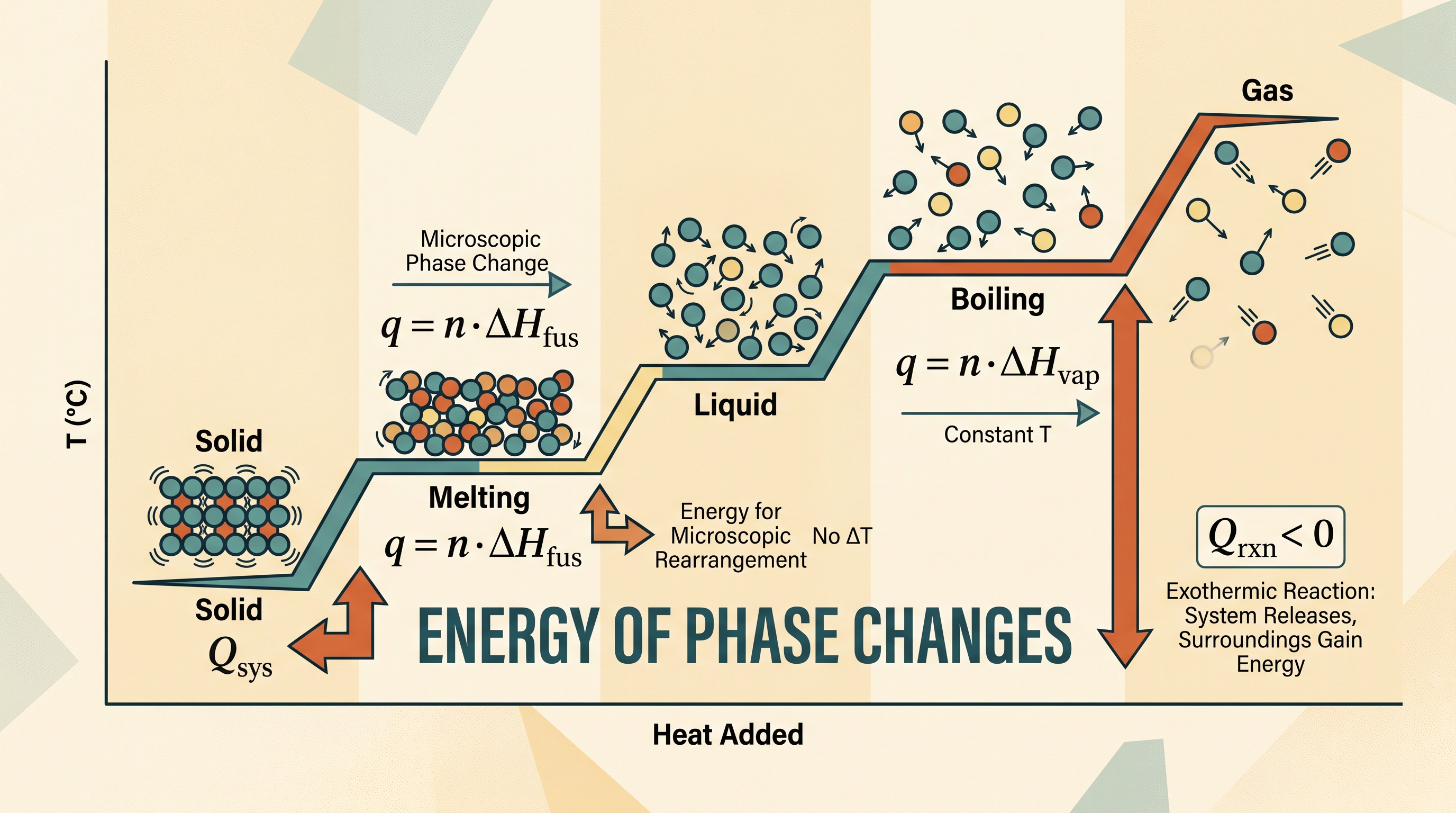
A pure substance can absorb or release energy during a phase change without changing temperature because the energy changes particle arrangement rather than average kinetic energy.
6.5 Energy of Phase Changes · 6.6 Introduction to Enthalpy of Reaction
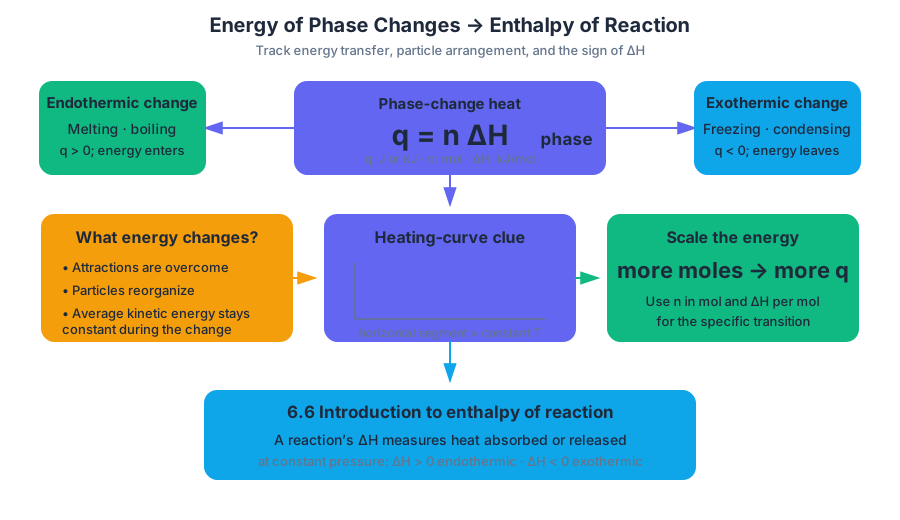
A pure substance can absorb or release energy during a phase change without changing temperature because the energy changes particle arrangement rather than average kinetic energy. Melting and vaporization require energy input; freezing and condensation release energy.
6.5 Energy of Phase Changes
Learning Objective 6.5.A: Explain changes in the heat $q$ absorbed or released by a system undergoing a phase transition based on the amount of substance in moles and the molar enthalpy of the phase transition.
Essential Knowledge 6.5.A.1: Energy must be transferred to a system for melting or boiling. During these processes, particles move into a higher-energy arrangement. During freezing or condensing, the system releases energy as particles move into a lower-energy arrangement.
During a phase change, the temperature of a pure substance remains constant. On a heating curve, this appears as a horizontal segment: energy continues entering the system, but the temperature does not rise. The incoming energy is being used to overcome intermolecular attractions or reorganize particles, not to increase their average kinetic energy.
The heat transferred is calculated from the amount of substance and the molar enthalpy of the phase transition:
$$q=n\Delta H_{\text{phase}}$$
where $q$ is heat in $\text{kJ}$ or $\text{J}$, $n$ is the amount in $\text{mol}$, and $\Delta H_{\text{phase}}$ is the molar enthalpy in $\text{kJ mol}^{-1}$ or $\text{J mol}^{-1}$.
Opposite phase changes
Essential Knowledge 6.5.A.2: The energy absorbed in one direction equals the energy released in the reverse direction with the opposite sign. For vaporization and condensation,
$$\Delta H_{\text{cond}}=-\Delta H_{\text{vap}}$$
Similarly, melting has a positive enthalpy, while freezing has the corresponding negative enthalpy:
$$\Delta H_{\text{freezing}}=-\Delta H_{\text{fusion}}$$
Worked example — vaporization and condensation: Suppose $\Delta H_{\text{vap}}$ for water is $40.7\ \text{kJ mol}^{-1}$. Vaporizing $2.00\ \text{mol}$ requires
$$q=(2.00\ \text{mol})\left(40.7\ \frac{\text{kJ}}{\text{mol}}\right)=81.4\ \text{kJ}$$
The reverse process releases the same magnitude:
$$q_{\text{cond}}=(2.00\ \text{mol})\left(-40.7\ \frac{\text{kJ}}{\text{mol}}\right)=-81.4\ \text{kJ}$$
The negative sign identifies energy leaving the condensing system.
Misconception check — “Temperature always rises when energy is added.” Not during a phase change of a pure substance. A temperature increase indicates increasing average kinetic energy; the flat portion of a heating curve represents energy changing particle attractions and spacing instead.
6.6 Introduction to Enthalpy of Reaction
Most AP-level reactions are studied at constant pressure. Under these conditions, the system’s enthalpy change, $\Delta H_{\text{rxn}}$, corresponds to the heat transferred at constant pressure:
$$q_p=\Delta H_{\text{rxn}}$$
For a reaction amount measured in moles,
$$q=n\Delta H_{\text{rxn}}$$
A negative $\Delta H_{\text{rxn}}$ indicates an exothermic reaction; a positive value indicates an endothermic reaction.
The amount $n$ must refer to the reaction quantity specified by the balanced chemical equation. If twice as much reacting substance reacts, twice as much total heat is transferred, but the molar enthalpy remains unchanged.
Worked example — reaction heat: A reaction has $\Delta H_{\text{rxn}}=-450\ \text{kJ mol}{\text{rxn}}^{-1}$. If $0.0500\ \text{mol}{\text{rxn}}$ occurs,
$$q_{\text{rxn}}=(0.0500\ \text{mol}{\text{rxn}}) \left(-450\ \frac{\text{kJ}}{\text{mol}{\text{rxn}}}\right) =-22.5\ \text{kJ}$$
The reaction releases $22.5\ \text{kJ}$, so the surroundings absorb approximately $22.5\ \text{kJ}$.
If the reacting amount is given as a mass, convert it to moles before using $q=n\Delta H$. For example, if $5.00\ \text{g}$ of a substance with molar mass $100.0\ \text{g mol}^{-1}$ reacts,
$$n=5.00\ \text{g}\left(\frac{1\ \text{mol}}{100.0\ \text{g}}\right)=0.0500\ \text{mol}$$
Then substitute this amount into the enthalpy relationship. Dimensional analysis should leave heat units, and the final answer should match the least precise measured quantity in significant figures.
AP skills and representations
Suggested Skill 1.B — Models and Representations: Describe components and quantitative information in models that connect particulate-level and macroscopic properties. Here, a heating curve or particle diagram should be interpreted together with $q$, $n$, and $\Delta H$: a flat temperature region represents a microscopic rearrangement while the equation reports its macroscopic energy cost.
Suggested Skill 5.F — Model Analysis: Perform multi-step calculations while tracking units and significant figures. A strong response shows the conversion from mass to moles, the enthalpy relationship, the sign convention, and a correctly rounded result.
Misconception check — “A negative heat means the surroundings lose energy.” The sign belongs to the system whose heat is being reported. For an exothermic reaction, $q_{\text{rxn}}<0$, while the surroundings gain energy. Confusing $q_{\text{rxn}}$ with $q_{\text{surroundings}}$ reverses the conclusion.
Retrieval check: A sample undergoes condensation with $\Delta H_{\text{vap}}=35.0\ \text{kJ mol}^{-1}$. What is $q$ when $0.250\ \text{mol}$ condenses? The correct setup is $q=(0.250\ \text{mol})(-35.0\ \text{kJ mol}^{-1})=-8.75\ \text{kJ}$: energy is released, and the temperature remains constant during the phase change.