From the free course AP Chemistry on Lykke
7.11 Introduction to Solubility Equilibria · 7.12 Common-Ion Effect
Key concepts: Solubility equilibria · Solubility product constant (Ksp) · Molar solubility · Relationship between Ksp and molar solubility · Common-ion effect · Le Châtelier’s principle · Dissolution equilibria · Qualitative solubility rules · Calculating solubility from Ksp · Effect of modifying solution composition on experimental results
A sparingly soluble salt does not simply “stop dissolving”; it reaches a dynamic balance in which solid dissolves and dissolved ions recombine at equal rates.
7.11 Introduction to Solubility Equilibria · 7.12 Common-Ion Effect
A sparingly soluble salt does not simply “stop dissolving”; it reaches a dynamic balance in which solid dissolves and dissolved ions recombine at equal rates.
The dissolution equilibrium
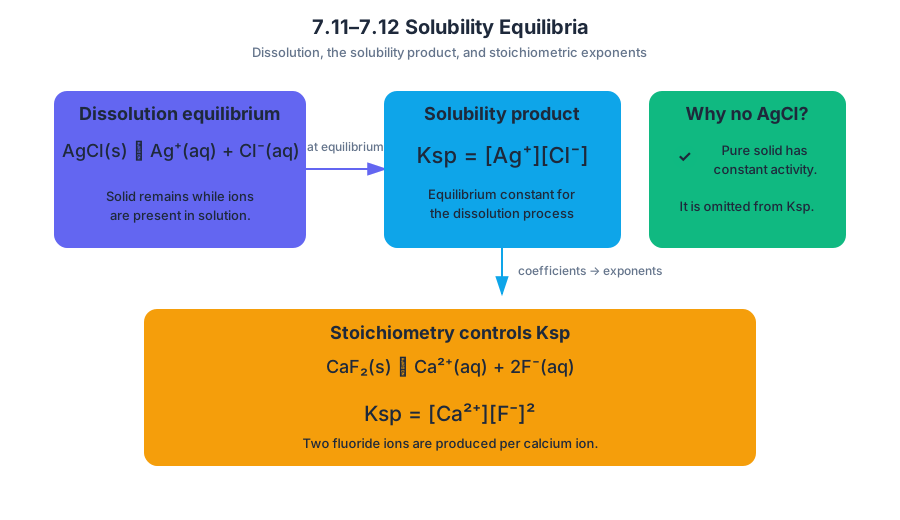
For a salt such as silver chloride, the equilibrium is
$$ \mathrm{AgCl(s)\rightleftharpoons Ag^+(aq)+Cl^-(aq)} $$
At equilibrium, some solid remains while ions are present in solution. The solubility product constant, $K_{sp}$, is the equilibrium constant for this dissolution process:
$$ K_{sp}=[\mathrm{Ag^+}][\mathrm{Cl^-}] $$
The solid $\mathrm{AgCl}$ does not appear in the expression because the concentration of a pure solid is effectively constant.
The stoichiometric coefficients in the dissolution equation become exponents in the $K_{sp}$ expression. For calcium fluoride,
$$ \mathrm{CaF_2(s)\rightleftharpoons Ca^{2+}(aq)+2F^-(aq)} $$
so
$$ K_{sp}=[\mathrm{Ca^{2+}}][\mathrm{F^-}]^2 $$
The exponent on fluoride is not optional: two fluoride ions are produced for every calcium ion.
Molar solubility and $K_{sp}$
Molar solubility is the number of moles of salt that dissolve per liter of solution. If the molar solubility of $\mathrm{CaF_2}$ is $s$, then dissolving $s$ moles per liter produces $s$ moles per liter of $\mathrm{Ca^{2+}}$ and $2s$ moles per liter of $\mathrm{F^-}$:
$$ [\mathrm{Ca^{2+}}]=s \qquad [\mathrm{F^-}]=2s $$
Substitution gives
$$ K_{sp}=s(2s)^2=4s^3 $$
For $K_{sp}=3.2\times10^{-11}$,
$$ s=\sqrt[3]{\frac{3.2\times10^{-11}}{4}} =2.0\times10^{-4}\ \mathrm{M} $$
Thus the molar solubility is $2.0\times10^{-4}\ \mathrm{M}$, while the equilibrium fluoride concentration is $4.0\times10^{-4}\ \mathrm{M}$.
Misconception check — $K_{sp}$ is not the same as solubility. A smaller $K_{sp}$ usually indicates a less soluble salt within a comparable stoichiometric pattern, but $K_{sp}$ and molar solubility have different meanings and units. Also, comparing numerical $K_{sp}$ values across salts with different formulas can be misleading because their ion concentrations enter the expressions differently.
The common-ion effect
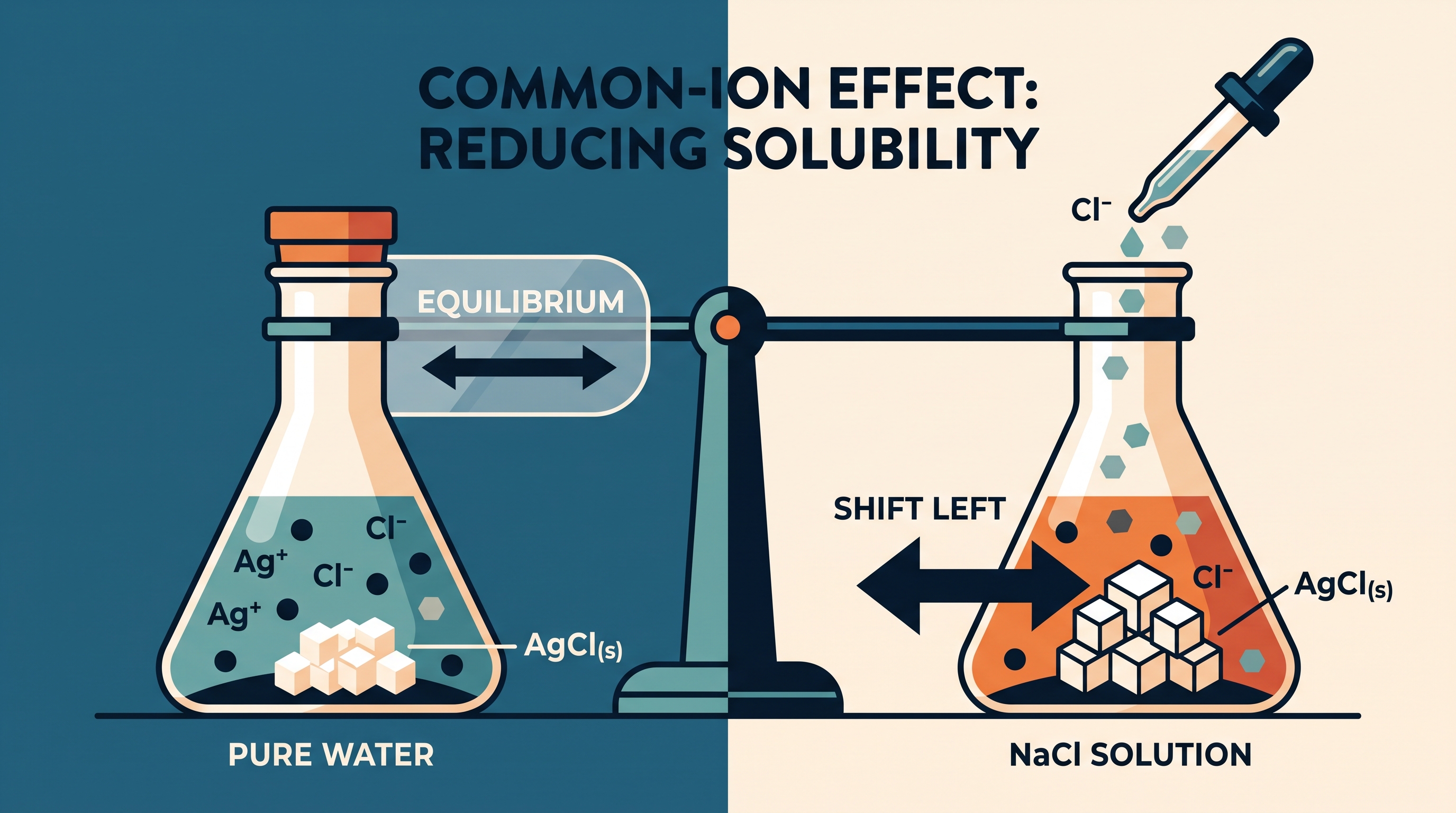
The common-ion effect occurs when a solution already contains an ion produced by a dissolving salt. Adding that ion decreases the salt’s solubility. This is required by the equilibrium expression, not an exception to it.
For $\mathrm{AgCl}$,
adding $\mathrm{NaCl}$ increases $[\mathrm{Cl^-}]$. The product $[\mathrm{Ag^+}][\mathrm{Cl^-}]$ would then exceed $K_{sp}$, so some $\mathrm{Ag^+}$ and $\mathrm{Cl^-}$ combine to form more $\mathrm{AgCl(s)}$. The equilibrium shifts left, and less solid dissolves.
This is the solubility-equilibrium application of Le Châtelier’s principle: adding a product favors the direction that consumes that product. The solid forms until the ion product again equals $K_{sp}$.
Quantitative common-ion calculation
Suppose $K_{sp}$ for $\mathrm{AgCl}$ is $1.8\times10^{-10}$ and the solution already contains $0.010\ \mathrm{M}$ $\mathrm{Cl^-}$ from $\mathrm{NaCl}$. Let $s$ be the additional concentration of $\mathrm{AgCl}$ that dissolves:
$$ [\mathrm{Ag^+}]=s \qquad [\mathrm{Cl^-}]\approx0.010 $$
The approximation is valid because the added $0.010\ \mathrm{M}$ chloride is much larger than the tiny amount supplied by dissolution.
$$ K_{sp}=s(0.010) $$
$$ s=\frac{1.8\times10^{-10}}{0.010} =1.8\times10^{-8}\ \mathrm{M} $$
In pure water, the molar solubility would be approximately $\sqrt{K_{sp}}=1.3\times10^{-5}\ \mathrm{M}$. The common ion reduces the solubility by roughly three orders of magnitude.
Solubility rules versus solubility equilibria
Qualitative solubility rules classify substances as generally soluble or insoluble; they do not replace an equilibrium calculation. A “soluble” salt can still have a finite saturation concentration, and a “slightly soluble” salt still dissolves to some extent. Use $K_{sp}$ when the problem supplies equilibrium data or asks for a numerical solubility.
The RbCl example illustrates this distinction. RbCl is classified as soluble, so its molar solubility is not normally treated as a small $K_{sp}$-controlled quantity in water at $20^\circ\mathrm{C}$. KCl contains the common ion $\mathrm{Cl^-}$, so a formal common-ion argument is chemically relevant; however, ordinary AP reasoning should not invent a numerical $K_{sp}$ for RbCl when none is provided. The defensible conclusion is that the experiment must distinguish a measurable saturation change from the qualitative prediction for a sparingly soluble salt.
Experimental consequences and AP skill
Changing the solvent, adding a common-ion source, altering concentrations, or failing to control temperature can change the measured solubility. For example, measuring the solubility of $\mathrm{AgCl}$ in pure water and then repeating the measurement in $\mathrm{NaCl}$ solution should produce a smaller dissolved amount and potentially more solid precipitate.
This topic develops Learning Objective 7.12.A: “Identify the solubility of a salt, and/or the value of $K_{sp}$ for the salt, based on the concentration of a common ion already present in solution.” It also applies Essential Knowledge 7.12.A.1, which states that a salt’s solubility is reduced when the solution already contains one of its ions and that the effect can be explained qualitatively with Le Châtelier’s principle or calculated from $K_{sp}$.
The relevant science practice is 2.F — Explain how modifications to an experimental procedure will alter results. A strong response names the changed ion concentration, connects it to the $K_{sp}$ expression, predicts the equilibrium shift, and states the observable consequence.
Retrieval check: For $\mathrm{PbI_2(s)\rightleftharpoons Pb^{2+}(aq)+2I^-(aq)}$, write $K_{sp}$ and predict what happens when $\mathrm{KI(aq)}$ is added. The expression is $K_{sp}=[\mathrm{Pb^{2+}}][\mathrm{I^-}]^2$; adding $\mathrm{I^-}$ shifts the equilibrium toward $\mathrm{PbI_2(s)}$, decreasing its molar solubility.
Source Materials
- AP Chemistry Course and Exam Description
- AP Chemistry Course and Exam Description Clarifications and Corrections
- AP Chemistry Course Overview
- AP Chemistry Course at a Glance
- AP Chemistry Course at a Glance Poster
- Adopt AP Chemistry
- AP Chemistry
- AP Chemistry
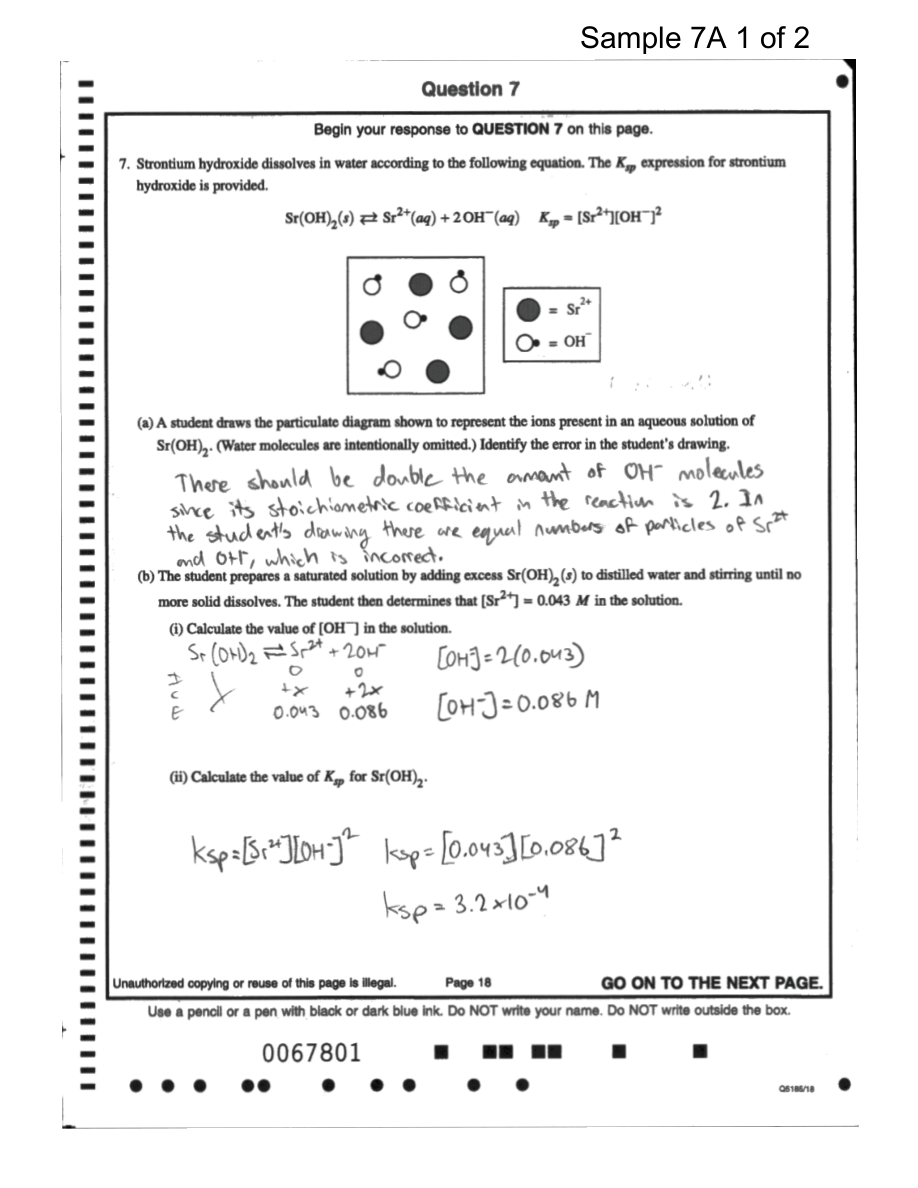
- Figure — Sample Responses Q7 (p. 3)
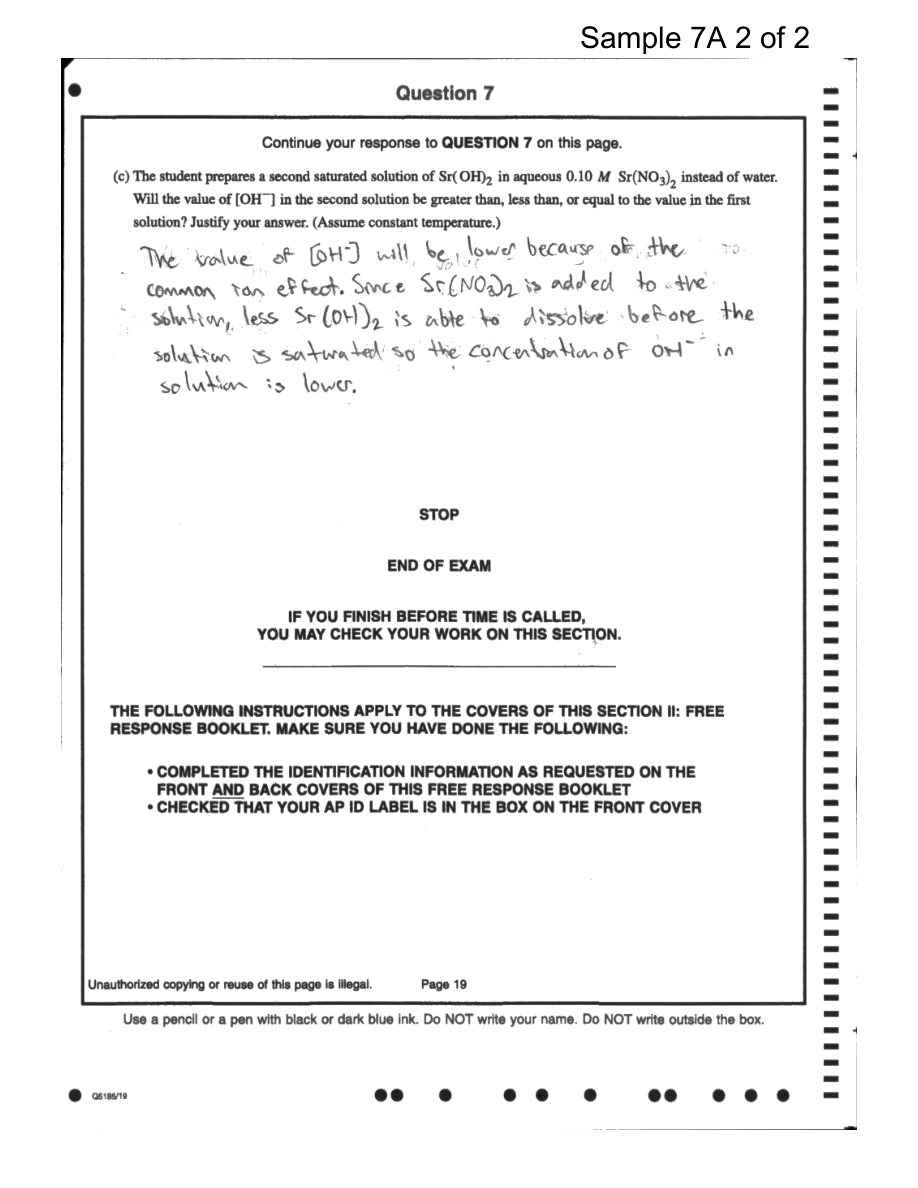
- Figure — Sample Responses Q7 (p. 4)
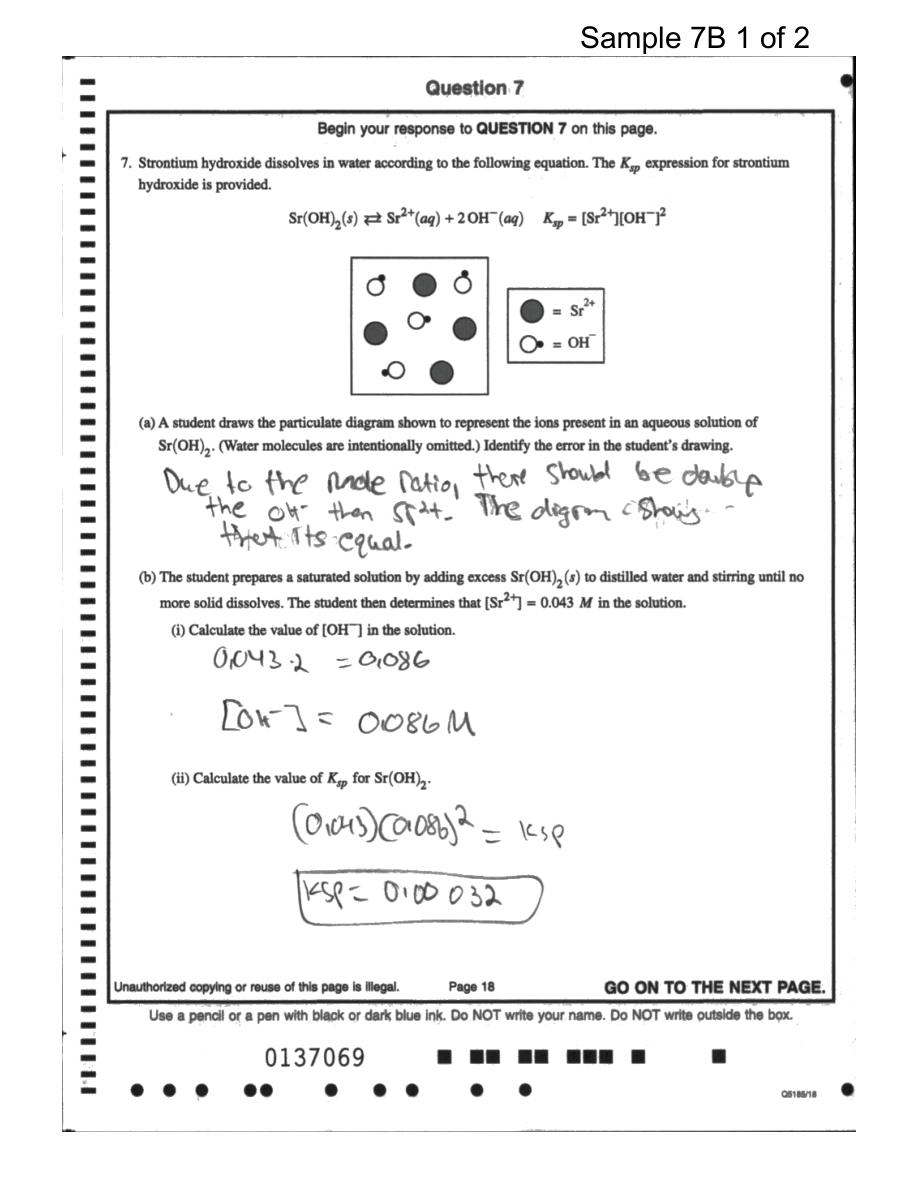
- Figure — Sample Responses Q7 (p. 5)
- Figure — Sample Responses Q7 (p. 6)