From the free course AP Chemistry on Lykke
9.11 Electrolysis and Faraday’s Law
Key concepts: Electrolysis · Faraday’s law · Nonspontaneous redox reactions · Thermodynamic spontaneity · External power sources · Stoichiometric calculations · Moles of electrons and electric charge · Current, charge, and time · Standard reduction potentials · Cell potential under nonstandard conditions
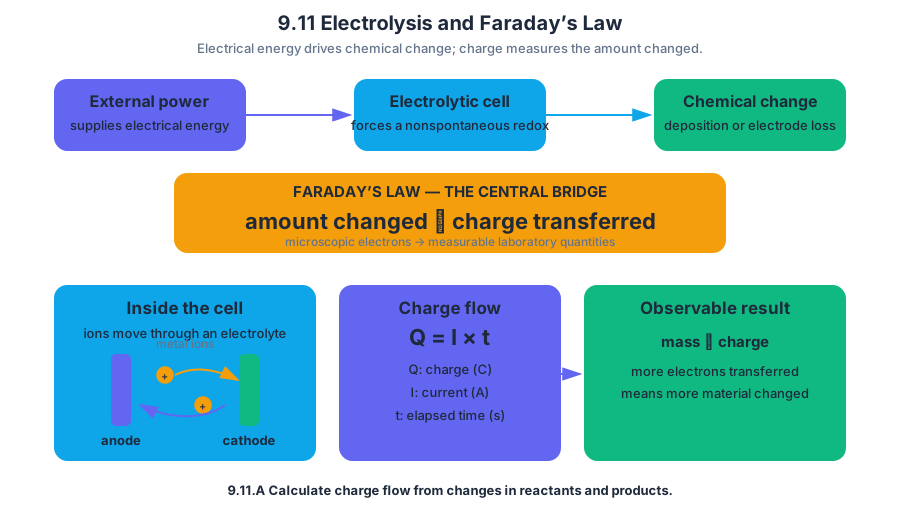
Electrolysis uses an external power source to force a redox reaction that would not proceed spontaneously. In an electrolytic cell, electrical energy becomes chemical change: metal ions may be reduced and deposited onto an electrode, or a solid electrode may be oxidized and removed.
9.11 Electrolysis and Faraday’s Law
Electrolysis uses an external power source to force a redox reaction that would not proceed spontaneously. In an electrolytic cell, electrical energy becomes chemical change: metal ions may be reduced and deposited onto an electrode, or a solid electrode may be oxidized and removed.
9.11.A — Calculate the amount of charge flow based on changes in the amounts of reactants and products in an electrochemical cell.
The central bridge is Faraday’s law: the amount of material changed at an electrode is proportional to the amount of charge transferred. The microscopic count of electrons connects to the macroscopic quantities measured in the laboratory—mass, current, and elapsed time.
Spontaneity and the need for an external power source
A galvanic cell produces electrical energy from a spontaneous reaction. For the reaction as written,
$$\Delta G^\circ=-nFE^\circ_{\text{cell}}$$
where $n$ is the number of moles of electrons transferred and $F$ is Faraday’s constant, approximately $96{,}485\ \text{C mol}^{-1}e^-$. Thus, a positive $E^\circ_{\text{cell}}$ corresponds to $\Delta G^\circ<0$ and a spontaneous reaction.
Electrolysis reverses that energy flow. The desired reaction has $\Delta G>0$ and, under the relevant conditions, a negative cell potential. An external power source supplies the energy needed to push electrons in the nonspontaneous direction. Under actual, nonstandard conditions, the cell potential for those conditions—not automatically the standard value—determines whether the forced reaction is nonspontaneous.
Misconception check — “A positive cell potential requires a battery.” A positive $E_{\text{cell}}$ indicates a spontaneous cell reaction. It is a negative cell potential for the reaction as written that signals the need for an external power source in electrolysis.
Faraday’s law as an electron-counting pipeline
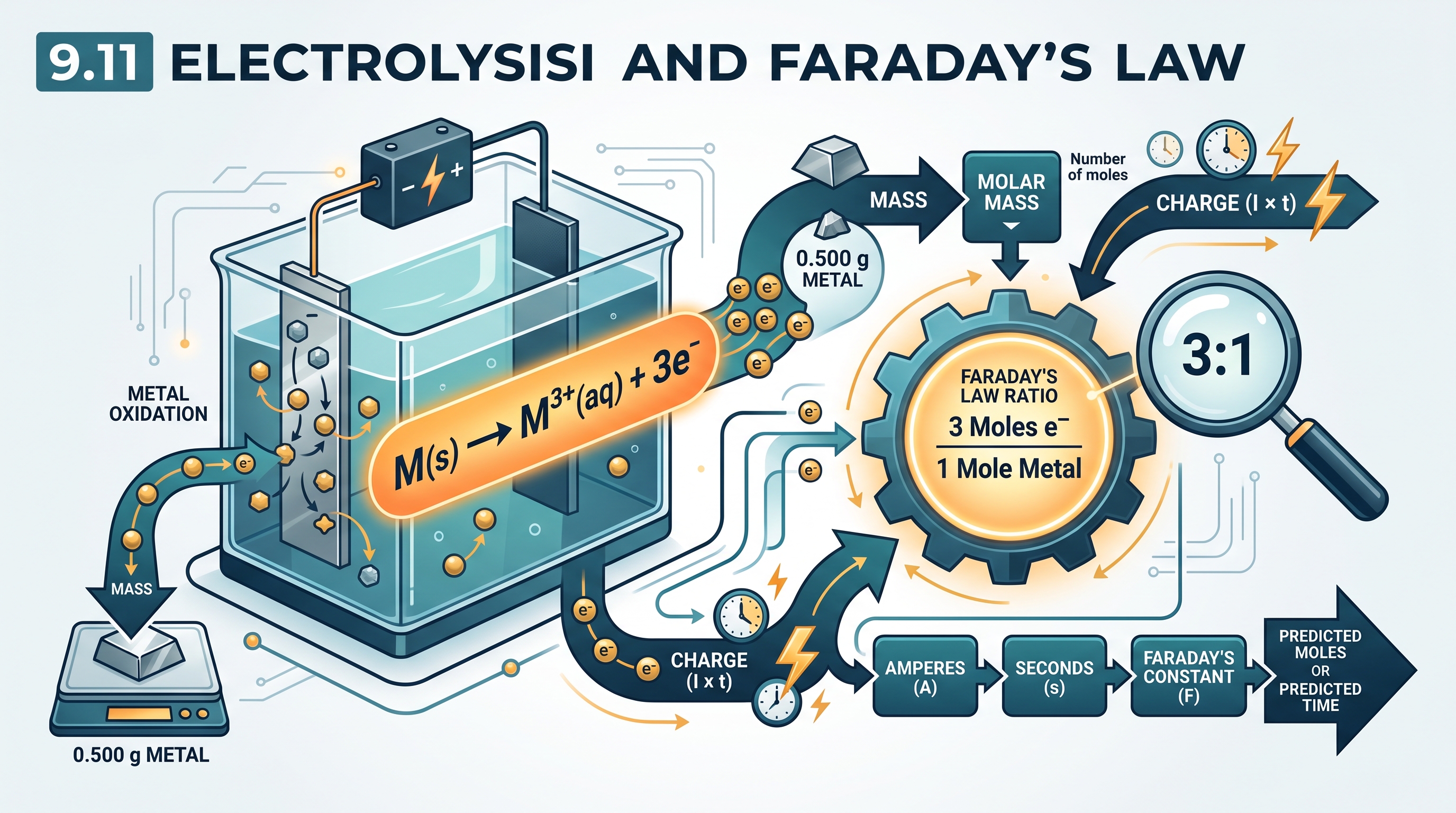
For any electrolytic calculation, begin with the balanced electrode half-reaction. The coefficient of $e^-$ gives the required electron-to-substance ratio. Then use dimensional analysis:
$$ \text{mass} \rightarrow \text{moles of substance} \rightarrow \text{moles of }e^- \rightarrow \text{coulombs} \rightarrow \text{seconds} $$
The essential knowledge is 9.11.A.1 — Faraday’s laws can be used to determine the stoichiometry of the redox reaction occurring in an electrochemical cell with respect to the number of electrons transferred, mass of material deposited on or removed from an electrode, current, time elapsed, and charge of ionic species.
The quantitative relationships are
$$ q=n_{e^-}F $$
and
$$ I=\frac{q}{t} $$
where $q$ is charge in coulombs, $n_{e^-}$ is moles of electrons, $I$ is current in amperes, and $t$ is time in seconds. Since $1\ \text{A}=1\ \text{C s}^{-1}$,
$$ t=\frac{q}{I}. $$
Worked example: plating rhodium
Suppose $2.8\ \text{g}$ of rhodium is plated from $\text{Rh}^{3+}(aq)$ at a current of $2.0\ \text{C s}^{-1}$. The reduction half-reaction is
$$ \text{Rh}^{3+}(aq)+3e^-\rightarrow\text{Rh}(s). $$
Therefore, $3$ moles of electrons are required for every $1$ mole of rhodium deposited.
First convert the deposited mass to moles of rhodium and then to moles of electrons:
$$ 2.8\ \text{g Rh} \left(\frac{1\ \text{mol Rh}}{102.91\ \text{g Rh}}\right) \left(\frac{3\ \text{mol }e^-}{1\ \text{mol Rh}}\right) =0.082\ \text{mol }e^-. $$
Convert electrons to charge and charge to time:
$$ 0.082\ \text{mol }e^- \left(\frac{96{,}485\ \text{C}}{1\ \text{mol }e^-}\right) \left(\frac{1\ \text{s}}{2.0\ \text{C}}\right) \approx 3.9\times10^3\ \text{s}. $$
The required charge is approximately
$$ q=(0.082)(96{,}485)\approx 7{,}868.68\ \text{C}, $$
and the required time is approximately
$$ t\approx3{,}900\ \text{s}. $$
The answer has two significant figures because both $2.8\ \text{g}$ and $2.0\ \text{C s}^{-1}$ have two significant figures.
Common error: using a $1:1$ ratio between moles of Rh and moles of electrons. The ionic charge controls the ratio: reducing $\text{Rh}^{3+}$ requires $3$ electrons per rhodium atom.
The same method for material removed
Faraday’s law applies equally when an electrode dissolves. For a metal with ionic charge $z+$, oxidation is represented by
$$ \text{M}(s)\rightarrow\text{M}^{z+}(aq)+ze^-. $$
If $m$ grams of $\text{M}(s)$ are removed, calculate
$$ m \left(\frac{1\ \text{mol M}}{\text{molar mass of M}}\right) \left(\frac{z\ \text{mol }e^-}{1\ \text{mol M}}\right) \left(\frac{96{,}485\ \text{C}}{1\ \text{mol }e^-}\right). $$
For example, removing $1.00\ \text{g}$ of a metal that oxidizes as
$$ \text{M}(s)\rightarrow\text{M}^{2+}(aq)+2e^- $$
requires twice as many moles of electrons per mole of metal as a $1+$ metal. The mass–moles–electrons–charge chain is unchanged; only the half-reaction and molar mass change.
Exam reasoning and retrieval check
A complete response should show the balanced redox half-reaction or net ionic equation, identify the electron ratio, carry units through each conversion, and report an answer with appropriate significant figures. This develops Science Practice 5: Mathematical Routines, while the half-reaction and electron-flow model engage Science Practice 1: Models and Representations and Science Practice 4: Model Analysis.
Retrieval check: An electrode loses $0.500\ \text{g}$ of a metal through $\text{M}(s)\rightarrow\text{M}^{3+}(aq)+3e^-$. Before calculating, identify the controlling ratio: how many moles of electrons are released per mole of metal? If the answer is not $3$, the half-reaction has not yet been used correctly.