From the free course AP Chemistry on Lykke
9.3 Gibbs Free Energy and Thermodynamic Favorability · 9.4 Thermodynamic and Kinetic Control
Key concepts: Gibbs free energy (ΔG°) · Thermodynamic favorability · The relationship between enthalpy, entropy, temperature, and free energy · Thermodynamic control · Kinetic control · Activation energy · Reaction rate · Chemical equilibrium · Distinguishing equilibrium from kinetic inhibition · The relationship between ΔG° and the equilibrium constant K
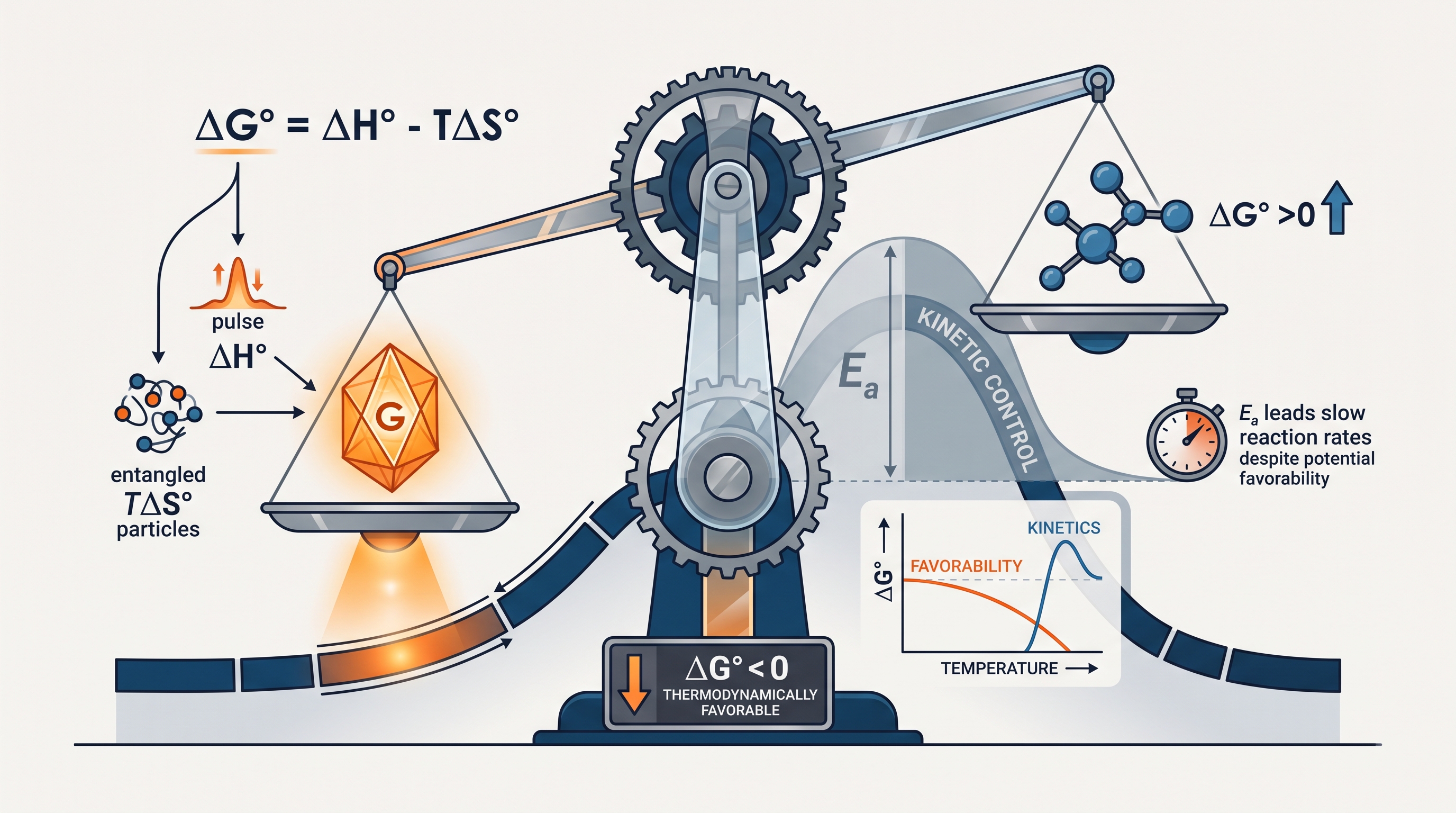
A reaction can be energetically favorable yet appear to do nothing: a thermodynamically favored process may be trapped behind a large activation-energy barrier. Gibbs free energy answers whether products are favored, while kinetics answers how quickly the system can get there.
9.3 Gibbs Free Energy and Thermodynamic Favorability · 9.4 Thermodynamic and Kinetic Control
A reaction can be energetically favorable yet appear to do nothing: a thermodynamically favored process may be trapped behind a large activation-energy barrier. Gibbs free energy answers whether products are favored, while kinetics answers how quickly the system can get there.
The free-energy test
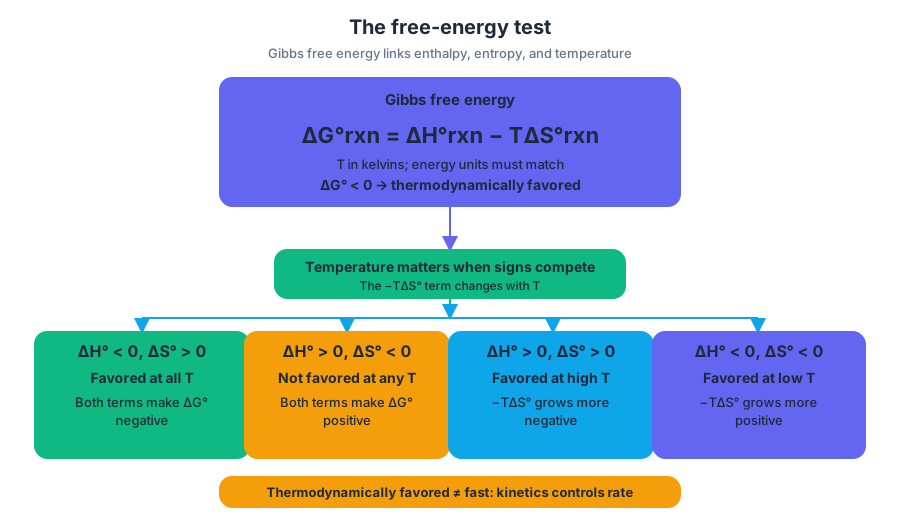
Gibbs free energy combines enthalpy, entropy, and temperature into one quantity that predicts thermodynamic favorability:
$$\Delta G^\circ_{\mathrm{rxn}}=\Delta H^\circ_{\mathrm{rxn}}-T\Delta S^\circ_{\mathrm{rxn}}$$
Here, $T$ must be measured in kelvins, and $\Delta H^\circ$ and $\Delta S^\circ$ must use compatible energy units. A process is thermodynamically favored under the stated conditions when $\Delta G^\circ_{\mathrm{rxn}}<0$.
Key distinction: $\Delta G^\circ<0$ means the process is thermodynamically favored; it does not mean the process is fast.
The signs of $\Delta H^\circ$ and $\Delta S^\circ$ determine whether temperature matters.
| $\Delta H^\circ$ | $\Delta S^\circ$ | Temperature effect | Favorability |
|---|---|---|---|
| $<0$ | $>0$ | Both terms make $\Delta G^\circ$ negative | Favored at all $T$ |
| $>0$ | $<0$ | Both terms make $\Delta G^\circ$ positive | Not favored at any $T$ |
| $>0$ | $>0$ | The $-T\Delta S^\circ$ term becomes more negative as $T$ rises | Favored at high $T$ |
| $<0$ | $<0$ | The $-T\Delta S^\circ$ term becomes more positive as $T$ rises | Favored at low $T$ |
Temperature as the deciding variable
When $\Delta H^\circ_{\mathrm{rxn}}>0$ and $\Delta S^\circ_{\mathrm{rxn}}>0$, the process is endothermic but produces a favorable entropy change. At sufficiently high temperature, the magnitude of $T\Delta S^\circ$ can exceed $\Delta H^\circ$, making $\Delta G^\circ$ negative.
Worked example. Suppose a process has $\Delta H^\circ_{\mathrm{rxn}}=+40.0\ \mathrm{kJ,mol^{-1}}$ and $\Delta S^\circ_{\mathrm{rxn}}=+100.\ \mathrm{J,mol^{-1},K^{-1}}$. Convert enthalpy to joules:
$$\Delta H^\circ_{\mathrm{rxn}}=+4.00\times10^4\ \mathrm{J,mol^{-1}}$$
At $500\ \mathrm{K}$:
$$\Delta G^\circ=(4.00\times10^4)-(500)(100.)=-1.00\times10^4\ \mathrm{J,mol^{-1}}$$
Because $\Delta G^\circ<0$, the process is thermodynamically favored at $500\ \mathrm{K}$. The crossover temperature occurs when $\Delta G^\circ=0$:
$$T=\frac{\Delta H^\circ}{\Delta S^\circ} =\frac{4.00\times10^4}{100.}=400\ \mathrm{K}$$
Thus, this process is favored above approximately $400\ \mathrm{K}$, assuming $\Delta H^\circ$ and $\Delta S^\circ$ remain constant.
Misconception check: A positive $\Delta S^\circ$ does not automatically make a reaction favored. The enthalpy term may still dominate at lower temperature.
Thermodynamic favorability and equilibrium tendency
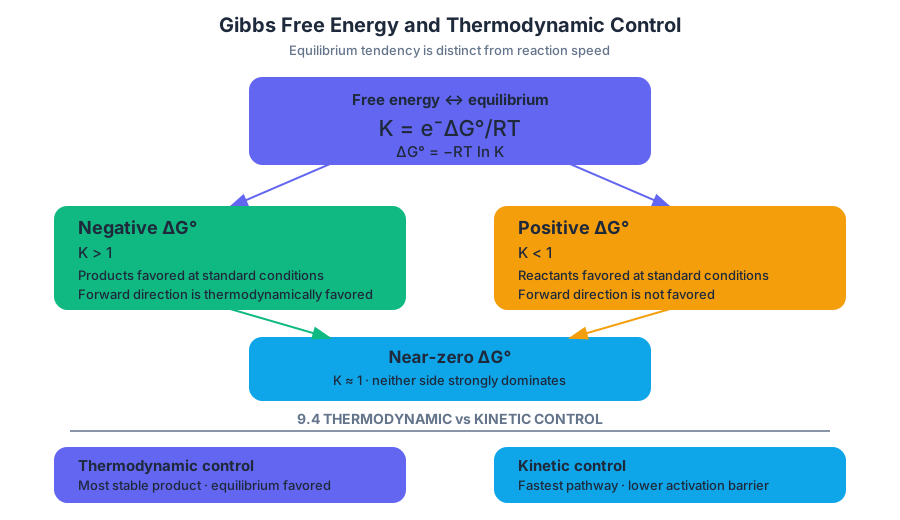
The standard free energy and equilibrium constant are connected by
$$K=e^{-\Delta G^\circ/RT}$$
and equivalently
$$\Delta G^\circ=-RT\ln K$$
where $R$ is the gas constant and $T$ is the absolute temperature. If $\Delta G^\circ$ is near zero, $K$ is close to $1$; if $\left|\Delta G^\circ\right|$ is much larger than $RT$, $K$ deviates substantially from $1$.
A negative $\Delta G^\circ$ corresponds to $K>1$, so products are favored relative to reactants under standard conditions. A positive $\Delta G^\circ$ corresponds to $K<1$, so the process is not thermodynamically favored in the stated direction.
Thermodynamic control versus kinetic control
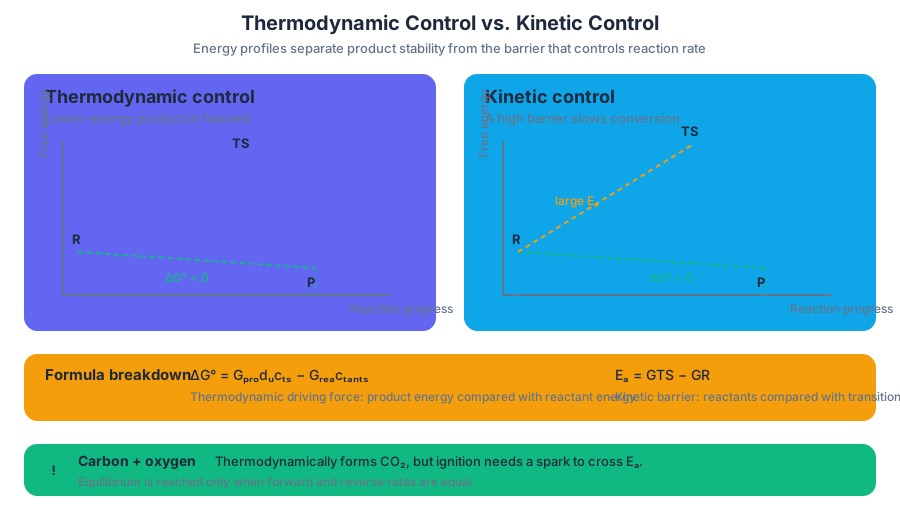
Thermodynamic control describes a situation in which the relative stability of products determines the observed outcome. The product arrangement with lower free energy is favored, provided the system can reach it.
Kinetic control occurs when a high activation-energy barrier prevents rapid conversion, even though the overall process has $\Delta G^\circ<0$. Activation energy, $E_a$, is the minimum energy required for reacting particles to reach the transition state.
A useful energy-profile comparison is:
- Thermodynamics: compare the energy of reactants and products; this determines $\Delta G$.
- Kinetics: compare the reactants with the transition state; this determines $E_a$ and strongly affects rate.
- Equilibrium: occurs when forward and reverse reaction rates are equal.
For example, carbon and oxygen can form carbon dioxide thermodynamically, but a piece of carbon does not instantly burst into flame in ordinary air. A spark supplies enough energy to overcome the activation barrier. Before ignition, the reaction is not necessarily at equilibrium; it may simply be kinetically inhibited.
Exam-critical distinction: Failure to observe a process at a noticeable rate does not prove that the system is at equilibrium. “Not visibly reacting” can mean “very slow,” not “forward and reverse rates are equal.”
AP Chemistry reasoning in this topic
Learning Objective 9.3.A: Explain whether a physical or chemical process is thermodynamically favored based on an evaluation of $\Delta G^\circ$. The essential knowledge is applied through the relationship $\Delta G^\circ=\Delta H^\circ-T\Delta S^\circ$, sign analysis, temperature reasoning, and the connection between $\Delta G^\circ$ and $K$ (EK 9.3.A.1–9.3.A.2).
Learning Objective 9.4.A: Explain the relationship between thermodynamic favorability and the rate at which a process occurs. The essential knowledge requires distinguishing a favorable process from a rapid process and relating kinetic inhibition to activation energy (EK 9.4.A.1–9.4.A.2).
The main science practices are Science Practice 1: Models and Representations when interpreting energy profiles, Science Practice 4: Model Analysis when connecting $\Delta H^\circ$, $\Delta S^\circ$, $\Delta G^\circ$, and $E_a$, Science Practice 5: Mathematical Routines when calculating free energy or $K$, and Science Practice 6: Argumentation when justifying favorability with an equation and a sign-based conclusion.
Retrieval check: A reaction has $\Delta H^\circ>0$ and $\Delta S^\circ>0$. Is it favored at all temperatures, no temperatures, low temperatures, or high temperatures? Explain using the sign of the $-T\Delta S^\circ$ term. Then state whether a measured rate of essentially zero proves equilibrium.