From the free course AP Chemistry on Lykke
4.7 Types of Chemical Reactions · 4.8 Introduction to Acid-Base Reactions
Key concepts: Types of chemical reactions · Acid-base reactions · Oxidation-reduction reactions · Precipitation reactions · Identifying and representing chemical reactions · Balancing chemical equations · Solubility of salts in water · Justifying reaction classifications using chemical principles
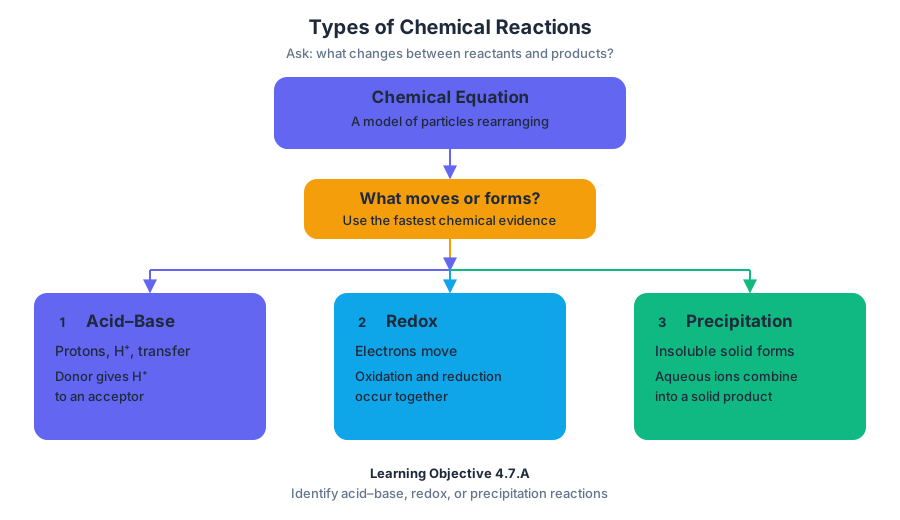
A chemical equation is more than a recipe: it is a compact model of particles rearranging, electrons moving, or protons transferring. The central diagnostic question is: what changes between reactants and products?
4.7 Types of Chemical Reactions · 4.8 Introduction to Acid-Base Reactions
A chemical equation is more than a recipe: it is a compact model of particles rearranging, electrons moving, or protons transferring. The central diagnostic question is: what changes between reactants and products?
Learning Objective 4.7.A: Identify a reaction as acid-base, oxidation-reduction, or precipitation.
| Reaction type | What moves or forms? | Fastest chemical evidence |
|---|---|---|
| Acid-base | One or more protons, $H^+$ | A proton donor transfers $H^+$ to a proton acceptor |
| Oxidation-reduction | One or more electrons | Oxidation numbers change |
| Precipitation | An insoluble ionic solid | Aqueous ions combine to form a solid product |
Representing a reaction accurately
A chemical equation must conserve atoms and, for ionic equations, charge. A balanced equation therefore expresses the same number of atoms of each element on both sides; its coefficients describe particle or mole ratios, while subscripts belong to the chemical formula and must not be changed during balancing.
For example, magnesium burns in oxygen:
$$ 2Mg(s)+O_2(g)\rightarrow 2MgO(s) $$
The coefficient $2$ means that two magnesium atoms—or two moles of magnesium—react for every one oxygen molecule—or one mole of oxygen molecules. Changing $MgO$ to $Mg_2O$ would not balance the equation; it would invent a different substance.
Worked example — balancing by inspection. Start with propane combustion:
$$ C_3H_8+O_2\rightarrow CO_2+H_2O $$
Balance carbon first: $3CO_2$. Then balance hydrogen: $4H_2O$. The products contain $10$ oxygen atoms, so use $5O_2$:
$$ C_3H_8+5O_2\rightarrow 3CO_2+4H_2O $$
This is also a redox reaction because carbon and oxygen change oxidation numbers. Complete combustion of a hydrocarbon produces carbon dioxide and water, making combustion an important subclass of oxidation-reduction reactions.
Acid-base reactions: follow the proton
An acid-base reaction involves the transfer of one or more protons, $H^+$, between chemical species. In the Brønsted-Lowry model, an acid donates $H^+$ and a base accepts $H^+$.
A clear example is the reaction of ammonia with water:
NH_3(aq)+H_2O(l)\rightleftharpoons NH_4^+(aq)+OH^-(aq)
Water donates a proton to $NH_3$, so water acts as the acid. Ammonia accepts that proton, so it acts as the base. The paired species $H_2O/OH^-$ and $NH_4^+/NH_3$ are conjugate acid-base pairs: each pair differs by exactly one $H^+$.
A neutralization is a common acid-base pattern. For a strong acid and strong base, the net ionic equation is:
$$ H^+(aq)+OH^-(aq)\rightarrow H_2O(l) $$
Misconception check — “An acid-base reaction must have $H^+$ written as a reactant.” Not necessarily. Proton transfer may occur between molecular species, as in the ammonia example. Identify the donor and acceptor by comparing formulas before and after the reaction.
Precipitation reactions: inspect the ions
A precipitation reaction occurs when aqueous reactants produce an insoluble or sparingly soluble ionic compound. The new solid is written with the state symbol $(s)$; aqueous ions that remain dissolved are spectators and cancel from the net ionic equation.
Suppose aqueous silver nitrate is mixed with aqueous sodium chloride:
$$ AgNO_3(aq)+NaCl(aq)\rightarrow AgCl(s)+NaNO_3(aq) $$
The complete ionic equation is:
$$ Ag^+(aq)+NO_3^-(aq)+Na^+(aq)+Cl^-(aq)\rightarrow AgCl(s)+Na^+(aq)+NO_3^-(aq) $$
Canceling the unchanged spectator ions gives:
$$ Ag^+(aq)+Cl^-(aq)\rightarrow AgCl(s) $$
The required solubility knowledge is deliberately limited: all sodium, potassium, ammonium, and nitrate salts are soluble in water. Rote memorization of additional solubility rules is not assessed. The chemical principle matters more than a long memorized list: determine whether the possible ionic product is insoluble enough to leave solution as a solid.
Redox as a second diagnostic
An oxidation-reduction reaction, or redox reaction, transfers electrons between chemical species. Because electrons are rarely written directly in an ordinary molecular equation, identify redox by tracking oxidation numbers: oxidation is an increase in oxidation number, and reduction is a decrease.
For the reaction
magnesium changes from $0$ to $+2$, so it is oxidized. Oxygen changes from $0$ to $-2$, so it is reduced. The same reaction can belong to more than one category: combustion is redox, and some acid-base reactions can also involve oxidation-number changes.
Misconception check — “Any reaction with oxygen is automatically combustion.” Oxygen participation alone is not enough for the complete-combustion pattern. For hydrocarbons, complete combustion specifically produces $CO_2$ and $H_2O$; classification still requires examining the actual chemical change.
AP reasoning and retrieval check
The primary assessed science practice is Science Practice 1: Models and Representations, especially Skill 1.B: Describe the components of and quantitative information from models and representations that illustrate both particulate-level and macroscopic-level properties. Explain both what you observe—such as a solid forming—and what particles must be doing—such as ions leaving solution to form an ionic lattice.
Use Science Practice 6: Argumentation when justifying a classification: state the reaction type, cite the equation or observation as evidence, and connect that evidence to proton transfer, electron transfer, or solid formation. Use Science Practice 5: Mathematical Routines when balancing coefficients and verifying conservation of atoms and charge.
Retrieval check. Classify each reaction and give one chemical justification:
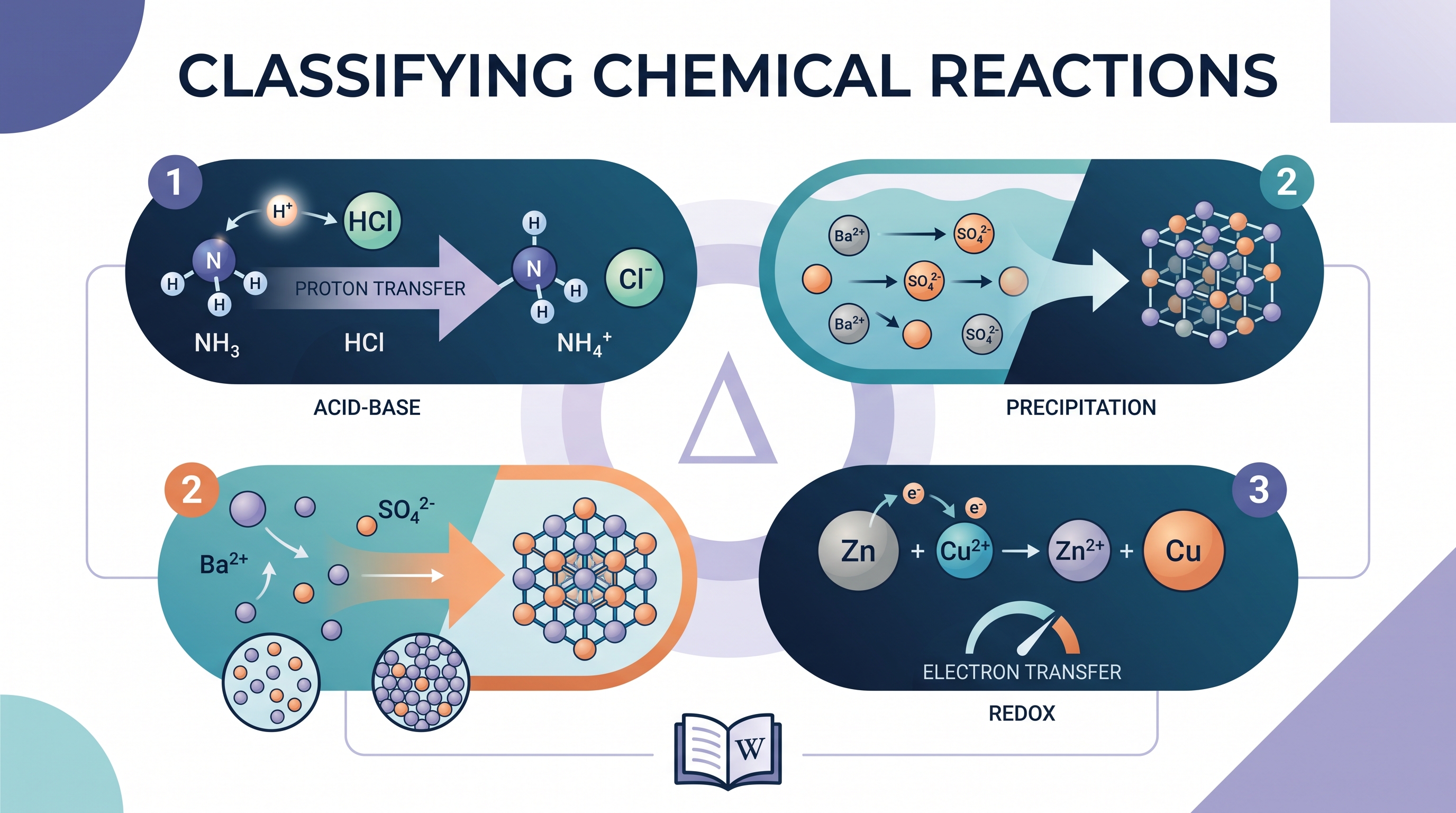
- $HCl(aq)+NH_3(aq)\rightarrow NH_4^+(aq)+Cl^-(aq)$
- $Ba^{2+}(aq)+SO_4^{2-}(aq)\rightarrow BaSO_4(s)$
- $Zn(s)+Cu^{2+}(aq)\rightarrow Zn^{2+}(aq)+Cu(s)$
Answers: (1) acid-base, because $NH_3$ accepts $H^+$; (2) precipitation, because an insoluble solid forms; (3) redox, because zinc is oxidized and copper ions are reduced. In every case, the justification identifies the chemical principle—not merely the reaction’s visual pattern.