From the free course AP Chemistry on Lykke
6.9 Hess’s Law
Key concepts: Hess’s law · Enthalpy of formation · Adding enthalpy-change values · Manipulating thermochemical equations · Using tabulated data · Molecular mass of Cl(g)
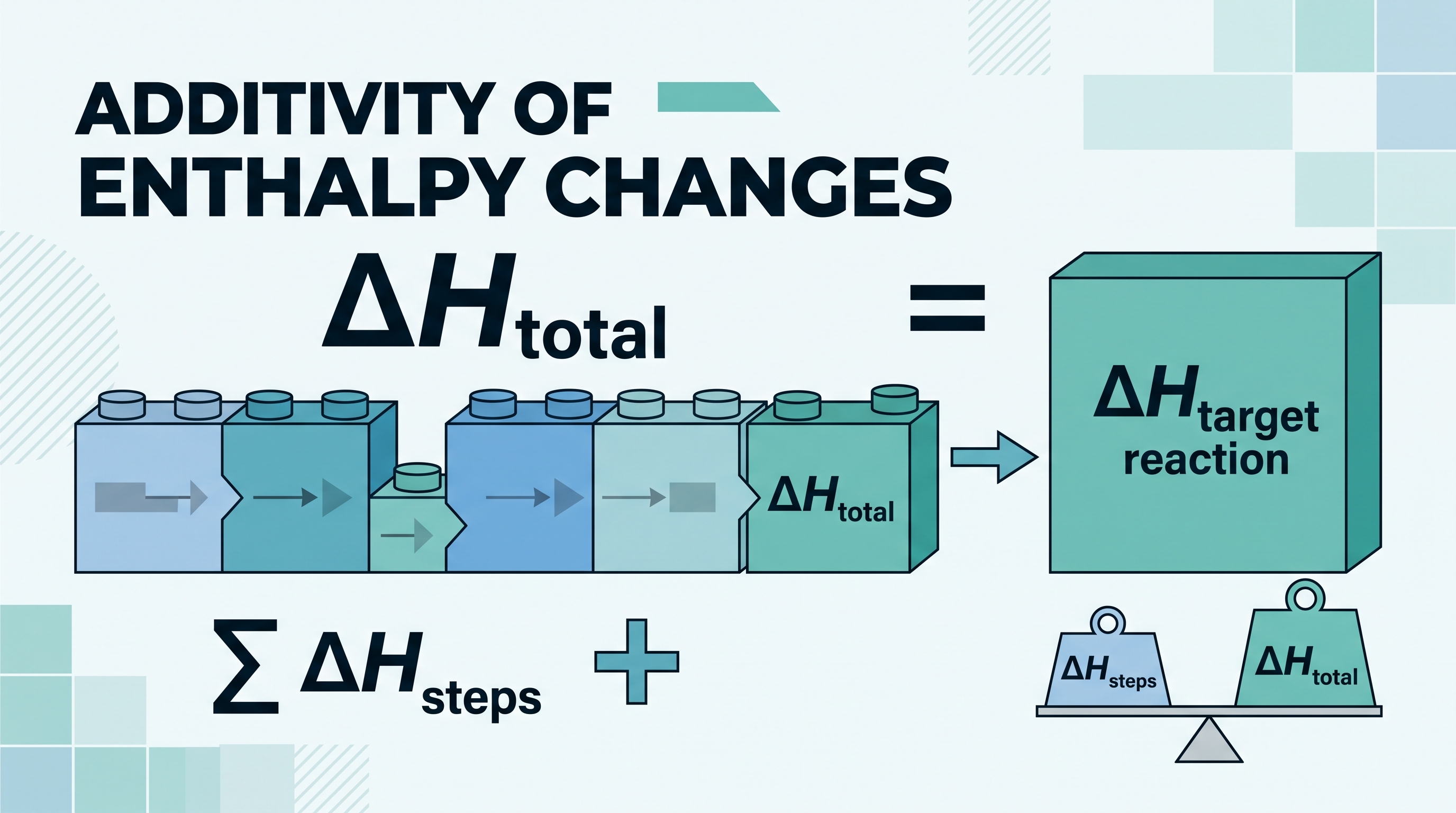
A reaction’s enthalpy change depends only on the starting substances and final substances, not on the route taken between them. Hess’s law turns that fact into a calculation method: if a target reaction can be built by adding known thermochemical equations, its overall enthalpy change is the sum of the…
6.9 Hess’s Law
A reaction’s enthalpy change depends only on the starting substances and final substances, not on the route taken between them. Hess’s law turns that fact into a calculation method: if a target reaction can be built by adding known thermochemical equations, its overall enthalpy change is the sum of the appropriately manipulated $\Delta H$ values.
Hess’s law: When chemical equations are added, their enthalpy changes are added as well—provided every equation is first adjusted so that the chemical species and coefficients combine to give the desired overall reaction.
The equation-manipulation rule
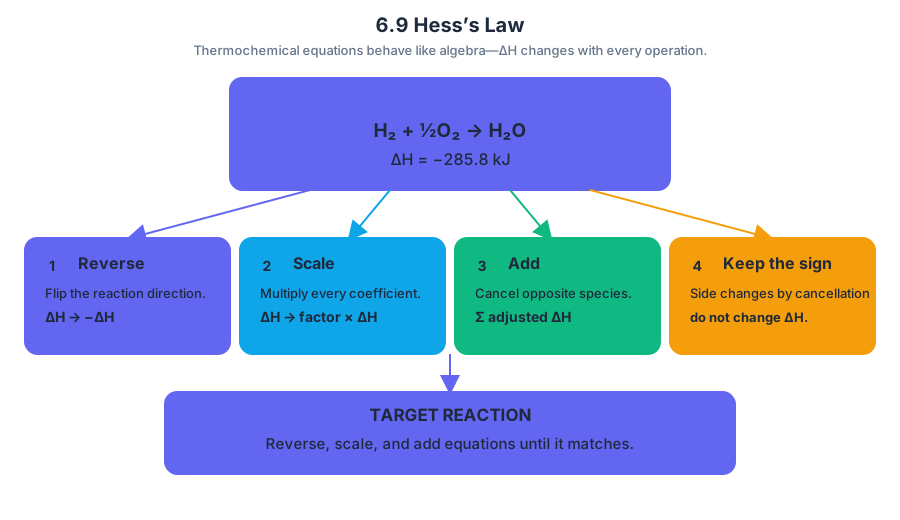
Thermochemical equations behave like algebraic equations, but their $\Delta H$ values must be manipulated at the same time.
- Reverse an equation: reverse the sign of $\Delta H$.
- Multiply every coefficient by a factor: multiply $\Delta H$ by the same factor.
- Add equations: cancel species appearing on opposite sides, then add the adjusted $\Delta H$ values.
- Do not alter $\Delta H$ merely because a species is written on a different side after cancellation; the sign changes only when the entire reaction is reversed.
Worked example: building a target reaction
Suppose the target reaction is the formation of methane from its elements:
$$ \mathrm{C(s) + 2H_2(g) \rightarrow CH_4(g)} $$
The available thermochemical equations are:
$$ \mathrm{C(s) + O_2(g) \rightarrow CO_2(g)} \qquad \Delta H_1^\circ=-393.5\ \mathrm{kJ,mol^{-1}} $$
$$ \mathrm{H_2(g) + \frac{1}{2}O_2(g) \rightarrow H_2O(l)} \qquad \Delta H_2^\circ=-285.8\ \mathrm{kJ,mol^{-1}} $$
$$ \mathrm{CH_4(g) + 2O_2(g) \rightarrow CO_2(g) + 2H_2O(l)} \qquad \Delta H_3^\circ=-890.3\ \mathrm{kJ,mol^{-1}} $$
The target contains $2\mathrm{H_2}$, so multiply the second equation by $2$:
$$ \mathrm{2H_2(g) + O_2(g) \rightarrow 2H_2O(l)} $$
$$ \Delta H_2' = 2(-285.8)=-571.6\ \mathrm{kJ,mol^{-1}} $$
The target has $\mathrm{CH_4}$ as a product, but equation $3$ has $\mathrm{CH_4}$ as a reactant. Reverse equation $3$ and change the sign of its enthalpy:
$$ \mathrm{CO_2(g) + 2H_2O(l) \rightarrow CH_4(g) + 2O_2(g)} $$
$$ \Delta H_3'=+890.3\ \mathrm{kJ,mol^{-1}} $$
Now add the three adjusted equations:
$$ \begin{aligned} \mathrm{C(s)+O_2(g)} &\rightarrow \mathrm{CO_2(g)} \ \mathrm{2H_2(g)+O_2(g)} &\rightarrow \mathrm{2H_2O(l)} \ \mathrm{CO_2(g)+2H_2O(l)} &\rightarrow \mathrm{CH_4(g)+2O_2(g)} \end{aligned} $$
Cancel $\mathrm{CO_2}$ and $\mathrm{2H_2O}$ because each appears on both sides. Cancel the two $\mathrm{O_2}$ molecules on the reactant side against the two on the product side. The result is exactly the target reaction:
Finally, add the adjusted enthalpy values:
$$ \Delta H^\circ
(-393.5)+(-571.6)+(+890.3)
-74.8\ \mathrm{kJ,mol^{-1}} $$
The negative value means that forming $1\ \mathrm{mol}$ of $\mathrm{CH_4(g)}$ from the elements, under the stated conditions, is exothermic.
Using tabulated enthalpy data
A table may provide standard enthalpy changes for reactions, including standard enthalpies of formation, $\Delta H_f^\circ$. The table values are not automatically ready to add. First compare each tabulated equation with the target: reverse, scale, or leave it unchanged as required. Only then combine the numbers.
A common scoring error is to reverse a chemical equation but keep the original sign. Another is to multiply coefficients—such as changing $1\mathrm{mol}$ of a substance to $2\mathrm{mol}$—without multiplying $\Delta H$. Both errors produce a chemically inconsistent result even if the final arithmetic is flawless.
Do not confuse enthalpy with concentration
Hess’s-law calculations use reaction equations and energy changes, not concentration values. A concentration may appear in the surrounding experimental information, but it belongs in a different calculation unless the question explicitly asks you to convert an amount into moles or determine a reaction quantity.
The same distinction applies to elemental chlorine. The atomic species $\mathrm{Cl(g)}$ has molecular mass approximately
$$ M_{\mathrm{Cl(g)}}=35.45\ \mathrm{g,mol^{-1}} $$
whereas molecular chlorine, $\mathrm{Cl_2(g)}$, has molar mass
$$ M_{\mathrm{Cl_2(g)}}=70.90\ \mathrm{g,mol^{-1}} $$
Thus, if a calculation involves $7.09\ \mathrm{g}$ of $\mathrm{Cl(g)}$:
$$ n=\frac{7.09\ \mathrm{g}}{35.45\ \mathrm{g,mol^{-1}}}=0.200\ \mathrm{mol} $$
Using $70.90\ \mathrm{g,mol^{-1}}$ would incorrectly treat chlorine atoms as $\mathrm{Cl_2}$ molecules.
AP skill connection and retrieval check
This problem pattern develops Science Practice 1: Models and Representations, because equations model chemical processes; Science Practice 4: Model Analysis, because you inspect and transform those models; and Science Practice 5: Mathematical Routines, because you scale and add enthalpy values. A strong written response also uses Science Practice 6: Argumentation when it explains why cancellation produces the target reaction.
Retrieval check: If a supplied equation is multiplied by $\frac{3}{2}$ and has $\Delta H= -40\ \mathrm{kJ,mol^{-1}}$, what enthalpy belongs to the adjusted equation? If the equation is also reversed, what is the final value?
Answer: scaling gives
$$ \Delta H=\frac{3}{2}(-40)=-60\ \mathrm{kJ,mol^{-1}} $$
Reversing the scaled equation changes the sign, so the final value is
$$ \boxed{+60\ \mathrm{kJ,mol^{-1}}} $$