From the free course AP Chemistry on Lykke
6.1 Endothermic and Exothermic Processes · 6.2 Energy Diagrams
Key concepts: Endothermic processes · Exothermic processes · Energy changes in a system · Energy transfer between a system and its surroundings · Heating and cooling of substances · Phase changes · Chemical transformations and reactions · Energy changes during bond formation · Dissolution and solution formation · Energy diagrams for physical and chemical transformations
A hand warmer becomes hot because its reacting system loses energy to its surroundings; an instant cold pack becomes cold because its dissolving system gains energy from its surroundings.
6.1 Endothermic and Exothermic Processes · 6.2 Energy Diagrams
A hand warmer becomes hot because its reacting system loses energy to its surroundings; an instant cold pack becomes cold because its dissolving system gains energy from its surroundings. The key question is not simply “Did the temperature change?” but which way did energy move, and what happened to the energy of the system?
System, surroundings, and energy change
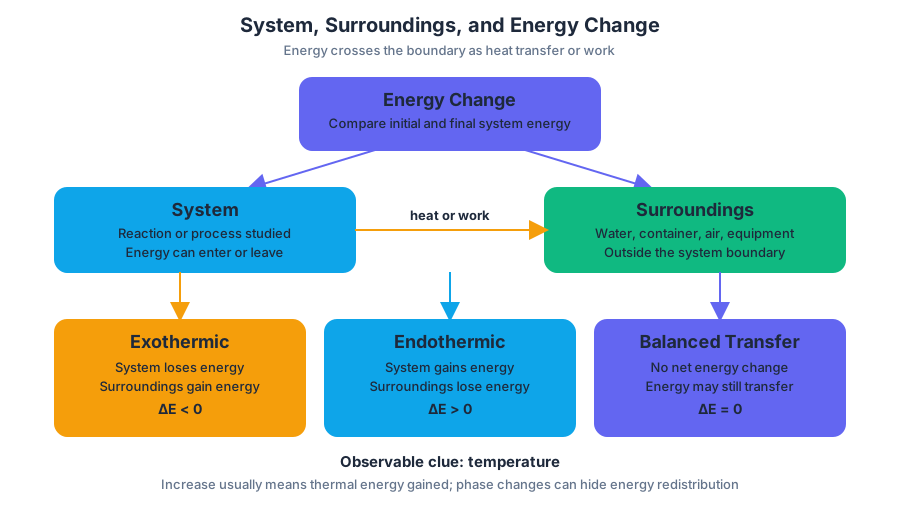
The system is the chemical reaction or physical process being studied. Everything outside it—the water, container, air, and laboratory equipment—is the surroundings. Energy can cross the boundary between them through heat transfer or work.
Exothermic process: A process in which the energy of the system decreases and energy is released to the surroundings.
Endothermic process: A process in which the energy of the system increases because energy is transferred from the surroundings to the system.
For an exothermic process, the system loses energy and the surroundings gain it. For an endothermic process, the system gains energy and the surroundings lose it. A process may also have no net energy change when energy transfers balance overall; that does not mean that no energy was transferred.
Temperature changes provide observable evidence of energy changes, as required by 6.1.A.1. If a substance remains in the same phase and comparable conditions apply, a temperature increase usually indicates that the substance gained thermal energy, while a temperature decrease indicates that it lost thermal energy. During a phase change, however, energy can be redistributed without changing temperature, so temperature alone is not a complete measure of the system’s total energy.
Chemical and physical processes
6.1.A — Learning Objective: Explain the relationship between experimental observations and energy changes associated with a chemical or physical transformation.
6.1.A.2 identifies several types of energy-changing processes: heating or cooling a substance, phase changes, and chemical transformations. Each may be endothermic, exothermic, or have no net energy change.
Consider melting ice. The solid absorbs energy as water molecules overcome some of the attractions holding them in the crystal structure. The energy is endothermic, even if the ice-water mixture remains at a nearly constant temperature while melting occurs. By contrast, when liquid water freezes, the system releases energy to the surroundings: freezing is exothermic.
A chemical reaction follows the same system–surroundings logic. In combustion, bonds in the reactants must be broken, which requires energy. New bonds form in the products, releasing energy. The reaction is exothermic when the energy released by forming product bonds exceeds the energy required to break reactant bonds.
$$ \text{energy released during product-bond formation}
\text{energy required for reactant-bond breaking} $$
Dissolution: why a mixture can heat or cool
Dissolving a substance requires changes in intermolecular or interparticle attractions. Some attractions between solute particles and some attractions between solvent particles must be disrupted; new solute–solvent attractions then form. The formation of the solution may be exothermic or endothermic, depending on the relative thermal energies involved, as stated in 6.1.A.4.
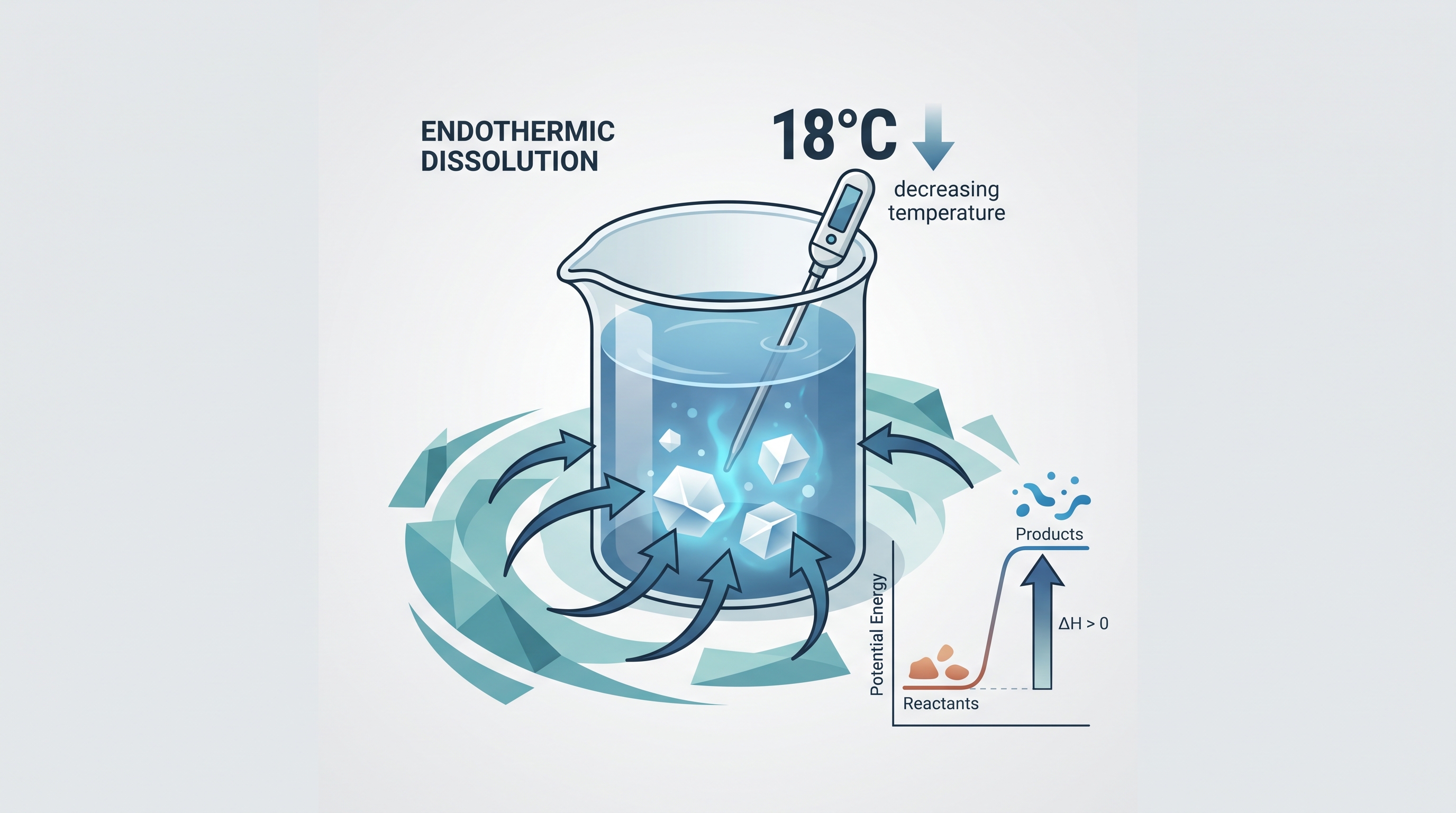
Worked example — interpreting a dissolving experiment: A solid dissolves in water, and the temperature of the mixture falls from $24.0^\circ\mathrm{C}$ to $18.5^\circ\mathrm{C}$. The mixture became colder, so energy moved from the surroundings into the dissolving system. The dissolution is therefore endothermic.
If instead the mixture warmed from $24.0^\circ\mathrm{C}$ to $31.0^\circ\mathrm{C}$, the dissolving system would have released energy to the surroundings, making the dissolution exothermic.
Misconception check — “Dissolving always absorbs heat”: Dissolution is not automatically endothermic. Its energy change depends on the balance between attractions disrupted and attractions formed. A temperature decrease is evidence for endothermic dissolution; a temperature increase is evidence for exothermic dissolution, provided the measurement conditions are comparable.
Reading energy diagrams
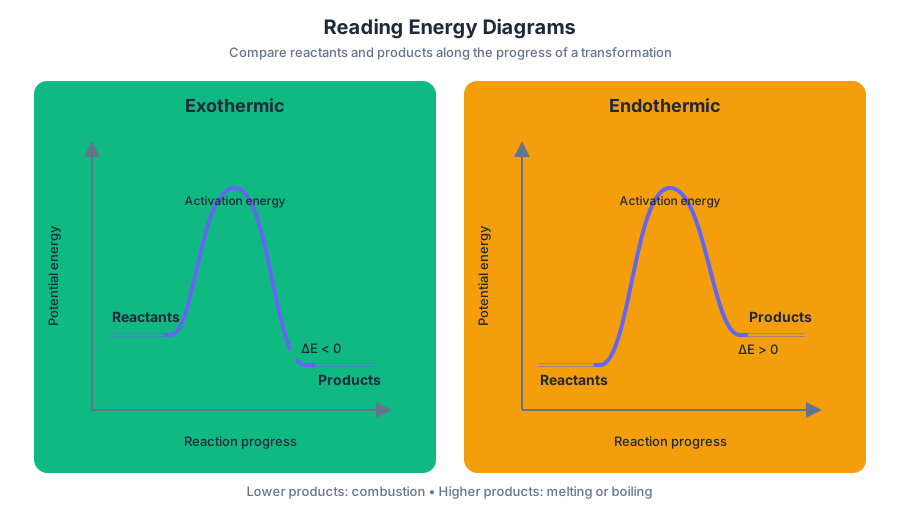
An energy diagram represents the relative energy of a system before and after a chemical or physical transformation. The vertical axis should identify energy, often potential energy, with appropriate units; the horizontal axis should show reaction progress or the progress of the transformation. This use of labeled axes and scientifically appropriate representations develops Science Practice 3.A, Representing Data and Phenomena.
For an exothermic transformation, the products lie at a lower energy than the reactants:
$$ E_{\text{products}} < E_{\text{reactants}} $$
Thus, the system’s energy decreases and the difference is transferred to the surroundings. For an endothermic transformation, the products lie at a higher energy:
The system has gained energy from the surroundings.
The same diagram logic applies to both combustion and phase changes. A combustion diagram places the products below the reactants because combustion is exothermic. A melting or boiling diagram places the final phase at higher energy than the initial phase because energy is required to separate particles against their attractions.
Argument from observations
Science Practice 6.D, Argumentation: Provide reasoning to justify a claim using chemical principles or laws, or using mathematical justification. A strong argument connects the observation, the claim, and the mechanism:
- Observation: The solution temperature decreases.
- Claim: The dissolution is endothermic.
- Reasoning: The dissolving system gained energy from the surroundings, producing the observed cooling.
Retrieval check: A reaction mixture becomes warmer, while the chemical system is the process being studied. Is the reaction endothermic or exothermic? On an energy diagram, should the products appear above or below the reactants? The answer is exothermic: energy moved into the surroundings, so the products appear at lower energy than the reactants.
Source Materials
- AP Chemistry Course and Exam Description
- AP Chemistry Course and Exam Description Clarifications and Corrections
- AP Chemistry Course Overview
- AP Chemistry Course at a Glance
- AP Chemistry Course at a Glance Poster
- Adopt AP Chemistry
- AP Chemistry
- AP Chemistry
- AP Chemistry-AP Students
- AP/College Chemistry-Khan Academy
- Guide to the AP Chemistry Exam-The Princeton Review
- AP Chemistry-Wikipedia