From the free course AP Chemistry on Lykke
9.7 Coupled Reactions · 9.8 Galvanic (Voltaic) and Electrolytic Cells
Key concepts: Coupled reactions and using an external energy source to drive thermodynamically unfavorable processes · Galvanic ( voltaic) cells · Electrolytic cells · Physical components and operational principles of electrochemical cells · Roles of electrodes, half-cell solutions, salt bridges, and voltage/current measuring devices · Oxidation and reduction at electrodes · Identifying the anode and cathode from electrode mass changes · Standard reduction potentials and electrochemical cell voltage · Stoichiometric relationships governing electrode mass changes · Relating cell descriptions and half-reactions to overall cell behavior
A redox reaction can either release usable electrical energy or consume electrical energy to force an otherwise unfavorable chemical change. The difference is the direction of energy conversion: a galvanic cell converts chemical energy into electrical energy, while an electrolytic cell uses an external energy…
9.7 Coupled Reactions · 9.8 Galvanic (Voltaic) and Electrolytic Cells
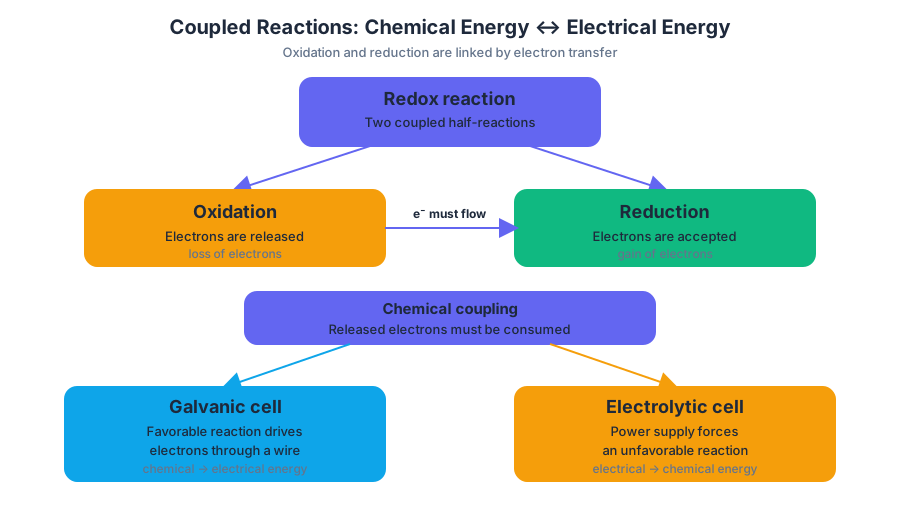
A redox reaction can either release usable electrical energy or consume electrical energy to force an otherwise unfavorable chemical change. The difference is the direction of energy conversion: a galvanic cell converts chemical energy into electrical energy, while an electrolytic cell uses an external energy source to drive a thermodynamically unfavorable reaction.
Learning Objective 9.8.A: Explain the relationship between the physical components of an electrochemical cell and the overall operational principles of the cell.
Coupled reactions: chemical energy and electrical energy
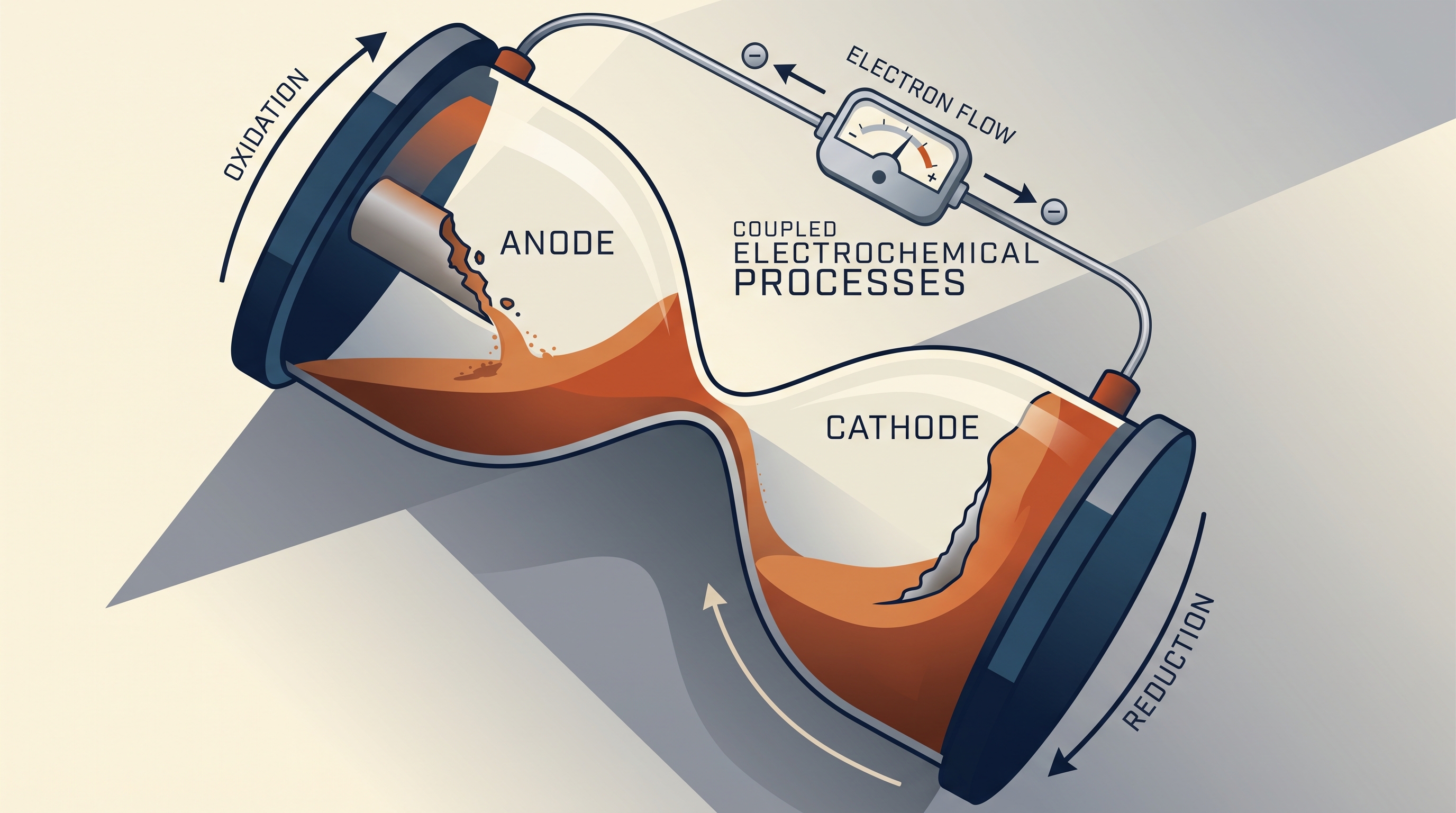
A redox reaction contains two coupled half-reactions. Oxidation removes electrons from one species, and reduction adds those electrons to another species. Because electrons released by oxidation must be consumed by reduction, the two processes cannot operate independently: they are chemically coupled.
In a galvanic cell, the favorable redox reaction is separated into two half-cells. Electrons are forced to travel through an external wire rather than transferring directly between reactants. Their movement can power a device.
An external energy source reverses this energy conversion in an electrolytic cell. A power supply pushes electrons in a direction that makes an unfavorable redox process occur. The same general idea appears when electrical energy drives electrolysis or recharges a battery; light energy can also drive an unfavorable coupled process, such as the overall conversion of carbon dioxide and water into glucose during photosynthesis.
The electrochemical-cell hardware
Essential Knowledge 9.8.A.1 requires connecting each physical component to its chemical job. A complete explanation must work at both the macroscopic level—what happens to electrodes, solutions, and meters—and the particulate level—how electrons and ions move.
| Component | Specific role |
|---|---|
| Electrodes | Conduct electrons between the half-cell reaction and the external circuit; oxidation or reduction occurs at their surfaces. |
| Half-cell solutions | Contain the dissolved ions or other reacting species involved in the half-reactions. |
| Salt bridge | Permits ion migration and maintains charge balance while preventing the two solutions from directly mixing. |
| Voltage/current measuring device | Detects the electrical potential difference or current produced by the cell. |
| External wire | Provides the pathway for electron movement between electrodes. |
The salt bridge is not an electron pathway. In a galvanic zinc–gold cell, oxidation at the zinc electrode produces additional $Zn^{2+}(aq)$, so anions from the salt bridge migrate toward the zinc half-cell. Reduction consumes $Au^{3+}(aq)$ in the gold half-cell, so cations from the salt bridge migrate toward that half-cell.
The rule that never changes
Essential Knowledge 9.8.A.3: oxidation occurs at the anode, and reduction occurs at the cathode, in every electrochemical cell.
Anode = oxidation; cathode = reduction.
This rule is more reliable than memorizing electrode signs. In a galvanic cell, the anode is the source of electrons and the cathode receives them. In an electrolytic cell, the external power supply reverses the electrical arrangement needed to force the reaction, but it does not reverse the identities of the electrodes: oxidation still occurs at the anode and reduction still occurs at the cathode.
The AP Chemistry exclusion statement is important: labeling an electrode as positive or negative will not be assessed. Identify electrodes by their half-reactions instead.
Macroscopic clues
An electrode that loses mass is undergoing oxidation and is therefore the anode. An electrode that gains mass is undergoing reduction and is therefore the cathode. Gas evolution can also reveal the half-reaction occurring at an electrode, especially in an electrolytic cell.
Named misconception — “The anode is always negative.”
That statement is not a dependable chemical rule. The electrode signs depend on whether the cell is galvanic or electrolytic; the oxidation–anode and reduction–cathode identities do not.
Worked example: a zinc–gold galvanic cell
Suppose the half-reactions are
$$ Au^{3+}(aq)+3e^- \rightarrow Au(s) $$
with $E^\circ_{\text{reduction}}=+1.50\ \text{V}$, and
$$ Zn(s)\rightarrow Zn^{2+}(aq)+2e^- $$
with $E^\circ_{\text{oxidation}}=+0.76\ \text{V}$.
Step 1: Identify the electrodes. Zinc loses electrons, so zinc is oxidized at the anode. Gold ions gain electrons, so gold forms at the cathode.
Step 2: Balance electron transfer. The least common multiple of $2$ and $3$ is $6$:
$$ 3Zn(s)\rightarrow 3Zn^{2+}(aq)+6e^- $$
$$ 2Au^{3+}(aq)+6e^-\rightarrow 2Au(s) $$
Step 3: Combine the half-reactions.
$$ 3Zn(s)+2Au^{3+}(aq)\rightarrow 3Zn^{2+}(aq)+2Au(s) $$
Electrons cancel because they are transferred internally between the coupled half-reactions.
Step 4: Calculate the standard cell potential.
$$ E^\circ_{\text{cell}}
E^\circ_{\text{reduction}}+E^\circ_{\text{oxidation}}
1.50\ \text{V}+0.76\ \text{V}
2.26\ \text{V} $$
The positive value supports a thermodynamically favorable galvanic reaction under standard conditions. Do not multiply an electrode potential by the coefficient used to balance electrons; voltage is not an extensive quantity.
Step 5: Predict mass changes. Three zinc atoms are consumed for every two gold atoms deposited. For an equal amount of transferred charge, compare
$$ 3(65.38\ \text{g mol}^{-1})=196.14\ \text{g} $$
of zinc consumed with
$$ 2(196.97\ \text{g mol}^{-1})=393.94\ \text{g} $$
of gold deposited per $6$ mol of electrons. The gold electrode gains more mass because the stoichiometric amount of gold produced has the larger total molar mass.
Science practices in action
This topic especially develops Science Practice 1: Models and Representations when interpreting cell diagrams, Science Practice 4: Model Analysis when using electron flow, ion migration, and electrode changes to infer operation, Science Practice 5: Mathematical Routines when balancing electrons and calculating $E^\circ_{\text{cell}}$, and Science Practice 6: Argumentation when justifying which electrode oxidizes, which gains mass, or whether a reaction is favorable. A voltage stated without the relevant half-reaction potentials is an unsupported claim.
Retrieval check
A cell contains an electrode that loses mass, a second electrode that gains mass, and a meter showing a positive cell potential. Identify the anode, cathode, oxidation process, reduction process, and electron-flow direction.
Answer: The mass-losing electrode is the anode and undergoes oxidation. The mass-gaining electrode is the cathode and undergoes reduction. Electrons travel through the external circuit from anode to cathode. A complete response should also identify the half-reactions and calculate or justify the measured cell potential from their potentials.