From the free course AP Chemistry on Lykke
5.9 Pre-Equilibrium Approximation · 5.10 Multistep Reaction Energy Profile
Key concepts: Pre-equilibrium approximation · Multistep reaction energy profiles · Activation energy · Overall energy change · Elementary reactions · Reaction mechanisms · Energetics of elementary reactions · Reaction energy profiles · Unit 5: Kinetics
A reaction can move quickly through a reversible first step, briefly building an intermediate, and then proceed slowly through a later step. The pre-equilibrium approximation uses that temporary equilibrium to express the concentration of the intermediate in terms of measurable reactant concentrations.
5.9 Pre-Equilibrium Approximation · 5.10 Multistep Reaction Energy Profile
A reaction can move quickly through a reversible first step, briefly building an intermediate, and then proceed slowly through a later step. The pre-equilibrium approximation uses that temporary equilibrium to express the concentration of the intermediate in terms of measurable reactant concentrations.
Pre-equilibrium approximation: turning an intermediate into a rate law
Consider the mechanism
A+B \rightleftharpoons I
$$ I+C \longrightarrow P $$
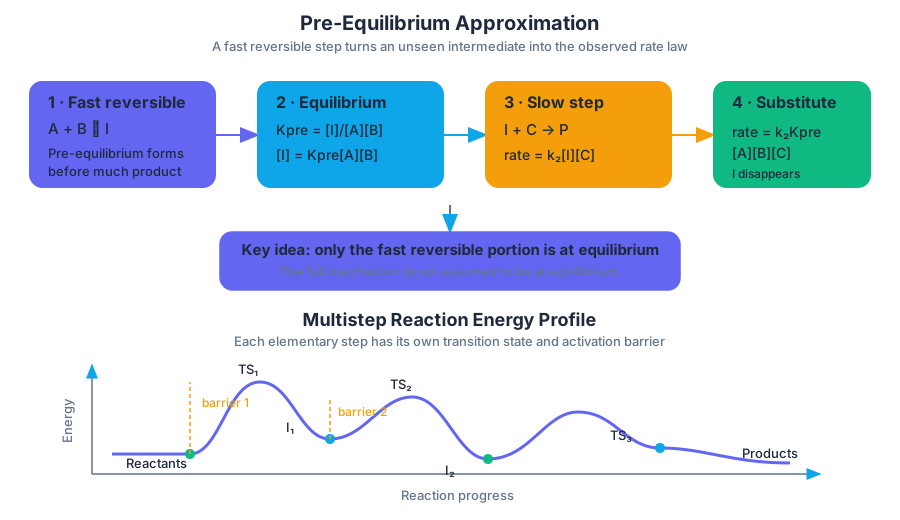
Here, $I$ is an intermediate: it is formed in one elementary reaction and consumed in another, so it does not appear in the overall reaction. If the first step is fast and reversible while the second step is slow, the first step can establish a pre-equilibrium before much product forms.
For the fast reversible step, write the equilibrium expression
$$ K_{\mathrm{pre}}=\frac{[I]}{[A][B]} $$
and solve for the intermediate concentration:
$$ [I]=K_{\mathrm{pre}}[A][B] $$
The slow elementary step determines the reaction rate:
$$ \text{rate}=k_2[I][C] $$
Substituting the pre-equilibrium expression gives
$$ \text{rate}=k_2K_{\mathrm{pre}}[A][B][C] $$
Thus, the experimentally observed rate law can contain $[A]$, $[B]$, and $[C]$, even though the intermediate $I$ never appears in the final rate law.
The key reasoning chain is:
$$ \text{fast reversible step} \longrightarrow \text{equilibrium expression for }[I] \longrightarrow \text{slow-step rate law} \longrightarrow \text{substitution} $$
This is not the same as assuming that every mechanism is at equilibrium. Only the designated fast reversible portion is treated as being in equilibrium.
Conditions and misconception check
Named misconception — “The slow step always gives the final rate law directly.” The slow step gives the rate law in terms of the species participating in that elementary step. If that step contains an intermediate, the intermediate concentration must be replaced using the pre-equilibrium relationship.
Named misconception — “Pre-equilibrium means the entire reaction has reached equilibrium.” It does not. Reactants may still be steadily converted into products. The approximation concerns a rapidly equilibrating early step, while the slower step continues to drain the intermediate toward products.
The approximation becomes unreliable when the first step does not establish equilibrium rapidly relative to the step that consumes the intermediate, or when the assumed slow step is not actually rate-controlling. Always check that the proposed mechanism and approximation are chemically consistent with the observed rate law.
From elementary reactions to an energy profile
A reaction energy profile plots chemical potential energy vertically against reaction progress horizontally. A single elementary reaction has one energy barrier: the peak represents the transition state, and the vertical distance from the reactants to that peak is the activation energy, $E_a$.
A multistep reaction energy profile is different from a general one-step profile because it displays the energetic sequence of several elementary reactions in a mechanism. Each additional elementary step contributes another peak and, usually, another valley.
For a mechanism
$$ R \longrightarrow I_1 \longrightarrow I_2 \longrightarrow P $$
the profile contains:
- the initial reactants, $R$;
- a peak for the transition state of step 1;
- the intermediate $I_1$;
- a peak for step 2;
- the intermediate $I_2$;
- a peak for step 3;
- the final products, $P$.
Each valley between peaks represents an intermediate, not a transition state.
Reading activation energy and overall energy change
Learning Objective 5.10.A: Represent the activation energy and overall energy change in a multistep reaction with a reaction energy profile.
Essential Knowledge 5.10.A.1: Knowledge of the energetics of each elementary reaction in a mechanism allows for the construction of an energy profile for a multistep reaction.
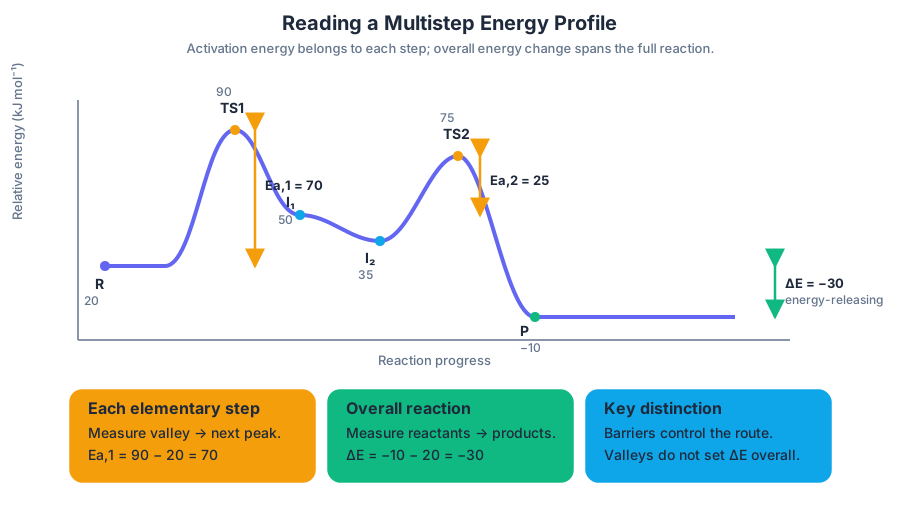
For every elementary step, measure activation energy from that step’s starting valley to its next peak:
$$ E_{a,1}=E_{\mathrm{TS1}}-E_R $$
$$ E_{a,2}=E_{\mathrm{TS2}}-E_{I_1} $$
The overall energy change is measured only from the initial reactants to the final products:
$$ \Delta E_{\mathrm{overall}}=E_P-E_R $$
If the products lie lower than the reactants, the overall reaction is energy-releasing; if they lie higher, it is energy-absorbing. The intermediate valleys affect the route but do not determine the overall energy change.
Worked profile interpretation. Suppose a multistep profile assigns the relative energies
$$ E_R=20\ \mathrm{kJ,mol^{-1}},\quad E_{I_1}=50\ \mathrm{kJ,mol^{-1}},\quad E_{\mathrm{TS1}}=90\ \mathrm{kJ,mol^{-1}} $$
$$ E_{I_2}=35\ \mathrm{kJ,mol^{-1}},\quad E_{\mathrm{TS2}}=75\ \mathrm{kJ,mol^{-1}},\quad E_P=-10\ \mathrm{kJ,mol^{-1}} $$
Then
$$ E_{a,1}=90-20=70\ \mathrm{kJ,mol^{-1}} $$
and
$$ E_{a,2}=75-50=25\ \mathrm{kJ,mol^{-1}} $$
while
$$ \Delta E_{\mathrm{overall}}=-10-20=-30\ \mathrm{kJ,mol^{-1}} $$
The reaction has a large first barrier but an overall energy decrease of $30\ \mathrm{kJ,mol^{-1}}$. Those are different quantities.
Skill focus: constructing the model
Suggested Skill 3.B: Representing Data and Phenomena means representing chemical substances or phenomena with appropriate diagrams or models. For a multistep profile, an effective model must show the relative energy of reactants, products, intermediates, and transition states; include one peak for each elementary reaction; label relevant activation energies; and show the overall energy change between the starting and ending species.
Named misconception — “The highest point is always the activation energy.” The highest point is a transition-state energy. An activation energy is a difference between a transition-state energy and the energy of the species immediately before that step. The overall rate-controlling barrier is identified by the largest relevant activation-energy difference, not merely by the peak with the greatest absolute height.
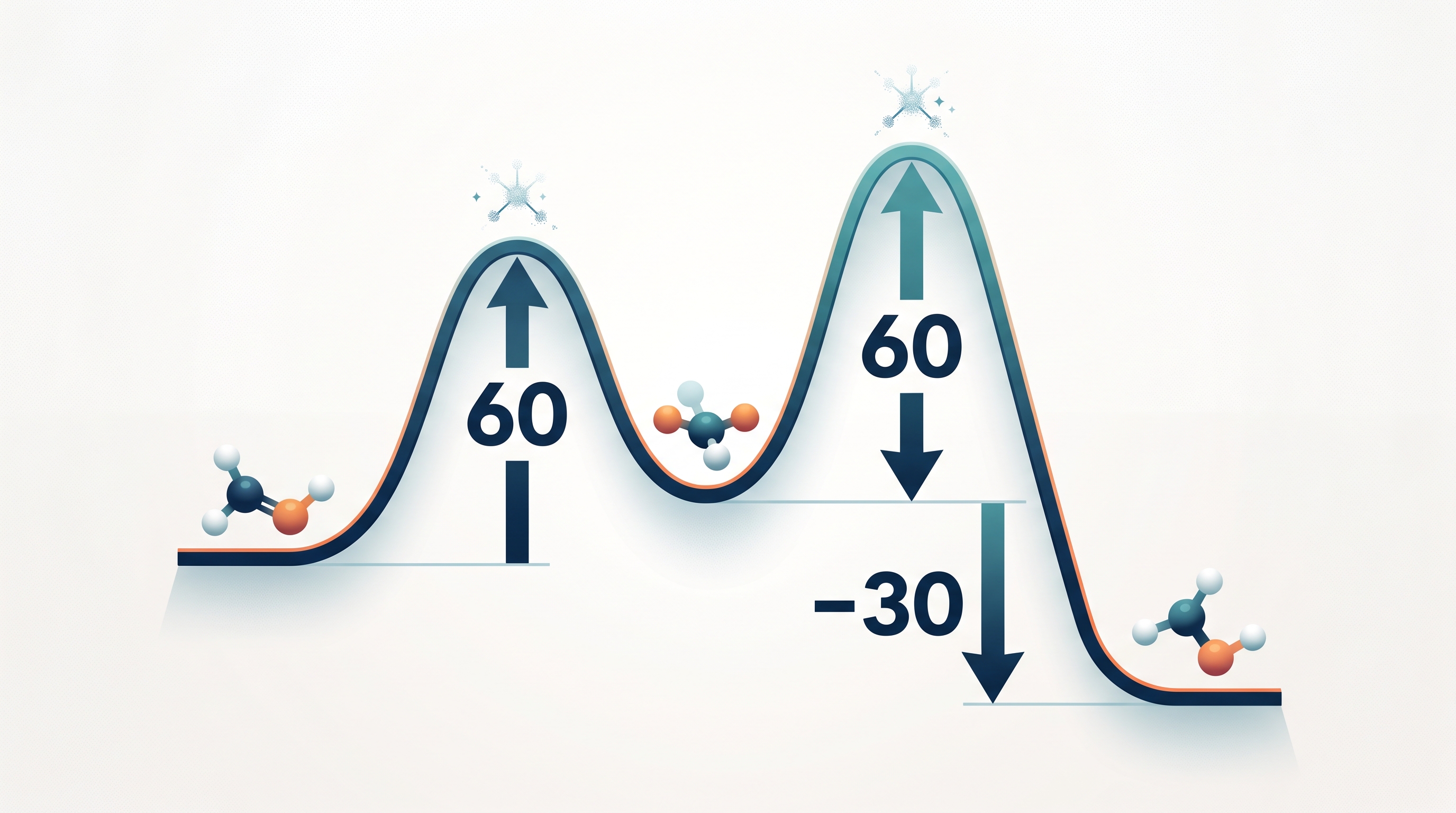
Retrieval check: A profile begins at $40\ \mathrm{kJ,mol^{-1}}$, reaches a first peak at $100\ \mathrm{kJ,mol^{-1}}$, falls to an intermediate at $60\ \mathrm{kJ,mol^{-1}}$, rises to a second peak at $120\ \mathrm{kJ,mol^{-1}}$, and ends at $10\ \mathrm{kJ,mol^{-1}}$. The answers are $E_{a,1}=60\ \mathrm{kJ,mol^{-1}}$, $E_{a,2}=60\ \mathrm{kJ,mol^{-1}}$, and $\Delta E_{\mathrm{overall}}=-30\ \mathrm{kJ,mol^{-1}}$. The equal activation energies do not make the two steps identical: their intermediates, molecular changes, and rate constants may still differ.