From the free course AP Chemistry on Lykke
6.3 Heat Transfer and Thermal Equilibrium · 6.4 Heat Capacity and Calorimetry
Key concepts: Heat transfer between bodies in thermal contact · Thermal equilibrium · Particle collisions and transfer of thermal energy · Average kinetic energy and temperature · Specific heat capacity · Heat capacity · The heat-transfer equation · Calorimetry and energy conservation · Temperature change dependence on mass · Units of specific heat capacity
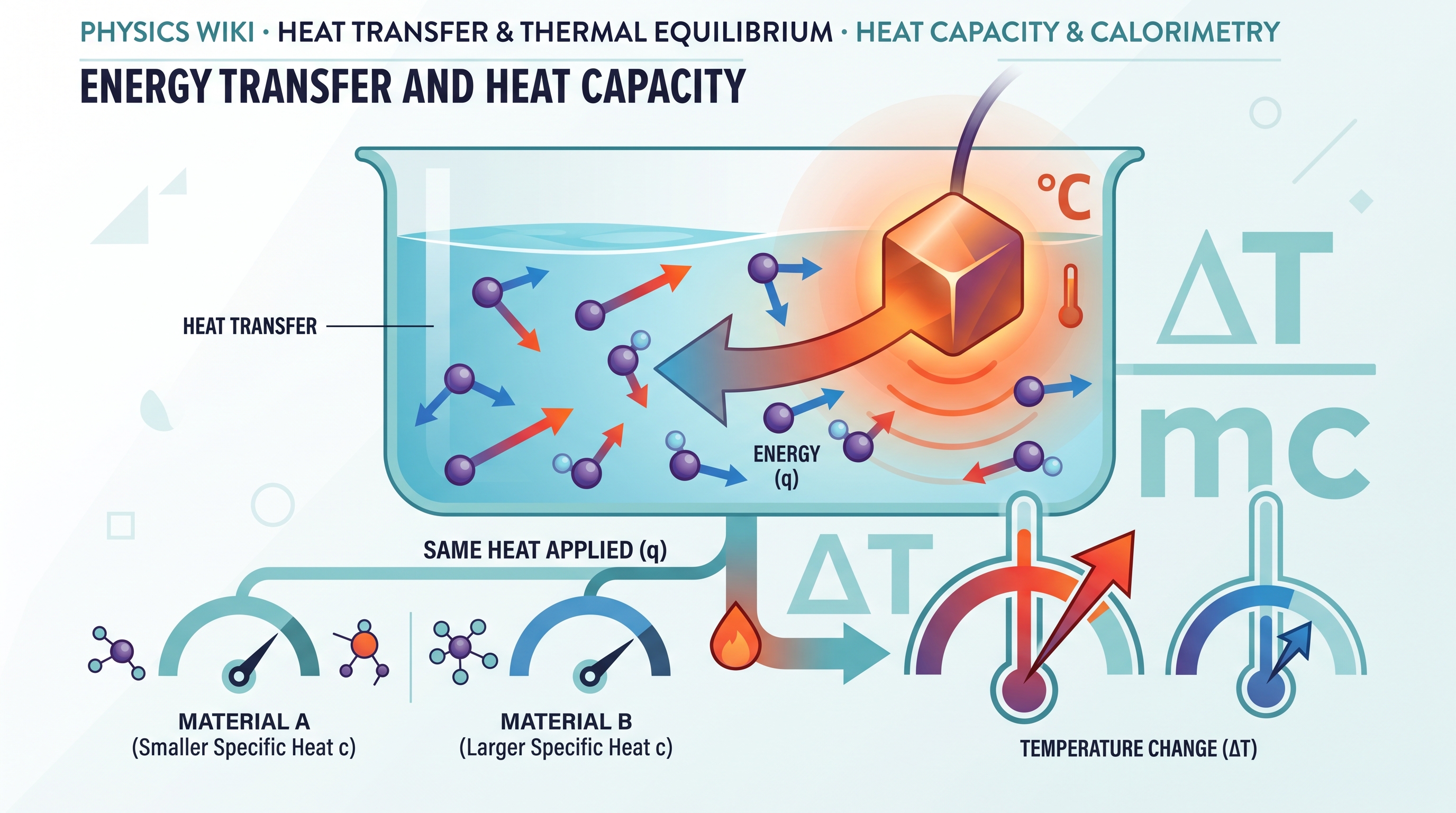
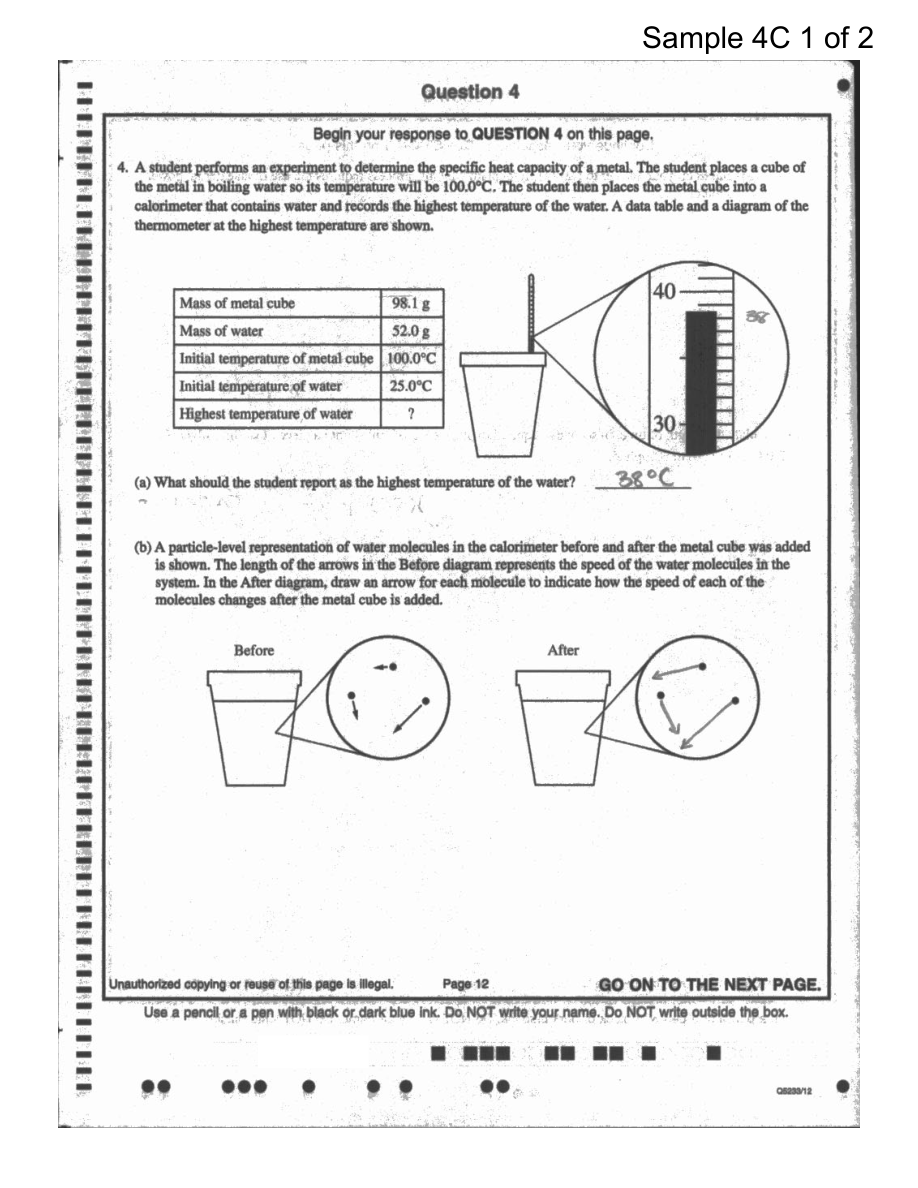
When a hot metal cube is dropped into cooler water, the metal cools while the water warms because microscopic collisions transfer thermal energy from faster-moving particles to slower-moving particles.
6.3 Heat Transfer and Thermal Equilibrium · 6.4 Heat Capacity and Calorimetry
When a hot metal cube is dropped into cooler water, the metal cools while the water warms because microscopic collisions transfer thermal energy from faster-moving particles to slower-moving particles.
Thermal energy moves through collisions
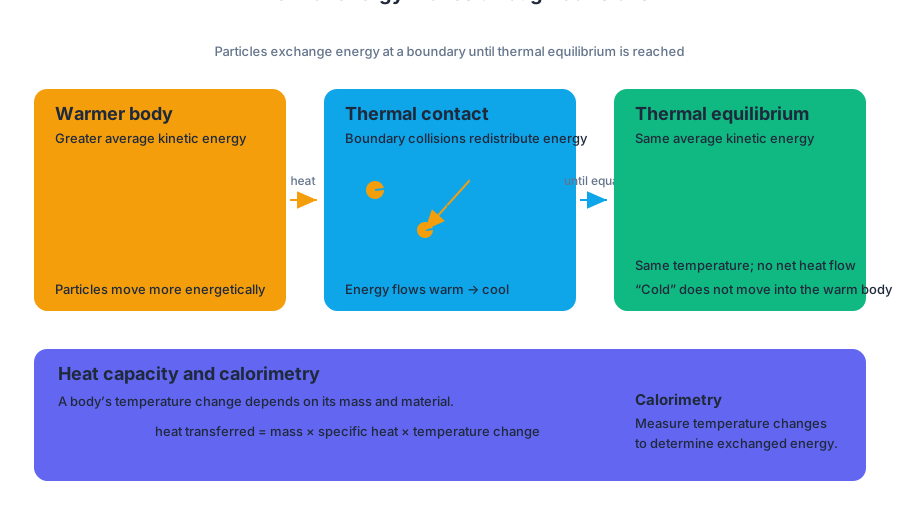
The particles in a warmer body have a greater average kinetic energy, meaning their particles move, vibrate, or rotate more energetically on average, than particles in a cooler body. When the two bodies are in thermal contact, particles at their boundary collide and redistribute energy.
The energy transfer is not caused by “cold moving” into the warmer object. Thermal energy is transferred as heat from the warmer body to the cooler body until both bodies have the same average kinetic energy and therefore the same temperature.
6.3.A.1: The particles in a warmer body have a greater average kinetic energy than those in a cooler body.
6.3.A.2: Collisions between particles in thermal contact can result in the transfer of energy; this is called heat transfer, heat exchange, or transfer of energy as heat.
6.3.A.3: At thermal equilibrium, the average kinetic energy and temperature of both bodies are the same.
Misconception check — “Thermal equilibrium means equal amounts of energy.” Not necessarily. Two objects can reach the same temperature while containing very different total thermal energies because total energy depends on the quantity of matter and the substance’s heat capacity. Thermal equilibrium means equal temperature, not equal mass or equal stored energy.
Quantifying heating and cooling
The heat transferred during a temperature change can be calculated with the heat-transfer equation:
$$q=mc\Delta T$$
Here, $q$ is the heat absorbed or released, $m$ is the mass, $c$ is the specific heat capacity, and $\Delta T$ is the temperature change:
$$\Delta T=T_{\text{final}}-T_{\text{initial}}$$
Specific heat capacity measures how much energy is required to change the temperature of one unit of mass by one degree. A common unit is $\mathrm{J/(g\cdot{}^\circ C)}$. Aluminum, for example, has a specific heat capacity of approximately:
$$c_{\text{Al}}=0.90\ \mathrm{J/(g\cdot{}^\circ C)}$$
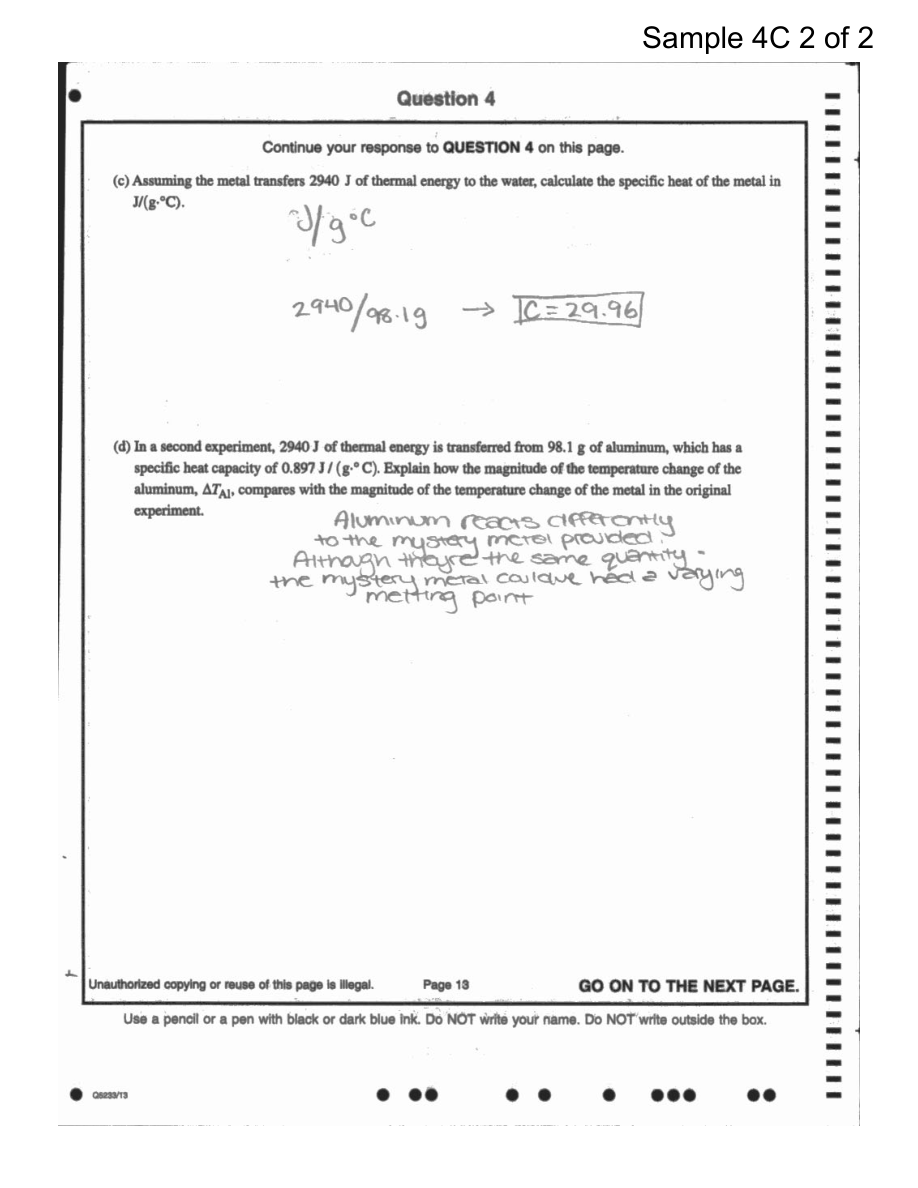
For a fixed mass and temperature change, a larger $c$ requires more heat. Conversely, if equal masses receive the same amount of thermal energy, the substance with the smaller specific heat capacity undergoes the larger temperature change.
| Substance receiving the same heat | Relative specific heat capacity | Temperature change |
|---|---|---|
| Lower-$c$ substance | Smaller | Larger |
| Higher-$c$ substance | Larger | Smaller |
Worked comparison. Suppose $100\ \mathrm{g}$ of aluminum receives $900\ \mathrm{J}$:
$$\Delta T=\frac{q}{mc}=\frac{900\ \mathrm{J}}{(100\ \mathrm{g})(0.90\ \mathrm{J/(g\cdot{}^\circ C)})}=10.0^\circ\mathrm{C}$$
The same $900\ \mathrm{J}$ transferred to $100\ \mathrm{g}$ of water, with $c=4.18\ \mathrm{J/(g\cdot{}^\circ C)}$, produces:
$$\Delta T=\frac{900\ \mathrm{J}}{(100\ \mathrm{g})(4.18\ \mathrm{J/(g\cdot{}^\circ C)})}=2.15^\circ\mathrm{C}$$
The aluminum changes temperature more because each gram of aluminum requires less energy per degree.
Heat capacity and energy conservation
Heat capacity, represented by $C$, is the amount of heat needed to change the temperature of an entire object by one degree. Unlike specific heat capacity, which is intensive and independent of sample size, heat capacity depends on how much substance is present:
$$q=C\Delta T$$
Because $C=mc$, the two equations are equivalent:
$$q=mc\Delta T=C\Delta T$$
The first law of thermodynamics states that energy is conserved. In an insulated calorimetry experiment, heat lost by one body is gained by another:
$$q_{\text{hot}}+q_{\text{cold}}=0$$
A positive $q$ indicates that a body absorbs heat; a negative $q$ indicates that it releases heat. Heating increases a system’s energy, while cooling decreases it.
Calorimetry: measuring an unknown heat capacity
Calorimetry determines heat transfer by tracking temperature changes, usually while limiting heat exchange with the surroundings. A hot metal placed in cooler water provides a direct application: calculate the water’s heat gain, set it equal in magnitude to the metal’s heat loss, and solve for the metal’s specific heat.
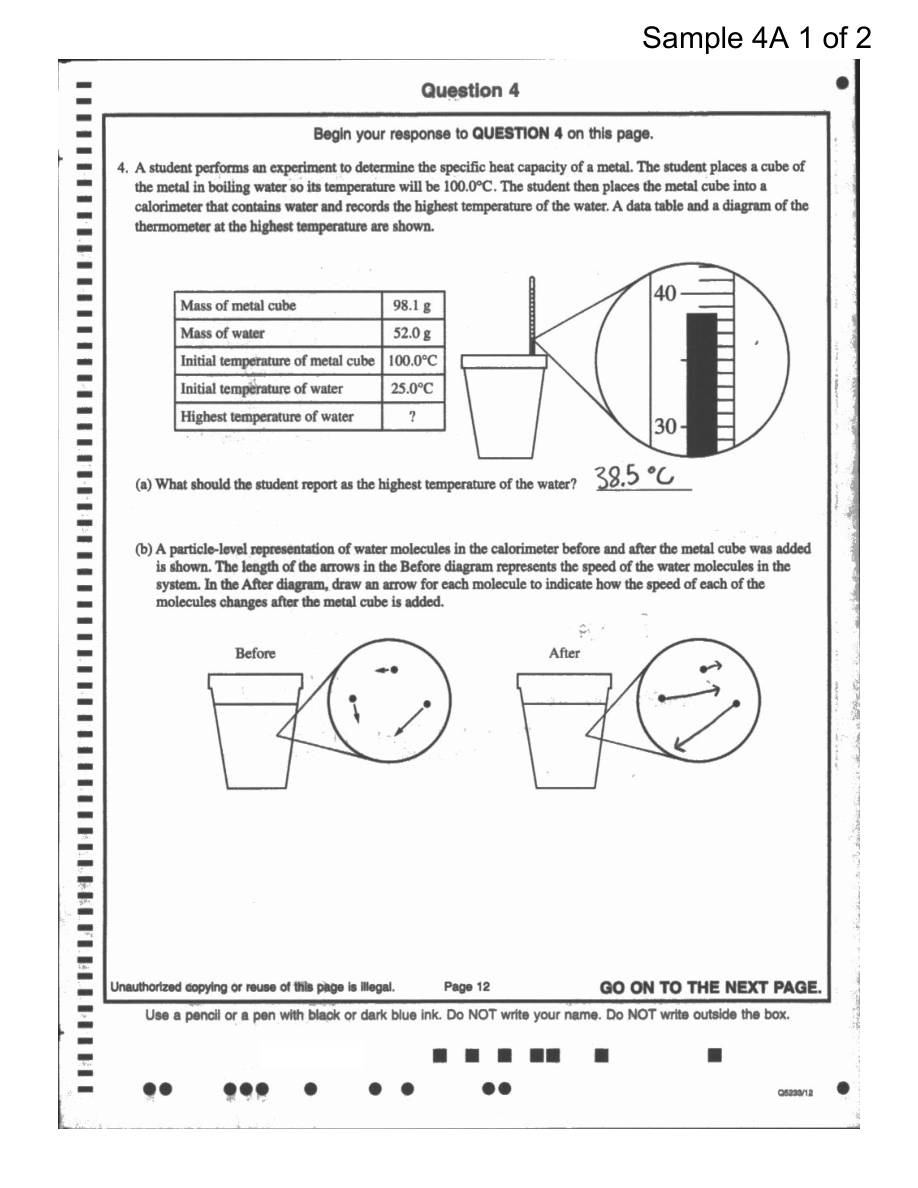
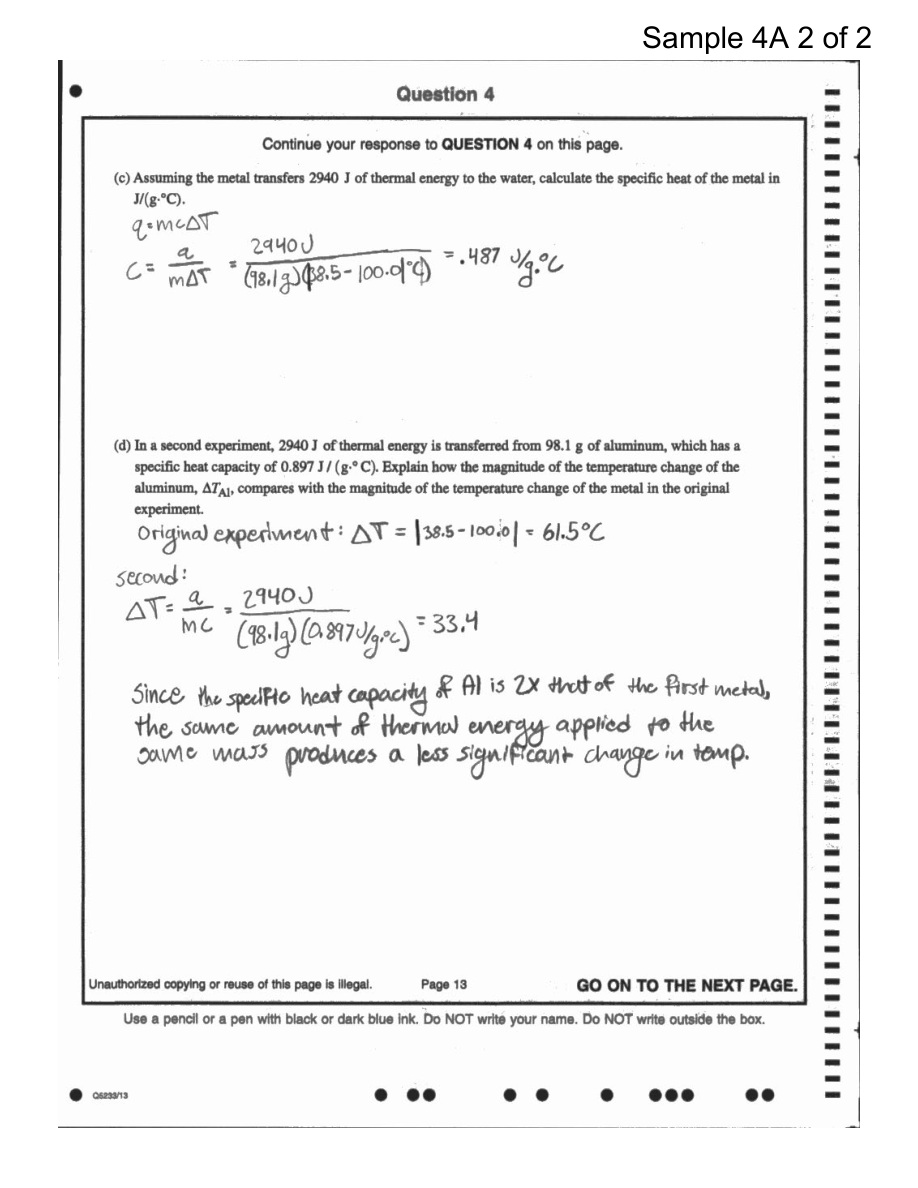
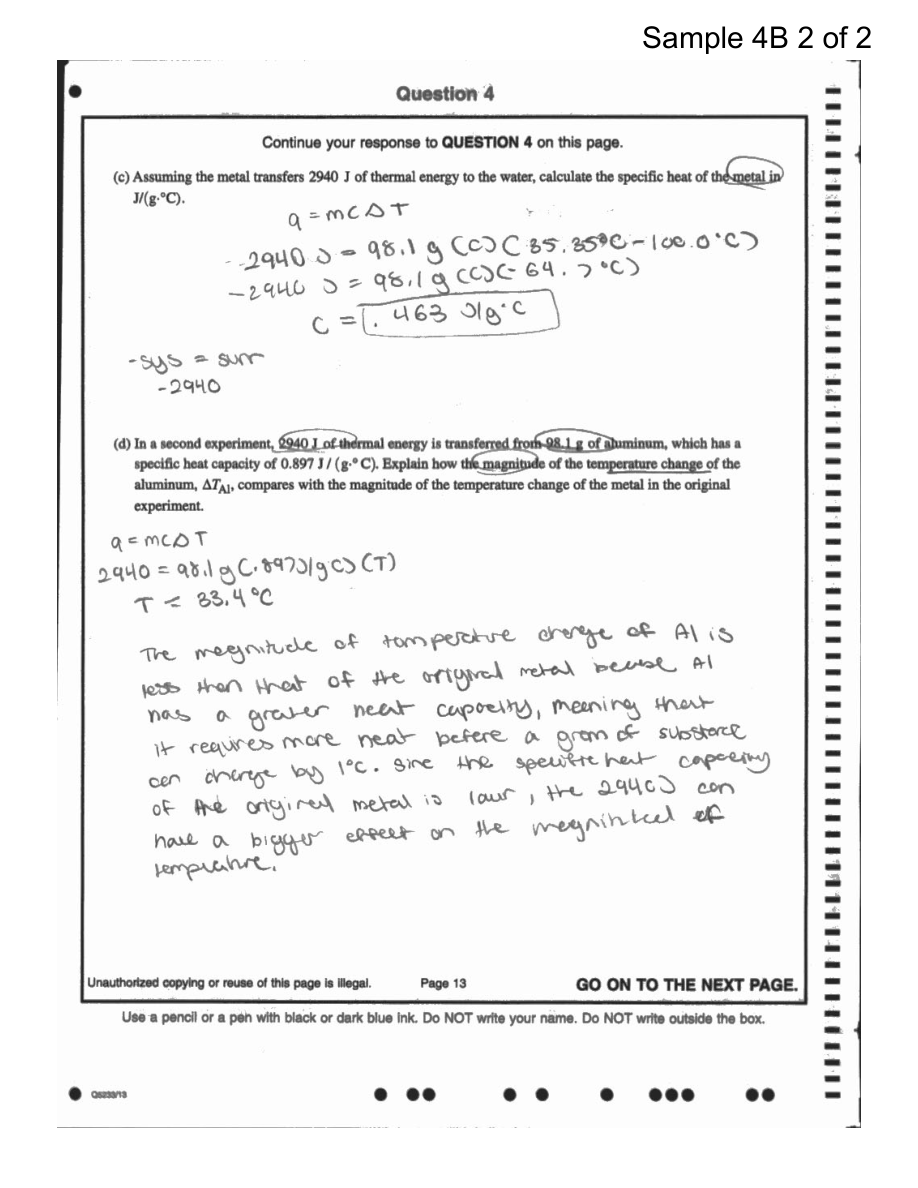
Worked calorimetry example. A $98.1\ \mathrm{g}$ metal sample cools from $100.0^\circ\mathrm{C}$ to $38.5^\circ\mathrm{C}$ and releases $2940\ \mathrm{J}$. Thus:
$$q_{\text{metal}}=-2940\ \mathrm{J}$$
$$\Delta T_{\text{metal}}=38.5^\circ\mathrm{C}-100.0^\circ\mathrm{C}=-61.5^\circ\mathrm{C}$$
Solving $q=mc\Delta T$ for the unknown specific heat gives:
$$c_{\text{metal}}=\frac{q_{\text{metal}}}{m_{\text{metal}}\Delta T_{\text{metal}}} =\frac{-2940\ \mathrm{J}}{(98.1\ \mathrm{g})(-61.5^\circ\mathrm{C})} =0.487\ \mathrm{J/(g\cdot{}^\circ C)}$$
The two negative signs are important: the metal releases heat and its temperature decreases. Their ratio produces the positive specific heat capacity expected for a substance.
AP reasoning in action
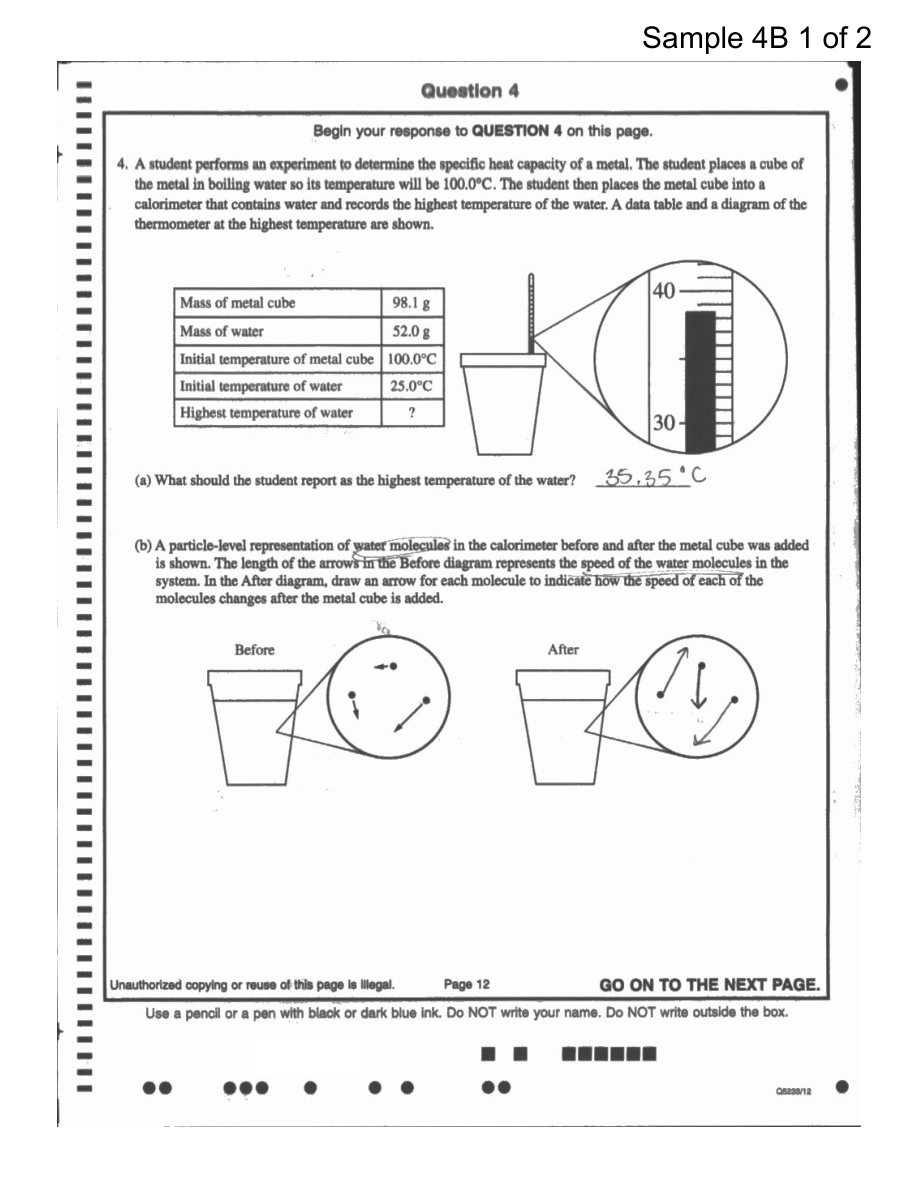
This topic uses Science Practice 1: Models and Representations when particle arrows represent average kinetic energy, Science Practice 3: Representing Data and Phenomena when a temperature change is connected to a microscopic collision model, and Science Practice 5: Mathematical Routines when $q=mc\Delta T$ and energy conservation are applied. A strong explanation connects all three: the hot sample’s particles collide with cooler-water particles, transfer energy, and produce the measured temperature changes.
Retrieval check. Two equal-mass samples absorb the same heat. Sample A has a smaller specific heat capacity than Sample B. Which sample has the larger $\Delta T$, and why? The correct reasoning is that Sample A has the larger temperature change because $\Delta T=q/(mc)$ and its smaller $c$ makes the denominator smaller.
Source Materials
- AP Chemistry Course and Exam Description
- AP Chemistry Course and Exam Description Clarifications and Corrections
- AP Chemistry Course Overview
- AP Chemistry Course at a Glance
- AP Chemistry Course at a Glance Poster
- Adopt AP Chemistry
- AP Chemistry
- AP Chemistry
- Figure — Sample Responses Q4 (p. 3)
- Figure — Sample Responses Q4 (p. 4)
- Figure — Sample Responses Q4 (p. 5)
- Figure — Sample Responses Q4 (p. 6)