From the free course AP Chemistry on Lykke
4.3 Representations of Reactions · 4.4 Physical and Chemical Changes
Key concepts: Representing chemical phenomena using data from laboratory setups or experimental results · Using evidence to explain changes and interactions of chemical substances · Distinguishing physical changes from chemical changes · Physical changes involve rearrangement of interactions without changing the substances · Melting as an example of a physical change · Formation and separation of mixtures as common physical changes · Chemical changes alter substances and produce different chemical species · Using representations of atoms or molecules to interpret chemical phenomena · Identifying potential sources of experimental error · Justifying claims about chemical phenomena with evidence and chemical principles
A substance can melt, mix, react, or separate while the visible result changes dramatically; the decisive question is whether the particles themselves remain the same.
4.3 Representations of Reactions · 4.4 Physical and Chemical Changes
A substance can melt, mix, react, or separate while the visible result changes dramatically; the decisive question is whether the particles themselves remain the same. Chemistry answers that question by connecting laboratory observations to particle-level representations and evidence.
Physical changes: new arrangement, same substances
Essential Knowledge 4.1.A.1: A physical change occurs when a substance undergoes a change in properties but not a change in composition.
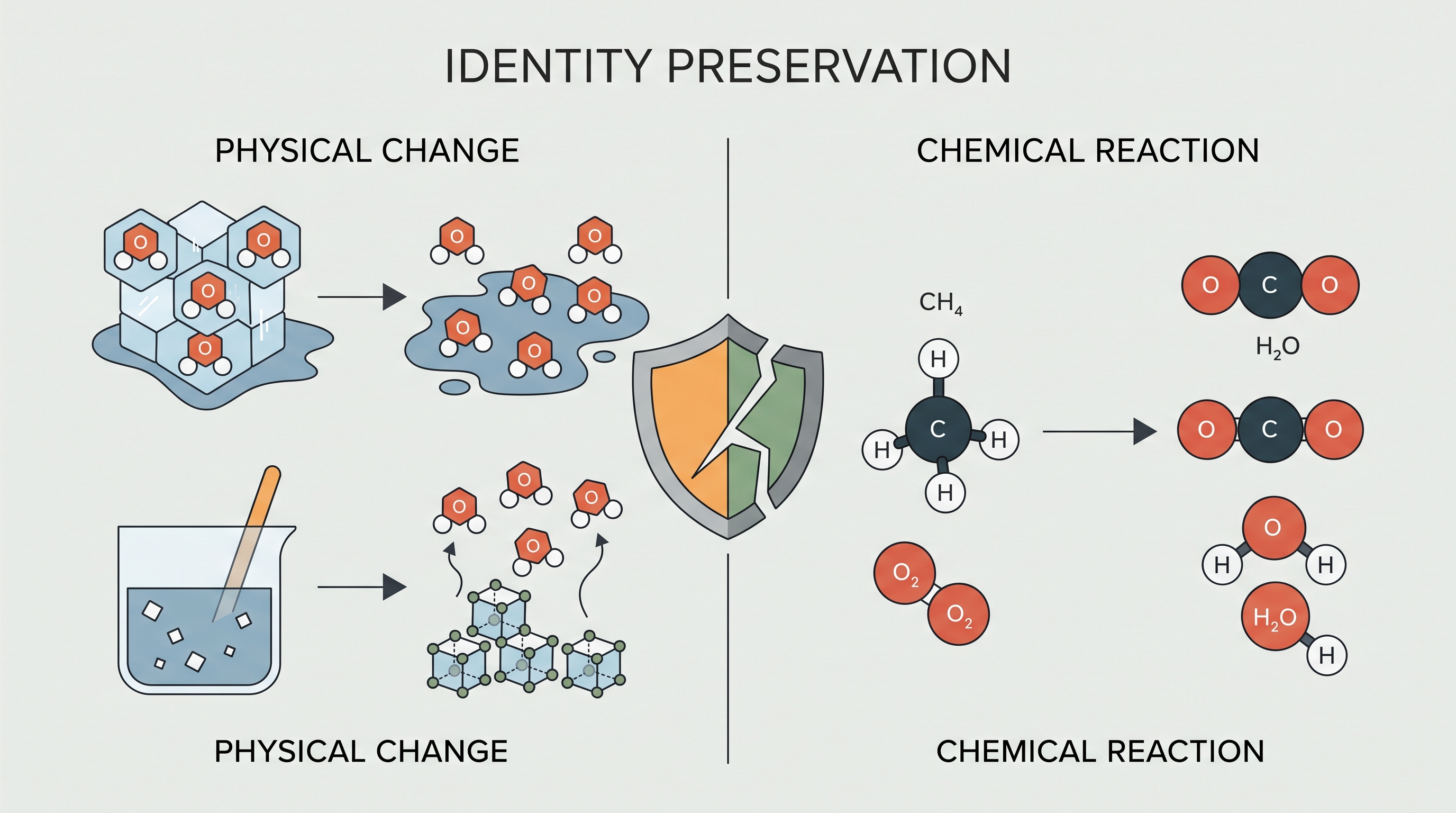
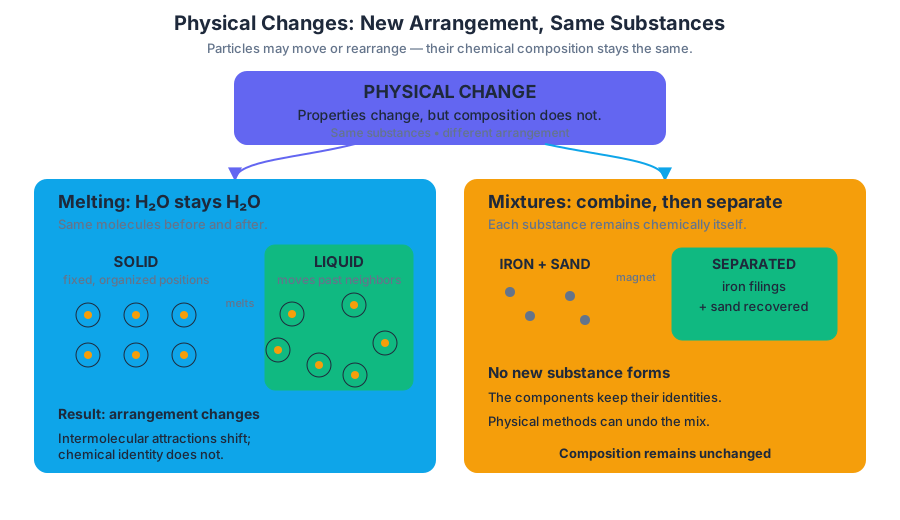
During a physical change, the particles may move differently, spread farther apart, or rearrange their interactions, but the particles remain chemically identical. Melting is the classic example: solid water becomes liquid water, yet the particles are still $H_2O$ molecules.
A particle-level model of melting should show the same molecules before and after:
- Solid: $H_2O$ molecules occupy relatively fixed positions and vibrate in an organized arrangement.
- Liquid: the same $H_2O$ molecules remain present, but they move past one another and have less constrained arrangements.
- Conclusion: intermolecular attractions and particle arrangement change; chemical composition does not.
Formation and separation of mixtures are also common physical changes. Combining iron filings and sand produces a mixture containing iron and sand, not a new substance made from them. A magnet can then separate the iron because the original substances retain their identities. Similarly, evaporating water from a salt solution separates water from dissolved salt without requiring the salt particles to become a different chemical species.
Chemical changes: different chemical species
Essential Knowledge 4.1.A.2: A chemical change occurs when substances are transformed into new substances, typically with different compositions.
A chemical change rearranges atoms into new combinations. The atoms are not destroyed, but the original molecules or ions are transformed, so the products have different chemical identities and properties from the reactants.
Possible laboratory evidence includes production of heat or light, formation of a gas, formation of a precipitate, or a color change. These observations are clues, not automatic proof: a temperature change can result from physical dissolving, and a color change can arise from dilution or mixing. The strongest claim connects several observations to a particle-level explanation.
From laboratory evidence to a chemical claim
Use the following reasoning chain when interpreting an experimental setup or data table:
- Observation: State exactly what was measured or seen.
- Evidence: Identify the relevant change in temperature, color, gas production, precipitate formation, mass, or phase.
- Particle representation: Describe whether particles merely changed arrangement or were transformed into new species.
- Chemical principle: Use conservation of atoms and the distinction between composition and arrangement.
- Claim: Conclude whether the evidence supports a physical or chemical change.
Worked example — two samples in the laboratory. A student observes that ice melts in one beaker. In another, two clear solutions are mixed; the mixture becomes cloudy and a solid settles.
- For the ice, the observation is a phase change from solid to liquid. A particle model contains $H_2O$ molecules before and after, so the change is physical.
- For the mixed solutions, the observation is formation of a precipitate. If the solid contains a new combination of ions, the particle model shows new chemical species forming, so the evidence supports a chemical change.
- The conclusion is not based merely on “something visible happened.” It follows from comparing particle identities and composition.
Misconception check — “Any color change proves a reaction.” Not necessarily. A color may become lighter because a solution was diluted, which changes the arrangement and concentration of particles without creating a new substance. Color change becomes stronger evidence for chemical change when it occurs with other evidence, such as gas formation or precipitate formation, and when a particle-level explanation accounts for it.
Representations, data, and experimental error
Chemical phenomena can be represented at several levels: a laboratory photograph or data table shows the macroscopic level; particle diagrams show atoms, molecules, or ions; and chemical equations symbolize the transformation. A good representation preserves the important evidence rather than merely illustrating appearance.
Science Practice 2 — Question and Method, Skill 2.B: “Identify evidence of chemical and physical changes in matter.” A student applying this skill must formulate a hypothesis or predict results, then decide which observations would distinguish unchanged substances from newly formed species.
Science Practice 2 — Question and Method, Skill 2.E: “Identify or describe potential sources of experimental error.” Examples include a thermometer touching the container instead of the solution, incomplete mixing, contamination from a previous trial, an unreadable precipitate, or gas escaping before its amount is recorded. Each error should be tied to its likely effect on the evidence.
Science Practice 2 — Question and Method, Skill 2.F: “Explain how modifications to an experimental procedure will alter results.” For example, if a student removes a filter paper before all liquid has passed through, some solid may remain in the filtrate. The apparent separation is then incomplete—not because the substances changed identity, but because the procedure failed to isolate them fully.
Science Practice 3 — Create representations or models of chemical phenomena requires translating observations into a particle-level model. Science Practice 4 — Model Analysis asks whether that model actually explains the data. Science Practice 6 — Argumentation requires supporting the physical- or chemical-change claim with evidence and chemical principles rather than with an unsupported visual impression.
Retrieval check
Which events are definitely physical changes: ice melting and salt-solution evaporation? Explain why both preserve particle identity and composition. In ice melting, $H_2O$ molecules remain $H_2O$ molecules; only their motion and arrangement change. In salt-solution evaporation, water particles leave the mixture while salt particles remain chemically unchanged. Both therefore alter phase, arrangement, or mixture composition without transforming the substances into different chemical species.

Source Materials
- AP Chemistry Course and Exam Description
- AP Chemistry Course and Exam Description Clarifications and Corrections
- AP Chemistry Course Overview
- AP Chemistry Course at a Glance
- AP Chemistry Course at a Glance Poster
- Adopt AP Chemistry
- AP Chemistry
- AP Chemistry
- Bullet How could students create or interpret graphs and other visual representations?
- About the Advanced Placement Program ® (AP ®)