From the free course AP Chemistry on Lykke
5.11 Catalysis
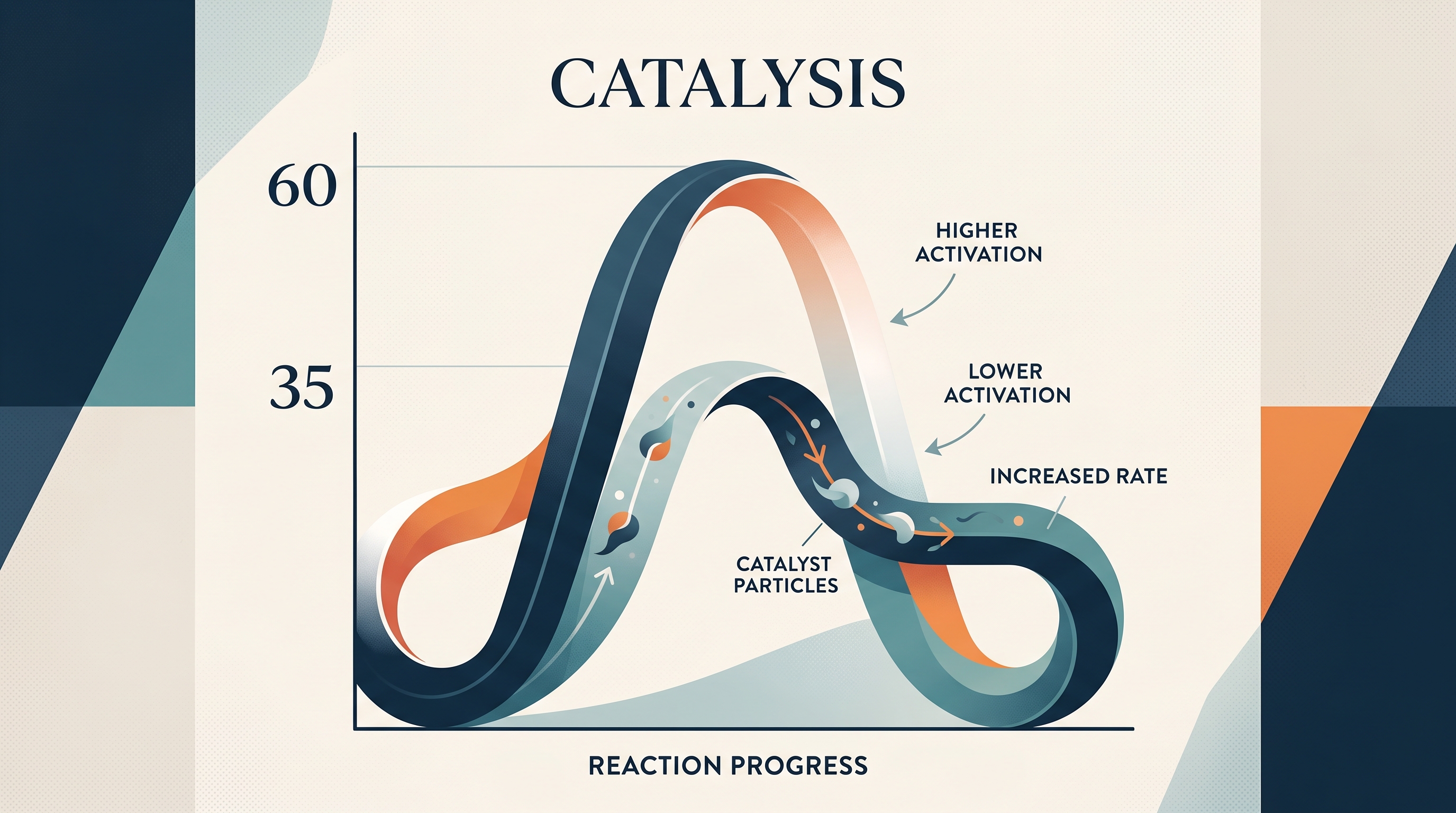
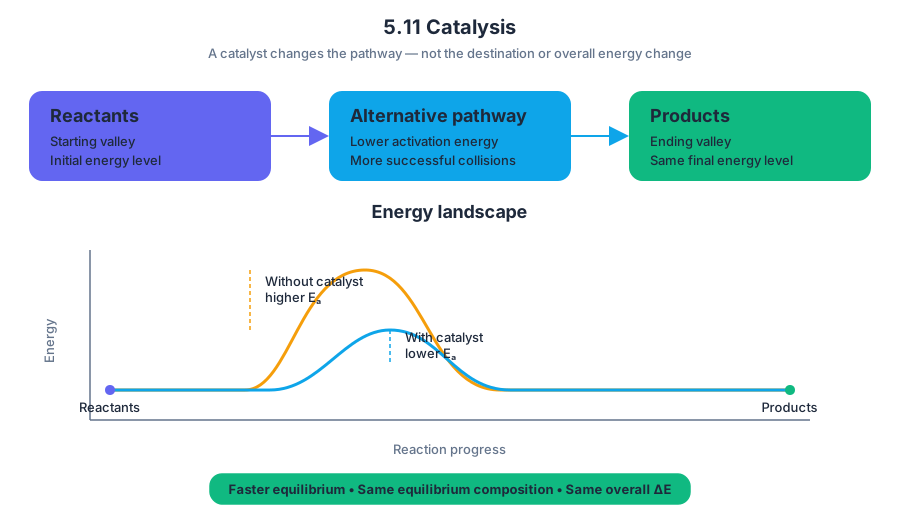
A catalyst increases the rate of a chemical reaction by providing an alternative reaction pathway with a lower activation energy, $E_a$. It changes how fast a reaction reaches equilibrium, not the final equilibrium composition or the overall energy change of the reaction.
5.11 Catalysis
A catalyst increases the rate of a chemical reaction by providing an alternative reaction pathway with a lower activation energy, $E_a$. It changes how fast a reaction reaches equilibrium, not the final equilibrium composition or the overall energy change of the reaction.
Imagine a mountain pass between two valleys. Reactants occupy one valley and products occupy the other. A catalyst does not move either valley up or down; it creates a lower pass between them. More particles can cross the lower pass successfully, so the reaction proceeds faster.
The energy picture
For a reaction, the activation energy is the minimum energy required for reactant particles to reach the transition state. On an energy diagram, a catalyzed pathway has a smaller peak than the uncatalyzed pathway.
$$ E_a = E_{\text{transition state}} - E_{\text{reactants}} $$
The catalyst may participate in one or more elementary steps, but it is regenerated by the end of the mechanism. Therefore, it appears as a reactant in one step and a product in another, then cancels when the elementary steps are added to obtain the overall reaction.
For example, suppose a catalyst, $C$, changes the reaction
$$ A + B \rightarrow D $$
into the two-step mechanism
$$ A + C \rightarrow AC $$
$$ AC + B \rightarrow D + C $$
Adding the steps gives
$$ A + B + C \rightarrow D + C $$
Because $C$ appears on both sides, it cancels:
$$ A + B \rightarrow D $$
The catalyst is not consumed in the net reaction, even though it is chemically involved in the mechanism.
What catalysis changes—and what it does not
| Quantity | Effect of adding a catalyst |
|---|---|
| Forward reaction rate | Increases |
| Reverse reaction rate | Increases |
| Activation energy | Decreases through an alternative pathway |
| Overall enthalpy change, $\Delta H$ | Unchanged |
| Overall Gibbs free-energy change, $\Delta G$ | Unchanged |
| Equilibrium constant, $K$ | Unchanged |
| Time required to reach equilibrium | Decreases |
| Equilibrium concentrations | Unchanged |
A catalyst accelerates both the forward and reverse reactions because it provides a lower-energy pathway in either direction. The system therefore reaches equilibrium sooner, but the catalyst does not shift the equilibrium position. Since $K$ depends on thermodynamic properties at a given temperature—not on the reaction pathway—the value of $K$ remains constant.
Key distinction: A catalyst changes kinetics, the speed and pathway of a reaction. It does not change thermodynamics, the energy difference between reactants and products.
Worked contextual example: catalytic decomposition
Hydrogen peroxide decomposes slowly according to
$$ 2H_2O_2(aq) \rightarrow 2H_2O(l) + O_2(g) $$
A catalyst such as iodide ion can increase the rate of oxygen formation. If the uncatalyzed pathway has an activation energy of $75\ \text{kJ mol}^{-1}$ and the catalyzed pathway has an activation energy of $42\ \text{kJ mol}^{-1}$, the catalyst lowers the barrier by
$$ \Delta E_a = 75 - 42 = 33\ \text{kJ mol}^{-1} $$
The reaction produces oxygen more rapidly, but the catalyst does not alter the reaction enthalpy. It also does not cause more total oxygen to form at equilibrium; it merely allows the system to approach that equilibrium more quickly.
Reasoning used: identify the catalyst from the mechanism or context, compare the activation-energy barriers, and separate rate information from equilibrium or energy-change information. A claim that “the catalyst makes the reaction more favorable” is incomplete or incorrect unless “favorable” is being used only to describe the lower kinetic barrier.
Catalysts in mechanisms
A catalyst can be homogeneous, meaning it is in the same phase as the reactants, or heterogeneous, meaning it is in a different phase. A solid metal surface, for example, can provide locations where gas molecules adsorb, bonds weaken, and reactants meet in a favorable orientation. The surface is regenerated rather than permanently used up.
Catalysts do not necessarily make every collision successful. They increase the fraction of collisions that have sufficient energy and an effective pathway for reaction. Temperature can also increase rate, but it does so by changing the distribution of particle energies; catalysis changes the pathway and therefore lowers $E_a$.
Common misconception check
Misconception: “A catalyst lowers the energy of the products.”
A catalyst lowers the energy of the transition state relative to the reactants. It does not change the energies of the reactants or products, so $\Delta H$ and $\Delta G$ for the overall reaction remain unchanged.
Misconception: “A catalyst shifts equilibrium toward products.”
Because both directions are accelerated, equilibrium is reached faster but remains at the same composition.
AP Chemistry skills in Topic 5.11
Topic 5.11 most directly develops Science Practice 1: Models and Representations, when interpreting or drawing reaction-energy diagrams and mechanisms; Science Practice 3: Representing Data and Phenomena, when connecting rate data or energy profiles to catalytic behavior; Science Practice 4: Model Analysis, when evaluating whether a proposed mechanism explains catalysis; Science Practice 5: Mathematical Routines, when calculating or comparing activation-energy changes; and Science Practice 6: Argumentation, when defending a claim about rate, equilibrium, or energy using evidence from a diagram, mechanism, or data set.
Retrieval check
A catalyst lowers the activation energy from $60\ \text{kJ mol}^{-1}$ to $35\ \text{kJ mol}^{-1}$. State one quantity that changes and two quantities that do not.
Answer: The reaction rate increases because the activation-energy barrier is lower. The overall $\Delta H$ and equilibrium constant, $K$, do not change.