From the free course AP Chemistry on Lykke
9.5 Free Energy and Equilibrium · 9.6 Free Energy of Dissolution
Key concepts: Gibbs free energy change (ΔG°) as a criterion for spontaneity and equilibrium · The relationship ΔG° = ΔH° − TΔS° · The relationship between ΔG° and the equilibrium constant K · How enthalpy and entropy changes affect the solubility of a salt · The three energetic factors in dissolution: breaking solute–solute interactions, breaking solvent–solvent interactions, and forming solute–solvent interactions · Why determining the total free-energy change of dissolution can be challenging because contributions may cancel · How favorable solvent–solute interactions influence dissolution · How changes in temperature can affect the free energy and solubility of a substance · Using calorimetry and temperature change to investigate the enthalpy of dissolution, such as dissolving KCl in water · The dissolution of magnesium hydroxide as an example of a sparingly soluble ionic compound
A salt can dissolve even when the solution becomes colder because spontaneity is controlled by free energy, not enthalpy alone. The decisive quantity is the standard free-energy change for dissolution, $\Delta G^\circ_{\mathrm{dissolution}}$: the Gibbs free-energy change when a specified amount of a substance…
9.5 Free Energy and Equilibrium · 9.6 Free Energy of Dissolution
A salt can dissolve even when the solution becomes colder because spontaneity is controlled by free energy, not enthalpy alone. The decisive quantity is the standard free-energy change for dissolution, $\Delta G^\circ_{\mathrm{dissolution}}$: the Gibbs free-energy change when a specified amount of a substance dissolves under standard conditions.
Key criterion: If $\Delta G^\circ_{\mathrm{dissolution}}<0$, dissolution is thermodynamically favorable under standard conditions; if $\Delta G^\circ_{\mathrm{dissolution}}>0$, the undissolved solid is favored under standard conditions.
The free-energy balance
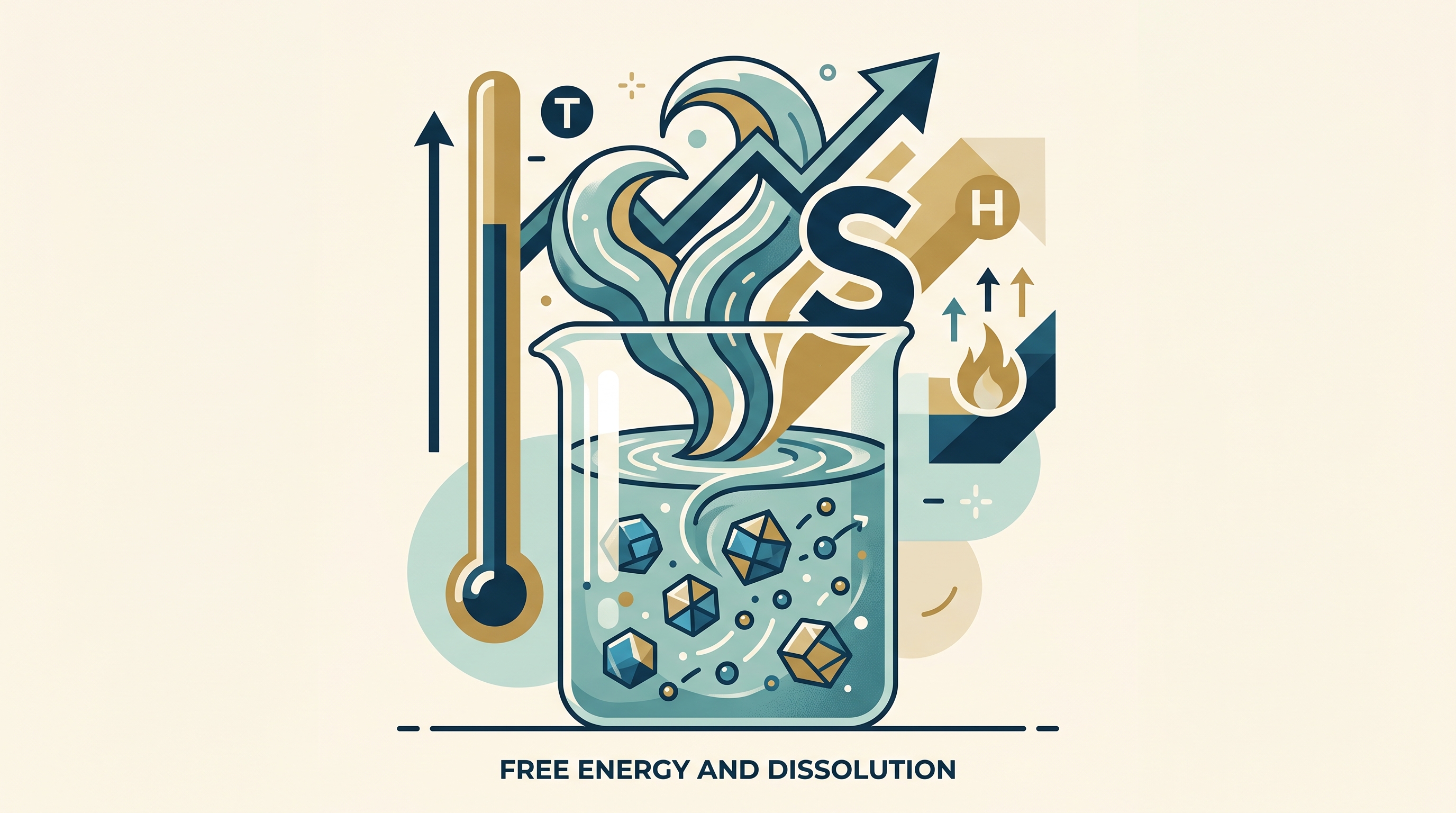
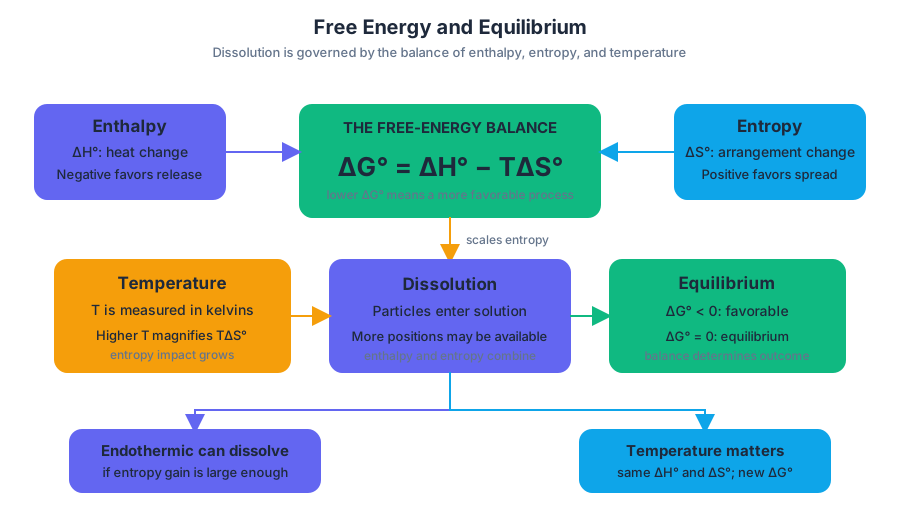
Free energy combines two competing effects: enthalpy, the heat-related energy change, and entropy, the change associated with the distribution of energy and matter among possible microscopic arrangements. Their relationship is
$$ \Delta G^\circ=\Delta H^\circ-T\Delta S^\circ $$
where $\Delta H^\circ$ is the standard enthalpy change, $\Delta S^\circ$ is the standard entropy change, and $T$ is the absolute temperature in kelvins.
A negative $\Delta H^\circ$ favors dissolution because the process releases energy. A positive $\Delta S^\circ$ also favors dissolution because the dissolved particles may be distributed among more positions and arrangements. However, either contribution can dominate: a dissolution with $\Delta H^\circ>0$ may still be favorable if the entropy increase is sufficiently large, especially at higher temperature.
The temperature factor matters because $T\Delta S^\circ$ grows as temperature increases. Thus, the same enthalpy and entropy changes can produce different free-energy changes at different temperatures. Solubility therefore depends on the combined enthalpy and entropy changes of dissolution, not on whether dissolution is simply exothermic or endothermic.
Free energy and equilibrium
At equilibrium, the forward and reverse processes continue microscopically, but there is no net thermodynamic driving force. The actual free-energy change under the existing conditions is
$$ \Delta G=0 $$
The standard free-energy change is connected to the equilibrium constant by
$$ \Delta G^\circ=-RT\ln K $$
where $R$ is the gas constant, $T$ is temperature in kelvins, and $K$ is the equilibrium constant.
This equation gives a useful scale:
- $K>1$ means $\ln K>0$, so $\Delta G^\circ<0$ and products are favored under standard conditions.
- $K<1$ means $\ln K<0$, so $\Delta G^\circ>0$ and reactants are favored under standard conditions.
- $K=1$ means $\Delta G^\circ=0$.
The important distinction is that $\Delta G^\circ$ describes standard conditions, whereas $\Delta G$ describes the current mixture. At equilibrium, $\Delta G$ is zero even when $\Delta G^\circ$ is not.
Why dissolving a salt requires three energetic steps
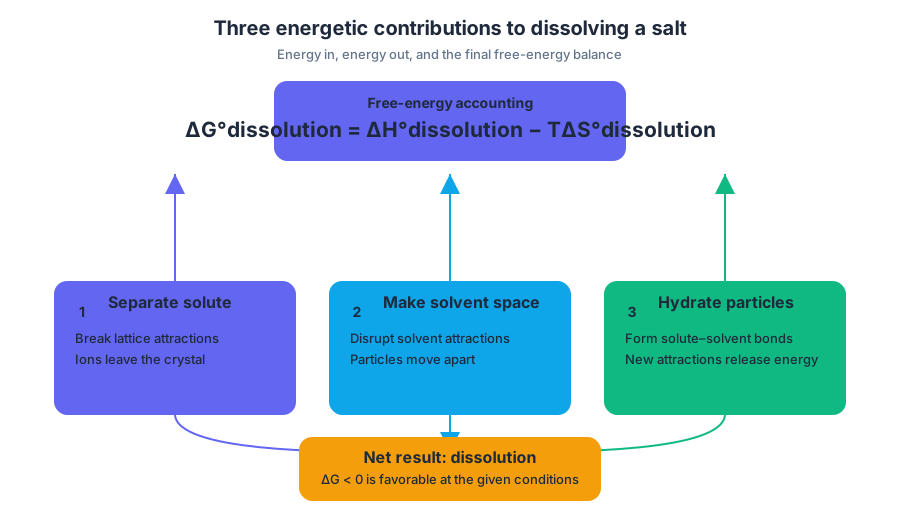
The CED learning objective 9.6.A is to explain the relationship between salt solubility and the enthalpy and entropy changes occurring during dissolution. Essential knowledge 9.6.A.1 identifies three particulate-level contributions that determine $\Delta G^\circ_{\mathrm{dissolution}}$.
Imagine separating an ionic solid into hydrated ions. The process can be analyzed as a three-part energy accounting system:
- Breaking solute–solute interactions: Energy is required to pull ions or molecules out of the solid lattice. For an ionic crystal, this means overcoming strong electrostatic attractions.
- Disrupting solvent–solvent interactions: Solvent particles must move apart to create space. This also requires energy because attractive interactions within the solvent are being disturbed.
- Forming solute–solvent interactions: New attractions form between the dissolved particles and solvent molecules. These interactions may release energy, or in some cases require energy overall.
The total enthalpy and entropy changes result from all three steps.
Why solubility can be difficult to predict
Each step changes both energy and molecular organization. Separating a rigid crystal may increase the number of accessible arrangements, while reorganizing solvent molecules around ions can make the solvent locally more ordered. Hydration or solvation may release substantial energy, but it also creates structured shells around the dissolved particles.
Because the three contributions can have opposite signs, their free energies may partially cancel:
$$ \Delta G^\circ_{\mathrm{dissolution}}
\Delta G^\circ_{\mathrm{solute-solute}} + \Delta G^\circ_{\mathrm{solvent-solvent}} + \Delta G^\circ_{\mathrm{solute-solvent}} $$
The individual contributions may be estimated in sign and relative magnitude, but predicting the exact total can be challenging. A salt with an endothermic dissolution is not automatically insoluble, and a salt with an exothermic dissolution is not automatically highly soluble.
Named misconception — “Heat determines solubility.”
An endothermic dissolution can be favorable if the entropy term is sufficiently favorable. Solubility reflects the net $\Delta G$, not $\Delta H$ alone.
Evidence from potassium chloride
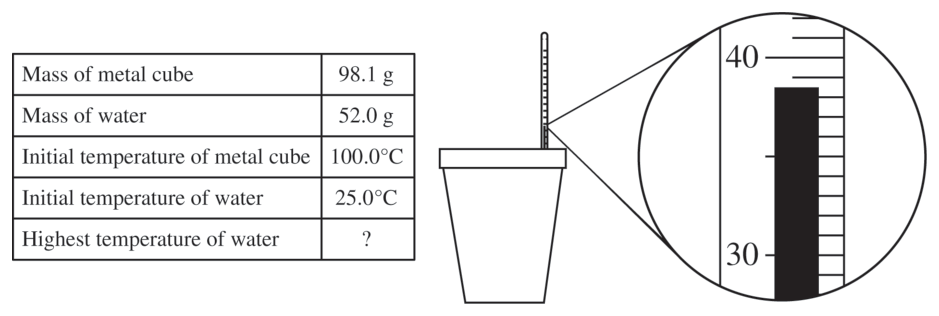
When potassium chloride, $KCl$, dissolves in water, the solution temperature decreases. Calorimetry interprets this temperature drop as evidence that the dissolution process absorbs heat from the surroundings:
$$ \Delta H_{\mathrm{dissolution}}>0 $$
This observation identifies the enthalpy contribution, but it does not by itself establish whether dissolution is thermodynamically favorable. The entropy change and the resulting $\Delta G$ must also be considered.
Magnesium hydroxide: equilibrium, not “no dissolving”
Magnesium hydroxide, $Mg(OH)_2$, is sparingly soluble, but its dissolution is an equilibrium process:
Mg(OH)_2(s)\rightleftharpoons Mg^{2+}(aq)+2OH^-(aq)
A small solubility means that equilibrium strongly favors the solid, corresponding to a small equilibrium constant for dissolution and therefore a positive or only weakly favorable $\Delta G^\circ$ under standard conditions. It does not mean that no particles dissolve.
For AP Skill 4.D, “Explain the degree to which a model or representation describes the connection between particulate-level properties and macroscopic properties,” connect the microscopic model to the observation: lattice attractions, solvent reorganization, and hydration determine the free-energy balance; that balance determines $K$; and $K$ determines the equilibrium extent of dissolution observed as solubility.
Retrieval check
A salt dissolves with $\Delta H^\circ>0$, but its solubility increases as temperature rises. What must be true about the entropy contribution over the relevant temperature range? Why would the temperature decrease during dissolution fail to prove that the salt is insoluble? A complete answer should identify a favorable $\Delta S^\circ$, apply $\Delta G^\circ=\Delta H^\circ-T\Delta S^\circ$, and distinguish enthalpy from the total free-energy change.
Source Materials
- AP Chemistry Course and Exam Description
- AP Chemistry Course and Exam Description Clarifications and Corrections
- AP Chemistry Course Overview
- AP Chemistry Course at a Glance
- AP Chemistry Course at a Glance Poster
- Adopt AP Chemistry
- AP Chemistry
- AP Chemistry
- Total for part (c) 3 points
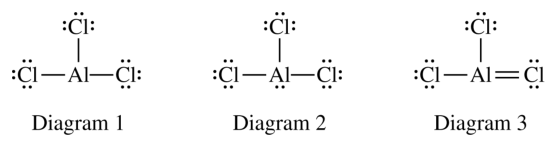
- (i) The AlCl3(g) molecule has a trigonal planar geometry. Which diagram (1, 2, or 3) can be eliminated
- Total for part (c) 3 points
- Total for part (d) 4 points