From the free course AP Chemistry on Lykke
AP Practice 2
Key concepts: Prerequisites for AP Chemistry · Laboratory instruction and hands-on investigations · Mole concept and dimensional analysis · Graphing experimental data with correct scales and units · Solubility product constants (Ksp) and ionic factors · Electrolysis · Stoichiometry involving changing or limiting/excess reactants · Particulate representations of matter · Chemical polarity and polarizability · Acid-base titration curves
A single laboratory investigation can force several kinds of chemical reasoning at once: converting masses with the mole concept, plotting data with defensible scales, interpreting particulate models, predicting precipitation with $K_{sp}$, and explaining electrolysis through electron transfer.
AP Practice 2
A single laboratory investigation can force several kinds of chemical reasoning at once: converting masses with the mole concept, plotting data with defensible scales, interpreting particulate models, predicting precipitation with $K_{sp}$, and explaining electrolysis through electron transfer. The practice task below is an original, unofficial short free-response problem designed around that integration.
Prerequisite readiness: Successful work assumes an introductory high school chemistry course and Algebra II, or equivalent preparation. You should be comfortable with balanced equations, proportional reasoning, scientific notation, logarithms, and unit conversions.
The laboratory context
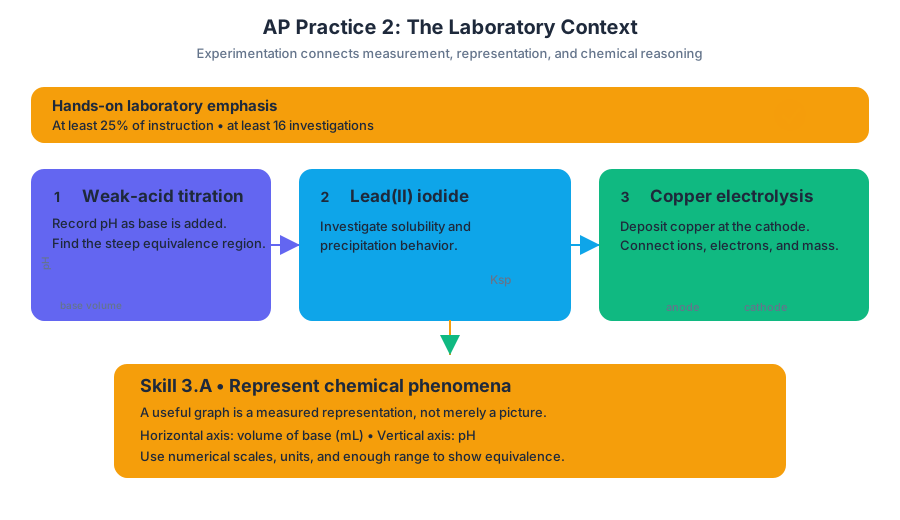
A student investigates a solution containing an unknown weak acid, then studies the solubility of lead(II) iodide and finally deposits copper by electrolysis. The laboratory sequence reflects the expected emphasis on experimentation: at least $25%$ of instructional time should involve hands-on laboratory work, with teachers conducting at least $16$ hands-on investigations.
The student records titration data as pH versus volume of base added. A scientifically useful graph must place the independent variable, volume of base, on the horizontal axis and pH on the vertical axis. Both axes require numerical scales, units where applicable, and enough range to reveal the steep region near the equivalence point.
A good graph is not merely a picture of the data. It is a representation of a chemical phenomenon, satisfying Skill 3.A: Represent chemical phenomena using appropriate graphing techniques, including correct scale and units. A smooth-looking curve cannot repair missing units, uneven scale intervals, or incorrectly assigned axes.
Original short free-response task
A student titrates $25.00\ \mathrm{mL}$ of a weak monoprotic acid with $0.1000\ \mathrm{M}$ sodium hydroxide. The pH-versus-volume data show the sharpest increase between $23.8\ \mathrm{mL}$ and $24.2\ \mathrm{mL}$ of base added.
(a) Identify the approximate equivalence-point volume and describe one graphing feature that should appear near that volume.
(b) At the equivalence point, the student has added $24.0\ \mathrm{mL}$ of $0.1000\ \mathrm{M}$ $NaOH$. Calculate the initial moles of weak acid.
(c) A separate sample contains $Pb^{2+}$ and is tested by adding one drop of $0.100\ \mathrm{M}$ $KI$. Write the net ionic equation for the precipitate formation and explain why ion charge is important when comparing solubility patterns.
(d) During electrolysis of aqueous $CuSO_4$, copper forms at the cathode. Identify whether the cathode process is oxidation or reduction and justify the answer using electrons.
Worked solution and scoring logic
(a) Equivalence point. The approximate equivalence volume is $24.0\ \mathrm{mL}$ because it lies in the center of the steepest pH change. The graph should show a rapid rise in pH near this volume, not necessarily a pH of $7.00$.
This earns the reasoning associated with identifying a chemical feature from a graph and supports Skill 3.A: Represent chemical phenomena using appropriate graphing techniques, including correct scale and units. A strong response connects the equivalence point to the sharp change in pH rather than simply choosing the largest recorded pH.
(b) Mole calculation.
$$ n(NaOH)=M V $$
$$ n(NaOH)=\left(0.1000\ \mathrm{mol,L^{-1}}\right) \left(0.0240\ \mathrm{L}\right) =2.40\times10^{-3}\ \mathrm{mol} $$
The acid is monoprotic, so the neutralization ratio is $1:1$:
$$ HA+OH^-\rightarrow A^-+H_2O $$
$$ n(HA)=n(OH^-)=2.40\times10^{-3}\ \mathrm{mol} $$
The calculation demonstrates Skill 5.F: Calculate, estimate, or predict an unknown quantity from known quantities by selecting and following a logical computational pathway and attending to precision, including dimensional analysis and significant figures. The volume must be converted from milliliters to liters before using molarity.
(c) Lead(II) iodide precipitation.
The net ionic equation is
Pb^{2+}(aq)+2I^-(aq)\rightleftharpoons PbI_2(s)
The ion charge matters because the solubility equilibrium contains the ion concentrations raised to stoichiometric powers:
$$ K_{sp}=[Pb^{2+}][I^-]^2 $$
A small amount of $0.100\ \mathrm{M}$ $KI$ can supply enough $I^-$ to make the ionic product exceed $K_{sp}$, causing precipitation. In comparing compounds, examine ion charge, ionic radius, and whether the ions are polyatomic or monoatomic; these structural factors influence lattice attractions and hydration, so solubility cannot be predicted from charge alone.
This response uses Skill 6.C: Support a claim with evidence from representations or models at the particulate level, such as the structure of atoms and/or molecules, and Skill 6.E: Provide reasoning to justify a claim using connections between particulate and macroscopic scales or levels. The particulate event—ions combining into a solid lattice—explains the visible cloudiness or precipitate.
(d) Electrolysis. Copper forms at the cathode by reduction:
$$ Cu^{2+}(aq)+2e^-\rightarrow Cu(s) $$
The cathode is defined by reduction, regardless of whether the cell is galvanic or electrolytic. The external power source forces this nonspontaneous process to occur. A response that says “cathode is negative, therefore reduction” is incomplete: the electron gain is the chemical justification.
Common traps
Misconception: equivalence always means neutral pH.
A strong acid–strong base titration has an equivalence point near pH $7$, but a weak acid–strong base titration has a basic equivalence solution because $A^-$ reacts with water.
Misconception: more $KI$ always means a proportionally larger precipitate.
Precipitation depends on the ionic product relative to $K_{sp}$. Once precipitation begins, dissolved-ion concentrations shift according to equilibrium; the process is not simply unrestricted mixing.
Misconception: oxidation occurs at the anode and reduction at the cathode only in batteries.
The locations are universal: oxidation at the anode, reduction at the cathode. What changes between galvanic and electrolytic cells is whether the reaction is spontaneous and how electrical energy is supplied.
Representation checkpoint
Draw three particulate-level snapshots for the lead(II) iodide test: before adding $KI$, immediately after ions mix, and after $PbI_2(s)$ forms. Then label which particles remain dissolved. This practices Skill 3.B: Represent chemical substances or phenomena with appropriate diagrams or models, while connecting symbolic equations to observable evidence.
Timing and error review
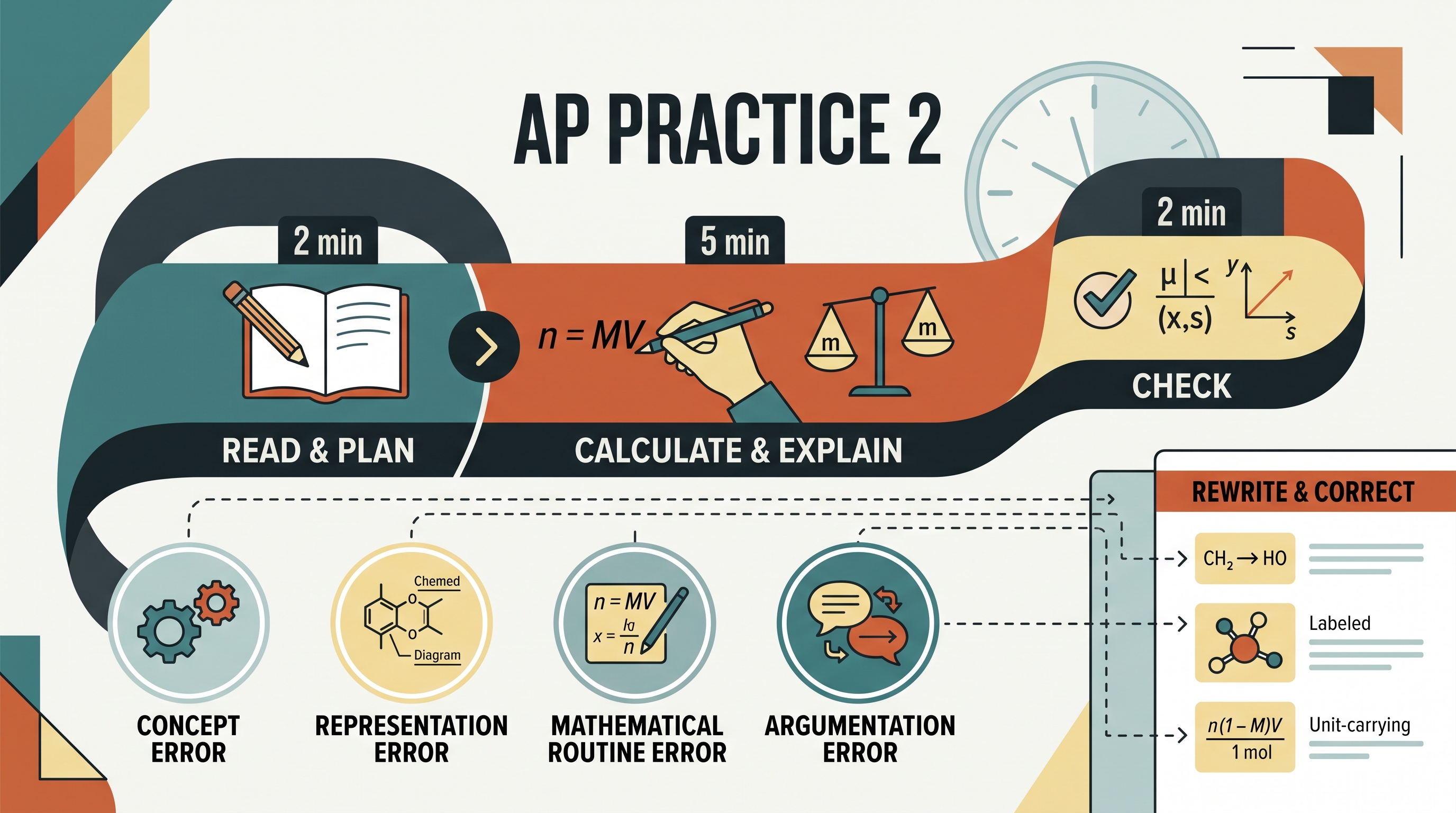
Allow approximately $9$ minutes for this short-response task: about $2$ minutes to read and plan, $5$ minutes to calculate and explain, and $2$ minutes to check units, equations, and labels. For each missed point, classify the error as concept, representation, mathematical routine, or argumentation; then rewrite the answer using a chemical equation, a labeled model, or a unit-carrying calculation.
Retrieval check: If the volume of $NaOH$ at equivalence doubled while its molarity stayed constant, what would happen to the calculated initial moles of $HA$? Explain using $n=MV$ and the $1:1$ reaction ratio.
Source Materials
- AP Chemistry Course and Exam Description
- AP Chemistry Course and Exam Description Clarifications and Corrections
- AP Chemistry Course Overview
- AP Chemistry Course at a Glance
- AP Chemistry Course at a Glance Poster
- Adopt AP Chemistry
- AP Chemistry
- AP Chemistry
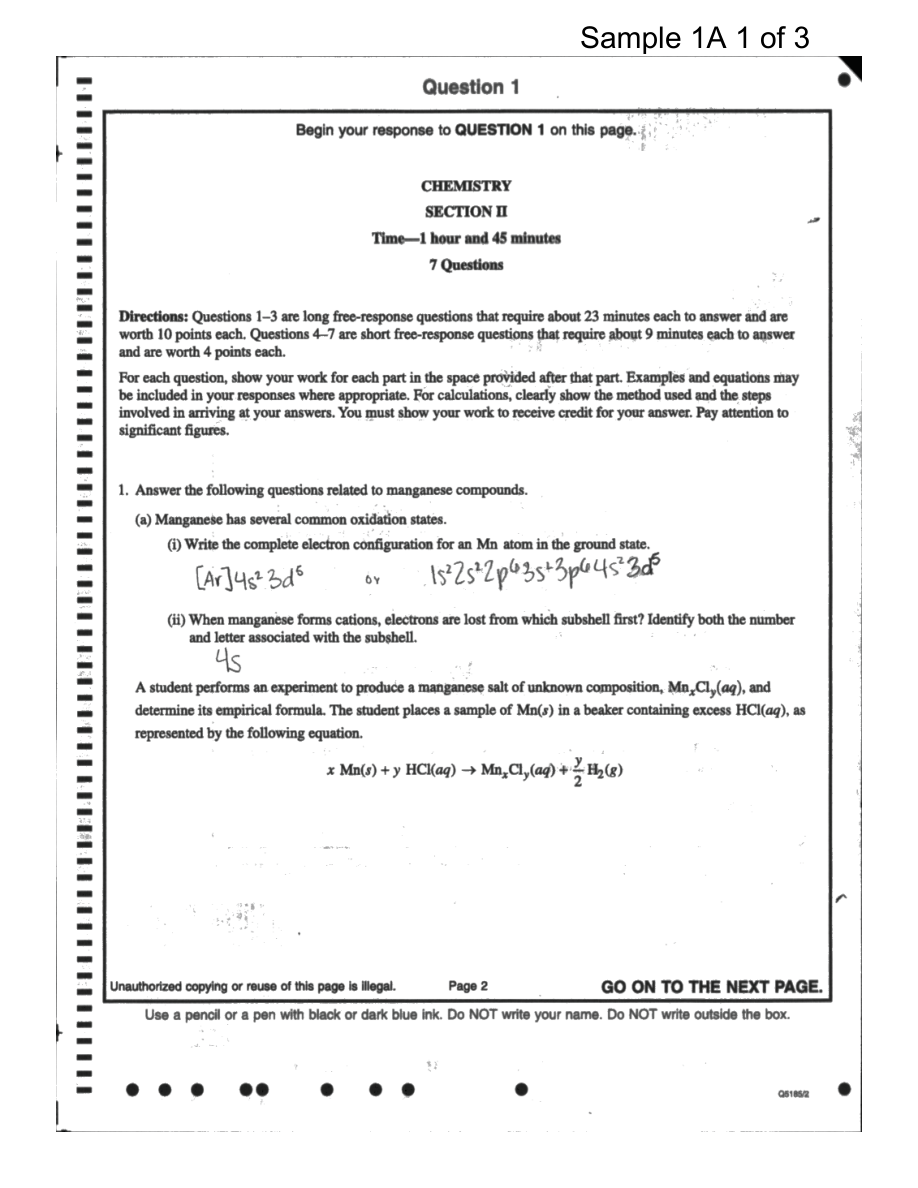
- Figure — Sample Responses Q1 (p. 4)
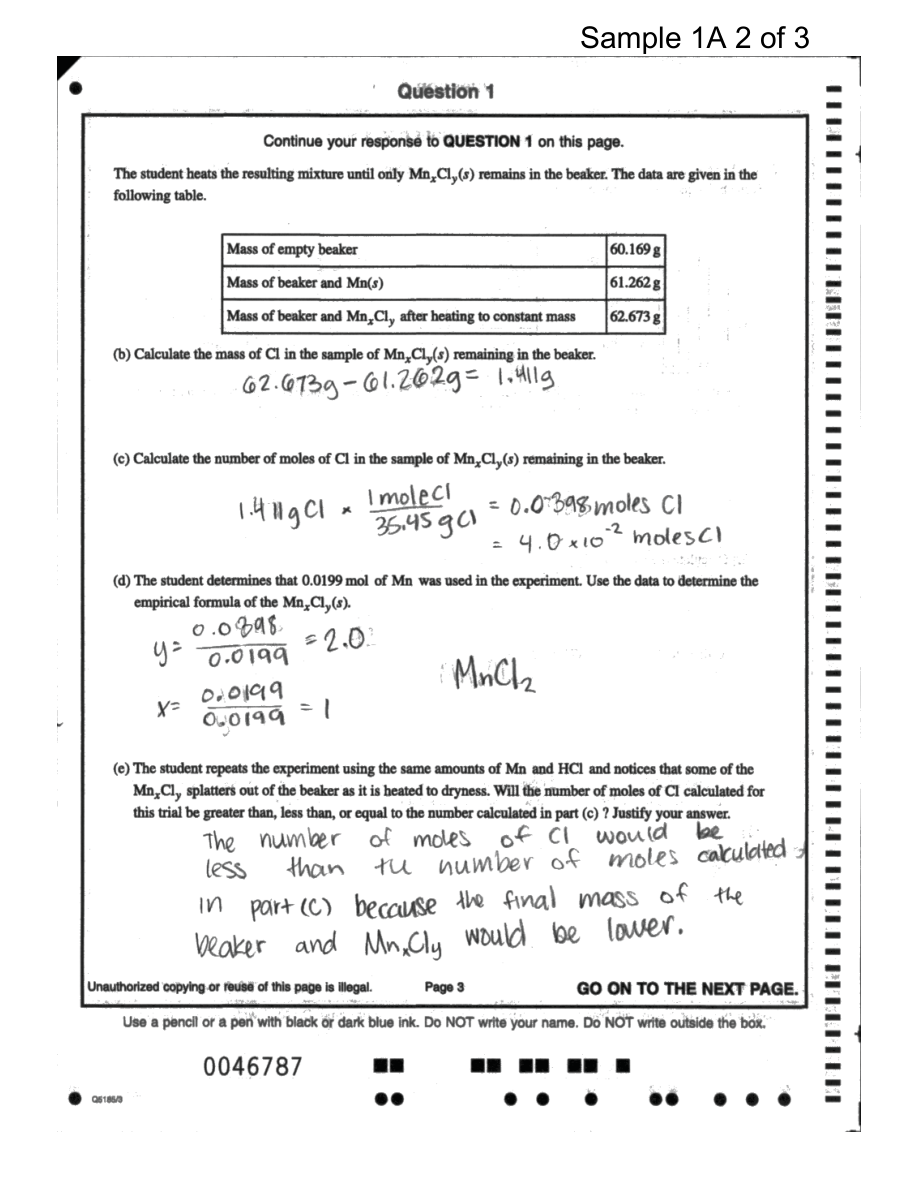
- Figure — Sample Responses Q1 (p. 5)
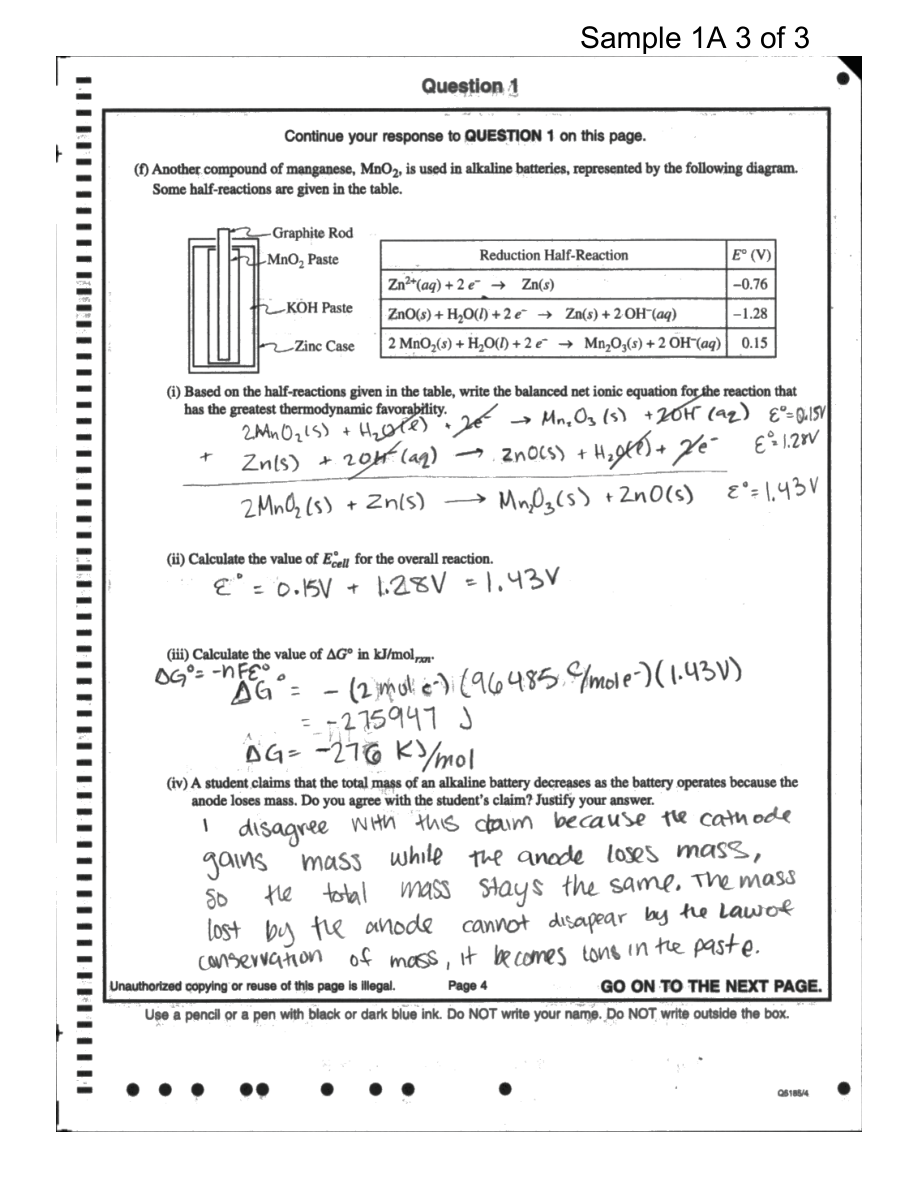
- Figure — Sample Responses Q1 (p. 6)
- Figure — Sample Responses Q1 (p. 7)