From the free course AP Chemistry on Lykke
4.9 Oxidation-Reduction Reactions
Key concepts: Oxidation and reduction half-reactions · Electrochemical cells and thermodynamic favorability · Standard reduction and oxidation potentials · Calculating standard cell potential · Balancing redox equations and electron transfer · Anodes, cathodes, and galvanic cells · Gibbs free energy and electrochemical cells · Alkaline battery redox chemistry · Electroplating and oxidation of water · Rhodium plating of silver
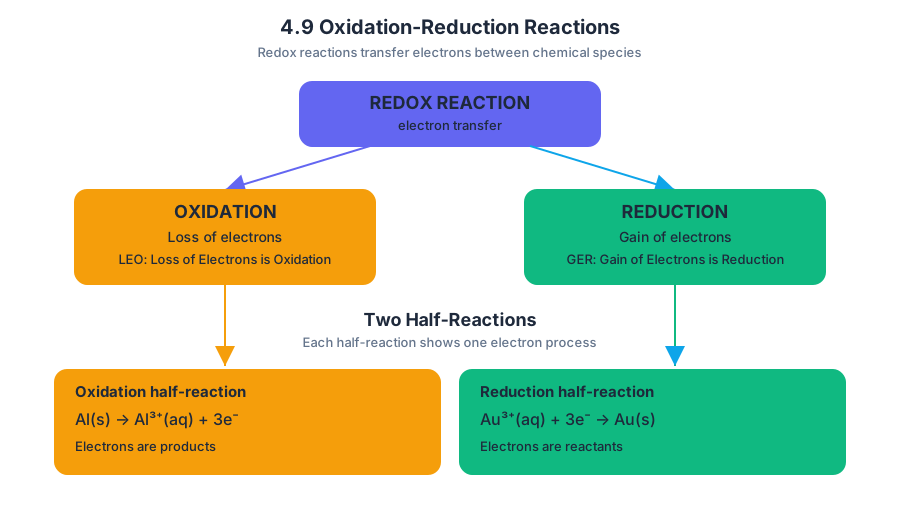
Oxidation-reduction reactions, or redox reactions, transfer electrons from one chemical species to another: oxidation is electron loss, while reduction is electron gain. The memory aid LEO says GER captures the bookkeeping: Loss of Electrons is Oxidation; Gain of Electrons is Reduction.
4.9 Oxidation-Reduction Reactions
Oxidation-reduction reactions, or redox reactions, transfer electrons from one chemical species to another: oxidation is electron loss, while reduction is electron gain. The memory aid LEO says GER captures the bookkeeping: Loss of Electrons is Oxidation; Gain of Electrons is Reduction.
Oxidation: loss of electrons.
Reduction: gain of electrons.
A redox reaction can be separated into two half-reactions, equations that show the oxidation and reduction processes independently. For example, aluminum atoms lose three electrons:
$$ \mathrm{Al(s) \rightarrow Al^{3+}(aq) + 3e^-} $$
The electrons appear among the products because aluminum is oxidized. A reduction half-reaction places electrons among the reactants, such as:
$$ \mathrm{Au^{3+}(aq) + 3e^- \rightarrow Au(s)} $$
Electrochemical cells: where electron transfer becomes voltage
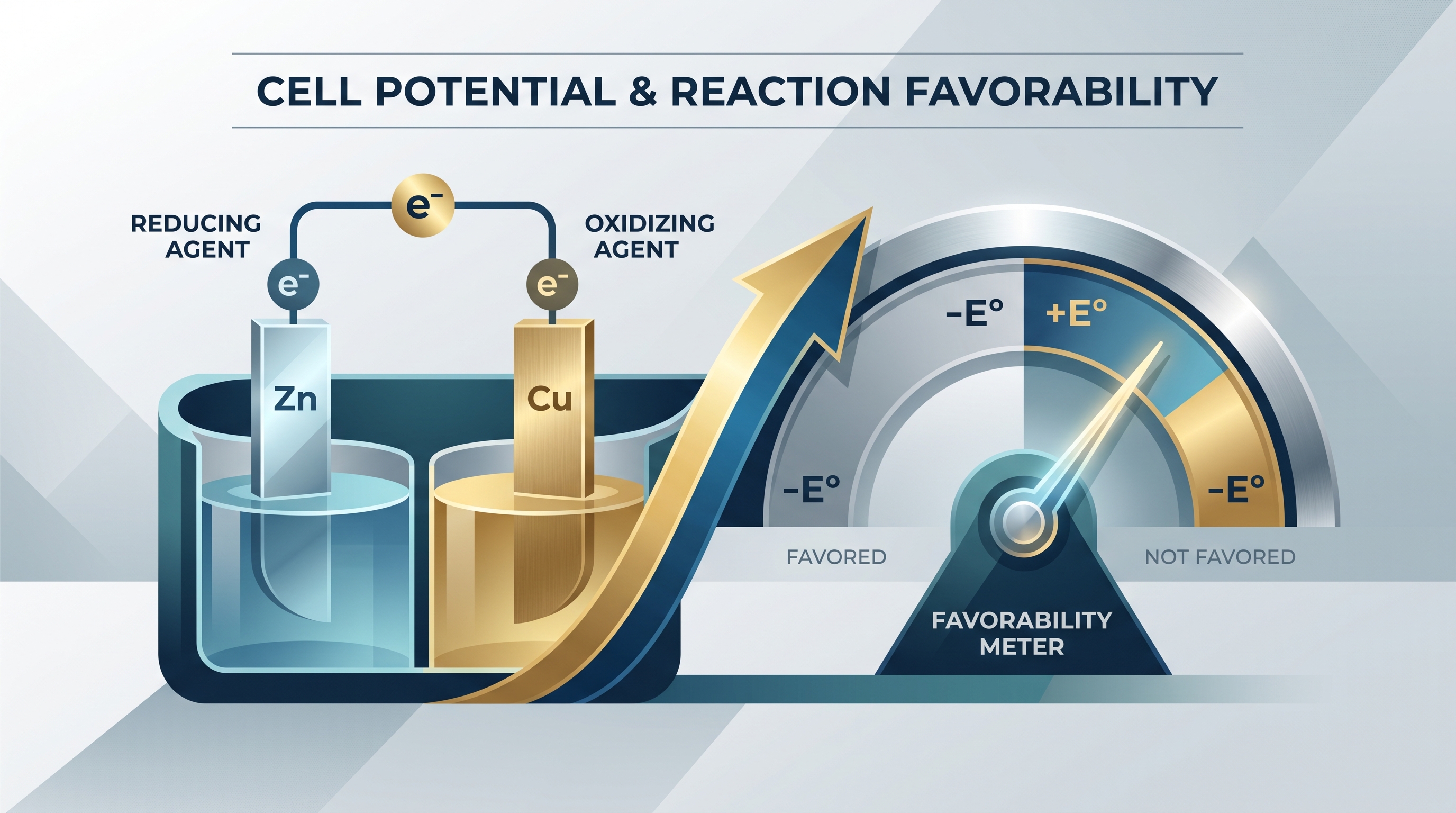
An electrochemical cell uses a redox reaction to move electrons through an external circuit or, in the reverse situation, uses an external power source to force electron transfer. The electrode where oxidation occurs is always the anode; the electrode where reduction occurs is always the cathode. This rule works for both galvanic and electrolytic cells.
A galvanic cell produces electrical energy from a thermodynamically favored reaction. Under standard conditions, the reaction is favored when the standard cell potential is positive:
$$E^\circ_{\mathrm{cell}} > 0$$
If $E^\circ_{\mathrm{cell}}<0$, the reaction as written is thermodynamically unfavored and requires an external potential to proceed. This is the central idea in Learning Objective 9.9.A, supported by Essential Knowledge 9.9.A.1 and 9.9.A.2.
In a galvanic cell, electrons flow spontaneously from the anode, where oxidation occurs, toward the cathode, where reduction occurs. The anode therefore supplies electrons to the circuit, while the cathode consumes them.
| Location | Reaction | Electron role |
|---|---|---|
| Anode | Oxidation | Electrons are produced |
| Cathode | Reduction | Electrons are consumed |
| Galvanic cell | Spontaneous overall reaction | Chemical energy becomes electrical energy |
Common misconception — “the anode is always negative.” In a galvanic cell, the anode is negative because it produces electrons. However, the reliable definition is chemical, not electrical: oxidation always occurs at the anode, and reduction always occurs at the cathode.
Standard reduction potentials and $E^\circ_{\mathrm{cell}}$
A standard reduction potential, $E^\circ$, measures the tendency of a species to be reduced under standard conditions. Reduction-potential tables list every half-reaction in the reduction direction. If a listed reduction half-reaction is reversed to create an oxidation half-reaction, its potential changes sign.
To calculate the cell potential, add the reduction potential for the cathode to the oxidation potential for the anode:
$$E^\circ_{\mathrm{cell}}=E^\circ_{\mathrm{reduction}}+E^\circ_{\mathrm{oxidation}}$$
If both tabulated values are written as reduction potentials, use:
$$E^\circ_{\mathrm{cell}}=E^\circ_{\mathrm{cathode}}-E^\circ_{\mathrm{anode}}$$
Do not multiply a potential by a stoichiometric coefficient when balancing electrons. Potential is an intensive property; it does not become three times larger merely because three electrons are transferred.
Worked example: zinc and gold
Consider:
$$ \mathrm{Zn(s)\rightarrow Zn^{2+}(aq)+2e^-} $$
with oxidation potential $E^\circ_{\mathrm{oxidation}}=+0.76\ \mathrm{V}$, and:
with reduction potential $E^\circ_{\mathrm{reduction}}=+1.50\ \mathrm{V}$.
Balance the electrons using the least common multiple, $6$:
$$ \mathrm{3Zn(s)\rightarrow 3Zn^{2+}(aq)+6e^-} $$
$$ \mathrm{2Au^{3+}(aq)+6e^-\rightarrow 2Au(s)} $$
Adding gives:
$$ \mathrm{3Zn(s)+2Au^{3+}(aq)\rightarrow3Zn^{2+}(aq)+2Au(s)} $$
The potential is:
$$E^\circ_{\mathrm{cell}}=(+0.76\ \mathrm{V})+(+1.50\ \mathrm{V})=+2.26\ \mathrm{V}$$
Because the result is positive, the reaction is thermodynamically favored as written.
Common misconception — “balance first, then multiply each potential.” Balancing changes $n$, the number of transferred electrons, but it does not change either half-cell potential. Multiply coefficients in the chemical equations only.
Cell potential and Gibbs free energy
Standard cell potential connects electrical behavior to thermodynamics through:
$$\Delta G^\circ=-nFE^\circ_{\mathrm{cell}}$$
Here, $n$ is the number of moles of electrons transferred per reaction as written, and $F$ is the Faraday constant:
$$F=96{,}485\ \mathrm{C,mol^{-1}\ e^-}$$
For the zinc-gold reaction, $n=6$ and $E^\circ_{\mathrm{cell}}=2.26\ \mathrm{V}$:
$$\Delta G^\circ=-(6)(96{,}485\ \mathrm{C,mol^{-1}})(2.26\ \mathrm{J,C^{-1}})$$
$$\Delta G^\circ=-1.31\times10^6\ \mathrm{J,mol^{-1}}=-1.31\times10^3\ \mathrm{kJ,mol^{-1}}$$
The negative $\Delta G^\circ$ agrees with the positive $E^\circ_{\mathrm{cell}}$.
Applying half-reactions to batteries and electroplating
In an alkaline battery, zinc is oxidized at the anode while manganese dioxide is reduced at the cathode. The battery diagram is therefore interpreted by locating the electron-producing zinc process and the electron-consuming $\mathrm{MnO_2}$ process, then combining their half-reactions so that electrons cancel. Although zinc material changes form and may migrate within the sealed battery, the battery’s total mass remains constant in a closed system.
Electroplating rhodium illustrates the opposite thermodynamic situation. Rhodium ions are reduced onto the object being coated:
$$ \mathrm{Rh^{3+}(aq)+3e^-\rightarrow Rh(s)} \qquad E^\circ=+0.80\ \mathrm{V} $$
Water is oxidized at the other electrode:
$$ \mathrm{2H_2O(l)\rightarrow O_2(g)+4H^+(aq)+4e^-} $$
To balance electrons, multiply the rhodium half-reaction by $4$ and the water half-reaction by $3$:
$$ \mathrm{4Rh^{3+}(aq)+6H_2O(l)\rightarrow4Rh(s)+3O_2(g)+12H^+(aq)} $$
The oxidation potential corresponding to the reverse of the water reduction potential is $-1.23\ \mathrm{V}$. Therefore:
$$E^\circ_{\mathrm{cell}}=(+0.80\ \mathrm{V})+(-1.23\ \mathrm{V})=-0.43\ \mathrm{V}$$
The negative value is appropriate: an external power supply must force the plating reaction. The tempting calculation $0.80-(-1.23)=+2.03\ \mathrm{V}$ incorrectly treats an oxidation potential as though it were already a reduction potential.
Retrieval check
A reaction has $E^\circ_{\mathrm{cell}}=-0.20\ \mathrm{V}$ as written. Is it thermodynamically favored under standard conditions? Which electrode is the site of oxidation, and what must happen to the equation to obtain a favored direction?
Answer: It is not favored as written. Oxidation occurs at the anode. Reversing the overall reaction reverses the sign, giving $E^\circ_{\mathrm{cell}}=+0.20\ \mathrm{V}$; the cathode and anode assignments also reverse for the new direction.