From the free course AP Chemistry on Lykke
AP Practice 6
A strong chemistry answer does more than state a number: it connects a representation, a measurement, a calculation, and a defensible scientific claim. This original, unofficial practice set uses a short free-response task built around that chain.
AP Practice 6
A strong chemistry answer does more than state a number: it connects a representation, a measurement, a calculation, and a defensible scientific claim. This original, unofficial practice set uses a short free-response task built around that chain. It emphasizes Science Practice 2: Question and Method, Science Practice 3: Representing Data and Phenomena, Science Practice 4: Model Analysis, Science Practice 5: Mathematical Routines, and Science Practice 6: Argumentation.
Task profile: evidence-based short free response
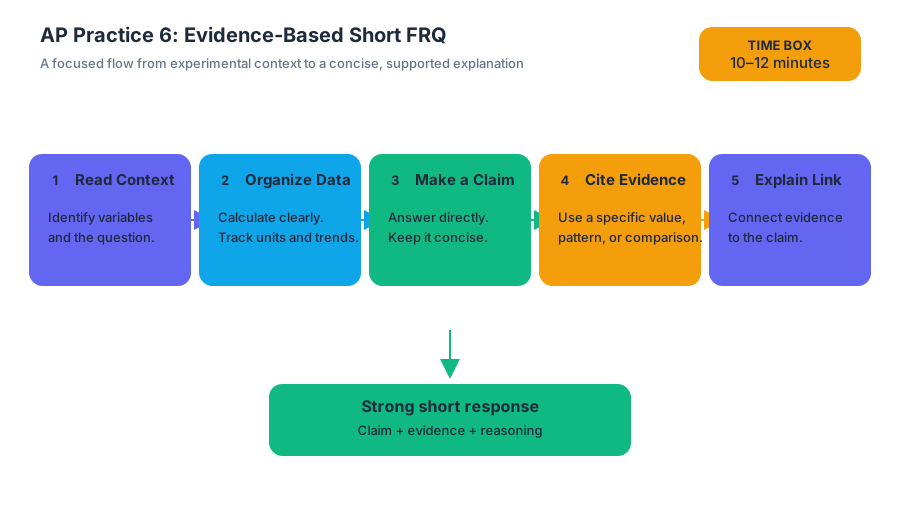
Treat this as a timed short free-response task. Spend approximately $10$–$12$ minutes reading the experimental context, organizing calculations, and writing explanations. A concise response earns more than a long response that hides its claim.
Original practice question: Determining an unknown concentration
A student investigates the concentration of a blue copper(II) ion solution, $Cu^{2+}(aq)$, using visible-light spectroscopy. The student prepares several solutions from a stock solution and measures the absorbance of each solution at the wavelength where the solution absorbs most strongly.
The relevant relationship is the Beer–Lambert law:
$$ A = \varepsilon b c $$
where $A$ is absorbance, $\varepsilon$ is the molar absorptivity, $b$ is the path length of the cuvette, and $c$ is the concentration of the absorbing species. The cuvette path length is constant for all measurements.
| Concentration of $Cu^{2+}$, $c$ ($mol,L^{-1}$) | Absorbance, $A$ |
|---|---|
| $0.0100$ | $0.118$ |
| $0.0200$ | $0.241$ |
| $0.0300$ | $0.356$ |
| $0.0400$ | $0.481$ |
An unknown sample has an absorbance of $0.302$.
(a) Identify the independent variable and dependent variable in the investigation.
(b) Use the data to estimate the concentration of the unknown sample.
(c) A student claims that the solution with concentration $0.0400\ mol,L^{-1}$ contains twice as many copper(II) ions as the solution with concentration $0.0200\ mol,L^{-1}$. Evaluate the claim.
(d) Identify one experimental condition that should be kept constant and explain why changing it could affect the absorbance.
Worked reasoning
(a) Variables
The independent variable is the concentration of $Cu^{2+}$, because the student deliberately changes it. The dependent variable is absorbance, because it is measured in response to the concentration.
Scoring logic: Name what is deliberately changed and what is measured. Do not identify “the solution” as a variable; that description is too vague.
(b) Interpolating from the calibration data
The unknown absorbance, $0.302$, lies between the absorbances for $0.0200\ mol,L^{-1}$ and $0.0300\ mol,L^{-1}$. Therefore, interpolate between those two points rather than extrapolating beyond the measured range.
Using a linear approximation:
$$ \frac{0.302-0.241}{0.356-0.241}
\frac{c-0.0200}{0.0300-0.0200} $$
$$ \frac{0.061}{0.115}
\frac{c-0.0200}{0.0100} $$
$$ c
0.0200 + \left(\frac{0.061}{0.115}\right)(0.0100) $$
$$ c \approx 0.0253\ mol,L^{-1} $$
The estimated concentration is therefore approximately $0.025\ mol,L^{-1}$.
Scoring logic: A complete mathematical response identifies the two surrounding data points, uses the trend represented by the data, and reports a concentration with appropriate units. A calculator-only answer without a visible setup may not demonstrate the reasoning required by Science Practice 5: Mathematical Routines.
(c) Connecting concentration to particle number
The claim is correct only if the two samples have equal volume. Concentration describes the number of moles per unit volume:
$$ c=\frac{n}{V} $$
The concentration ratio is
$$ \frac{0.0400}{0.0200}=2.00 $$
Thus, equal volumes of the two solutions contain a $2.00$ ratio of moles, and therefore a $2.00$ ratio of $Cu^{2+}$ ions. If the volumes differ, the total numbers of ions cannot be compared from concentration alone.
This is an application of Science Practice 6: Argumentation: the claim must include the condition that makes the evidence sufficient.
(d) Controlling experimental conditions
The wavelength should remain constant. Absorbance depends on how strongly the substance absorbs the selected wavelength; changing the wavelength changes $\varepsilon$ and can change the measured absorbance even when the concentration is unchanged. Other valid controls include cuvette path length, solvent, temperature, and instrument blanking.
Common misconception check
Misconception: “Absorbance is the concentration.” Absorbance is a measured response related to concentration through $A=\varepsilon bc$. It is proportional to concentration only when the wavelength, path length, chemical identity, and relevant experimental conditions are held constant.
Misconception: “A trend line proves every sample follows the model perfectly.” The data support an approximately linear relationship, but measurement uncertainty and preparation error remain possible. A scientifically careful answer says “estimated” or “approximately,” especially when interpolating.
Error-review routine
After completing the task, classify each missed point:
- Representation error: Did you misread the table or relationship?
- Mathematical error: Did you use the wrong quantities, units, or equation?
- Method error: Did you confuse an independent variable with a control?
- Reasoning error: Did your conclusion omit a condition or fail to connect evidence to the claim?
Then rewrite only the weakest response in one or two precise sentences. The goal is not merely to obtain $0.025\ mol,L^{-1}$; it is to make the data, model, calculation, and conclusion agree.

Source Materials
- AP Chemistry Course and Exam Description
- AP Chemistry Course and Exam Description Clarifications and Corrections
- AP Chemistry Course Overview
- AP Chemistry Course at a Glance
- AP Chemistry Course at a Glance Poster
- Adopt AP Chemistry
- AP Chemistry
- AP Chemistry
- AP Chemistry-AP Students
- AP/College Chemistry-Khan Academy
- Guide to the AP Chemistry Exam-The Princeton Review
- AP Chemistry-Wikipedia