From the free course AP Chemistry on Lykke
3.1 Intermolecular and Interparticle Forces · 3.2 Properties of Solids
Key concepts: Intermolecular forces and macroscopic properties · London dispersion forces · Dipole-induced dipole interactions · Molecular polarity and polarizability · Relative strength of intermolecular forces · Solubility and intermolecular interactions · Covalent network solids · Three-dimensional and two-dimensional covalent networks · Macroscopic properties of solids · Chromatography as evidence of polarity
A liquid’s boiling point, a dye’s movement through paper, and graphite’s surprising softness all arise from how particles attract one another. Intermolecular forces are attractions between separate molecules; interparticle forces is the broader term, including attractions between atoms, ions, and molecules.
3.1 Intermolecular and Interparticle Forces · 3.2 Properties of Solids
A liquid’s boiling point, a dye’s movement through paper, and graphite’s surprising softness all arise from how particles attract one another. Intermolecular forces are attractions between separate molecules; interparticle forces is the broader term, including attractions between atoms, ions, and molecules.
From invisible attractions to visible properties
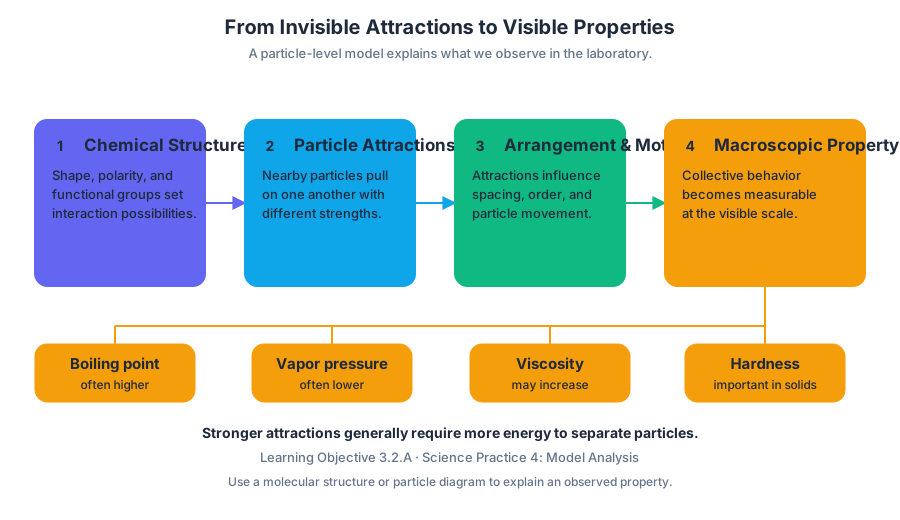
A molecule’s structure determines how strongly it interacts with nearby particles. Stronger attractions generally require more energy to separate particles, so they can produce higher boiling points, lower vapor pressures, greater viscosity, or greater hardness in a solid.
The central reasoning chain is:
$$ \text{chemical structure} \longrightarrow \text{particle attractions} \longrightarrow \text{particle arrangement and motion} \longrightarrow \text{macroscopic property} $$
This is the focus of Learning Objective 3.2.A: explain the relationship among a substance’s macroscopic properties, its particulate-level structure, and the interactions between its particles. In AP Chemistry, this connection is developed through Science Practice 4: Model Analysis, especially when a particle diagram or molecular structure must explain an observed property.
London dispersion forces
London dispersion forces are attractions caused by temporary, fluctuating dipoles. Even a nonpolar molecule has electrons that move constantly; for an instant, the electron cloud may be more concentrated on one side, creating a temporary partial negative end and a temporary partial positive end in the same molecule. That temporary dipole can distort a neighboring electron cloud and induce an opposite dipole.
According to Essential Knowledge 3.1.A.1, London dispersion forces result from Coulombic interactions between temporary, fluctuating dipoles and are always attractive. They occur between nonpolar molecules, polar molecules, and mixtures containing both.
The ease with which an electron cloud can be distorted is called polarizability. Larger particles with more electrons are usually more polarizable. Molecular shape also matters: elongated molecules can have greater surface-to-surface contact than compact molecules, increasing the total attraction.
Misconception check — “Nonpolar means no attractions.” Nonpolar molecules have no permanent dipole, but they still experience London dispersion forces. A sample of nonpolar molecules can condense because temporary dipoles continually attract neighboring particles.
Dipole-induced dipole interactions and polarity
A dipole-induced dipole interaction occurs when a polar molecule approaches a nonpolar molecule. The polar molecule’s permanent dipole distorts the nonpolar molecule’s electron cloud, producing an induced dipole. The attraction becomes stronger as the polar molecule’s dipole magnitude increases and as the nonpolar molecule becomes more polarizable.
Polar molecules also experience dipole-dipole attractions. These depend on both dipole magnitude and orientation: opposite partial charges attract, while similarly charged ends repel. Polar molecules of comparable size usually attract more strongly than nonpolar molecules because dipole-dipole interactions act in addition to London dispersion forces.
Other important attractions include ion-dipole forces, between an ion and a polar molecule, and hydrogen bonding, a particularly strong interaction in which hydrogen covalently bonded to nitrogen, oxygen, or fluorine is attracted to a nearby electronegative atom. These interactions are relevant to Essential Knowledge 3.1.A.3 and 3.1.A.4.
When comparing forces, first ask whether the particles are the same chemical species or different species, as required by Learning Objective 3.1.A. For molecules of the same species, compare size, electron count, shape, and polarizability. For different species, identify all applicable interactions rather than assigning a single force automatically.
Worked example: why a larger nonpolar molecule can boil at a higher temperature
Compare two nonpolar molecules with similar shapes: one has fewer electrons, and the other has many more. Neither has permanent dipole-dipole attractions, but the larger molecule has a more polarizable electron cloud. Its London dispersion forces are stronger, so more energy is required to separate its molecules. The larger molecule therefore tends to have the higher boiling point and lower vapor pressure.
Solubility: separating old attractions and forming new ones
Solubility describes how much of one substance dissolves in another. Dissolving is not simply “particles disappearing”; it requires breaking attractions among solute particles and solvent particles, then forming new solute-solvent attractions.
$$ \text{net dissolving tendency} \sim \text{new solute-solvent attractions}
\text{interactions that must be disrupted} $$
A polar solvent tends to interact favorably with polar solutes through dipole-dipole, hydrogen-bonding, or ion-dipole attractions. A nonpolar solvent tends to dissolve nonpolar substances through London dispersion forces. This is the molecular meaning behind the useful pattern “like dissolves like,” although solubility depends on the balance of all interactions involved.
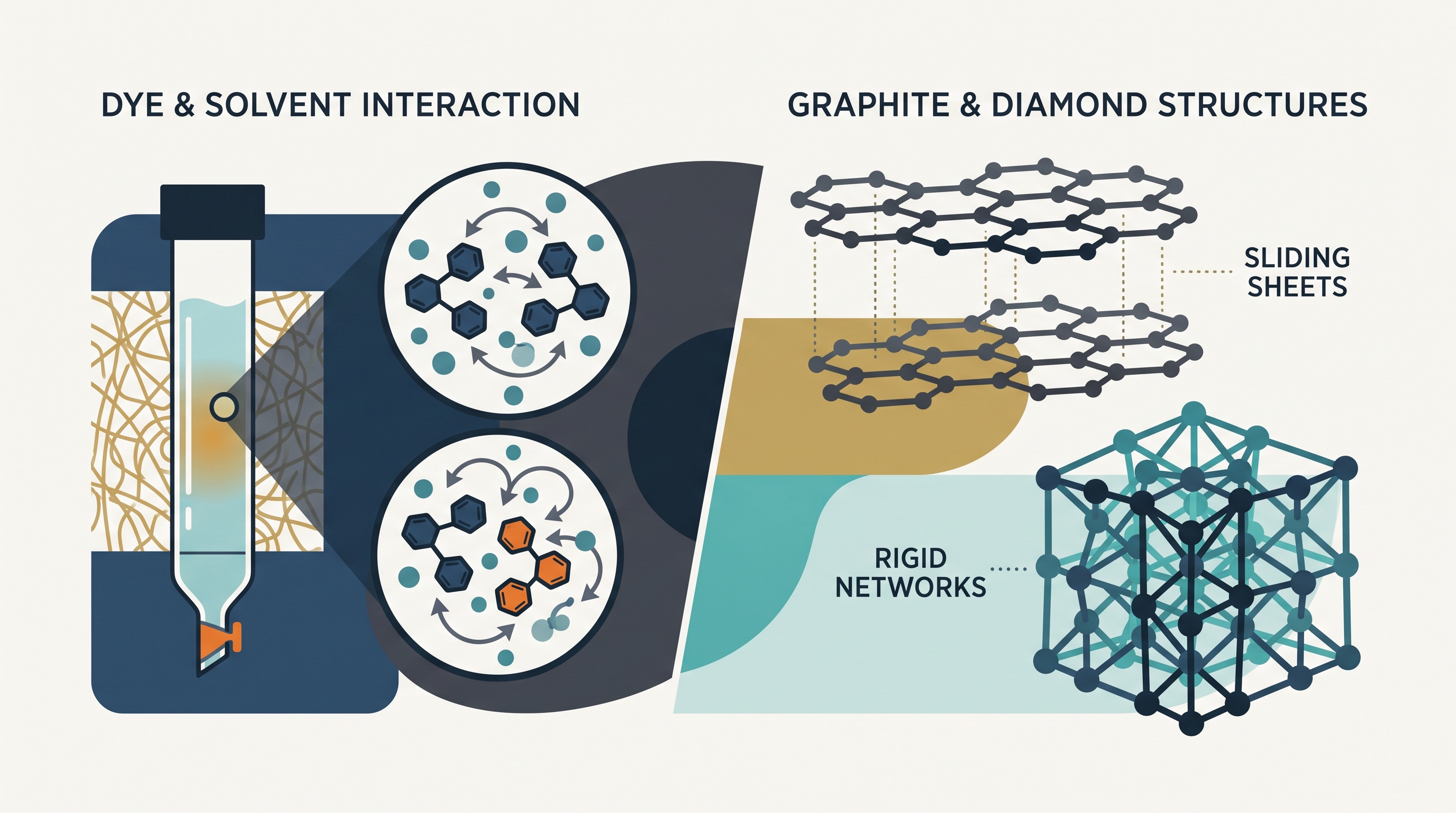
Chromatography provides a visible polarity test. As a solvent moves across paper, different dyes repeatedly partition between the mobile solvent and the stationary paper. A dye that interacts more strongly with the solvent travels farther; a dye that interacts more strongly with the paper travels less. Comparing the distances can identify which dye is most polar relative to that solvent-paper system.
Covalent network solids
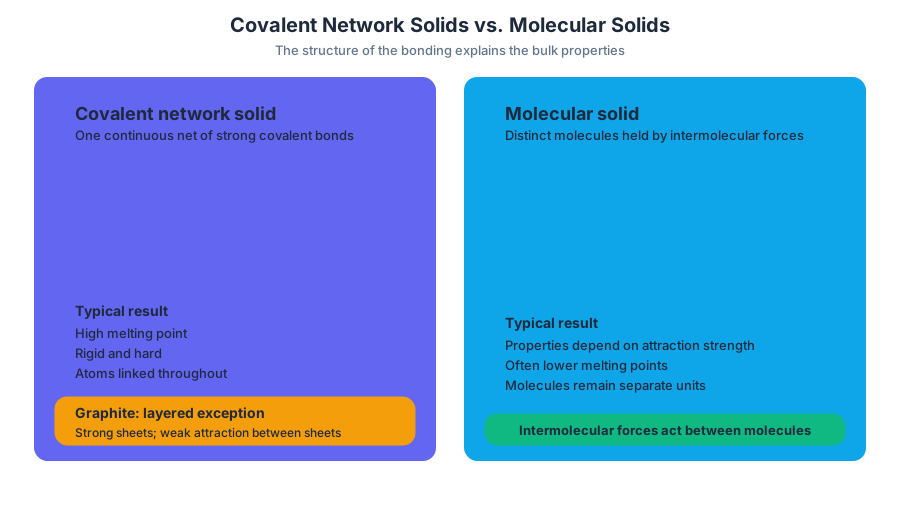
A covalent network solid consists of atoms joined by covalent bonds throughout an extended structure rather than separate molecules held together only by intermolecular forces. The network may extend in three dimensions, as in diamond, or in two-dimensional layers, as in graphite.
Essential Knowledge 3.2.A.4 identifies covalent network solids as structures formed from nonmetals and metalloids, either as elements or as binary compounds such as silicon dioxide and silicon carbide. Because strong covalent bonds connect atoms across the network, these substances generally have high melting points and are rigid and hard.
Graphite is the essential structural exception. Each layer contains strong covalent bonds, but the attraction between adjacent layers is much weaker, allowing the layers to slide past one another relatively easily. Pencil “lead” marks paper because graphite layers shear away, even though each individual layer is strongly bonded.
By contrast, Essential Knowledge 3.2.A.5 describes molecular solids as collections of distinct molecules held together between molecules by intermolecular forces. Their bulk properties therefore depend strongly on the strength of those intermolecular attractions, rather than on one continuous covalent network.
In-flow retrieval check
A nonpolar dye travels farther in a particular chromatography solvent than a polar dye. Which interaction is probably stronger for the traveling dye: dye-paper or dye-solvent? Answer: dye-solvent. The dye is spending more time associated with the mobile solvent, so it moves farther. Explain the same result at the particulate level, then predict why graphite can be soft while diamond is hard.
Source Materials
- AP Chemistry Course and Exam Description
- AP Chemistry Course and Exam Description Clarifications and Corrections
- AP Chemistry Course Overview
- AP Chemistry Course at a Glance
- AP Chemistry Course at a Glance Poster
- Adopt AP Chemistry
- AP Chemistry
- AP Chemistry
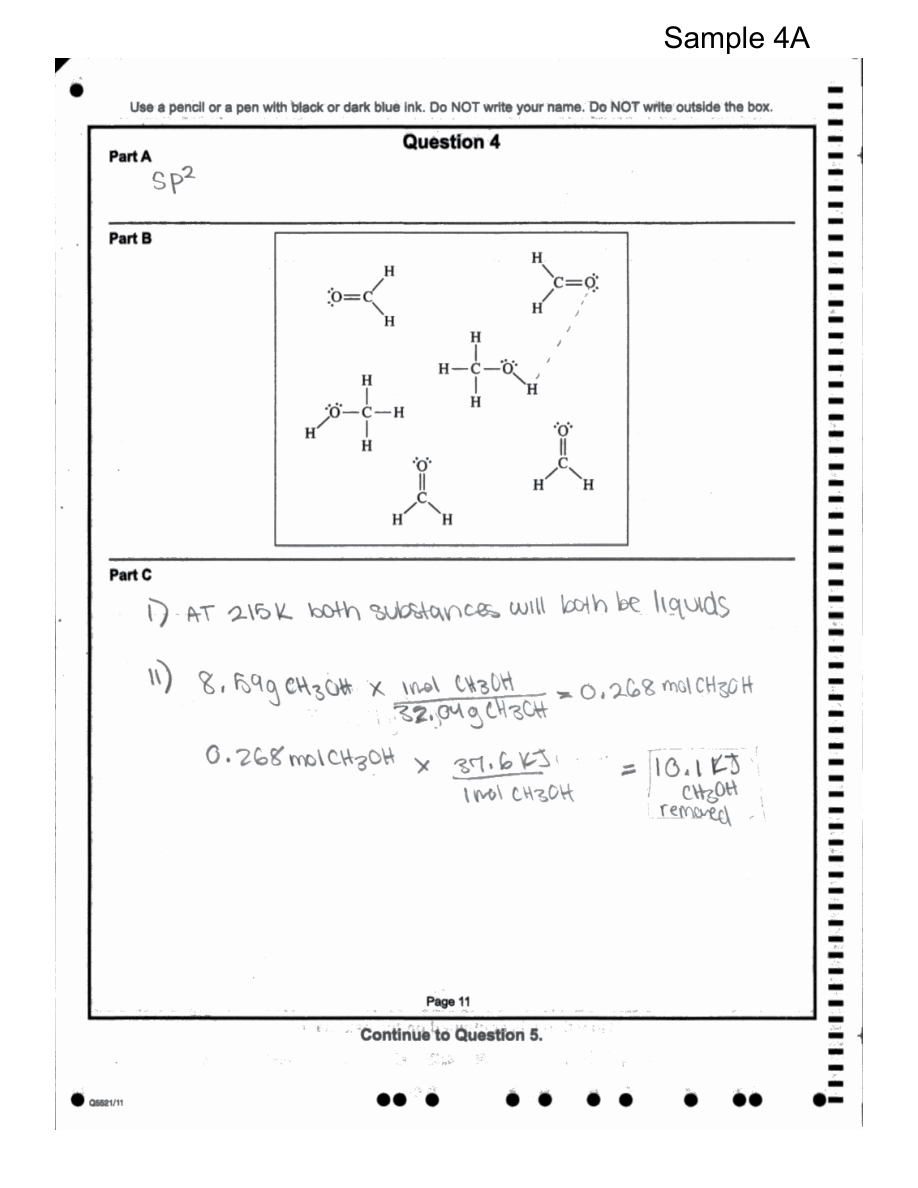
- Figure — Sample Responses Q4 (p. 3)
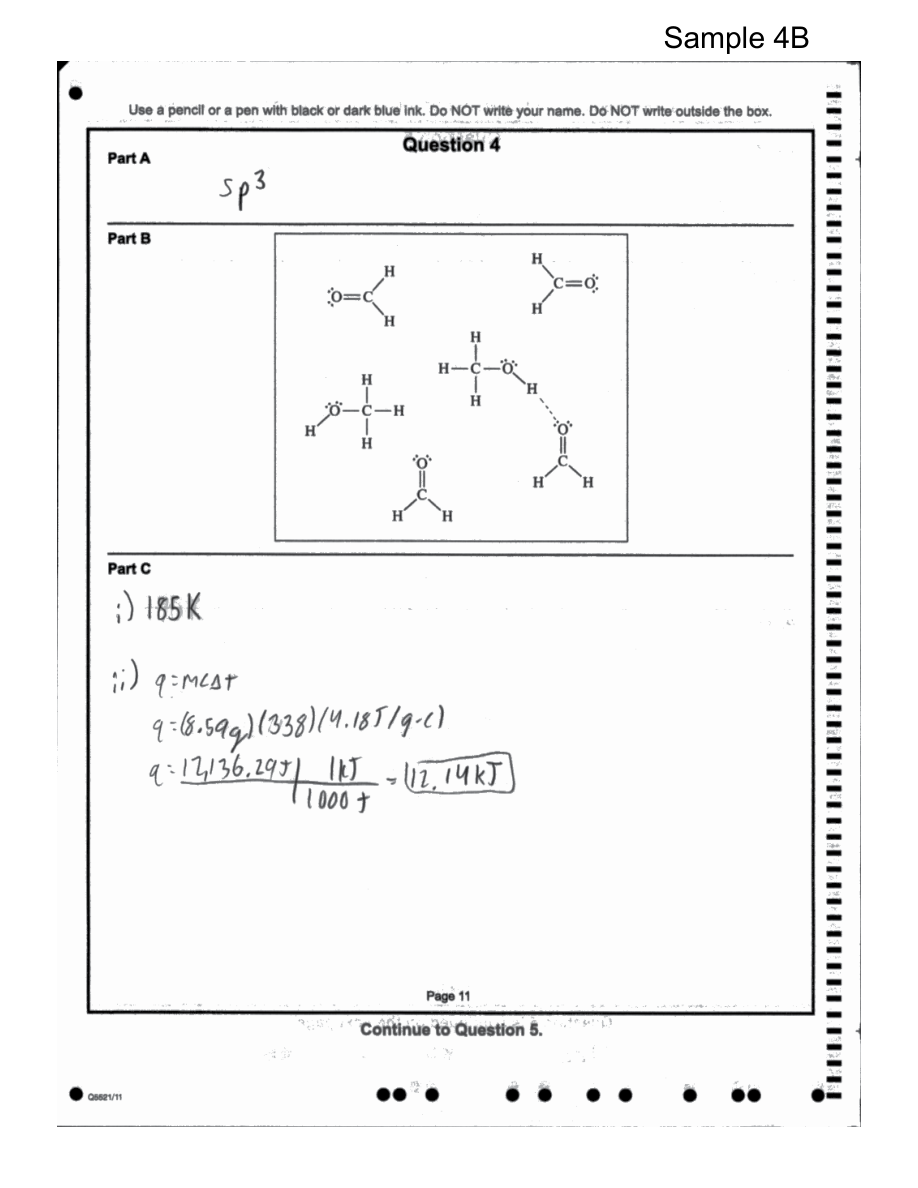
- Figure — Sample Responses Q4 (p. 4)
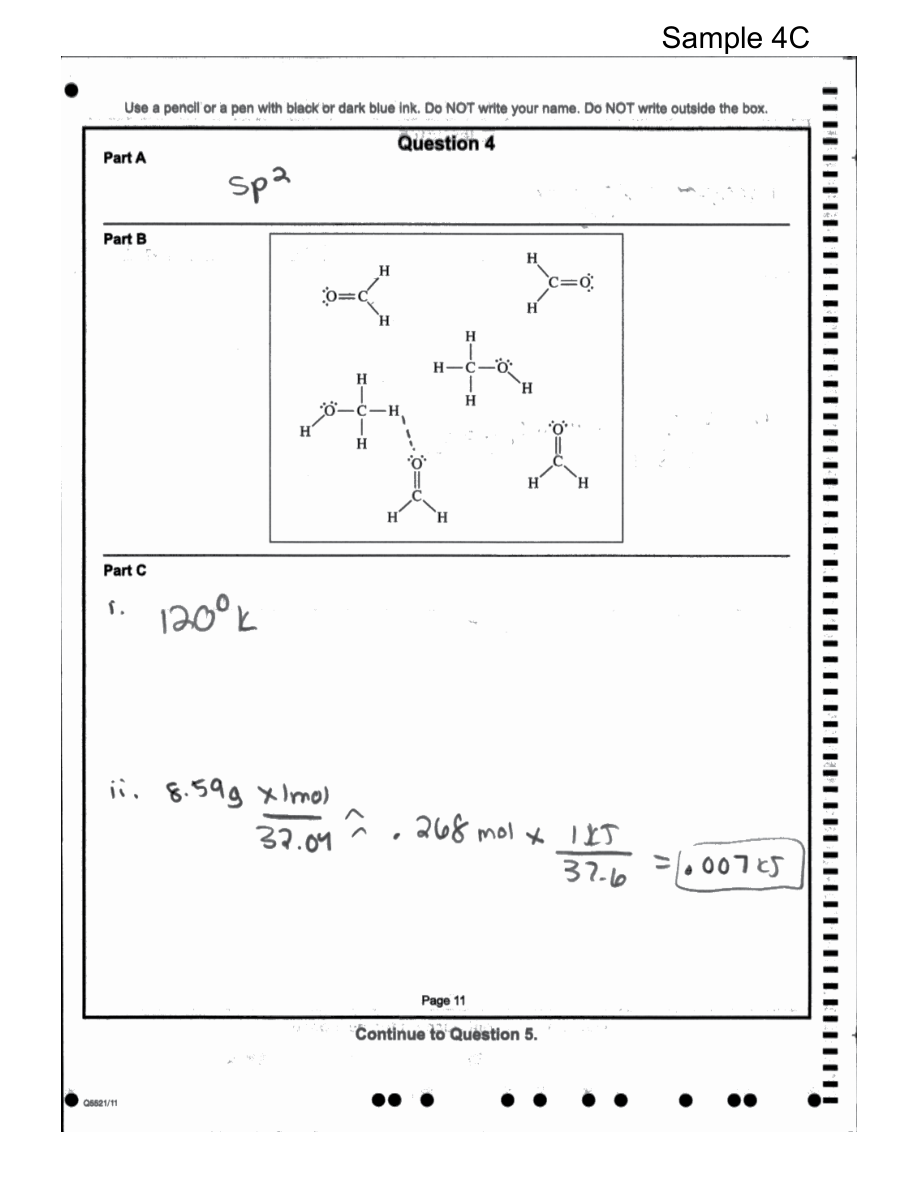
- Figure — Sample Responses Q4 (p. 5)
- AP Chemistry-AP Students