From the free course AP Chemistry on Lykke
3.5 Kinetic Molecular Theory · 3.6 Deviation from Ideal Gas Law
Key concepts: Kinetic Molecular Theory (KMT) · Temperature as a macroscopic measure of the average kinetic energy of gas particles · Kinetic energy of moving particles · Particle models of gases · Maxwell–Boltzmann kinetic-energy distribution curves · Ideal-gas assumptions as a simplification · Deviation of real gases from ideal behavior · Interparticle attractions in real gases · Finite particle volume in real gases · Connections between particulate and macroscopic scales
A gas’s pressure and temperature are macroscopic clues to what its particles are doing at the microscopic scale: moving continuously, randomly, and with a range of kinetic energies.
3.5 Kinetic Molecular Theory · 3.6 Deviation from Ideal Gas Law
A gas’s pressure and temperature are macroscopic clues to what its particles are doing at the microscopic scale: moving continuously, randomly, and with a range of kinetic energies. Kinetic molecular theory (KMT) connects those invisible motions to measurable gas properties, while the behavior of real gases reveals where the ideal-gas model becomes too simple.
Kinetic Molecular Theory: motion behind gas behavior
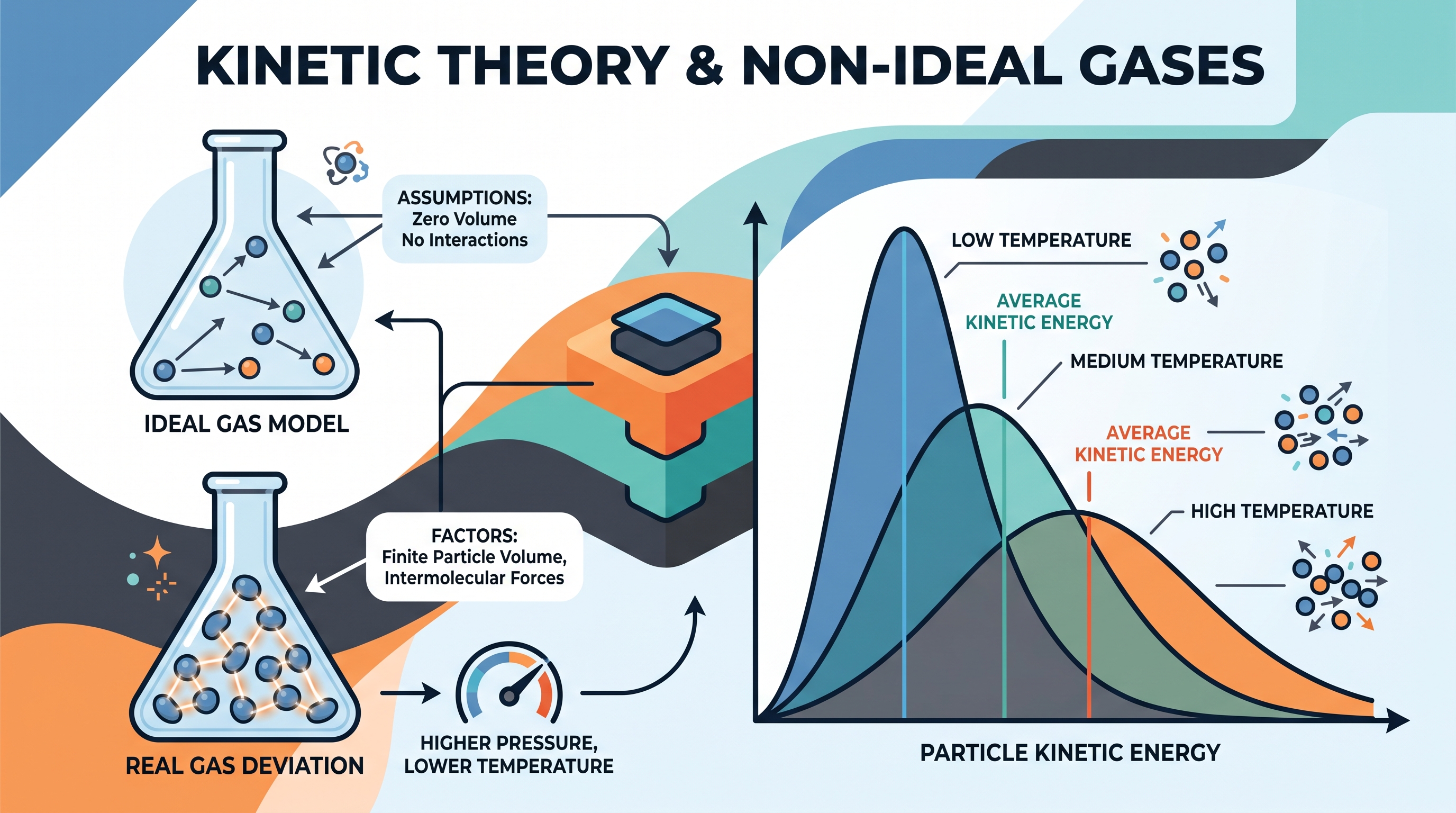
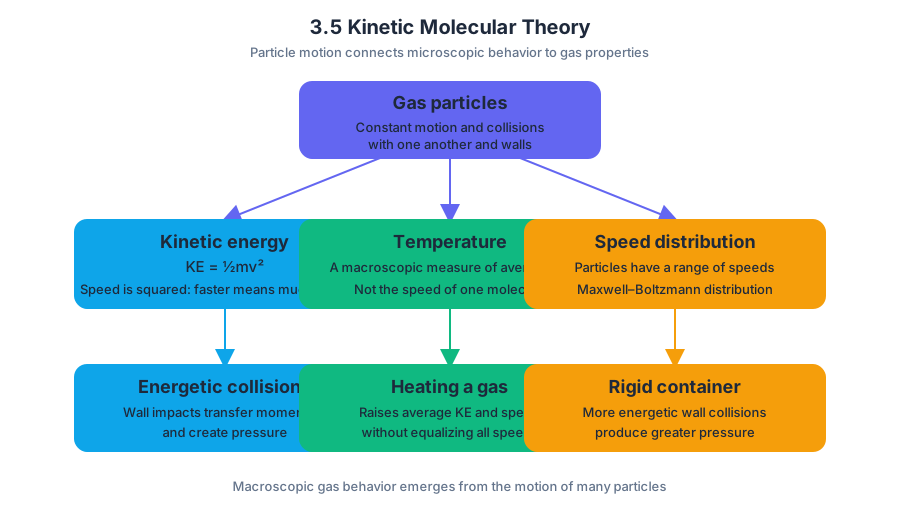
KMT explains gas behavior by modeling particles as constantly moving and colliding. The particles in a sample do not all move at one identical speed; instead, their kinetic energies are distributed across a range.
3.5.A.1: The kinetic molecular theory (KMT) relates the macroscopic properties of gases to motions of the particles in the gas. The Maxwell–Boltzmann distribution describes the distribution of the kinetic energies of particles at a given temperature.
The kinetic energy of a moving particle is represented by
$$ KE=\frac{1}{2}mv^2 $$
where $m$ is the particle’s mass and $v$ is its speed. Because speed is squared, a faster particle has disproportionately more kinetic energy. Temperature is therefore not the kinetic energy of one particular molecule; it is a macroscopic measure related to the average kinetic energy of the particles in the sample.
Heating a gas increases its average kinetic energy. The particles move faster on average, and collisions with the container walls become more energetic. In a rigid container, this produces a greater pressure. Importantly, heating does not make every particle move at the same speed.
Maxwell–Boltzmann distributions
A Maxwell–Boltzmann distribution is a graph showing how many particles have each range of kinetic energies. The horizontal axis represents kinetic energy, and the vertical axis represents the number or fraction of particles possessing that energy.
When temperature increases, the distribution broadens and spreads toward higher kinetic energies. Its peak becomes lower because the particles are distributed across a wider range, while the average kinetic energy increases.
| Temperature change | Particle-level interpretation | Distribution change |
|---|---|---|
| Lower temperature | Particles move more slowly on average | Narrower curve concentrated at lower $KE$ |
| Higher temperature | Particles move faster on average, but still have varied speeds | Broader curve shifted toward higher $KE$ |
Worked example — heating a sealed aerosol can. Suppose a sealed, rigid can is warmed. The can’s volume and the amount of gas remain essentially constant. Heating broadens the kinetic-energy distribution and shifts more particles into higher-energy motion; those particles strike the walls more frequently and with greater momentum transfer. The macroscopic pressure inside the can rises, even though the particles themselves have not chemically changed.
The ideal-gas model and its limits
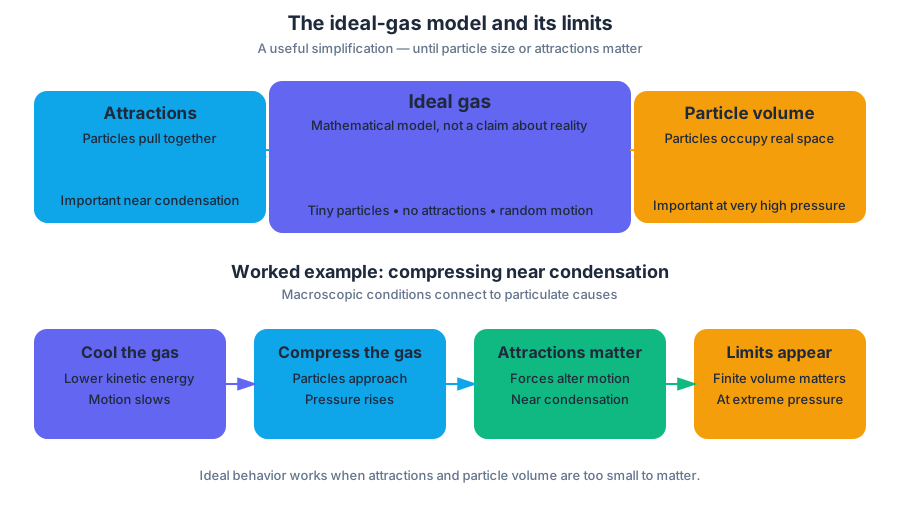
The ideal-gas model is a useful simplification. It treats gas particles as having negligible volume compared with the container and assumes that particles do not exert attractions on one another. It also represents their motion as continuous and random, with collisions modeled in a simplified way.
An ideal gas is not a claim that real particles have no size or attractions. It is a mathematical model that works best when those effects are too small to matter.
Real gases deviate from ideal behavior for two principal reasons identified in Essential Knowledge 3.6.A.1:
- Interparticle attractions become important when conditions approach condensation, especially at relatively low temperatures. Attractions pull particles toward one another, changing how freely they move and how strongly they collide with the container.
- Particle volume becomes important at extremely high pressures. Gas particles occupy real space, so the volume available for particle motion is smaller than the container volume assumed by the ideal model.
Worked example — compressing a gas near condensation. A sample of gas is cooled and compressed until it approaches condensation. Cooling lowers the particles’ average kinetic energy, so attractive forces have a greater opportunity to influence their motion. As pressure becomes very high, the particles’ finite volumes also become significant. An explanation at AP level must connect the observed non-ideal behavior to both the macroscopic conditions and these particulate causes.
Argumentation across scales
Topic 3.6 is tied to Science Practice 6: Argumentation, specifically 6.E: Provide reasoning to justify a claim using connections between particulate and macroscopic scales or levels. A strong response does not merely state that a gas “is non-ideal”; it identifies the condition—near condensation temperature or extremely high pressure—and explains the particle-level cause.
Named misconception — “All particles have the same kinetic energy at a given temperature.” Temperature describes an average, not a uniform value. The Maxwell–Boltzmann curve shows that particles have a distribution of kinetic energies; increasing temperature shifts the population toward higher energies while retaining a range of particle energies.
Retrieval check: A gas sample is heated, and its Maxwell–Boltzmann curve becomes broader and shifts toward higher kinetic energy. What microscopic change does this represent, and why can a real gas deviate from ideal behavior when compressed to extremely high pressure?
Source Materials
- AP Chemistry Course and Exam Description
- AP Chemistry Course and Exam Description Clarifications and Corrections
- AP Chemistry Course Overview
- AP Chemistry Course at a Glance
- AP Chemistry Course at a Glance Poster
- Adopt AP Chemistry
- AP Chemistry
- AP Chemistry
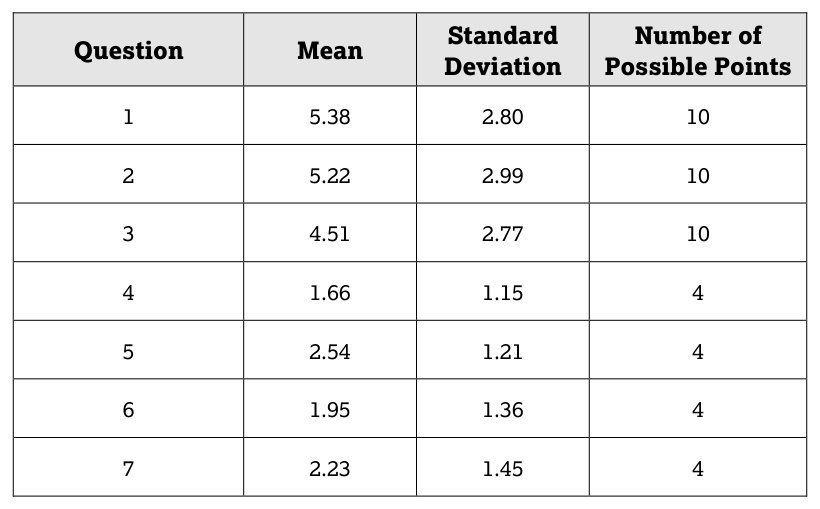
- Figure — Scoring Statistics (p. 1)
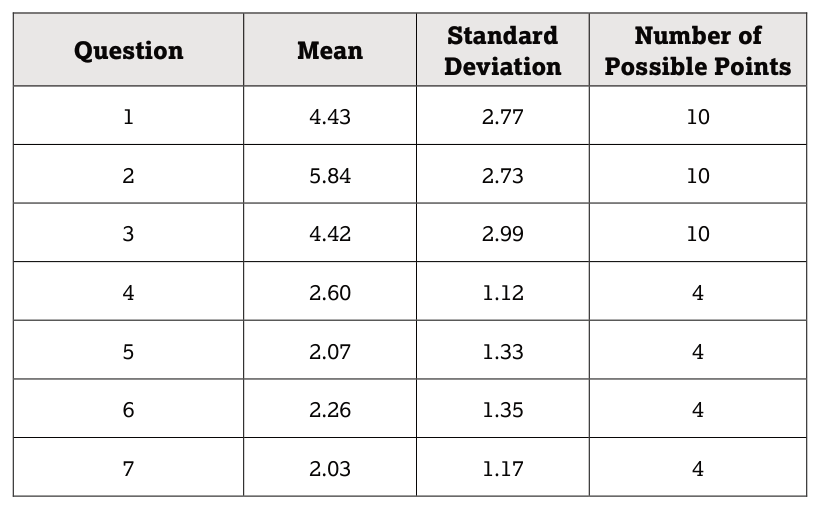
- Figure — Scoring Statistics (p. 1)
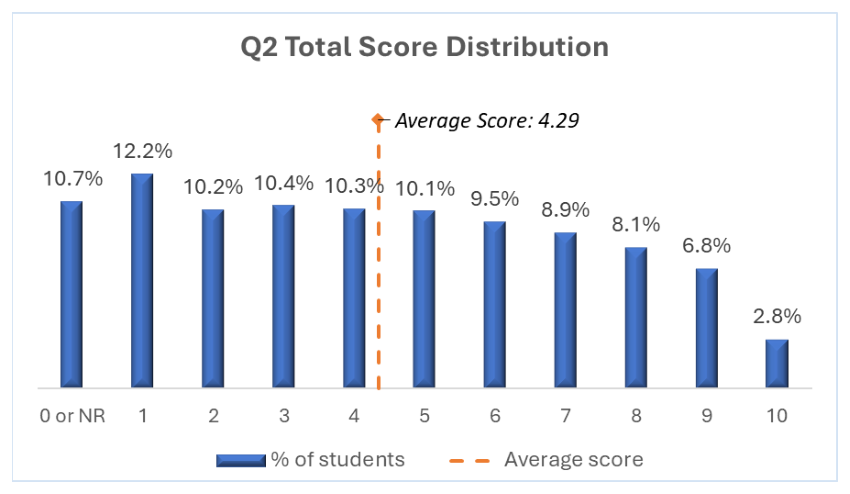
- Q2 Point-by-Point Distribution