From the free course AP Chemistry on Lykke
2.3 Structure of Ionic Solids · 2.4 Structure of Metals and Alloys
Key concepts: Structure of ionic solids · Structure of metals and alloys · Using visual models of atoms and ions to explain macroscopic properties · Relationship between particle structure and substance properties · Metallic bonding and the sea of mobile electrons · Electrical conductivity of metals and alloys · Alloys as mixtures of metals · Composition and properties of sterling silver · Tarnishing of metal alloys · Electrochemical cell voltage calculations
A crystal of table salt and a piece of copper can both look like ordinary solids, yet their particles are organized in fundamentally different ways: an ionic solid locks oppositely charged ions into a repeating lattice, while a metal places positive metal ions in a lattice surrounded by mobile, delocalized electrons.
2.3 Structure of Ionic Solids · 2.4 Structure of Metals and Alloys
A crystal of table salt and a piece of copper can both look like ordinary solids, yet their particles are organized in fundamentally different ways: an ionic solid locks oppositely charged ions into a repeating lattice, while a metal places positive metal ions in a lattice surrounded by mobile, delocalized electrons. Those microscopic models explain why salt crystals fracture but copper can be bent, and why solid salt does not conduct electricity while copper does.
Ionic solids: an organized three-dimensional lattice
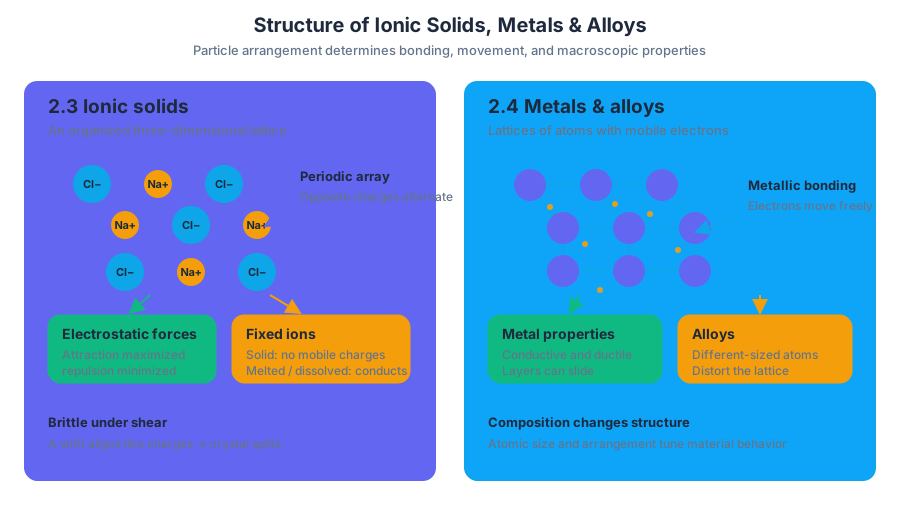
Learning Objective 2.3.A requires students to represent an ionic solid with a particulate model consistent with Coulomb’s law and the properties of its constituent ions. In an ionic crystal, cations and anions occupy a systematic, periodic three-dimensional array. The arrangement maximizes attractive interactions between opposite charges while minimizing repulsive interactions between like charges.
Essential Knowledge 2.3.A.1: The cations and anions in an ionic crystal are arranged in a systematic, periodic 3-D array that maximizes the attractive forces among cations and anions while minimizing the repulsive forces.
A useful model of sodium chloride is not a collection of separate sodium chloride molecules. Instead, it is an extended pattern in which each $Na^+$ ion is surrounded by nearby $Cl^-$ ions, and each $Cl^-$ ion is surrounded by nearby $Na^+$ ions. The model must show both charge and relative particle size: changing an ion’s charge or radius changes the distances and strengths of the electrostatic interactions.
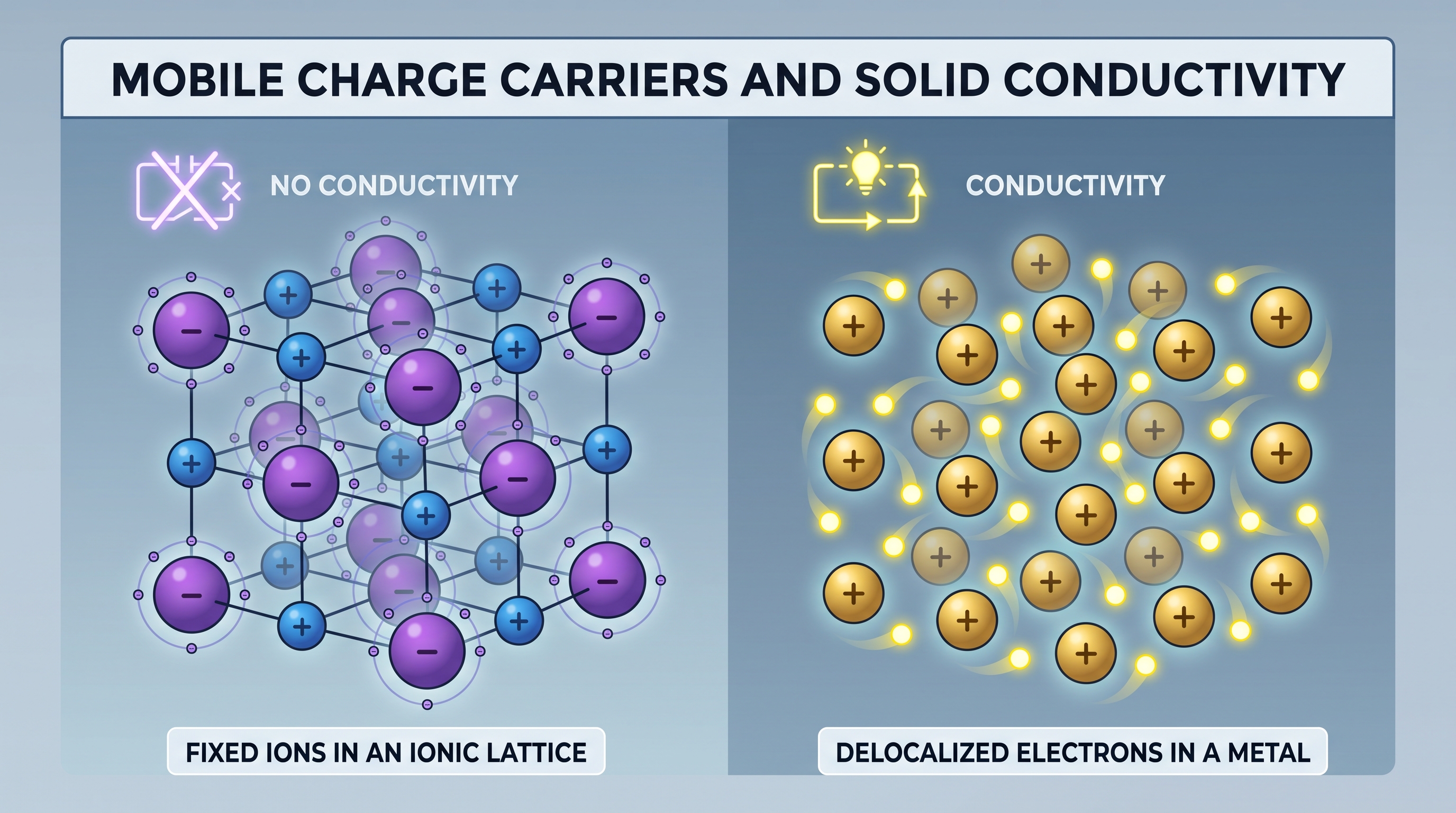
The lattice model predicts macroscopic properties. Because the ions are held in fixed positions, a solid ionic crystal generally does not conduct electricity: its charged particles cannot move through the solid. If the crystal melts or dissolves in water, ions can move, so the material can conduct. Ionic solids are also often brittle. When a layer of ions shifts, like charges may become aligned beside one another; strong repulsion then causes the crystal to split rather than deform smoothly.
Worked model-analysis example
Imagine comparing two diagrams. Model A shows alternating positive and negative ions in a repeating array. Model B shows positive ions clustered beside positive ions, with negative ions clustered elsewhere. Model A is consistent with 2.3.A.1 because it maximizes cation–anion attraction and reduces cation–cation and anion–anion repulsion. Model B is not a plausible stable ionic crystal, even if its total numbers of positive and negative charges are correct.
The exam-relevant reasoning is Science Practice 4: Model Analysis, specifically 4.C Explain the connection between particulate-level and macroscopic properties of a substance using models and representations. Do not merely identify the lattice; use it to explain an observation: fixed ions account for poor solid-state conductivity, and the periodic arrangement of strong attractions accounts for a rigid crystal structure.
Metals: positive ions in a sea of electrons
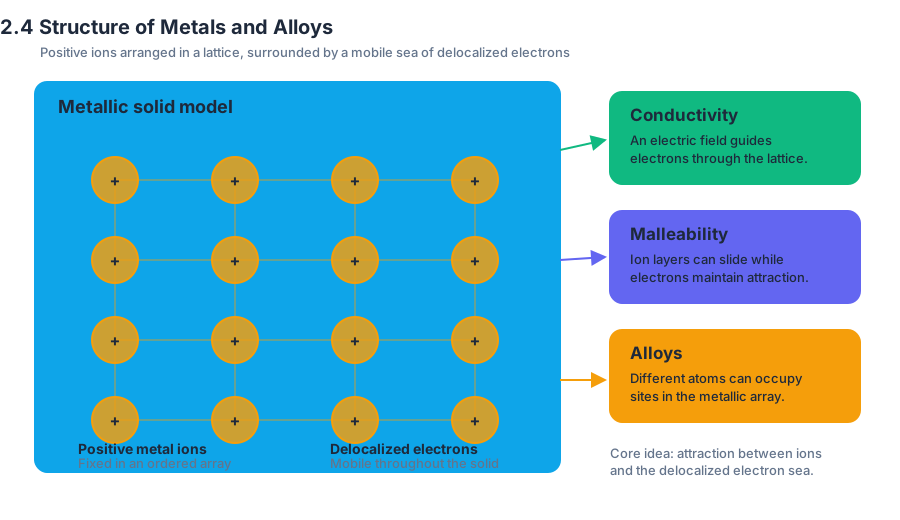
Learning Objective 2.4.A requires students to represent a metallic solid and/or alloy using a model that shows the essential characteristics of its structure and interactions. In the metallic-bonding model, positive metal ions form an array while valence electrons are delocalized, meaning they are not assigned to one particular atom. They move throughout the solid as a mobile “sea of electrons.”
Essential Knowledge 2.4.A.1: Metallic bonding can be represented as an array of positive metal ions surrounded by delocalized valence electrons, or a “sea of electrons.”
The mobile electrons explain why metals conduct electricity: when an electric field is applied, the electrons can move through the lattice and carry charge. The same model helps explain malleability and ductility. If layers of metal ions slide, the delocalized electrons continue to attract the positive ions, so the structure can change shape without the entire lattice shattering.
Alloys: changing the lattice without eliminating electron mobility
An alloy is a metallic solid containing atoms of more than one element. Its properties depend strongly on how the different-sized atoms fit into the metal lattice.
An interstitial alloy forms when much smaller atoms occupy spaces between larger metal atoms. In steel, carbon atoms occupy interstitial spaces in an iron lattice. These smaller atoms obstruct the movement of iron layers, so the alloy is typically harder and less easily deformed than pure iron.
Essential Knowledge 2.4.A.2: Interstitial alloys form between atoms of significantly different radii, where the smaller atoms fill the interstitial spaces between the larger atoms, as in carbon in iron.
A substitutional alloy forms when atoms of comparable radius replace some of the original atoms in the lattice. In certain brass alloys, zinc atoms substitute for copper atoms. The substitutions distort the regular lattice and can increase strength while preserving the delocalized-electron model, so the alloy generally remains electrically conducting.
Essential Knowledge 2.4.A.3: Substitutional alloys form between atoms of comparable radius, where one atom substitutes for the other in the lattice, as in zinc substituting for copper in certain brass alloys.
Sterling silver illustrates a substitutional-alloy context: it contains $92.5%$ silver and $7.5%$ other metals, such as copper, by mass. It remains metallic and conducts electricity, but its altered lattice gives it greater durability than pure silver. Over time, sterling silver can tarnish because surface atoms undergo chemical reactions with substances in the environment; conductivity and metallic structure do not mean that the surface is chemically unreactive.
Misconception check
Misconception: “All solids conduct because their particles contain electrons.” Conductivity requires mobile charge carriers, not merely charged particles or electrons somewhere inside atoms. In a solid ionic crystal, ions are present but fixed; in a metal or metallic alloy, delocalized electrons can move through the structure.
Retrieval check: Which model best explains each observation: an ionic lattice, a pure-metal lattice, an interstitial alloy, or a substitutional alloy?
- A crystal fractures when layers shift.
- A solid conducts electricity and can be drawn into wire.
- Carbon makes iron harder.
- Zinc replaces copper atoms in brass.
Answers: $1$ is an ionic lattice, $2$ is a pure-metal lattice, $3$ is an interstitial alloy, and $4$ is a substitutional alloy. In every case, the strongest explanation begins with the particle model and ends with the observable property.
Source Materials
- AP Chemistry Course and Exam Description
- AP Chemistry Course and Exam Description Clarifications and Corrections
- AP Chemistry Course Overview
- AP Chemistry Course at a Glance
- AP Chemistry Course at a Glance Poster
- Adopt AP Chemistry
- AP Chemistry
- AP Chemistry
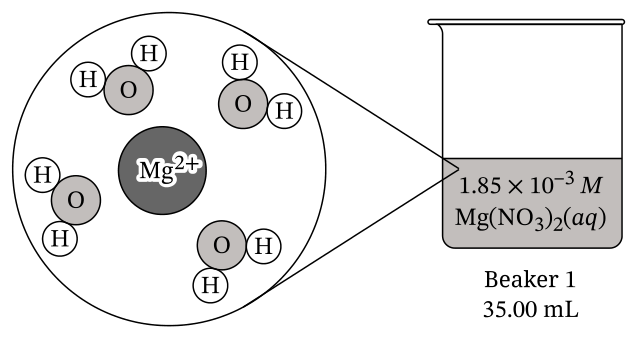
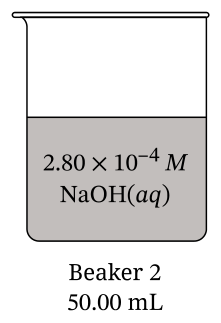
- B. The particle diagram shown represents a magnesium ion, Mg2+, in beaker 1. A sodium
- B. The particle diagram shown represents a magnesium ion, Mg2+, in beaker 1. A sodium