From the free course AP Chemistry on Lykke
8.9 Henderson-Hasselbalch Equation · 8.10 Buffer Capacity
Key concepts: Henderson–Hasselbalch equation · Using the acid/conjugate-base concentration ratio to calculate pH · Determining pKa from the half-equivalence point · Interpreting titration curves · Identifying the buffer region · Recognizing the equivalence point · Calculating moles and molarity from titration data · Buffer capacity and the effect of buffer components
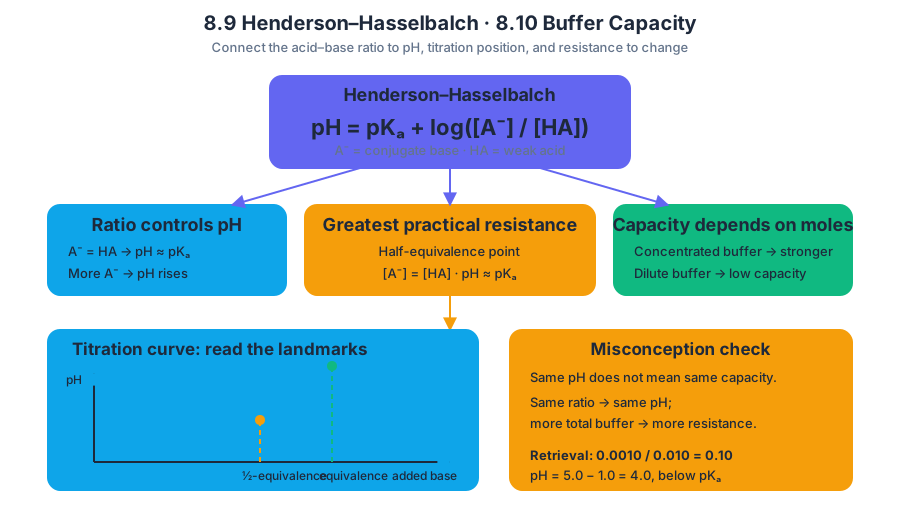
A buffer’s pH is controlled mainly by the ratio of conjugate base to weak acid, not by the absolute amount of solution. For a weak acid $\mathrm{HA}$ and its conjugate base $\mathrm{A^-}$:
8.9 Henderson–Hasselbalch Equation · 8.10 Buffer Capacity
A buffer’s pH is controlled mainly by the ratio of conjugate base to weak acid, not by the absolute amount of solution. For a weak acid $\mathrm{HA}$ and its conjugate base $\mathrm{A^-}$:
$$\mathrm{pH}=\mathrm{p}K_a+\log\left(\frac{[\mathrm{A^-}]}{[\mathrm{HA}]}\right)$$
Here, $[\mathrm{A^-}]$ is the concentration of the conjugate base and $[\mathrm{HA}]$ is the concentration of the weak acid. If both concentrations are multiplied or divided by the same factor, their ratio remains unchanged, so the pH remains approximately unchanged.
Using a concentration ratio to calculate pH
Suppose a buffer contains $0.020\ \mathrm{M}$ conjugate base and $0.010\ \mathrm{M}$ weak acid, with $\mathrm{p}K_a=4.1$. The ratio must be written in the order base over acid:
$$ \mathrm{pH}=4.1+\log\left(\frac{0.020}{0.010}\right) $$
$$ \mathrm{pH}=4.1+\log(2) $$
$$ \boxed{\mathrm{pH}\approx 4.4} $$
The base concentration is twice the acid concentration, so the logarithm is positive and the pH is higher than $\mathrm{p}K_a$. If the concentrations had been reversed, the ratio would be $0.5$, the logarithm would be negative, and the pH would be lower than $\mathrm{p}K_a$.
The half-equivalence point reveals $\mathrm{p}K_a$
During the titration of a weak acid with a strong base, the strong base converts some $\mathrm{HA}$ into $\mathrm{A^-}$:
$$ \mathrm{HA(aq)+OH^-(aq)\rightarrow A^-(aq)+H_2O(l)} $$
At the half-equivalence point, exactly half of the original weak acid has been neutralized. The moles of weak acid remaining equal the moles of conjugate base produced:
$$ [\mathrm{A^-}]=[\mathrm{HA}] $$
Therefore,
$$ \mathrm{pH}=\mathrm{p}K_a+\log(1)=\mathrm{p}K_a $$
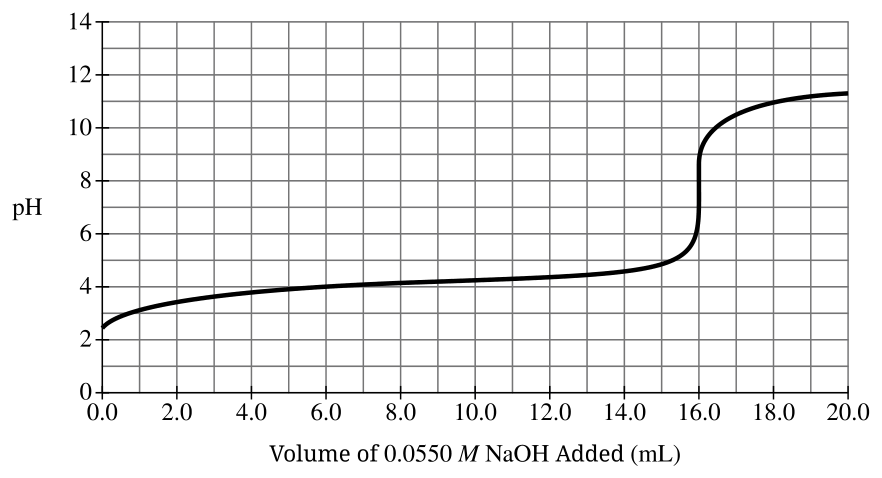
For the $\mathrm{HAsc}$ titration, the equivalence point occurs at approximately $16.0\ \mathrm{mL}$ of $\mathrm{NaOH}$. The half-equivalence point is therefore $8.0\ \mathrm{mL}$, where the titration curve gives $\mathrm{pH}\approx 4.2$. The experimental value is reported as:
$$ \boxed{\mathrm{p}K_a\approx 4.1} $$
An acceptable experimental range is $4.0$–$4.3$. The equivalence-point pH, approximately $8.5$, is not the $\mathrm{p}K_a$.
Reading the titration curve
A weak-acid/strong-base titration curve has three visually important regions:
| Curve feature | Chemical meaning |
|---|---|
| Gentle rising region before equivalence | Buffer region: both $\mathrm{HA}$ and $\mathrm{A^-}$ are present |
| Midpoint of the steep rise | Equivalence point: stoichiometric neutralization is complete |
| Region after equivalence | Excess $\mathrm{OH^-}$ controls the pH |
For $\mathrm{HAsc}$, the buffer region includes $8.0\ \mathrm{mL}$ of added $\mathrm{NaOH}$, where $\mathrm{pH}\approx 4.2$. The sharp rise is centered near $16.0\ \mathrm{mL}$ and $\mathrm{pH}\approx 8.5$. The equivalence point is above $\mathrm{pH}=7$ because $\mathrm{Asc^-}$, the conjugate base of a weak acid, reacts with water to produce some $\mathrm{OH^-}$.
Connecting titration stoichiometry to buffer composition
At the equivalence point, the $1:1$ reaction means that the moles of $\mathrm{NaOH}$ added equal the original moles of $\mathrm{HAsc}$:
$$ 0.0160\ \mathrm{L}\times 0.0550\ \mathrm{mol\ L^{-1}} =8.80\times10^{-4}\ \mathrm{mol\ HAsc} $$
If the original acid sample volume was $0.0100\ \mathrm{L}$, its molarity was:
$$ [\mathrm{HAsc}] =\frac{8.80\times10^{-4}\ \mathrm{mol}}{0.0100\ \mathrm{L}} =\boxed{0.0880\ \mathrm{M}} $$
Before equivalence, added $\mathrm{OH^-}$ determines how much $\mathrm{HAsc}$ becomes $\mathrm{Asc^-}$. Those stoichiometric mole amounts can be used in the Henderson–Hasselbalch ratio because both species occupy the same solution volume; the volume factors cancel in the ratio.
Working backward from pH to the ratio
For a buffer with $\mathrm{pH}=4.7$ and $\mathrm{p}K_a=4.1$:
$$ 4.7=4.1+\log\left(\frac{[\mathrm{Asc^-}]}{[\mathrm{HAsc}]}\right) $$
$$ 0.6=\log\left(\frac{[\mathrm{Asc^-}]}{[\mathrm{HAsc}]}\right) $$
$$ \frac{[\mathrm{Asc^-}]}{[\mathrm{HAsc}]}=10^{0.6}\approx\boxed{4.0} $$
The expression $10^{-\mathrm{pH}}$ calculates $[\mathrm{H^+}]$. It does not calculate the buffer ratio. The ratio here requires $10^{\mathrm{pH}-\mathrm{p}K_a}$, so $10^{-(\mathrm{pH}-\mathrm{p}K_a)}$ gives the reciprocal ratio, not $\dfrac{[\mathrm{Asc^-}]}{[\mathrm{HAsc}]}$.
Buffer capacity
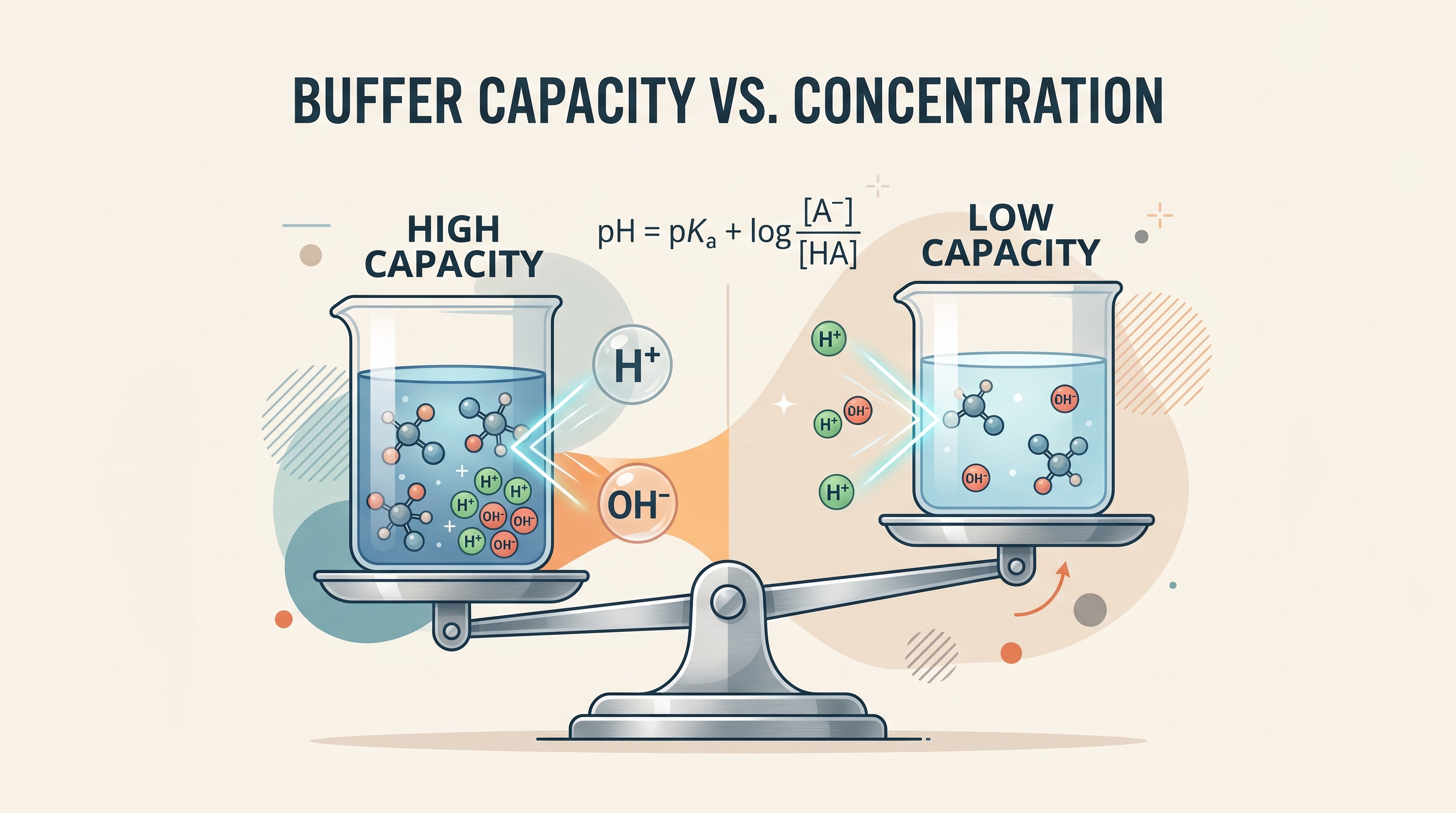
Buffer capacity is a buffer’s ability to resist a pH change when acid or base is added. Capacity depends on the amounts and relative proportions of both buffer components: $\mathrm{HA}$ must absorb added $\mathrm{OH^-}$, while $\mathrm{A^-}$ must absorb added $\mathrm{H^+}$.
A buffer has its greatest practical resistance near the half-equivalence point, where $[\mathrm{A^-}]=[\mathrm{HA}]$ and $\mathrm{pH}\approx\mathrm{p}K_a$. A very dilute buffer may have the correct pH but low capacity because only a small number of moles can react.
Misconception check: Equal pH does not necessarily mean equal buffer capacity. Two buffers can have the same base-to-acid ratio, and therefore the same pH, while the more concentrated buffer resists added acid or base more effectively.
These calculations exercise Science Practice 3: Representing Data and Phenomena, especially when extracting the half-equivalence and equivalence points from a curve; Science Practice 5: Mathematical Routines, when manipulating logarithms, ratios, and titration quantities; and Science Practice 6: Argumentation, when defending why a point on the curve represents $\mathrm{p}K_a$ or why a buffer resists pH change.
Retrieval check: A buffer has $\mathrm{p}K_a=5.0$, $[\mathrm{A^-}]=0.0010\ \mathrm{M}$, and $[\mathrm{HA}]=0.010\ \mathrm{M}$. Is its pH above or below $5.0$? Since $\dfrac{[\mathrm{A^-}]}{[\mathrm{HA}]}=0.10$, $\log(0.10)=-1$, so $\mathrm{pH}=4.0$, below $\mathrm{p}K_a$.
Source Materials
- AP Chemistry Course and Exam Description
- AP Chemistry Course and Exam Description Clarifications and Corrections
- AP Chemistry Course Overview
- AP Chemistry Course at a Glance
- AP Chemistry Course at a Glance Poster
- Adopt AP Chemistry
- AP Chemistry
- AP Chemistry
- i. Calculate the molar concentration of the ascorbic acid solution.