From the free course AP Chemistry on Lykke
4.5 Stoichiometry · 4.6 Introduction to Titration
Key concepts: Advanced stoichiometry · Gas laws · The ideal gas law · Aqueous solution chemistry · Molarity · Introduction to titration · Practical laboratory applications · Investigation 7 · Purification applications
A chemical equation becomes experimentally useful only when its coefficients are treated as a quantitative recipe: they connect particles, moles, masses, gas volumes, and solution concentrations.
4.5 Stoichiometry · 4.6 Introduction to Titration
A chemical equation becomes experimentally useful only when its coefficients are treated as a quantitative recipe: they connect particles, moles, masses, gas volumes, and solution concentrations.
The stoichiometric map
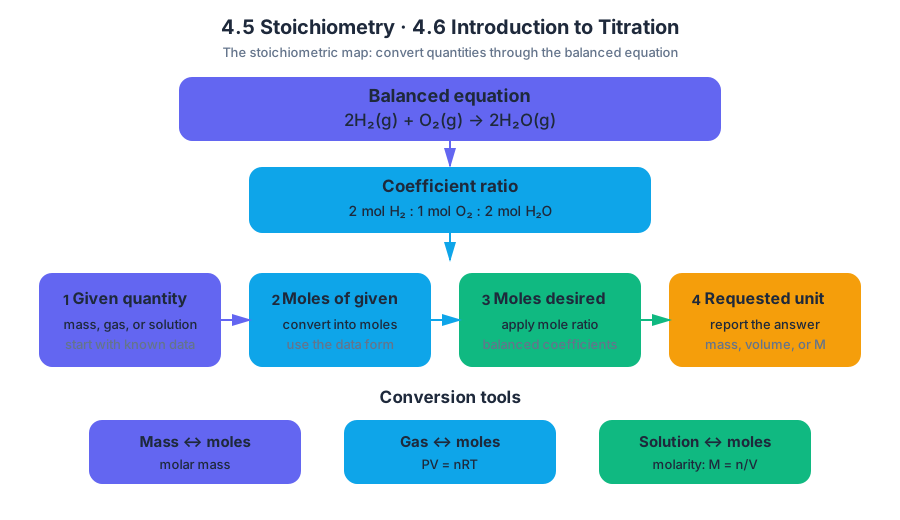
A balanced equation such as
$$ 2H_2(g)+O_2(g)\rightarrow 2H_2O(g) $$
does not say that $2\ \mathrm{g}$ of hydrogen reacts with $1\ \mathrm{g}$ of oxygen. Its coefficients give mole relationships: $2$ mol $H_2$ react with $1$ mol $O_2$ to produce $2$ mol $H_2O$. Every advanced stoichiometry problem is a controlled conversion through that ratio.
The general pathway is:
$$ \text{given quantity} \rightarrow \text{moles of given substance} \rightarrow \text{moles of desired substance} \rightarrow \text{requested unit} $$
The middle conversion uses the coefficients of the balanced equation. The first and last conversions depend on the form of the data: molar mass for mass, $PV=nRT$ for gases, and molarity for aqueous solutions.
Gas stoichiometry: using $PV=nRT$
For a gas, the ideal gas law relates pressure, volume, amount, and temperature:
$$ PV=nRT $$
Here, $P$ is pressure, $V$ is volume, $n$ is amount in moles, $R$ is the gas constant, and $T$ is absolute temperature in kelvins. The temperature must be converted using $T(\mathrm{K})=T(^\circ\mathrm{C})+273.15$.
Worked example: identifying the limiting reactant
A reaction produces hydrogen gas according to
$$ Mg(s)+2HCl(aq)\rightarrow MgCl_2(aq)+H_2(g) $$
Suppose $0.120$ mol of magnesium reacts with $0.180$ mol of hydrochloric acid. Magnesium would require
$$ 0.120\ \mathrm{mol\ Mg}\times \frac{2\ \mathrm{mol\ HCl}}{1\ \mathrm{mol\ Mg}} =0.240\ \mathrm{mol\ HCl} $$
Only $0.180$ mol $HCl$ is available, so $HCl$ is the limiting reactant. The amount of hydrogen is therefore
$$ 0.180\ \mathrm{mol\ HCl}\times \frac{1\ \mathrm{mol\ H_2}}{2\ \mathrm{mol\ HCl}} =0.0900\ \mathrm{mol\ H_2} $$
At $298\ \mathrm{K}$ and $1.00\ \mathrm{atm}$,
$$ V=\frac{nRT}{P} =\frac{(0.0900)(0.08206)(298)}{1.00} =2.20\ \mathrm{L} $$
The limiting reactant controls the product amount; the excess reactant does not.
Misconception check — “The reactant with fewer grams is limiting.” Limiting status cannot be judged from mass alone. Convert each reactant to the amount of product it could form, or compare the available-to-required mole ratios. A large mass of a substance with a large molar mass may represent fewer moles than expected.
Aqueous stoichiometry and molarity
Molarity is the amount of solute per liter of solution:
$$ M=\frac{n}{V} $$
where $M$ has units of $\mathrm{mol,L^{-1}}$ and $V$ must be measured in liters. Rearranging gives the especially useful relationship
$$ n=MV $$
Thus, a measured solution volume can enter a stoichiometric calculation directly after multiplication by its molarity.
For example, $25.00\ \mathrm{mL}$ of $0.1500\ \mathrm{M}$ $NaOH$ contains
$$ n=(0.1500\ \mathrm{mol,L^{-1}})(0.02500\ \mathrm{L}) =0.003750\ \mathrm{mol\ NaOH} $$
If the reaction requires a $1:1$ mole ratio between $NaOH$ and another reactant, then $0.003750$ mol of that reactant is consumed. If the ratio is not $1:1$, the balanced equation—not the volumes alone—determines the conversion.
CED traceability: Topic 4.5 Stoichiometry centers on Learning Objective 4.5.A and includes the quantitative integration identified in Essential Knowledge 4.5.A.3: stoichiometric reasoning may involve masses, gas quantities, and molarity in aqueous solutions.
Titration: measuring an unknown concentration
A titration determines an unknown concentration by reacting the unknown solution with a solution of known concentration. The known solution is the titrant; the solution being analyzed is the sample. A buret delivers the titrant while the volume required for the reaction is measured accurately.
At the reaction’s equivalence point, stoichiometrically sufficient titrant has been added. An indicator may produce a visible color change near this point, but the indicator’s color change is an experimental signal, not the definition of equivalence.
For a $1:1$ reaction, the calculation is often
$$ M_{\text{unknown}}V_{\text{unknown}}
M_{\text{titrant}}V_{\text{titrant}} $$
For any other ratio, first calculate titrant moles and then apply the balanced-equation mole ratio.
Titration example
If $18.60\ \mathrm{mL}$ of $0.1000\ \mathrm{M}$ $NaOH$ neutralizes $25.00\ \mathrm{mL}$ of a monoprotic acid $HA$,
$$ n_{NaOH}=(0.1000)(0.01860)=0.001860\ \mathrm{mol} $$
Because
$$ HA+NaOH\rightarrow NaA+H_2O $$
has a $1:1$ ratio,
$$ M_{HA}=\frac{0.001860}{0.02500} =0.07440\ \mathrm{M} $$
Misconception check — “Equivalence point means equal volumes.” Equal volumes matter only in special cases. Equivalence means equal stoichiometric amounts after accounting for the reaction coefficients. A $2:1$ reaction requires a different relationship between the measured volumes and concentrations.
Investigation 7: from measurement to purification
Investigation 7 provides a practical setting for connecting mathematical chemistry to a laboratory process such as determining composition, monitoring a reaction, or evaluating purification. A defensible investigation records initial and final buret readings, solution concentrations, sample volume, balanced-equation ratios, calculations, uncertainty, and a conclusion supported by measured evidence.
The laboratory sequence is:
- Measure the sample or product carefully.
- Add titrant until the endpoint is reached.
- Convert titrant volume to moles using $n=MV$.
- Use the balanced equation to determine moles of the unknown.
- Convert to concentration, mass, purity, or yield.
- Compare the result with a claimed or expected value.
This is where Science Practice 1: Models and Representations, especially 1.B, becomes visible: the balanced equation is a particulate-level model that predicts the macroscopic volume required in the buret. Science Practice 3: Representing Data and Phenomena supports recording and interpreting buret data; Science Practice 5: Mathematical Routines supports dimensional analysis and significant figures; and Science Practice 6: Argumentation supports a conclusion linking the calculated amount to evidence.
Retrieval check
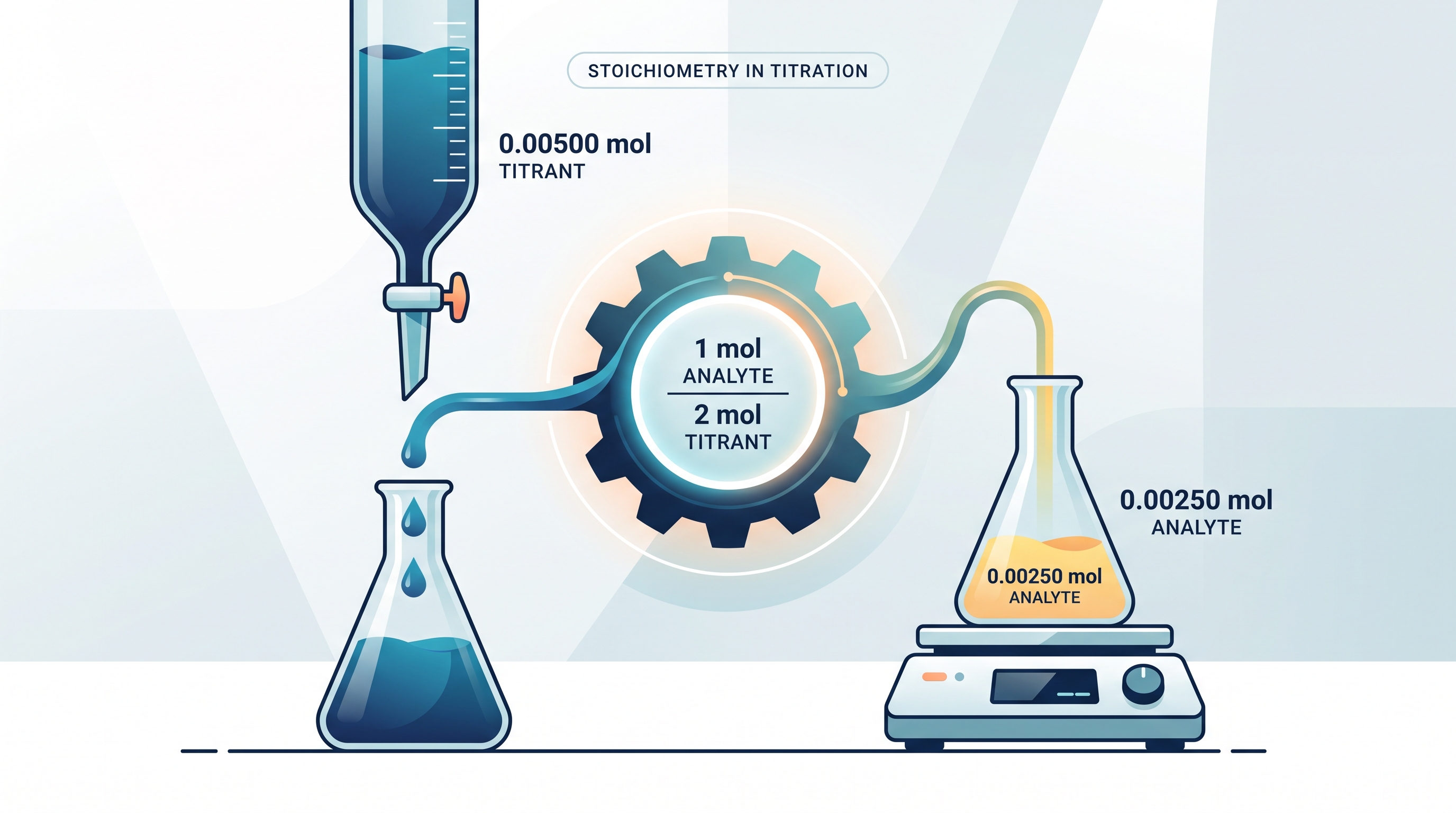
A $0.250\ \mathrm{M}$ solution provides $0.00500\ \mathrm{mol}$ of titrant. If the balanced reaction requires $2$ mol of titrant per $1$ mol of analyte, the analyte amount is
$$ 0.00500\ \mathrm{mol}\times\frac{1\ \mathrm{mol\ analyte}}{2\ \mathrm{mol\ titrant}} =0.00250\ \mathrm{mol} $$
The essential question is not “What formula applies?” but “What measured quantity must be converted into moles, and what coefficient ratio connects it to the unknown?”