From the free course AP Chemistry on Lykke
5.1 Reaction Rates · 5.2 Introduction to Rate Law
Key concepts: Reaction rates as changes in reactant or product concentrations over time · Rate law expressions for chemical reactions · Reaction order with respect to an individual reactant · Overall reaction order · Rate constant (k) · Temperature dependence of the rate constant · Units of the rate constant based on overall reaction order · Determining reactant orders by comparing initial rates · First-order kinetics and linear plots of ln(reactant concentration) versus time · Using radioactive decay and crystal violet fading as examples of kinetics
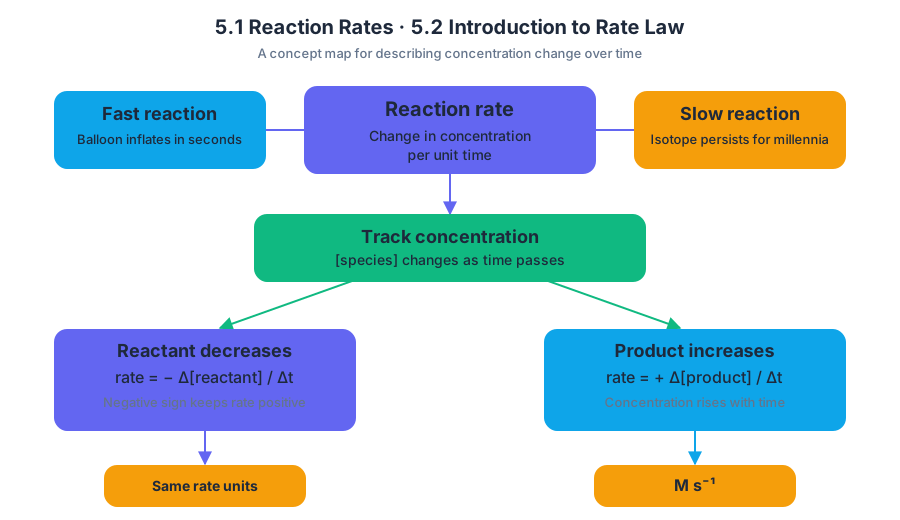
A chemical reaction can be fast enough to inflate a balloon in seconds or slow enough to preserve a radioactive isotope for thousands of years.
5.1 Reaction Rates · 5.2 Introduction to Rate Law
A chemical reaction can be fast enough to inflate a balloon in seconds or slow enough to preserve a radioactive isotope for thousands of years. Reaction rate is the change in concentration of a reactant or product per unit time.
Rate describes how the concentration of a reaction species changes over time.
For a reactant, concentration decreases, so its rate is written with a negative sign; for a product, concentration increases:
$$ \text{rate}=-\frac{\Delta[\text{reactant}]}{\Delta t} \qquad \text{or} \qquad \text{rate}=\frac{\Delta[\text{product}]}{\Delta t} $$
The usual units are molarity per second, written as $\text{M},\text{s}^{-1}$.
From measured rate to rate law
A measured rate tells how fast a reaction is proceeding under particular conditions. A rate law is the equation that connects that rate to the concentrations of reactants and a proportionality constant called the rate constant, $k$:
$$ \text{rate}=k[A]^m[B]^n $$
Here, $[A]$ and $[B]$ are reactant concentrations. The exponents $m$ and $n$ are determined experimentally; they cannot usually be inferred from the coefficients in the balanced chemical equation.
The exponent attached to one reactant is its reaction order with respect to that reactant. Thus, $m$ is the order with respect to $A$, and $n$ is the order with respect to $B$. The overall reaction order is the sum of all concentration exponents:
$$ \text{overall order}=m+n $$
| Rate-law feature | Meaning |
|---|---|
| $[A]^m$ | Order $m$ with respect to $A$ |
| $[B]^n$ | Order $n$ with respect to $B$ |
| $m+n$ | Overall reaction order |
| $k$ | Rate constant at a particular temperature |
Misconception check — coefficients are not automatically orders. For a reaction such as $2A+B\rightarrow C$, the rate law is not automatically $k[A]^2[B]$. Reaction orders come from experimental rate data unless the reaction is known to occur in a single elementary step, a distinction developed later.
Determining orders by comparing initial rates
The method of initial rates determines one reactant’s order by comparing experiments in which that reactant changes while the others remain constant. If doubling $[A]$ doubles the initial rate, the reaction is first-order in $A$; if doubling $[A]$ quadruples the rate, it is second-order in $A$.
Worked example: ascorbic acid and triiodide
Suppose three trials produce the following initial-rate observations:
- Trial 1: $[HA sc]=0.225\ \text{M}$, $[I_3^-]=0.200\ \text{M}$, rate $=1.229\times10^{-4}\ \text{M},\text{s}^{-1}$
- Trial 3: $[HA sc]=0.450\ \text{M}$, $[I_3^-]=0.200\ \text{M}$, rate $=2.457\times10^{-4}\ \text{M},\text{s}^{-1}$
Only $[HA sc]$ doubles, and the rate also doubles:
$$ \frac{\text{rate}_3}{\text{rate}_1}
\left(\frac{[HA sc]_3}{[HA sc]_1}\right)^m $$
$$ 2=2^m\Rightarrow m=1 $$
Therefore, the reaction is first-order with respect to $[HA sc]$. If a second comparison shows that doubling $[I_3^-]$ also doubles the rate, then:
$$ \text{rate}=k[HA sc][I_3^-] $$
Now calculate $k$ using Trial 3:
$$ k=\frac{\text{rate}}{[HA sc][I_3^-]} $$
$$ k= \frac{2.457\times10^{-4}\ \text{M},\text{s}^{-1}} {(0.450\ \text{M})(0.200\ \text{M})} $$
$$ k=2.73\times10^{-3}\ \text{M}^{-1}\text{s}^{-1} $$
The units follow from the equation: $k$ must convert $\text{M}^2$ into $\text{M},\text{s}^{-1}$.
The rate constant and temperature
The rate constant, $k$, measures the proportionality between reactant concentrations and reaction rate. Its numerical value depends on temperature, so a rate law must be understood as applying at a specified temperature. The units of $k$ also depend on the overall reaction order.
$$ \begin{aligned} \text{zero order:}\quad &[k]=\text{M},\text{s}^{-1}\ \text{first order:}\quad &[k]=\text{s}^{-1}\ \text{second order:}\quad &[k]=\text{M}^{-1}\text{s}^{-1} \end{aligned} $$
Misconception check — $k$ is not the same as rate. Rate changes when concentrations change. At fixed temperature, $k$ remains constant for a given reaction and rate-law form; changing temperature changes $k$.
First-order evidence in concentration–time data
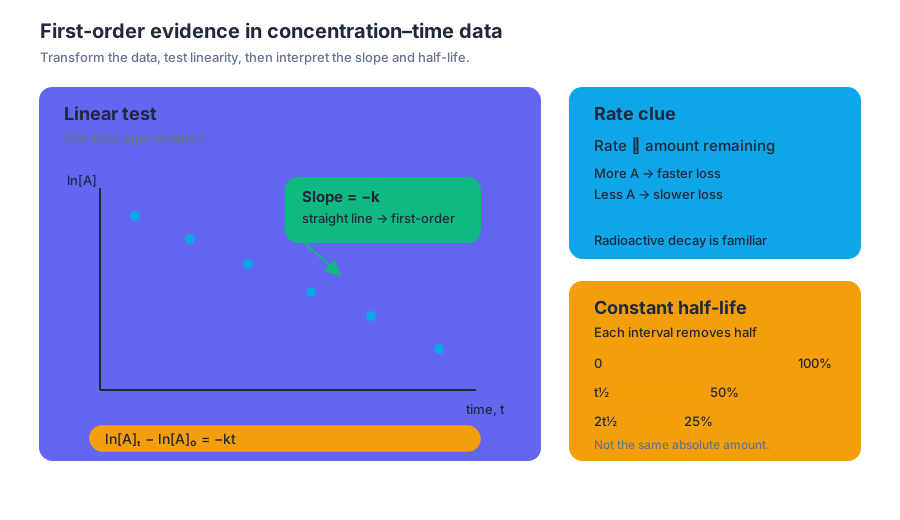
For a reaction first-order in a monitored reactant $A$, a plot of $\ln[A]$ against time is linear:
$$ \ln[A]_t-\ln[A]_0=-kt $$
The slope is $-k$. Radioactive decay is a familiar first-order process because the decay rate is proportional to the amount of radioactive material remaining. A constant half-life is another characteristic clue: each successive half-life removes half of what remains, not the same absolute amount.
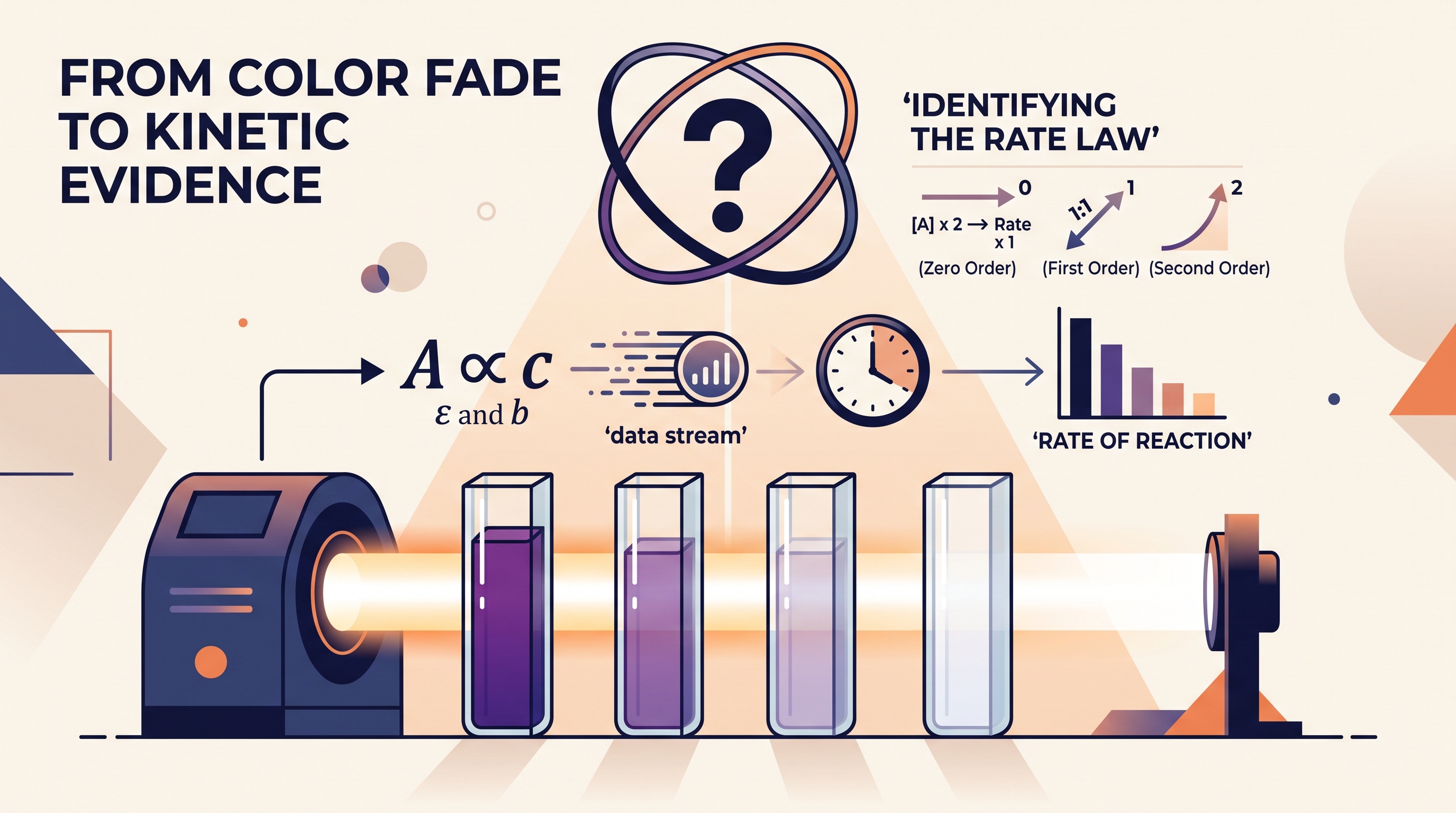
Crystal violet: seeing kinetics with light
The fading or decomposition of crystal violet provides a direct laboratory investigation of rate law. Because crystal violet absorbs visible light, its concentration can be monitored with a spectrophotometer using Beer’s law:
$$ A=\varepsilon bc $$
At constant path length $b$ and molar absorptivity $\varepsilon$, absorbance $A$ is proportional to concentration $c$. Concentration–time data can therefore be transformed into rate information and tested for the rate law that best describes the reaction.
This investigation connects a visible phenomenon—purple color fading—to particle-level kinetics and mathematical evidence. It develops LO 5.2.A, especially EK 5.2.A.1–5.2.A.5: interpreting rate laws, identifying individual and overall reaction orders, relating units to order, recognizing the temperature dependence of $k$, and using initial-rate comparisons.
The principal AP skill is Skill 5.C: Mathematical Routines — Explain the relationship between variables within an equation when one variable changes. A strong response does not merely state “first-order”; it identifies what was held constant, compares concentration and rate ratios, and explains why the observed proportionality gives the exponent.
Retrieval check. If doubling $[A]$ leaves the rate unchanged, what is the order with respect to $A$? If doubling $[A]$ makes the rate eight times larger, what is the order? Answers: zero order and third order, because $2^0=1$ and $2^3=8$.
Source Materials
- AP Chemistry Course and Exam Description
- AP Chemistry Course and Exam Description Clarifications and Corrections
- AP Chemistry Course Overview
- AP Chemistry Course at a Glance
- AP Chemistry Course at a Glance Poster
- Adopt AP Chemistry
- AP Chemistry
- AP Chemistry
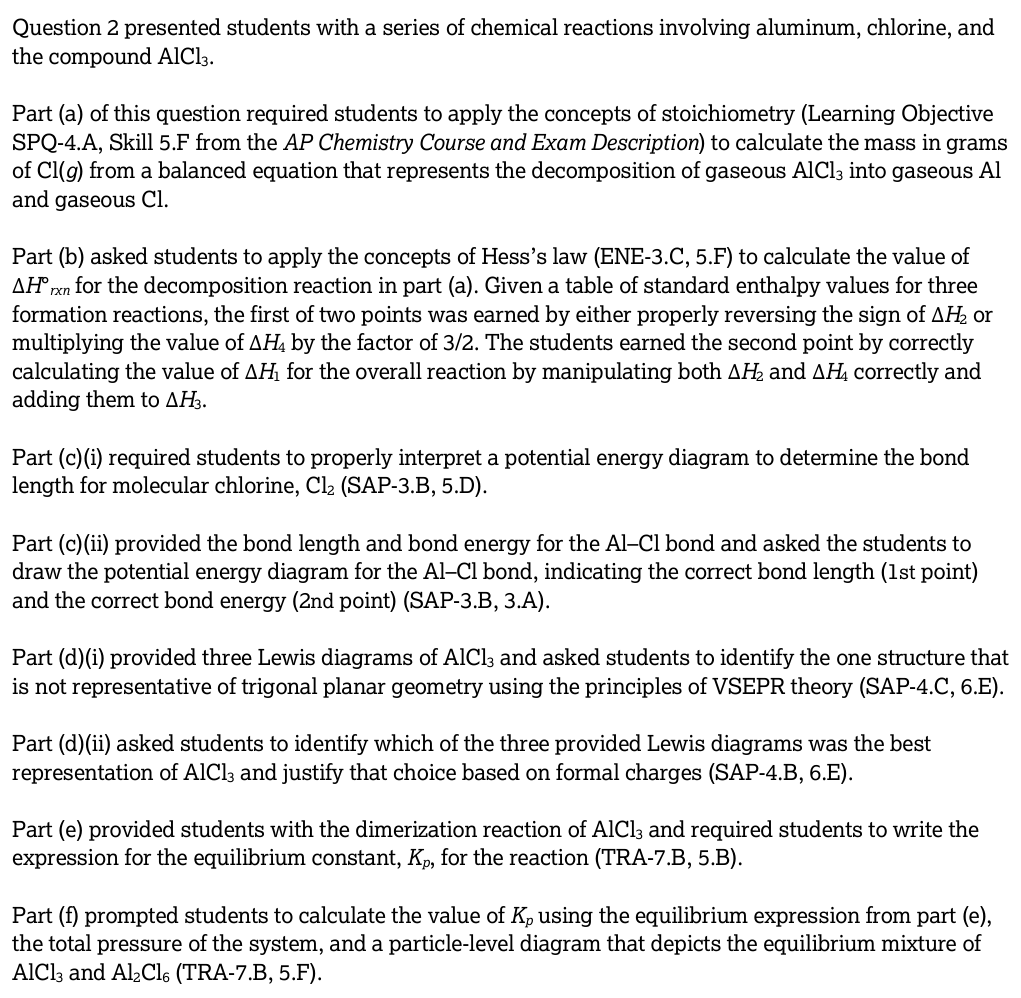
- Sample: 2A Score: 10 This response earned 10 points. In part (a) the point was earned for the correct calculated value reported with the correct number of significant figures. In part (b) the first po
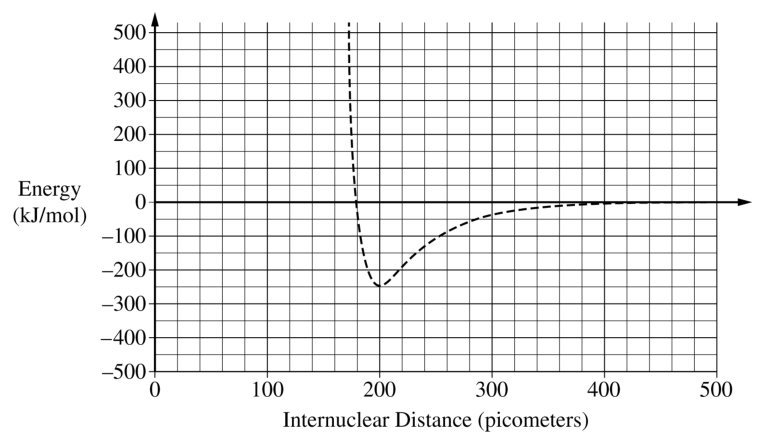
- (i) Based on the graph, what is the bond length, in picometers, for Cl2 ? _________
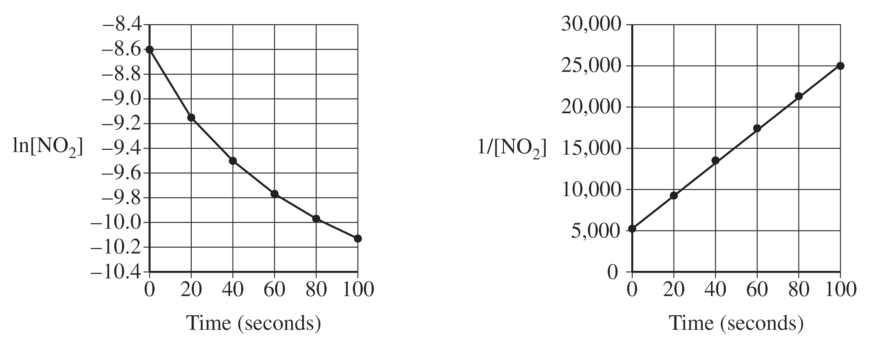
- Based on these data, the scientist makes the claim that the rate law for the reaction is rate k NO2 2 = [ ] .
- AP Chemistry-AP Students