From the free course AP Chemistry on Lykke
2.7 VSEPR and Hybridization
Key concepts: VSEPR theory and its use in explaining molecular shapes · Hybridization nomenclature: sp, sp2, and sp3 · Approximate bond angles associated with molecular geometries · Dimensional analysis as a self-correction tool in calculations · Checking that final units match the requested units, such as kJ
A molecule’s shape is not decoration: it determines which atoms can approach one another, how bonds are oriented, and often how the substance reacts. VSEPR theory—Valence Shell Electron-Pair Repulsion theory—explains molecular shape by treating electron domains around a central atom as charged regions that spread…
2.7 VSEPR and Hybridization
A molecule’s shape is not decoration: it determines which atoms can approach one another, how bonds are oriented, and often how the substance reacts. VSEPR theory—Valence Shell Electron-Pair Repulsion theory—explains molecular shape by treating electron domains around a central atom as charged regions that spread out to minimize repulsion.
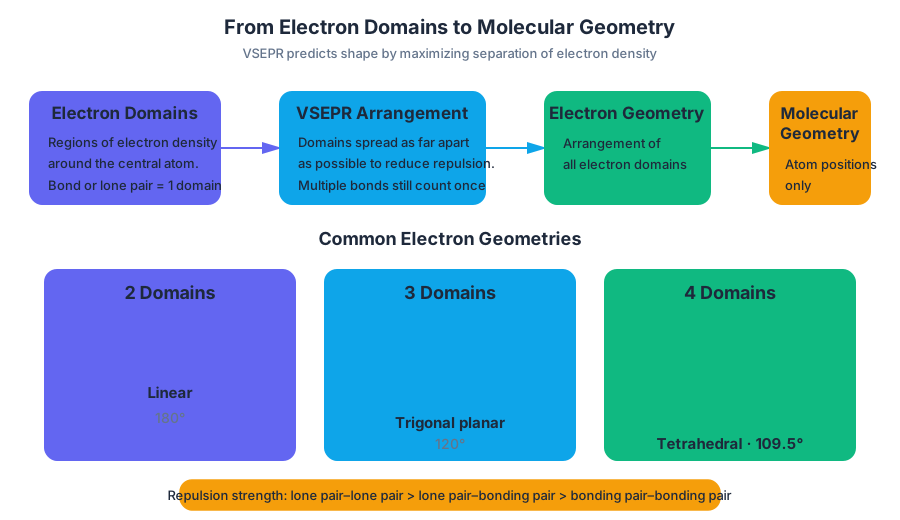
From electron domains to molecular geometry
An electron domain is a region of electron density around the central atom. A single bond, double bond, triple bond, lone pair, or unpaired electron counts as one domain. A multiple bond contains more electrons than a single bond, but it still occupies one overall direction in the VSEPR model.
The electron domains arrange themselves as far apart as possible. The resulting electron geometry describes the arrangement of all domains, while the molecular geometry describes only the positions of the atoms. Lone pairs affect the arrangement even though they are not included in the name of the molecular shape.
| Electron domains around central atom | Electron geometry | Approximate bond angle |
|---|---|---|
| $2$ | Linear | $180^\circ$ |
| $3$ | Trigonal planar | $120^\circ$ |
| $4$ | Tetrahedral | $109.5^\circ$ |
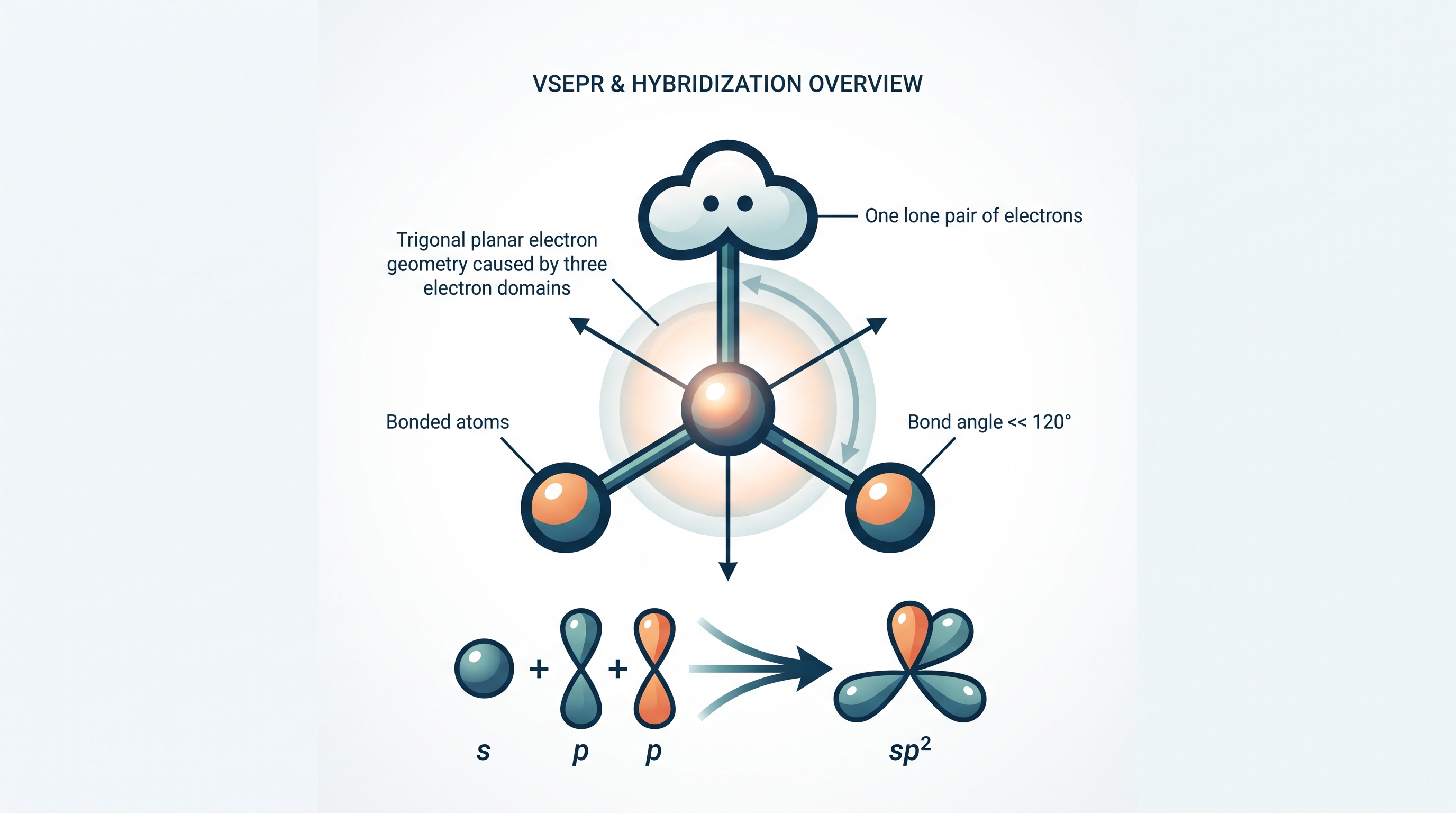
Repulsions are not equally strong. Lone pair–lone pair repulsion is stronger than lone pair–bonding pair repulsion, which is stronger than bonding pair–bonding pair repulsion. Therefore, lone pairs compress nearby bond angles.
Worked molecular-shape example: nitrogen oxides
In $NO_2$, the nitrogen has approximately three electron domains: two bonding regions and one region associated with the unpaired electron. The arrangement is approximately trigonal planar, so the nitrogen is described with $sp^2$ hybridization and the bond angle is approximately $120^\circ$.
In $NO_2^+$, nitrogen has two bonding domains and no lone pair. The domains move opposite each other, giving a linear molecular geometry. Nitrogen is therefore described with $sp$ hybridization, and the bond angle is approximately $180^\circ$.
Key distinction: Count electron domains around the central atom—not the number of lines in a structural formula and not the number of atoms in the molecule.
Hybridization nomenclature
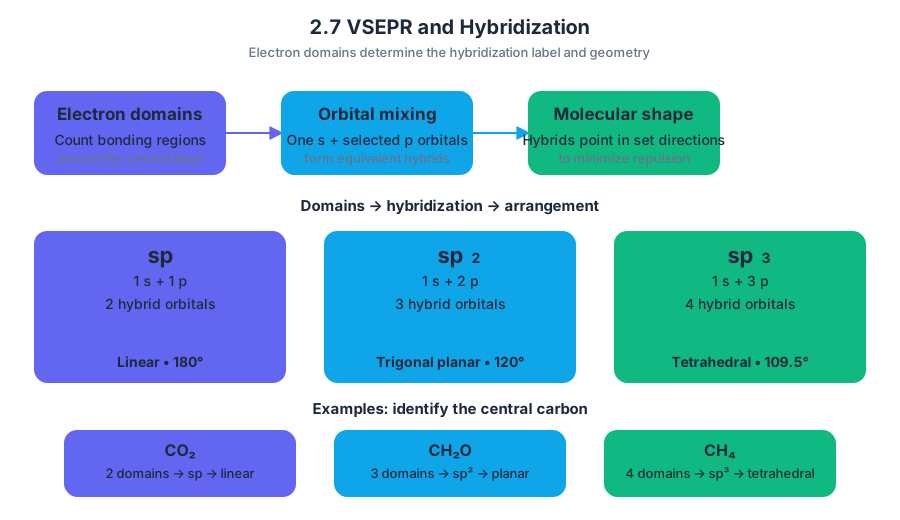
Hybridization is a model in which atomic orbitals combine to produce a set of equivalent hybrid orbitals oriented in particular directions. The notation names the orbitals mixed: $s$ for an $s$ orbital and $p$ for a $p$ orbital.
For the hybridization nomenclature assessed here:
- $sp$ means one $s$ orbital combines with one $p$ orbital, producing two hybrid orbitals and a linear arrangement.
- $sp^2$ means one $s$ orbital combines with two $p$ orbitals, producing three hybrid orbitals and a trigonal-planar arrangement.
- $sp^3$ means one $s$ orbital combines with three $p$ orbitals, producing four hybrid orbitals and a tetrahedral electron arrangement.
The hybridization label follows the number of electron domains:
$$ \text{number of electron domains} \longrightarrow \text{hybridization} $$
$$ 2 \longrightarrow sp,\qquad 3 \longrightarrow sp^2,\qquad 4 \longrightarrow sp^3 $$
For example, the central carbon in $CO_2$ has two bonding domains, so it is $sp$ hybridized and linear. The central carbon in $CH_2O$ has three electron domains—two $C-H$ bonds and one $C=O$ bond—so it is $sp^2$ hybridized and approximately trigonal planar. A carbon atom with four single-bonding domains, such as the carbon in $CH_4$, is $sp^3$ hybridized and tetrahedral.
Misconception check
Misconception: a double bond counts as two electron domains. It does not. The entire double bond points in one direction and therefore counts as one domain for VSEPR. The same rule applies to a triple bond.
Misconception: hybridization is the same as electron configuration. Electron configuration describes how electrons occupy atomic orbitals. Hybridization is a bonding-and-shape model used to describe the directions of orbitals involved in bonding. Do not assign $sp^3$ merely because an atom has four valence electrons; assign it when the central atom has four electron domains.
Hybridization involving $d$ orbitals is outside the assessed scope here. For the required cases, stop at $sp$, $sp^2$, and $sp^3$.
Dimensional analysis: the unit check that catches bad chemistry
Dimensional analysis tracks units through a calculation. It is a self-correction tool: if the requested quantity is energy, the final units must be energy units such as $\text{kJ}$.
Suppose a molecular-energy calculation gives a molar enthalpy change of $40.4\ \text{kJ mol}^{-1}$ for $0.250\ \text{mol}$ of a substance:
$$ 0.250\ \text{mol} \left( \frac{40.4\ \text{kJ}}{1\ \text{mol}} \right)
10.1\ \text{kJ} $$
The $\text{mol}$ units cancel, leaving $\text{kJ}$, exactly as required. If a proposed setup ended in $\text{mol}$, $\text{K}$, or $\text{kJ mol}^{-1}$, the calculation would be fundamentally mismatched to the question—even if the numerical value looked reasonable.
Retrieval check
A central atom has three electron domains: two bonds and one lone pair. Predict its electron geometry, approximate bond angle, and hybridization. Then explain why a double bond would still count as only one domain. Finally, if an energy calculation is requested in $\text{kJ}$, identify the unit that must appear after all conversion factors cancel.
Source Materials
- AP Chemistry Course and Exam Description
- AP Chemistry Course and Exam Description Clarifications and Corrections
- AP Chemistry Course Overview
- AP Chemistry Course at a Glance
- AP Chemistry Course at a Glance Poster
- Adopt AP Chemistry
- AP Chemistry
- AP Chemistry
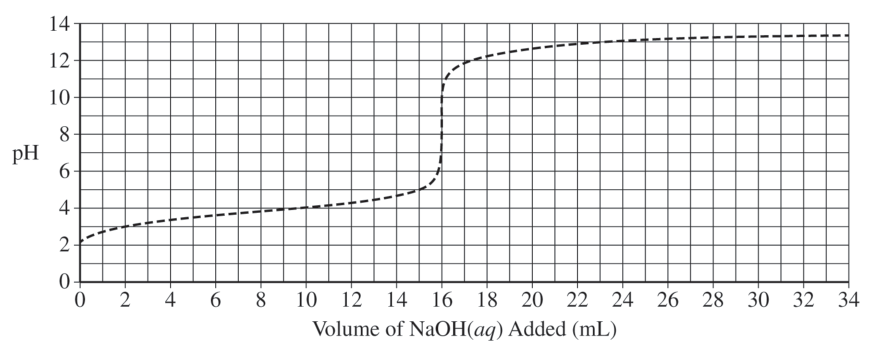
- (c) Use the information in the graph to determine the approximate pKa of lactic acid. ____________
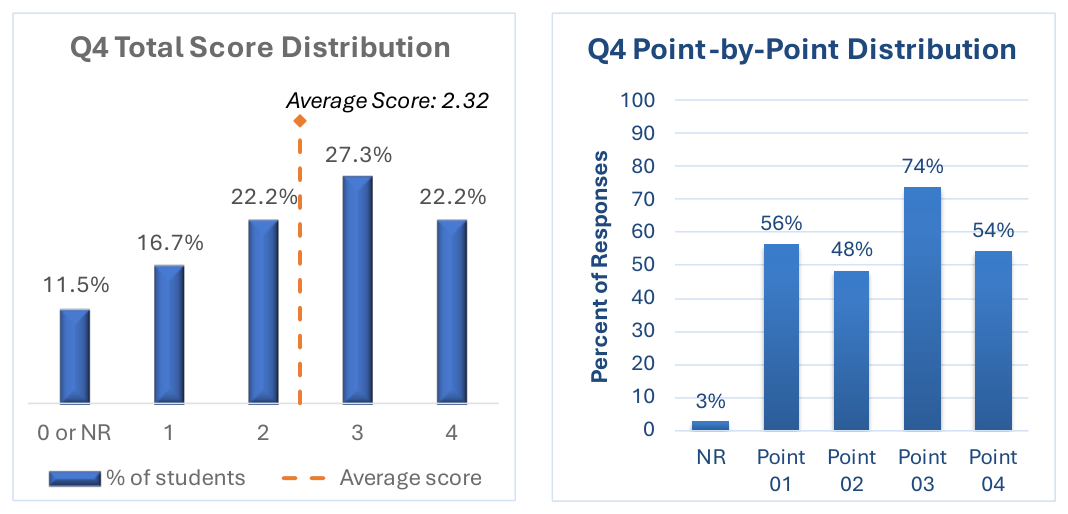
- • Part A was a moderately accessible point. Correct responses correctly identified the hybridization of the valence orbitals of the C atom in H2CO as sp2.