From the free course AP Chemistry on Lykke
4.1 Introduction to Reactions · 4.2 Net Ionic Equations
Key concepts: Representing physical and chemical processes with chemical equations · Balanced molecular equations · Complete ionic equations · Net ionic equations · Conservation of mass in chemical reactions · Conservation of charge in chemical reactions · Writing equations for physical changes · Writing equations from the identities of reactants and products · Writing ionic equations for a given chemical reaction · Determining the limiting reactant and product yield
A chemical equation is a compact model of what happens when matter changes: it identifies the substances involved, shows how particles are rearranged, and records the numerical relationships required by conservation laws.
4.1 Introduction to Reactions · 4.2 Net Ionic Equations
A chemical equation is a compact model of what happens when matter changes: it identifies the substances involved, shows how particles are rearranged, and records the numerical relationships required by conservation laws. The central question is simple but powerful: How can symbols prove that atoms and charge are conserved while showing which particles actually react?
A physical change can also be written as an equation because the substance’s identity remains unchanged. For example, liquid water becoming vapor is represented as
$$ H_2O(l) \rightarrow H_2O(g) $$
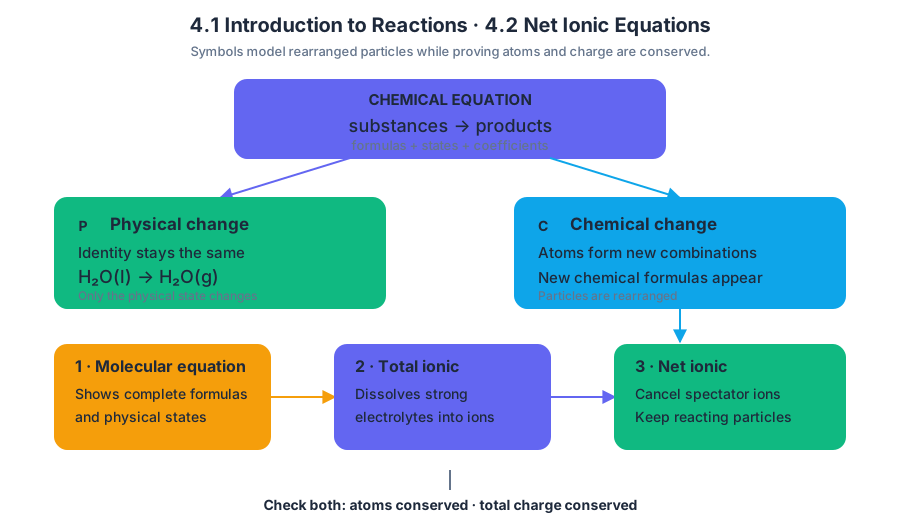
The formula remains $H_2O$ on both sides; only the physical state changes. A chemical change, by contrast, rearranges atoms into new combinations, so at least one new chemical formula appears.
Conservation determines whether an equation is balanced
A balanced chemical equation has equal numbers of atoms of every element on both sides. This expresses conservation of mass: atoms are rearranged, not created or destroyed. For ionic reactions, the total charge must also be equal on both sides, expressing conservation of charge.
4.2.A.1: All physical and chemical processes can be represented symbolically by balanced equations.
4.2.A.2: Chemical equations represent chemical changes as rearrangements of atoms into new combinations. Equal numbers of atoms before and after demonstrate conservation of mass and charge.
Balance equations by changing coefficients, never subscripts. A coefficient changes the number of particles or formula units; changing a subscript changes the substance itself. For the reaction of hydrogen gas with oxygen gas:
$$ H_2(g) + O_2(g) \rightarrow H_2O(l) $$
There are two oxygen atoms on the left but only one on the right. Placing a coefficient of $2$ before water creates two oxygen atoms and four hydrogen atoms on the product side:
$$ 2H_2(g) + O_2(g) \rightarrow 2H_2O(l) $$
Now both elements are conserved.
Misconception check — “Balancing means making formulas symmetrical.” It does not. The formulas tell you which substances exist; coefficients tell you the reacting ratio. The equation above means $2$ molecules, formula units, or moles of $H_2$ react with $1$ of $O_2$ to form $2$ of $H_2O$.
Three symbolic views of one reaction
4.2.A.3 identifies three forms used according to context:
| Equation form | What it shows | Example purpose |
|---|---|---|
| Molecular equation | Compounds as intact formulas | Overall reaction and stoichiometric ratios |
| Complete ionic equation | Dissolved strong electrolytes separated into ions | Every aqueous particle present |
| Net ionic equation | Only species that chemically participate | The essential reaction |
Consider aqueous silver nitrate reacting with aqueous sodium chloride. The molecular equation is
$$ AgNO_3(aq) + NaCl(aq) \rightarrow AgCl(s) + NaNO_3(aq) $$
This balanced molecular equation represents the overall reaction. It shows that insoluble silver chloride forms, but it does not show that the aqueous compounds are present as ions.
In the complete ionic equation, soluble strong electrolytes are separated:
$$ Ag^+(aq) + NO_3^-(aq) + Na^+(aq) + Cl^-(aq) \rightarrow AgCl(s) + Na^+(aq) + NO_3^-(aq) $$
The ions $Na^+$ and $NO_3^-$ appear unchanged on both sides. They are spectator ions: present in solution but not chemically transformed.
Canceling the spectator ions gives the net ionic equation:
$$ Ag^+(aq) + Cl^-(aq) \rightarrow AgCl(s) $$
This equation shows the species that actually participate. It remains balanced in atoms and charge: one silver atom and one chlorine atom occur on each side, and the total charge is $+1-1=0$ on the left and $0$ for solid $AgCl$ on the right.
A reliable writing pipeline
When reactant or product identities are supplied, use this sequence:
- Write correct chemical formulas and physical states.
- Balance the molecular equation with coefficients.
- Separate only dissolved strong electrolytes in the complete ionic equation.
- Keep solids, liquids, gases, and weak electrolytes intact.
- Cancel identical spectator ions.
- Check atoms and total charge in the net ionic equation.
For example, calcium carbonate solid reacting with hydrochloric acid produces aqueous calcium ions, carbon dioxide gas, and liquid water:
$$ CaCO_3(s) + 2HCl(aq) \rightarrow CaCl_2(aq) + CO_2(g) + H_2O(l) $$
The complete ionic form is
$$ CaCO_3(s) + 2H^+(aq) + 2Cl^-(aq) \rightarrow Ca^{2+}(aq) + 2Cl^-(aq) + CO_2(g) + H_2O(l) $$
After canceling chloride ions:
$$ CaCO_3(s) + 2H^+(aq) \rightarrow Ca^{2+}(aq) + CO_2(g) + H_2O(l) $$
Misconception check — “Every aqueous substance splits.” Only soluble strong electrolytes are written as separate ions. A solid such as $AgCl(s)$ does not split in the equation, and a molecular substance such as $H_2O(l)$ remains intact.
AP reasoning practices in action
- Science Practice 1: Models and Representations — Select molecular, complete ionic, or net ionic notation to represent the relevant chemical scale.
- Science Practice 3: Representing Data and Phenomena — Translate an observed precipitate, gas formation, or phase change into a symbolic equation.
- Science Practice 4: Model Analysis — Test whether atoms, charge, phases, and spectator-ion cancellations are chemically consistent.
- Science Practice 5: Mathematical Routines — Use coefficients as mole ratios and balance equations systematically.
- Science Practice 6: Argumentation — Justify that a proposed equation is valid using conservation of atoms and charge.
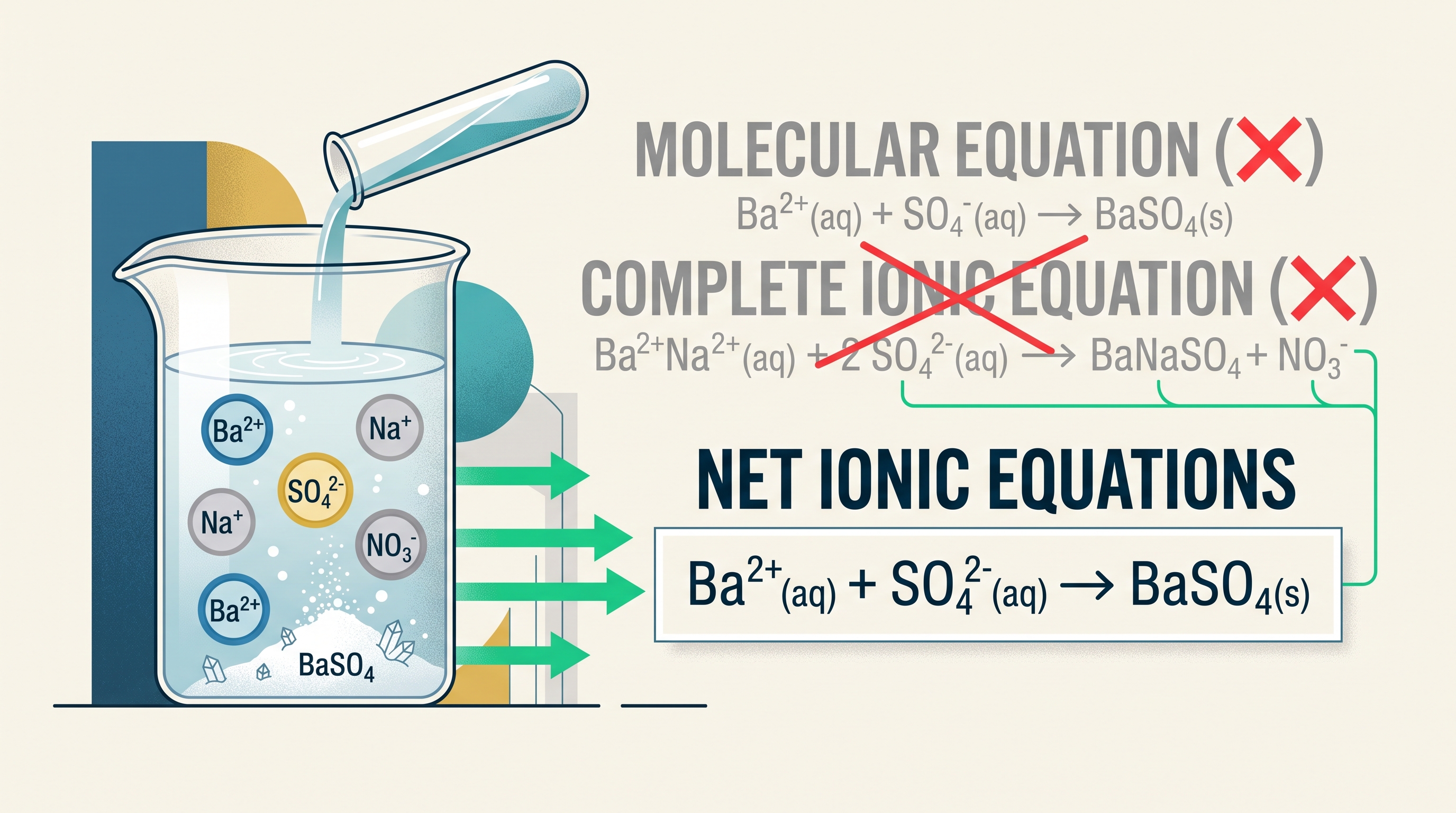
Retrieval check: Write the net ionic equation for aqueous barium ions reacting with aqueous sulfate ions to form solid barium sulfate. Then verify both atom count and charge.
Answer:
$$ Ba^{2+}(aq) + SO_4^{2-}(aq) \rightarrow BaSO_4(s) $$
The atoms match, and the total charge is $0$ on both sides.
Source Materials
- AP Chemistry Course and Exam Description
- AP Chemistry Course and Exam Description Clarifications and Corrections
- AP Chemistry Course Overview
- AP Chemistry Course at a Glance
- AP Chemistry Course at a Glance Poster
- Adopt AP Chemistry
- AP Chemistry
- AP Chemistry
- Part (a) was challenging for students. Successful responses recognized that the solid calcium carbonate reactant should be written as undissociated and that one of the products is the Ca2+(aq) ion, no
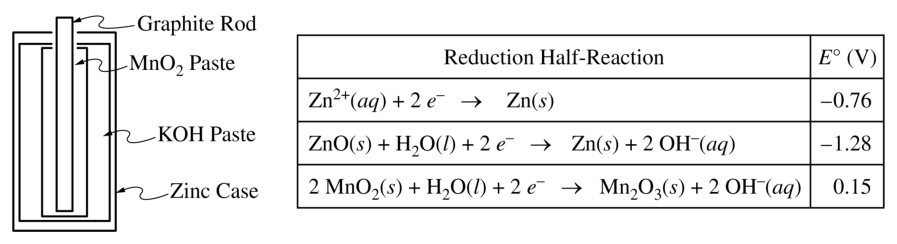
- (i) Based on the half-reactions given in the table, write the balanced net ionic equation for the reaction that has the greatest thermodynamic favorability.
- AP Chemistry-AP Students
- AP/College Chemistry-Khan Academy