From the free course AP Chemistry on Lykke
7.5 Magnitude of the Equilibrium Constant · 7.6 Properties of the Equilibrium Constant
Key concepts: Meaning of the equilibrium constant K · Relationship between the magnitude of K and the extent of a reaction · Large K (K ≫ 1) indicates products predominate at equilibrium · Small K indicates reactants predominate at equilibrium · Using equilibrium concentrations to explain concentration relationships · Equilibrium between an un-ionized weak base and its conjugate acid · Equilibrium constant Kp for reactions involving gases · Calculating an equilibrium constant from equilibrium data
At equilibrium, the value of $K$ answers a composition question: which side of the reaction contains more chemical species? It does not answer how quickly the system reaches equilibrium.
7.5 Magnitude of the Equilibrium Constant · 7.6 Properties of the Equilibrium Constant
At equilibrium, the value of $K$ answers a composition question: which side of the reaction contains more chemical species? It does not answer how quickly the system reaches equilibrium. A reaction can have a very large $K$ and still reach equilibrium slowly, or a small $K$ and reach equilibrium rapidly.
Learning Objective 7.5.A: Explain the relationship between the magnitude of the equilibrium constant and the relative concentrations of chemical species at equilibrium.
Essential Knowledge 7.5.A.1: The magnitude of the equilibrium constant indicates the relative concentrations of reactants and products present at equilibrium.
Reading the magnitude of $K$
For a general reaction,
aA+bB\rightleftharpoons cC+dD
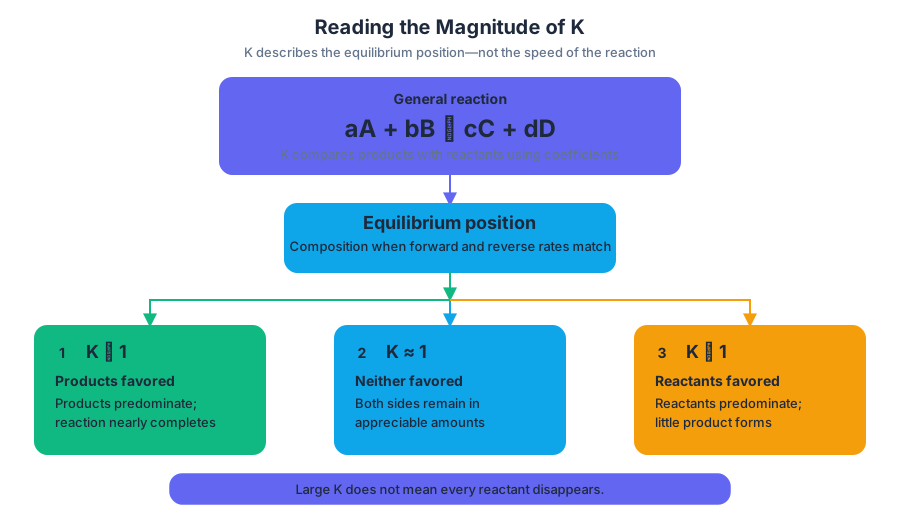
the equilibrium constant compares product concentrations with reactant concentrations according to the reaction’s stoichiometric coefficients. The numerical value of $K$ therefore describes the equilibrium position—the mixture’s composition once the forward and reverse processes occur at equal rates.
The most useful interpretations are qualitative:
| Magnitude of $K$ | Equilibrium position | Relative composition |
|---|---|---|
| $K\gg 1$ | Far toward products | Products predominate; the reaction proceeds nearly to completion |
| $K\approx 1$ | Neither side strongly favored | Reactants and products are present in appreciable amounts |
| $K\ll 1$ | Far toward reactants | Reactants predominate; only a relatively small amount of product forms |
A large value such as $K=4.0\times10^5$ means that the product side is strongly favored. It does not mean that every reactant particle disappears: equilibrium requires some reactants and products to remain whenever the reaction is reversible. Likewise, $K=2.0\times10^{-6}$ means that reactants predominate, not that the reaction produces absolutely no product.
Misconception check: “Large $K$ means fast reaction” is incorrect. $K$ measures how far a reaction proceeds toward products; reaction rate measures how quickly it gets there. Temperature and activation energy influence rate, while the equilibrium constant at a given temperature describes equilibrium composition.
Using equilibrium concentrations as evidence
Suppose equilibrium data for
N_2O_4(g)\rightleftharpoons 2NO_2(g)
give
$$ K_c=1.25\times10^{-2}. $$
The calculation follows the equilibrium-expression method established for Topic 7.4. The important interpretation is that $K_c$ is much less than $1$, so the equilibrium mixture contains substantially more $N_2O_4$ than $NO_2$ relative to the stoichiometric relationship. The reaction lies toward the reactant side: $N_2O_4$ predominates.
That conclusion must be tied to the chemical equation, not merely to isolated concentration values. Because two moles of $NO_2$ correspond to one mole of $N_2O_4$, the comparison is weighted by the coefficients in the equilibrium expression. A statement such as “the concentration of $N_2O_4$ is larger, so $K_c$ is small” is incomplete; the stronger argument is that the calculated ratio of product terms to reactant terms is only $1.25\times10^{-2}$, demonstrating reactant-favored equilibrium.
Argumentation (6.D): A complete explanation makes a claim about which species predominate, cites the magnitude of $K$ as evidence, and connects that evidence to the balanced equation and equilibrium concentration relationship.
$K_c$ and $K_p$
For gas-phase reactions, equilibrium may be described using partial pressures rather than molar concentrations. The corresponding constant is $K_p$:
$$ K_p=\frac{(P_C)^c(P_D)^d}{(P_A)^a(P_B)^b} $$
where each $P$ is an equilibrium partial pressure. The interpretation remains the same: $K_p\gg1$ indicates products predominate, while $K_p\ll1$ indicates reactants predominate. The numerical values of $K_c$ and $K_p$ may differ because concentration and pressure use different measures, but each constant describes equilibrium composition for its chosen representation.
Weak-base equilibrium as a species relationship
A weak base illustrates how an equilibrium constant describes the relative amounts of two related species. For a weak base $B$ in water,
B(aq)+H_2O(l)\rightleftharpoons BH^+(aq)+OH^-(aq)
the un-ionized base $B$ is in equilibrium with its conjugate acid, $BH^+$. The base-ionization constant is
$$ K_b=\frac{[BH^+][OH^-]}{[B]}. $$
This is the required weak-base relationship identified in 8.3.A.4, where $K_b$ is often reported through $pK_b$:
$$ pK_b=-\log K_b. $$
Because a weak base ionizes only partially, $[B]$ remains much larger than the concentrations of $BH^+$ and $OH^-$ at equilibrium. Thus, a small $K_b$ indicates that the equilibrium lies mostly toward the un-ionized base. The phrase “weak” refers to limited ionization at equilibrium—not to a slow reaction.
Retrieval check
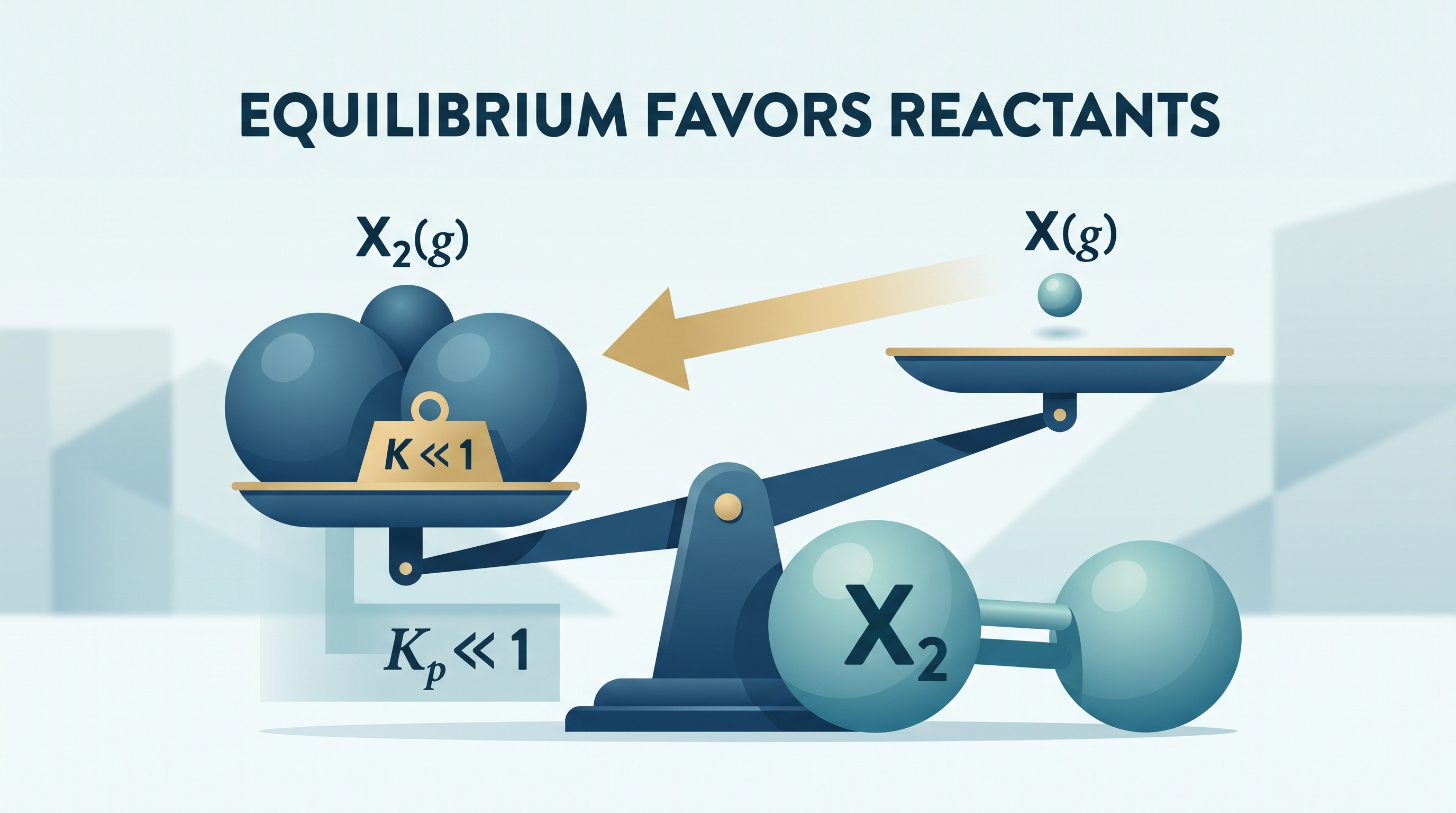
For the reaction
X_2(g)\rightleftharpoons 2X(g),
a calculated value of $K_p=3.0\times10^{-7}$ is obtained from equilibrium partial pressures. Which species predominates, and what evidence supports the conclusion? The answer should identify $X_2$ as predominant and explain that $K_p\ll1$, so the equilibrium position lies strongly toward reactants.
Source Materials
- AP Chemistry Course and Exam Description
- AP Chemistry Course and Exam Description Clarifications and Corrections
- AP Chemistry Course Overview
- AP Chemistry Course at a Glance
- AP Chemistry Course at a Glance Poster
- Adopt AP Chemistry
- AP Chemistry
- AP Chemistry
- (e) In a third experiment, the student investigates the enthalpy of the reaction between lactic acid and sodium