From the free course AP Chemistry on Lykke
8.7 pH and pKₐ · 8.8 Properties of Buffers
Key concepts: pH · pKₐ · Properties of buffers
A buffer can absorb a small dose of acid or base while keeping its pH nearly steady because it contains a weak acid and the base formed when that acid loses a proton.
8.7 pH and pKₐ · 8.8 Properties of Buffers
A buffer can absorb a small dose of acid or base while keeping its pH nearly steady because it contains a weak acid and the base formed when that acid loses a proton. The key question is not simply how much acid is present, but how strongly the acid holds its proton and how much of each conjugate partner is available.
pH measures hydronium concentration
pH is a logarithmic measure of hydronium-ion concentration:
$$ \mathrm{pH}=-\log[H_3O^+] $$
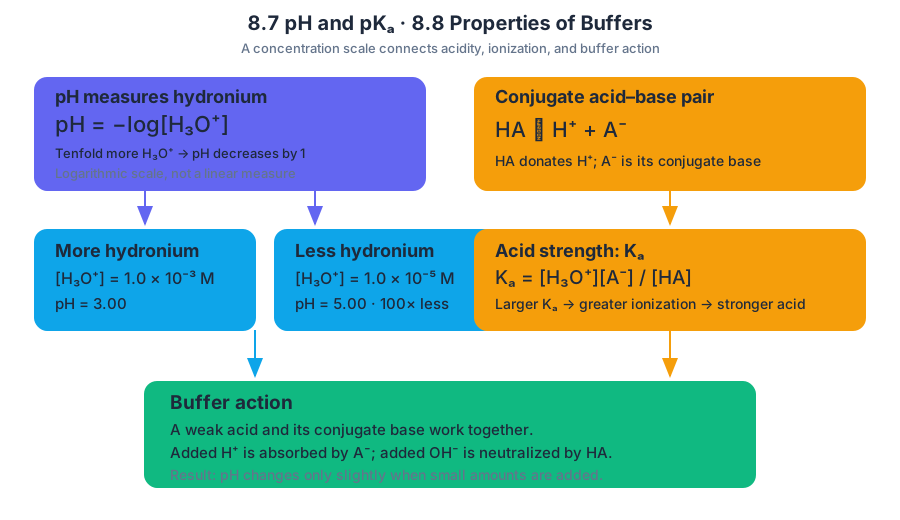
A tenfold increase in $[H_3O^+]$ lowers the pH by exactly $1$ unit. Thus, a solution with $[H_3O^+]=1.0\times10^{-3}\ \mathrm{M}$ has $\mathrm{pH}=3.00$, while one with $[H_3O^+]=1.0\times10^{-5}\ \mathrm{M}$ has $\mathrm{pH}=5.00$. The second solution is one hundred times less concentrated in hydronium, not merely “two pH units less acidic.”
For a conjugate acid-base pair,
HA \rightleftharpoons H^+ + A^-
the acid-dissociation constant is
$$ K_a=\frac{[H_3O^+][A^-]}{[HA]} $$
where $HA$ is the weak acid and $A^-$ is its conjugate base. A larger $K_a$ means greater ionization and therefore a stronger acid.
pKₐ compares acid strength
pKₐ is the negative logarithm of $K_a$:
$$ \mathrm{p}K_a=-\log K_a $$
Because of the negative sign, smaller pKₐ values correspond to stronger acids. A difference of $2.60$ pKₐ units represents a factor of
$$ 10^{2.60}\approx 4.0\times10^2 $$
in $K_a$.
Consider two weak acids:
| Acid | pKₐ | Relative strength |
|---|---|---|
| $HA_1$ | $3.20$ | Stronger |
| $HA_2$ | $5.80$ | Weaker |
The acid with $\mathrm{p}K_a=3.20$ has the larger $K_a$ and ionizes more extensively. The difference is not a small numerical distinction: $HA_1$ is approximately $400$ times stronger than $HA_2$ because
$$ \frac{K_{a,1}}{K_{a,2}}=10^{5.80-3.20}=10^{2.60}\approx400 $$
Why a weak acid and its conjugate base make a buffer
A buffer requires appreciable amounts of both members of a conjugate pair, such as $HA/A^-$. The weak acid consumes added hydroxide:
$$ HA+OH^-\rightarrow A^-+H_2O $$
The conjugate base consumes added hydronium:
$$ A^-+H_3O^+\rightarrow HA+H_2O $$
These reactions remove most of the added strong base or strong acid before it can cause a large change in $[H_3O^+]$. The buffer does not make the pH perfectly constant; it makes the change smaller.
A buffer containing only $HA$ cannot efficiently remove added $H_3O^+$ because it lacks enough $A^-$. A solution containing only $A^-$ cannot efficiently remove added $OH^-$ because it lacks enough $HA$. The pair is essential.
pH, pKₐ, and the balance between buffer components
The pH of a weak-acid buffer depends strongly on the ratio of conjugate base to weak acid. When the concentrations of $HA$ and $A^-$ are equal, the acid equilibrium expression gives
$$ K_a=[H_3O^+] $$
so
$$ \mathrm{pH}=\mathrm{p}K_a $$
This is a special condition, not a universal identity. A solution’s pH equals its pKₐ only when the relevant weak acid and conjugate base are present in equal amounts.
A useful visual model is a proton-transfer balance:
$$ \begin{array}{c} \text{mostly }HA \quad \longleftrightarrow \quad \text{mostly }A^-\ \text{more capacity for }OH^- \qquad \text{more capacity for }H_3O^+ \end{array} $$
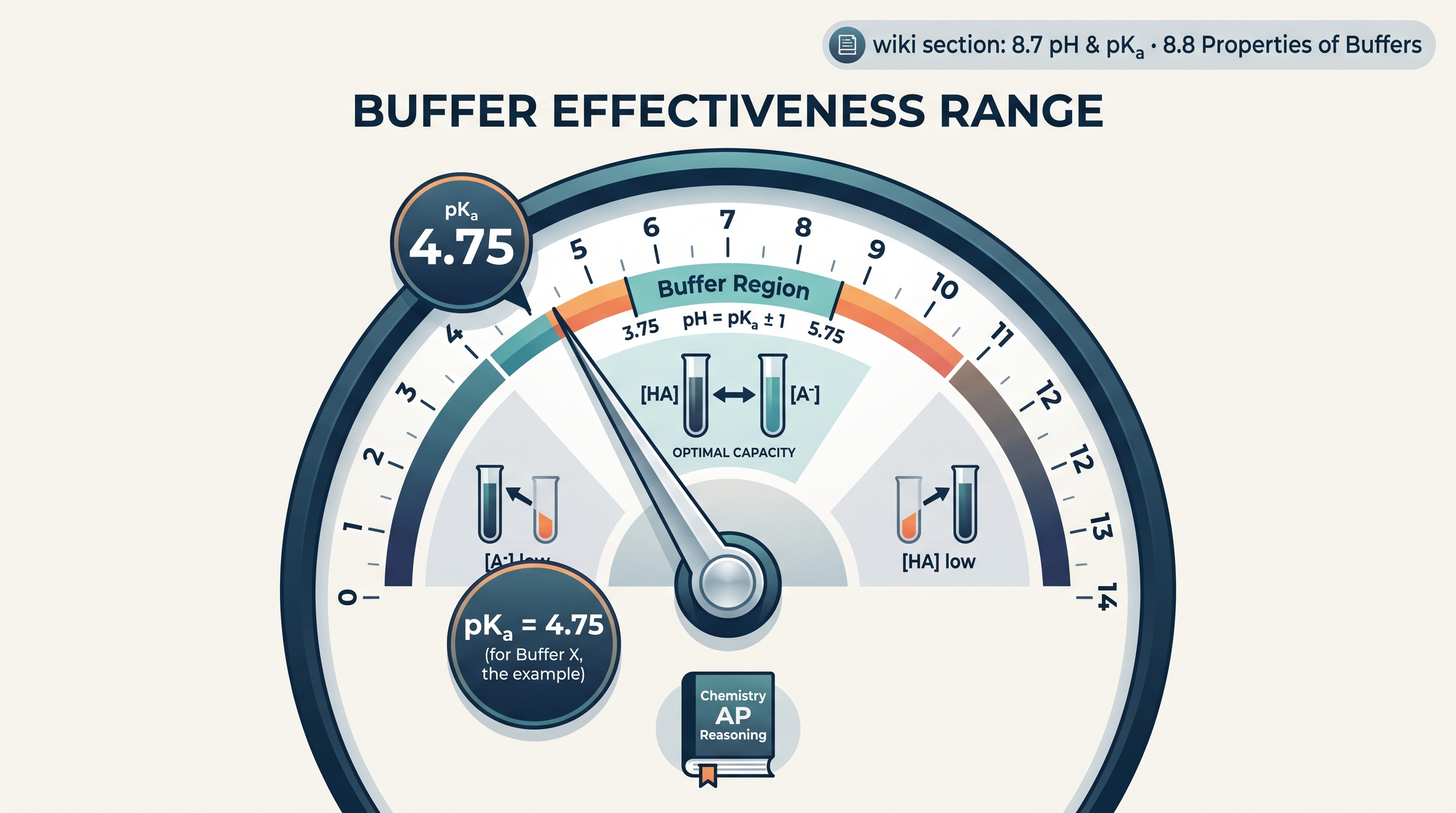
A buffer works best near its pKₐ because neither component is nearly depleted. If the solution contains overwhelmingly $HA$, it may neutralize added $OH^-$ but has little $A^-$ available for added acid. If it contains overwhelmingly $A^-$, the reverse limitation applies.
Worked comparison: choosing a buffer
Suppose a process must remain near pH $3.2$. Two candidate weak-acid systems have pKₐ values of $3.20$ and $5.80$.
- The $HA_1/A_1^-$ system has $\mathrm{p}K_a=3.20$, matching the target pH. Equal amounts of $HA_1$ and $A_1^-$ can therefore establish that pH and provide substantial resistance in both directions.
- The $HA_2/A_2^-$ system has $\mathrm{p}K_a=5.80$. At pH $3.2$, equilibrium strongly favors $HA_2$, leaving too little $A_2^-$ for effective removal of added $H_3O^+$.
- The first system is the better buffer for pH $3.2$.
Misconception check — “A stronger acid makes a better buffer.” A strong acid is highly ionized and does not coexist in useful equilibrium with a substantial conjugate-base concentration. Effective buffers generally use a weak acid and its conjugate base, with a pKₐ close to the desired pH.
AP reasoning in the chemistry
This topic uses Science Practice 1: Models and Representations when the equilibrium equation and conjugate-pair diagram represent particle-level proton transfer. It uses Science Practice 3: Representing Data and Phenomena when pH or pKₐ values are interpreted on a logarithmic scale, Science Practice 4: Model Analysis when a proposed buffer is judged from its component ratio, Science Practice 5: Mathematical Routines when logarithms and $K_a$ relationships are calculated, and Science Practice 6: Argumentation when buffer choice is justified with equilibrium evidence. Science Practice 2: Question and Method enters when an investigation tests how added acid or base changes a buffer’s pH.
Retrieval check: Two buffers have equal total concentration. Buffer $X$ uses an acid with $\mathrm{p}K_a=4.75$; buffer $Y$ uses an acid with $\mathrm{p}K_a=7.20$. For a target pH of $4.8$, which is better, and why? Buffer $X$: its pKₐ is close to the target, so both $HA$ and $A^-$ can remain available to neutralize additions of either $H_3O^+$ or $OH^-$.