From the free course AP Chemistry on Lykke
7.1 Introduction to Equilibrium · 7.2 Direction of Reversible Reactions
Key concepts: Equilibrium · Introduction to equilibrium · Direction of reversible reactions · Le Châtelier’s principle · Particulate representations of equilibrium systems · Model analysis · Required course content for AP Chemistry Unit 7
A reversible reaction does not simply “run forward until the reactants disappear.” In a closed system, products can react to reform reactants while reactants continue forming products.
7.1 Introduction to Equilibrium · 7.2 Direction of Reversible Reactions
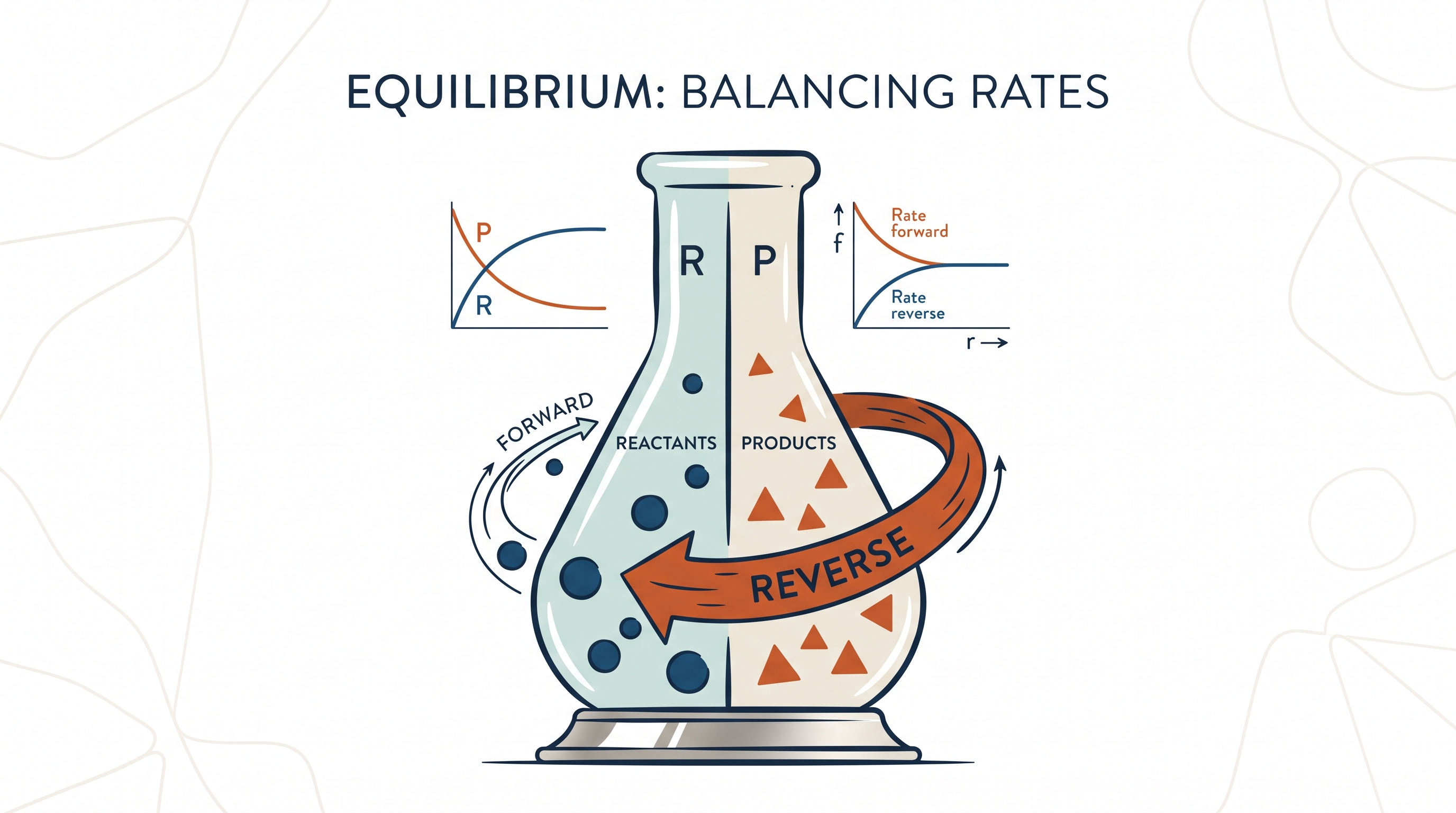
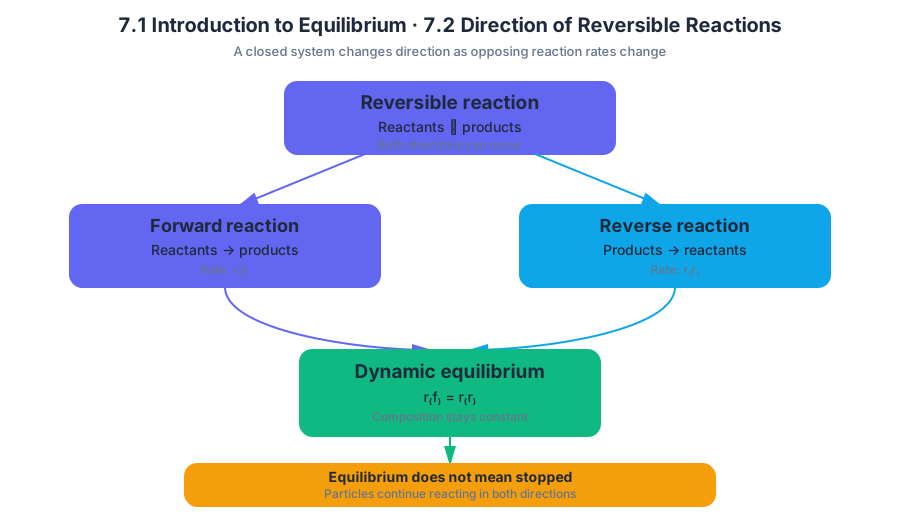
A reversible reaction does not simply “run forward until the reactants disappear.” In a closed system, products can react to reform reactants while reactants continue forming products. Equilibrium is the dynamic state in which the forward and reverse reactions occur at equal rates, so the macroscopic composition remains constant even though particles continue reacting.
Unit 7, Equilibrium, represents approximately $7$–$9%$ of the AP Chemistry Exam. The central question is not whether a reaction stops, but how the relative rates of opposing reactions determine the system’s direction and response to change.
Reversible reactions: two directions at once
A reversible reaction is represented with opposing arrows:
$$ \text{reactants} \rightleftharpoons \text{products} $$
Imagine a crowded doorway connecting two rooms. At first, many people move from Room A into Room B, so the population of Room B rises quickly. As Room B becomes more crowded, more people begin returning to Room A. Eventually, people still pass through the doorway in both directions, but the number moving each way per unit time is equal. The populations remain steady even though motion continues.
The same logic applies chemically. Topic 7.2 Direction of Reversible Reactions focuses on how the relative rates of the forward and reverse reactions determine the net direction of change.
Essential Knowledge 7.2.A.1: If the forward reaction is faster than the reverse reaction, there is a net conversion of reactants to products. If the reverse reaction is faster, there is a net conversion of products to reactants. Equilibrium is reached when the two rates are equal.
The changing direction of a reaction
Consider the reversible reaction
A \rightleftharpoons B
Immediately after placing mostly $A$ in the container, the forward rate is relatively large because many $A$ particles can collide and convert into $B$. The reverse rate is initially small because few $B$ particles are present. Therefore, the system undergoes a net conversion of $A$ to $B$.
As $A$ is consumed, the forward rate tends to decrease. As $B$ accumulates, the reverse rate tends to increase. The system reaches equilibrium when
$$ \text{rate}{\text{forward}}=\text{rate}{\text{reverse}} $$
At equilibrium, the concentrations of $A$ and $B$ are constant, but they are not necessarily equal. Equal rates do not mean equal amounts of reactants and products.
Dynamic equilibrium means that opposing microscopic processes continue at equal rates while observable, macroscopic properties remain constant.
Particulate diagrams: seeing equilibrium at the particle level
A particulate diagram models a chemical system by drawing individual atoms, molecules, or ions. It can show whether a system contains only reactants, only products, or a stable mixture of both. The diagram is useful because equilibrium is invisible at the macroscopic level: a flask may appear unchanged while particles continue to transform.
To analyze a particulate representation, count species, not merely shapes. A species is a distinct chemical entity identified by its composition and charge. For example, in a diagram containing $4$ molecules of $A_2$, $3$ molecules of $B$, and $2$ molecules of $AB$, the total number of represented particles is
$$ 4+3+2=9\text{ particles} $$
However, the number of particles is not the same as the number of species types. That diagram contains three species types: $A_2$, $B$, and $AB$. Also distinguish molecules from atoms: one $A_2$ particle contains two atoms, whereas one $B$ particle contains one atom.
Misconception check — “Equilibrium means equal amounts.”
False. Equilibrium means equal forward and reverse rates. A system may contain mostly reactants, mostly products, or comparable amounts of both.
Le Châtelier’s principle: predicting a response
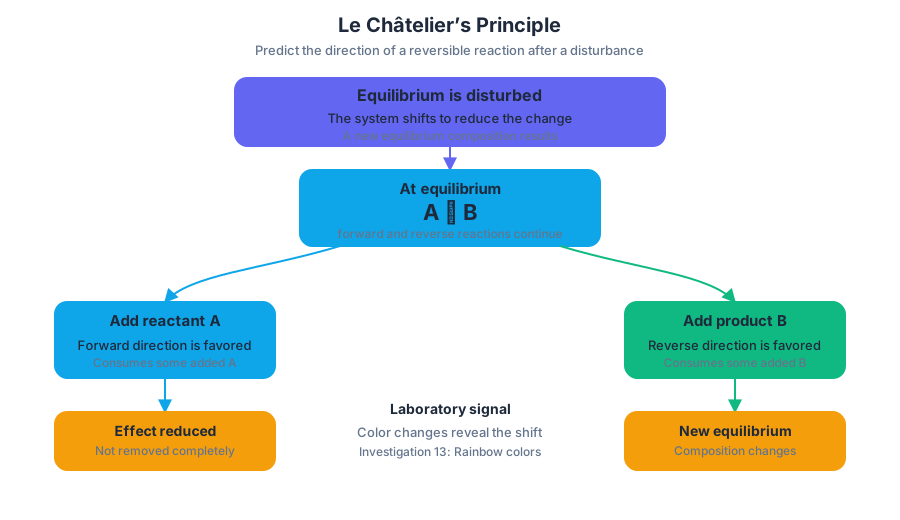
Le Châtelier’s principle predicts the qualitative response of an equilibrium system after a disturbance: when a system at equilibrium is changed, it shifts in the direction that tends to reduce the effect of that change and establish a new equilibrium.
For example, if additional reactant is added to
A \rightleftharpoons B
the system responds by favoring the direction that consumes some of the added $A$—the forward direction. If additional $B$ is added, the system favors the reverse direction, consuming some of the added product. The shift does not remove the disturbance completely; it reduces its effect while producing a new equilibrium composition.
This principle has a laboratory application in Investigation 13, “Can We Make the Colors of the Rainbow? An Application of Le Châtelier’s Principle.” Color changes provide a macroscopic signal that the particulate-level balance of an equilibrium system has changed.
AP Science Practice connection: Model Analysis
The suggested skill is 4.D — Model Analysis: Explain the degree to which a model or representation describes the connection between particulate-level properties and macroscopic properties. A strong explanation links the diagram to observable evidence: unequal forward and reverse rates produce a net composition change, while equal rates produce constant macroscopic composition.
A model is not the chemical system itself. A particulate drawing may omit solvent molecules, show only a sample of particles, or use symbols that are not to scale. Use it to identify trends and relationships, but count carefully and state what the representation actually supports.
Retrieval check
A sealed container initially contains many product particles and very few reactant particles. The reverse reaction is faster than the forward reaction. What happens first, and what condition eventually signals equilibrium?
Answer: There is a net conversion of products into reactants. As the relative rates change, the system approaches a state in which the forward and reverse rates are equal; particles continue reacting, but the macroscopic composition remains constant.
Source Materials
- AP Chemistry Course and Exam Description
- AP Chemistry Course and Exam Description Clarifications and Corrections
- AP Chemistry Course Overview
- AP Chemistry Course at a Glance
- AP Chemistry Course at a Glance Poster
- Adopt AP Chemistry
- AP Chemistry
- AP Chemistry
- AP Chemistry-AP Students
- AP/College Chemistry-Khan Academy
- Guide to the AP Chemistry Exam-The Princeton Review
- AP Chemistry-Wikipedia