From the free course AP Chemistry on Lykke
9.9 Cell Potential and Free Energy · 9.10 Cell Potential Under Nonstandard Conditions
Key concepts: Standard cell potential (E°cell) · Cell potential under nonstandard conditions · Relationship between cell potential and Gibbs free energy · Relationship among E°, ΔG°, K, and temperature · Standard reduction potentials · Oxidation and reduction half-reactions · Reaction quotient (Q) · Nernst equation · Spontaneity and equilibrium in electrochemical cells · Effects of deviations from standard conditions
A cell voltage is more than a meter reading: it reveals whether a redox reaction is thermodynamically favored and how strongly the reaction is being driven.
9.9 Cell Potential and Free Energy · 9.10 Cell Potential Under Nonstandard Conditions
A cell voltage is more than a meter reading: it reveals whether a redox reaction is thermodynamically favored and how strongly the reaction is being driven. The central question is, how do half-reactions, free energy, equilibrium, and concentration combine to determine the voltage of an electrochemical cell?
From half-reactions to standard cell potential
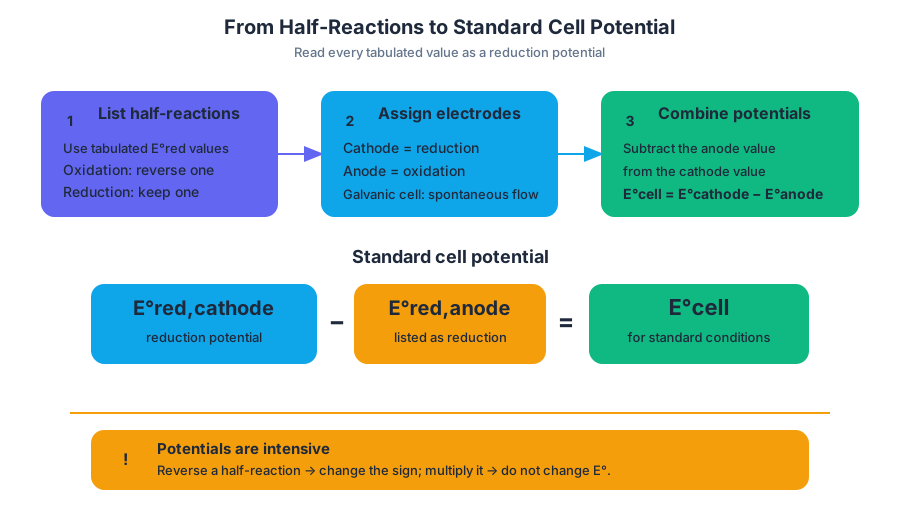
A standard reduction potential, written $E^\circ_{\text{red}}$, measures the tendency of a reduction half-reaction to gain electrons under standard conditions. Standard reduction potentials are listed as reductions, even when a particular cell uses one of them in reverse as an oxidation.
9.9.A.2: Calculate the standard cell potential by identifying the oxidation and reduction half-reactions and combining their standard reduction potentials.
For a galvanic cell, reduction occurs at the cathode and oxidation occurs at the anode. Because tabulated values are reduction potentials, use:
$$ E^\circ_{\text{cell}}
E^\circ_{\text{red,cathode}}
E^\circ_{\text{red,anode}} $$
Do not multiply a potential by a coefficient when balancing electrons. Potential is an intensive quantity: reversing a half-reaction changes the sign of its potential, but multiplying the half-reaction does not change the potential.
Worked example: finding $E^\circ_{\text{cell}}$
Consider the following balanced half-reactions:
$$ 2\text{MnO}_2(s)+\text{H}_2\text{O}(l)+2e^- \rightarrow \text{Mn}_2\text{O}_3(s)+2\text{OH}^-(aq) $$
$$ \text{Zn}(s)+2\text{OH}^-(aq) \rightarrow \text{ZnO}(s)+\text{H}_2\text{O}(l)+2e^- $$
The manganese reaction is reduction and has $E^\circ_{\text{red}}=0.15\ \text{V}$. The zinc reaction is oxidation, but its listed reduction potential is $-1.28\ \text{V}$. Therefore:
$$ E^\circ_{\text{cell}}
0.15\ \text{V}-(-1.28\ \text{V})
1.43\ \text{V} $$
The positive value indicates that the overall reaction is thermodynamically favored under standard conditions. The balanced overall reaction is:
$$ 2\text{MnO}_2(s)+\text{Zn}(s) \rightarrow \text{Mn}_2\text{O}_3(s)+\text{ZnO}(s) $$
Here, $n=2$ mol $e^-$ are transferred per mole of reaction. That electron count comes from the balanced redox equation, not from whichever half-reaction happens to be written first.
Cell potential and Gibbs free energy
Standard Gibbs free energy change, $\Delta G^\circ$, describes the thermodynamic driving force for a reaction under standard conditions. For an electrochemical reaction:
$$ \Delta G^\circ=-nFE^\circ_{\text{cell}} $$
where $n$ is the number of moles of electrons transferred per mole of reaction and $F$ is Faraday’s constant:
$$ F=96{,}485\ \text{C mol}^{-1}e^- $$
For the manganese–zinc cell:
$$ \Delta G^\circ
-(2)(96{,}485\ \text{C mol}^{-1}e^-)(1.43\ \text{J C}^{-1}) $$
$$ \Delta G^\circ
-2.76\times10^5\ \text{J mol}^{-1}_{\text{rxn}}
-276\ \text{kJ mol}^{-1}_{\text{rxn}} $$
The signs form a required three-way connection:
| Standard cell potential | $\Delta G^\circ$ | Thermodynamic interpretation |
|---|---|---|
| $E^\circ_{\text{cell}}>0$ | $\Delta G^\circ<0$ | Forward reaction is favored |
| $E^\circ_{\text{cell}}=0$ | $\Delta G^\circ=0$ | System is at equilibrium |
| $E^\circ_{\text{cell}}<0$ | $\Delta G^\circ>0$ | Forward reaction is unfavored |
A positive $E^\circ_{\text{cell}}$ predicts a thermodynamically favored spontaneous reaction under standard conditions. “Spontaneous” does not mean “fast”: kinetics determines how rapidly a reaction occurs, while $\Delta G^\circ$ determines its thermodynamic favorability.
Connecting $E^\circ$, $\Delta G^\circ$, and $K$
At equilibrium, the reaction has no remaining thermodynamic driving force, so $\Delta G=0$. Combining
with
$$ \Delta G^\circ=-RT\ln K $$
gives:
$$ \ln K=\frac{nFE^\circ_{\text{cell}}}{RT} $$
Here, $R$ is the gas constant and $T$ is absolute temperature in kelvins.
Thus, at a fixed temperature, a positive $E^\circ_{\text{cell}}$ corresponds to $\ln K>0$, so $K>1$. Products are favored at equilibrium under standard conditions. A negative $E^\circ_{\text{cell}}$ corresponds generally to $K<1$, meaning reactants are favored.
Nonstandard conditions: why the voltage changes
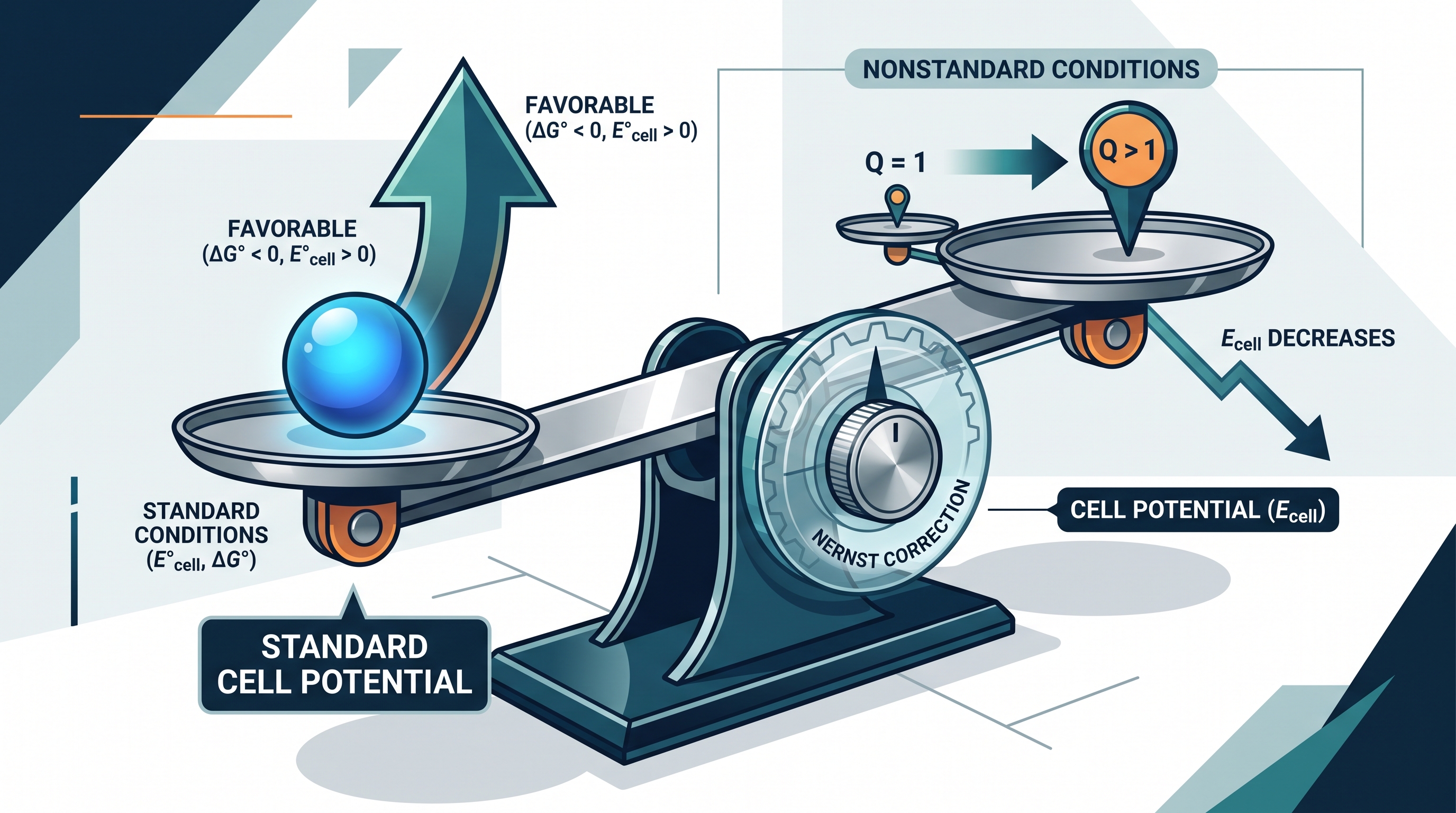
Standard conditions are a reference state, not the only state in which a cell operates. Under nonstandard conditions, the cell potential depends on the concentrations or other activities of the active species through the reaction quotient, $Q$.
For a general reaction
$$ aA+bB\rightarrow cC+dD $$
the reaction quotient is
$$ Q=\frac{a_C^c a_D^d}{a_A^a a_B^b} $$
where $a_i$ represents the activity of each active species. Pure solids and pure liquids are omitted because their activities are treated as constant.
The Nernst equation expresses the change:
$$ E_{\text{cell}}
E^\circ_{\text{cell}}
\left(\frac{RT}{nF}\right)\ln Q $$
In this equation, $n$ is the number of electrons transferred, $R$ is the gas constant, $T$ is temperature in kelvins, and $F$ is Faraday’s constant.
The most useful reasoning is qualitative:
- If $Q=1$, then $\ln Q=0$, so $E_{\text{cell}}=E^\circ_{\text{cell}}$.
- If $Q<1$, then $\ln Q<0$, so subtracting it increases $E_{\text{cell}}$.
- If $Q>1$, then $\ln Q>0$, so $E_{\text{cell}}$ decreases.
- As $Q$ approaches $K$, the system approaches equilibrium and the driving force decreases.
- At equilibrium, $Q=K$ and $E_{\text{cell}}=0$.
For the manganese–zinc reaction, the solids are omitted:
$$ Q=\frac{a_{\text{Mn}_2\text{O}3}}{a{\text{MnO}_2}^2} $$
If the solid activities remain effectively constant, $Q$ is approximately constant as well. In a cell reaction containing dissolved ions or gases, however, changing an active species can shift $Q$ and therefore change the measured voltage.
A concentration thought experiment
Suppose a reaction consumes aqueous reactants and produces aqueous products. Adding reactant decreases $Q$. The Nernst equation then predicts an increase in $E_{\text{cell}}$, because the system is farther from equilibrium in the forward direction and has a larger driving force.
Adding product increases $Q$, which lowers $E_{\text{cell}}$. The reaction still may proceed forward if $Q<K$, but it proceeds with less electrical driving force than it had under standard conditions.
Misconception check
Misconception: “A positive cell potential means the reaction is fast.”
Correction: $E_{\text{cell}}>0$ means the reaction is thermodynamically favored in the written direction. It says nothing by itself about activation energy or reaction rate.
Misconception: “Increasing every concentration always increases the voltage.”
Correction: only the effect on $Q$ matters. Increasing a reactant concentration usually decreases $Q$ and raises $E_{\text{cell}}$; increasing a product concentration usually raises $Q$ and lowers $E_{\text{cell}}$. Stoichiometric exponents also matter.
Misconception: “The Nernst equation is mainly a substitution exercise.”
Correction: 9.10.A.4 emphasizes qualitative reasoning. Before calculating, determine whether the change makes $Q$ larger or smaller and whether the cell moves toward or away from equilibrium.
AP skill connection and retrieval check
This topic most directly develops Science Practice 5: Mathematical Routines when calculating $E^\circ_{\text{cell}}$, $\Delta G^\circ$, $\ln K$, or $E_{\text{cell}}$. It also develops Science Practice 4: Model Analysis when interpreting half-reactions, potential diagrams, and the Nernst equation, and Science Practice 6: Argumentation when justifying favorability from the signs of $E^\circ_{\text{cell}}$ and $\Delta G^\circ$.
Retrieval check: A cell has $E^\circ_{\text{cell}}=0.80\ \text{V}$. If the reaction quotient increases from $Q=1$ to $Q>1$, does $E_{\text{cell}}$ increase or decrease, and why?
Answer: It decreases because $\ln Q$ becomes positive, so the Nernst correction is subtracted from $E^\circ_{\text{cell}}$. The reaction is moving toward equilibrium, so its driving force becomes smaller.