From the free course AP Chemistry on Lykke
Course Framework, Skills and Reasoning Processes
Key concepts: Purpose of AP Chemistry as a college-level general chemistry course · Development of robust conceptual understanding applicable to future coursework and phenomena · Viewing chemical phenomena through macroscopic, microscopic, and symbolic levels · Using chemical models to analyze, explain, and predict phenomena · Supporting claims and conclusions with evidence · School-created curricula aligned with AP Chemistry content and skills · AP Course Audit requirements for schools offering AP courses · Organization of course content into commonly taught units · Science practices including questioning, data representation, and argumentation · Atomic structure as the foundation of the course
AP Chemistry asks a deceptively large question: How can observations of matter become explanations and predictions about invisible particles, energy, and change? A solution may fizz, a metal may conduct, or a spectrum may show separate lines; chemistry connects each visible event to a microscopic model and a…
Course Framework, Skills and Reasoning Processes
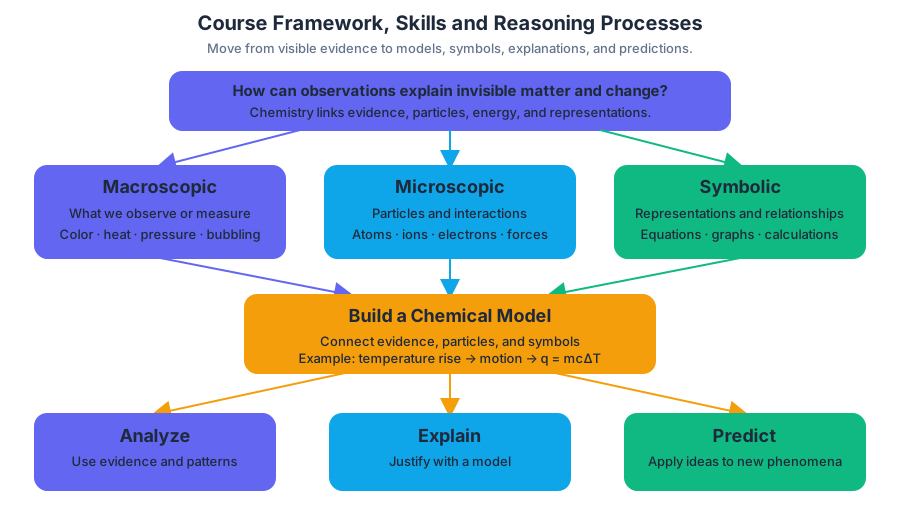
AP Chemistry asks a deceptively large question: How can observations of matter become explanations and predictions about invisible particles, energy, and change? A solution may fizz, a metal may conduct, or a spectrum may show separate lines; chemistry connects each visible event to a microscopic model and a symbolic representation such as an equation, graph, or calculation.
Core purpose: AP Chemistry is a challenging, research-based, college-level general chemistry course designed to develop a robust conceptual understanding of chemical principles that can be applied to future coursework and to unfamiliar phenomena.
That purpose is broader than memorizing reactions. Students learn to move among three levels of description:
- Macroscopic: what can be observed or measured, such as color, temperature, pressure, mass, or bubbling.
- Microscopic or sub-microscopic: particles and interactions, such as atoms, ions, molecules, electrons, and intermolecular forces.
- Symbolic: chemical formulas, balanced equations, graphs, mathematical relationships, and diagrams.
A strong explanation connects all three. For example, a temperature increase is a macroscopic observation; faster-moving particles provide a microscopic explanation; and $q = mc\Delta T$ supplies the symbolic relationship used to quantify the energy transfer. A chemical model is useful when it does more than illustrate an idea: it helps students analyze, explain, and predict phenomena.
The nine-unit content map
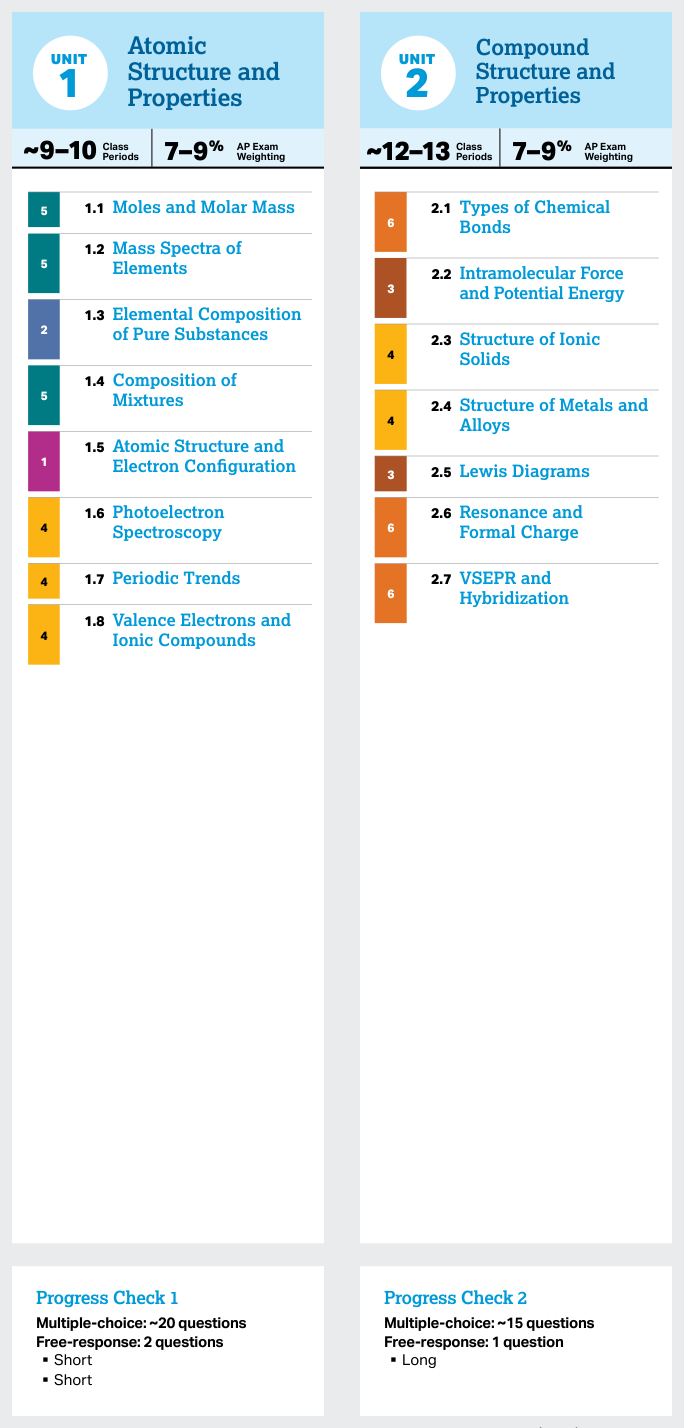
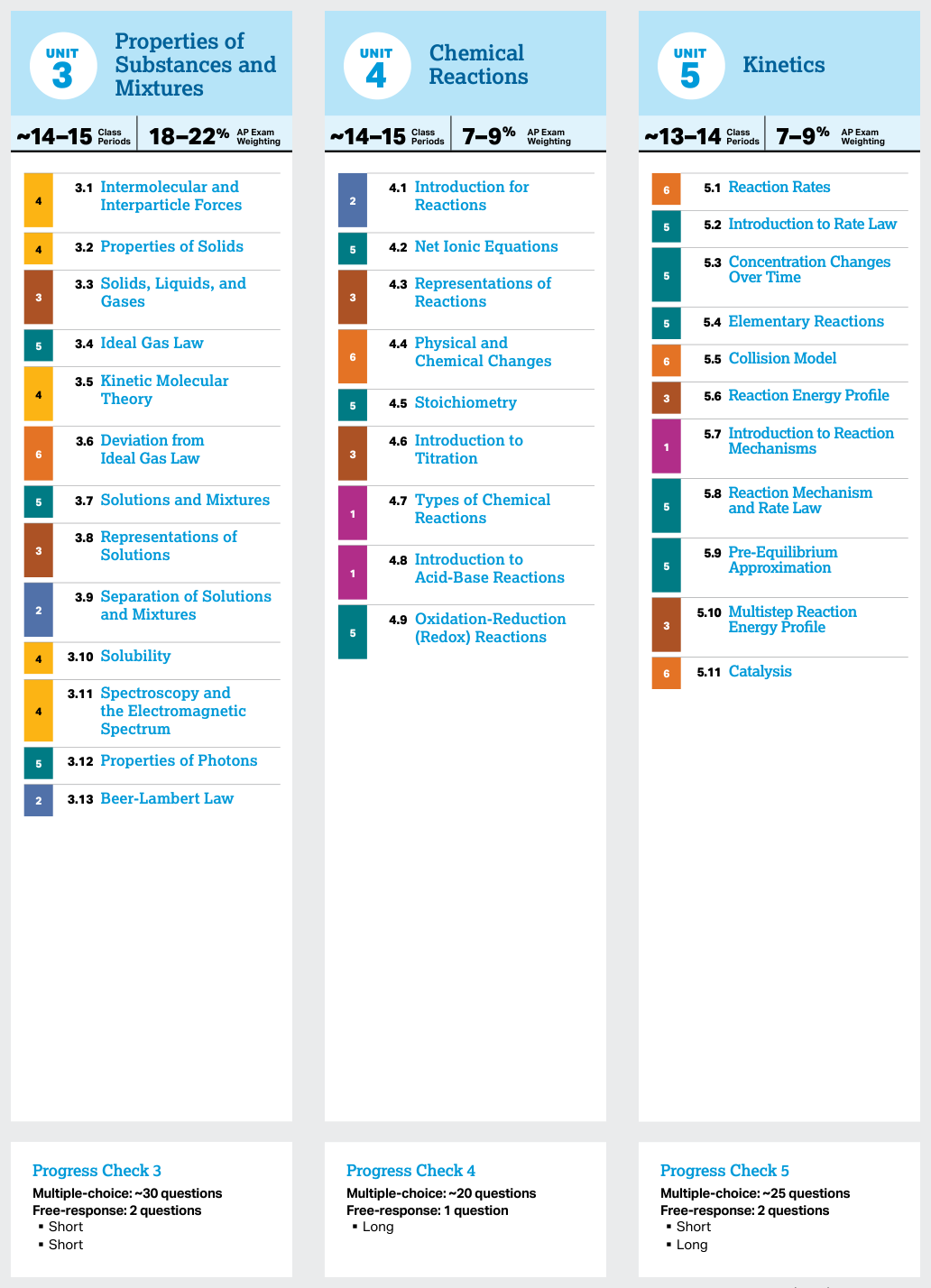
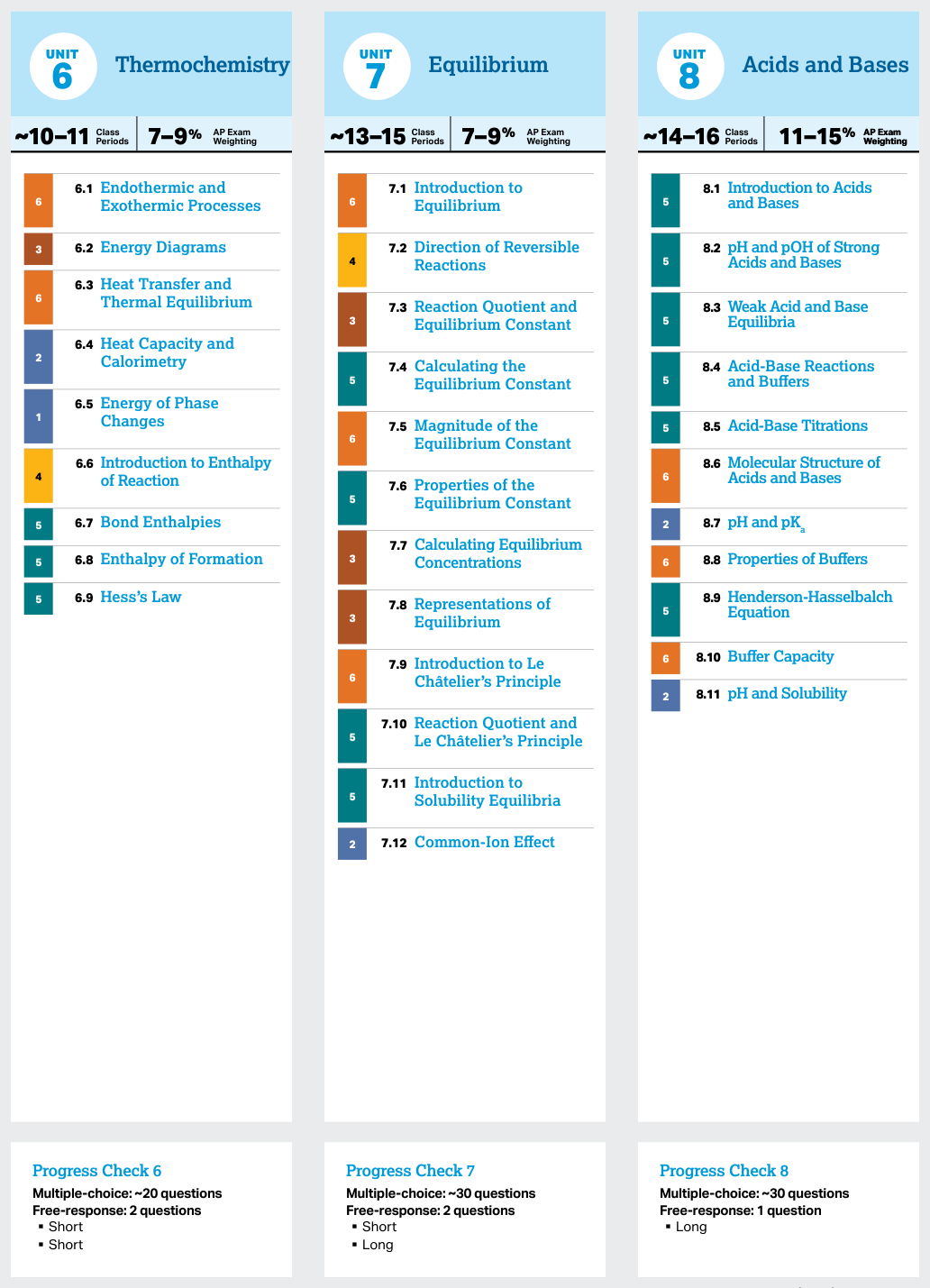
The framework organizes content into nine commonly taught units. Schools may adopt this sequence or modify it, but every required concept and skill must still be addressed. Unit 1, Atomic Structure and Properties, establishes the foundation: later explanations of bonding, reactions, spectra, periodic trends, and energy depend on a workable model of atoms and electrons.
| Unit | Multiple-choice exam weighting |
|---|---|
| Unit 1: Atomic Structure and Properties | $7%-9%$ |
| Unit 2: Compound Structure and Properties | $7%-9%$ |
| Unit 3: Properties of Substances and Mixtures | $18%-22%$ |
| Unit 4: Chemical Reactions | $7%-9%$ |
| Unit 5: Kinetics | $7%-9%$ |
| Unit 6: Thermochemistry | $7%-9%$ |
| Unit 7: Equilibrium | $7%-9%$ |
| Unit 8: Acids and Bases | $11%-15%$ |
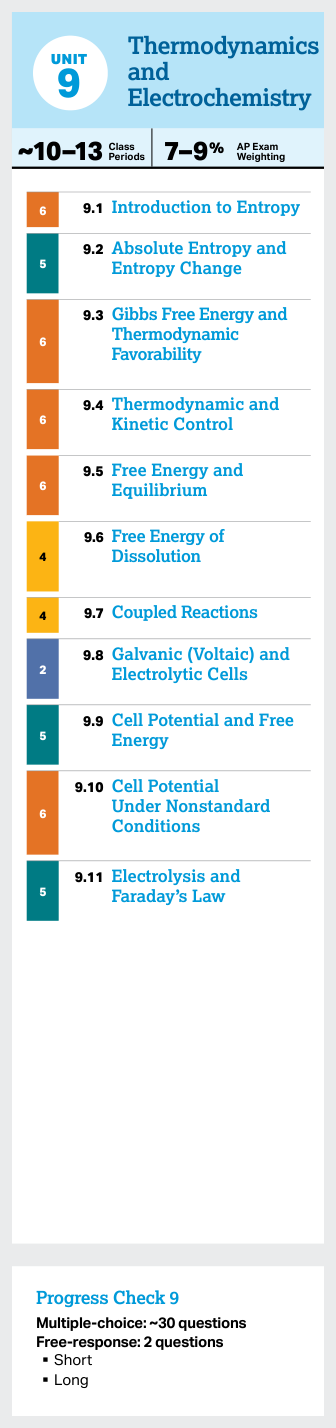
| Unit 9: Thermodynamics and Electrochemistry | $7%-9%$ |
The weighting is guidance for emphasis, not a substitute for understanding. The science practices spiral through all nine units: a kinetics investigation may require a graph, a rate-law calculation, model analysis, experimental-error reasoning, and an evidence-based claim in the same task.
The six science practices
The practices describe what students do with chemistry knowledge. They are not isolated laboratory skills; they are reasoning tools used in multiple-choice questions, free-response questions, calculations, representations, and investigations.
Science Practice 1: Models and Representations requires students to describe chemical models and representations, including representations across scales, and to use them to communicate chemical structure, properties, and phenomena.
Science Practice 2: Question and Method requires students to determine scientific questions and methods. Its skills include identifying testable questions, proposing or describing experimental methods, collecting and analyzing data, attending to precision, identifying potential sources of experimental error (2.E), and explaining how a procedural modification will alter results (2.F).
Science Practice 3: Representing Data and Phenomena means creating representations or models of chemical phenomena:
- 3.A: Represent chemical phenomena using appropriate graphing techniques, including correct scale and units.
- 3.B: Represent chemical substances or phenomena with appropriate diagrams or models, such as an electron configuration.
- 3.C: Represent visually the relationship between structures and interactions across multiple levels or scales, such as particulate and macroscopic descriptions.
Science Practice 4: Model Analysis asks students to interpret models rather than merely draw them. Students describe what a model shows, identify relationships among its parts, use it to explain chemical behavior, recognize limitations, and determine whether a model supports a prediction or conclusion.
Science Practice 5: Mathematical Routines requires students to calculate an unknown quantity from known quantities by selecting and following a logical computational pathway. Dimensional analysis, appropriate units, precision, and significant figures are part of the reasoning—not cosmetic final steps.
Science Practice 6: Argumentation means developing an explanation or scientific argument:
- 6.A: Make a scientific claim.
- 6.B: Support a claim with evidence from experimental data.
- 6.C: Support a claim with evidence from representations or particulate-level models.
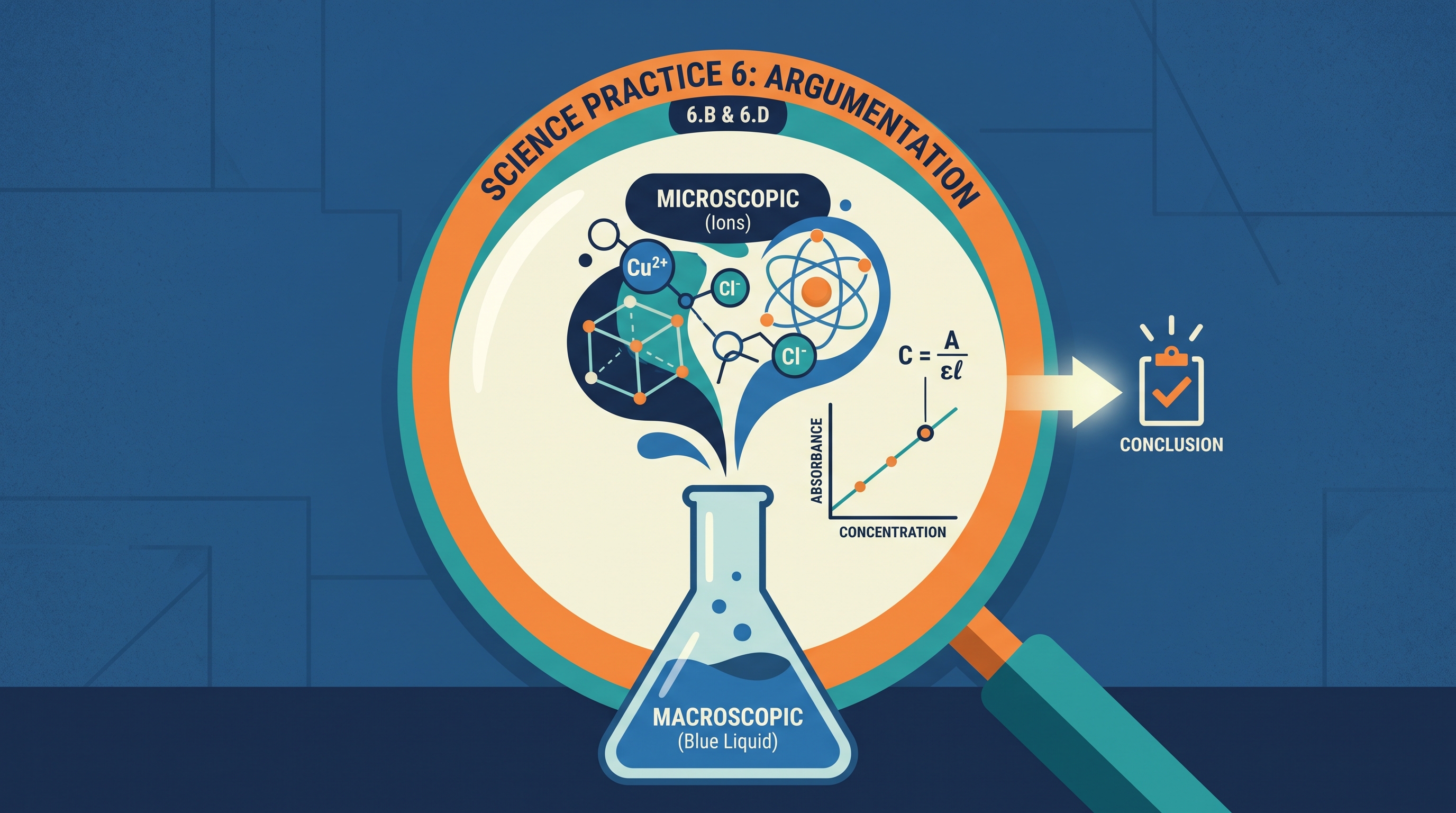
- 6.D: Provide reasoning using chemical principles, laws, or mathematical justification.
- 6.E: Connect particulate and macroscopic scales.
- 6.F: Connect experimental results with chemical concepts, processes, or theories.
- 6.G: Explain how experimental error may affect experimental results.
How the practices work together
A complete response follows a chain:
$$ \text{question} \rightarrow \text{method} \rightarrow \text{data} \rightarrow \text{representation} \rightarrow \text{model} \rightarrow \text{claim} $$
Suppose students investigate whether increasing temperature changes reaction rate. They identify a testable question (Science Practice 2: Question and Method), control relevant variables, measure time or concentration, graph the results (3.A), use collision-based reasoning (Science Practice 4: Model Analysis), calculate a rate (Science Practice 5: Mathematical Routines), and argue from evidence (Science Practice 6: Argumentation). If a thermometer responds slowly, 2.E, 2.F, and 6.G connect the error to the reliability of the conclusion.
Local curriculum, laboratories, and course authorization
The framework is not a complete day-by-day curriculum. Teachers create local curricula by selecting content and experiences that develop the required understandings and skills while meeting state or local requirements. Schools offering AP courses must participate in the AP Course Audit, demonstrate access to college-level resources, incorporate all required CED units and science practices, and connect chemistry to real-world questions.
Inquiry is central. At least $25%$ of instructional time is devoted to hands-on laboratory work, with a minimum of $16$ hands-on investigations, including at least $6$ guided-inquiry investigations; students maintain a laboratory notebook. A useful notebook records observations, data, calculations, representations, error analysis, and conclusions—evidence of the complete reasoning process rather than a polished answer alone.
Retrieval check
A sample is visibly blue, its particles are represented as ions in a diagram, and its concentration is calculated from absorbance. Identify the three levels of description, then name the practice used to justify a conclusion from the absorbance data. Answer: blue is macroscopic, the ion diagram is microscopic, concentration from absorbance is symbolic, and the evidence-based justification uses Science Practice 6: Argumentation, especially 6.B and 6.D.


Source Materials
- AP Chemistry Course and Exam Description
- AP Chemistry Course and Exam Description Clarifications and Corrections
- AP Chemistry Course Overview
- AP Chemistry Course at a Glance
- AP Chemistry Course at a Glance Poster
- Adopt AP Chemistry
- AP Chemistry
- AP Chemistry
- Figure — AP Chemistry Course and Exam Description (p. 1)
- Figure — AP Chemistry Course and Exam Description (p. 15)
- continued on next page
- continued on next page