From the free course AP Chemistry on Lykke
3.9 Separation of Solutions and Mixtures · 3.10 Solubility
Key concepts: Separation of solutions and mixtures · Chromatography · Chromatograms and relative polarity · Distillation · Differential intermolecular attractions · Solubility · Saturated solutions · Ion stoichiometry in dissolved compounds · Molar enthalpy of solution (ΔHsoln) · Temperature changes during dissolution
A dissolved substance cannot be removed from a true solution by ordinary filtration because its particles are distributed at the molecular or ionic scale. Separation becomes possible when a method exploits a difference in intermolecular attractions, volatility, or solubility.
3.9 Separation of Solutions and Mixtures · 3.10 Solubility
A dissolved substance cannot be removed from a true solution by ordinary filtration because its particles are distributed at the molecular or ionic scale. Separation becomes possible when a method exploits a difference in intermolecular attractions, volatility, or solubility.
Chromatography: separation by competing attractions
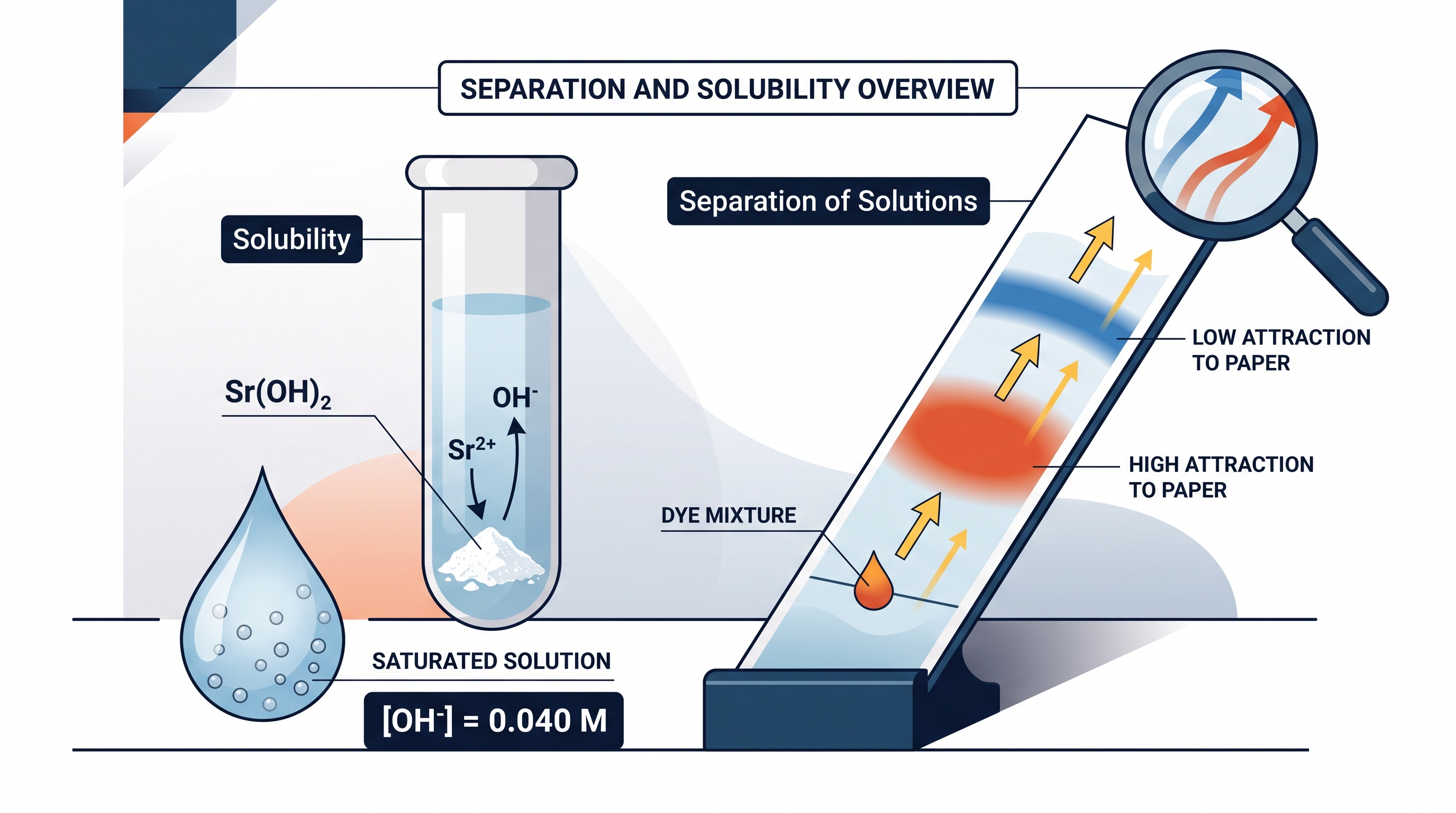
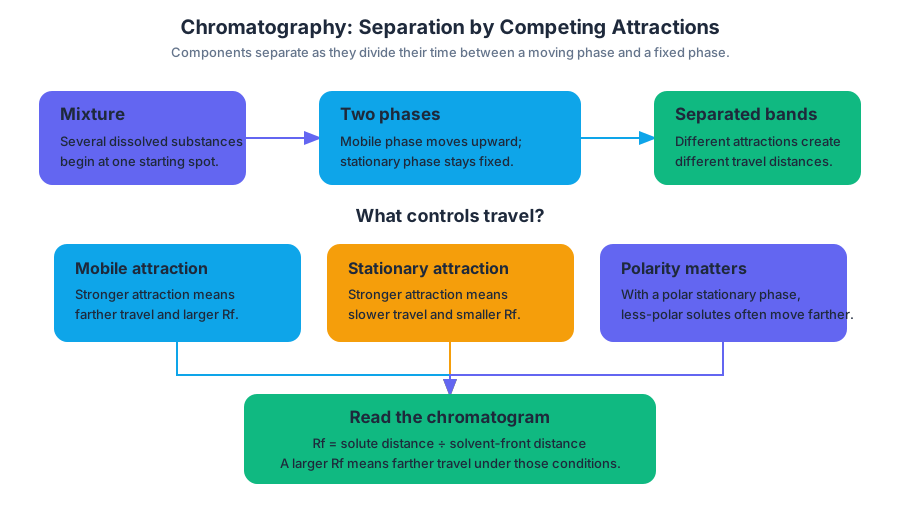
Chromatography separates components because each substance interacts differently with two phases: a mobile phase, which moves, and a stationary phase, which stays fixed. In paper, thin-layer, and column chromatography, a component that is more strongly attracted to the mobile phase travels farther; a component more strongly attracted to the stationary phase travels more slowly.
A chromatogram records the separated components as spots or bands. For a paper chromatogram, the relative distance traveled is often summarized by
$$ R_f=\frac{\text{distance traveled by solute}}{\text{distance traveled by solvent front}} $$
A larger $R_f$ means that the substance traveled farther under those conditions. If the stationary phase is relatively polar, a less-polar substance commonly spends more time in the mobile phase and has a larger $R_f$. This comparison is conditional: changing the solvent or stationary phase can change the order and distances.
CED alignment — Topic 3.9: Learning Objective 3.9.A, “Explain the results of a separation experiment based on intermolecular interactions,” rests on Essential Knowledge 3.9.A.1. The associated Suggested Skill is 2.C: Identify experimental procedures that are aligned to the question (which may include a sketch of a lab setup). This is Science Practice 2: Question and Method: choose chromatography when the question concerns different interactions with the two phases.
Worked interpretation
Suppose three dyes produce $R_f$ values of $0.18$, $0.52$, and $0.81$ on a polar paper strip. The dye with $R_f=0.18$ interacted most strongly with the paper relative to the solvent; the dye with $R_f=0.81$ interacted most strongly with the mobile phase. The chromatogram therefore supports a relative polarity interpretation, not an absolute polarity measurement.
Misconception check: “The largest spot must represent the most polar substance.” Spot size primarily reflects amount, concentration, and spreading. Travel distance—not spot area—is the evidence used for relative movement and interaction strength.
Distillation: separation by volatility
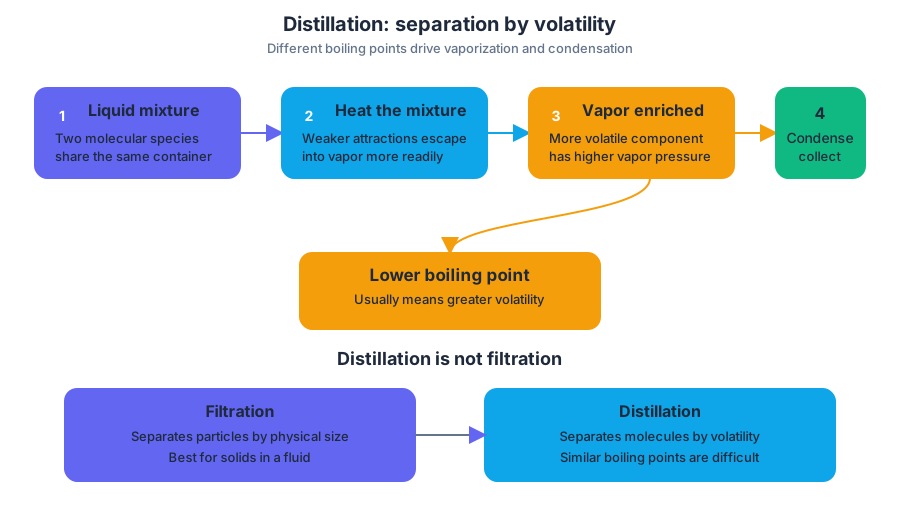
Distillation separates substances by taking advantage of differences in boiling point. A liquid with weaker intermolecular attractions escapes into the vapor phase more readily, giving it a higher vapor pressure and usually a lower boiling point. During distillation, the vapor becomes enriched in the more volatile component, then condensation collects that vapor as liquid.
Distillation is not the same as filtration. Filtration separates particles that differ greatly in physical size; distillation separates molecular species whose intermolecular attractions produce different vapor pressures. A mixture of liquids with very similar boiling points is difficult to separate completely because their vapor compositions remain similar.
Solubility and saturation
Solubility is the maximum amount of solute that dissolves in a specified quantity of solvent under specified conditions. A saturated solution contains dissolved solute at its solubility limit. Adding more solid to a saturated solution does not increase the dissolved concentration; the excess remains undissolved while dissolution and crystallization can occur dynamically.
For ionic compounds, the formula controls the ion ratio in solution. Dissolution of strontium hydroxide is represented by
$$ \mathrm{Sr(OH)_2(s)\rightleftharpoons Sr^{2+}(aq)+2OH^-(aq)} $$
Therefore,
$$ [\mathrm{OH^-}]=2[\mathrm{Sr^{2+}}] $$
If a saturated solution has $[\mathrm{Sr^{2+}}]=0.043\ \mathrm{M}$, then
$$ [\mathrm{OH^-}] =2(0.043\ \mathrm{M}) =0.086\ \mathrm{M} $$
The factor of $2$ is required by both atom conservation and charge balance: one $\mathrm{Sr^{2+}}$ requires two $\mathrm{OH^-}$ ions to produce electrically neutral dissolved formula units.
Misconception check: The concentration of hydroxide is not automatically equal to the concentration of strontium ions. Subscripts in the dissolution equation become stoichiometric concentration relationships.
Enthalpy of solution and temperature change
The molar enthalpy of solution, $\Delta H_{\mathrm{soln}}$, is the enthalpy change when one mole of an ionic compound dissolves in water. The observed temperature change depends on both this molar quantity and how much material dissolves:
$$ q=n\Delta H_{\mathrm{soln}} $$
For the surrounding solution, the same energy appears with the opposite sign:
$$ q_{\mathrm{solution}}=mc\Delta T $$
Thus, the magnitude of $\Delta T$ increases when more moles dissolve, when $|\Delta H_{\mathrm{soln}}|$ is larger, or when the solution has a smaller total heat capacity.
If equal masses of KCl and RbCl dissolve and the magnitude of their molar enthalpies of solution is approximately equal, their temperature changes are approximately equal when the solutions have equal specific heat capacities. The comparison must account for the number of moles, not merely the grams:
$$ n=\frac{m}{M} $$
Equal masses of substances with different molar masses contain different numbers of moles.
Retrieval check
A solution contains $0.020\ \mathrm{M}$ $\mathrm{Sr^{2+}}$ from saturated $\mathrm{Sr(OH)_2}$. Predict $[\mathrm{OH^-}]$ and identify whether chromatography or distillation would better separate two dissolved dyes with different attractions to polar paper.
Answer: $[\mathrm{OH^-}]=0.040\ \mathrm{M}$. Chromatography is appropriate because the dyes differ in their relative attractions to the mobile and stationary phases.