From the free course AP Chemistry on Lykke
AP Practice 1
Key concepts: AP principles of clarity and transparency through publicly available course frameworks and sample exam questions · AP opposition to indoctrination and emphasis on analyzing multiple perspectives · Evidence-based discussion in which students evaluate arguments rather than one another · Respect for diversity in students’ backgrounds, experiences, and viewpoints · AP Chemistry course organization into units on properties of substances and mixtures, chemical reactions, kinetics, thermochemistry, equilibrium, acids and bases, and thermodynamics and electrochemistry · Laboratory investigation practices, including experimental design, prediction, data collection and analysis, mathematical routines, explanation, and communication · Use of formative assessment, such as Progress Checks, to identify and address student misunderstandings · Mass spectrometry as a tool for analyzing isotopic abundance and identifying elements in mixtures
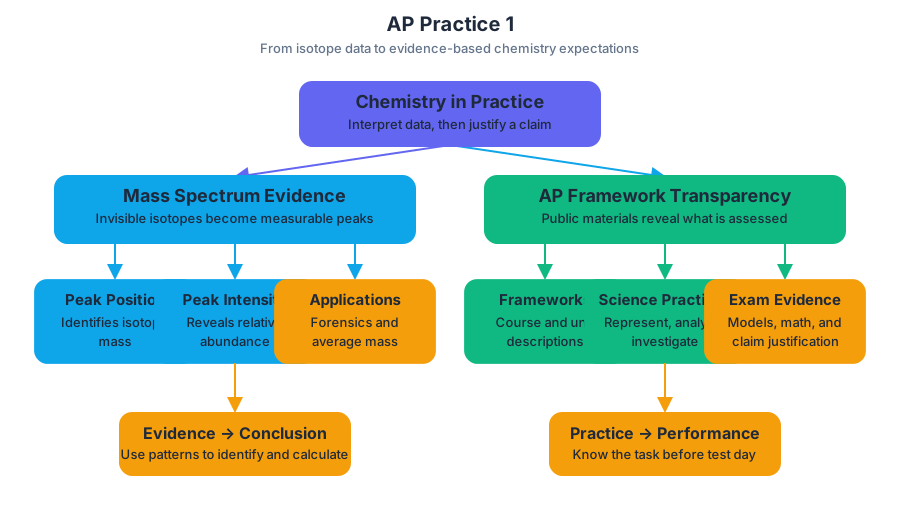
A mass spectrum can turn an invisible isotope mixture into measurable evidence: peak position identifies isotope mass, while peak intensity reveals relative abundance. That same reasoning appears in forensic science, where isotope patterns can help distinguish substances, identify an element in a mixture, or…
AP Practice 1
A mass spectrum can turn an invisible isotope mixture into measurable evidence: peak position identifies isotope mass, while peak intensity reveals relative abundance. That same reasoning appears in forensic science, where isotope patterns can help distinguish substances, identify an element in a mixture, or calculate an element’s average atomic mass.
The AP Program makes its course frameworks, unit descriptions, science practices, and sample exam questions publicly available. These materials make expectations transparent: students can see not only what chemistry is assessed, but also whether they must represent data, analyze a model, perform a mathematical routine, design an investigation, or justify a claim with evidence.
The task type: data-based multiple choice
This practice uses an original multiple-choice question built around a scientific representation. On the current AP Chemistry Exam, multiple-choice questions may require a student to move among a spectrum, a numerical calculation, a particulate interpretation, and a chemical conclusion. The strongest approach is not to guess from a familiar pattern; it is to identify what each datum means and connect it to the claim being tested.
Science Practice 3: Representing Data and Phenomena means translating observations into useful representations and interpreting what those representations show.
The question also uses Science Practice 5: Mathematical Routines, because isotope abundance must be converted into a weighted average. It touches Science Practice 6: Argumentation when the calculated result is used as evidence for identifying an element.
Original practice question
A forensic laboratory analyzes a pure element recovered from a small metal fragment. Its mass spectrum contains two major peaks:
| Isotope | Isotopic mass | Relative abundance |
|---|---|---|
| $X$-63 | $63.0\ \mathrm{u}$ | $69.0%$ |
| $X$-65 | $65.0\ \mathrm{u}$ | $31.0%$ |
Which statement is best supported by the spectrum?
A. The sample is a mixture of two elements, because it produces two peaks.
B. The average atomic mass of the element is $64.0\ \mathrm{u}$.
C. The average atomic mass of the element is approximately $63.6\ \mathrm{u}$, consistent with an element whose naturally occurring isotopes have masses near $63\ \mathrm{u}$ and $65\ \mathrm{u}$.
D. The $X$-65 isotope contains two more protons than the $X$-63 isotope.
Worked reasoning
The two peaks have different masses but represent isotopes of the same element. Isotopes have the same number of protons and different numbers of neutrons, so the two peaks do not by themselves prove that two elements are present.
Convert each percentage to a decimal fraction, multiply each isotope’s mass by its abundance, and add:
$$ \text{average atomic mass}
(63.0\ \mathrm{u})(0.690)+(65.0\ \mathrm{u})(0.310) $$
$$ \text{average atomic mass}
43.47\ \mathrm{u}+20.15\ \mathrm{u}
63.62\ \mathrm{u} $$
The result is approximately $63.6\ \mathrm{u}$, so C is correct. The average lies closer to $63.0\ \mathrm{u}$ because the $X$-63 isotope is more abundant.
Examiner-rewarded reasoning: interpret peak positions as isotope masses, interpret intensities as relative abundances, use a weighted average rather than an ordinary mean, and connect the numerical result to an evidence-based identification.
Why the other choices fail
A confuses isotopes with elements. A mass spectrum showing two isotope peaks can be evidence for one element with two isotopes. A mixture of elements would be supported only if the pattern contained isotope masses belonging to different elements.
B uses the unweighted average, $(63.0+65.0)/2$, which assumes equal abundance. The abundances are not equal, so the average must be closer to $63.0\ \mathrm{u}$.
D confuses atomic number with mass number. The isotope labels differ by two mass units, meaning the nuclei differ by two neutrons, not two protons. Changing the number of protons changes the element.
Evidence, perspectives, and respectful argument
AP points are awarded for chemically correct evidence and reasoning, not for agreement with a particular political, cultural, or personal viewpoint. When a chemistry claim has competing interpretations—for example, whether a spectrum represents a pure element or a mixture—students should compare the assumptions, data, and explanatory power of each interpretation.
A productive discussion evaluates arguments rather than classmates. Students may bring different backgrounds, experiences, and viewpoints to questions involving forensic science, environmental chemistry, medicine, or technology. Those differences deserve respect; personal attacks do not belong in evidence-based scientific discussion. Primary data and reliable sources should decide the chemical claim.
Laboratory practice behind the question
The same reasoning cycle extends beyond a multiple-choice item:
$$ \text{question} \rightarrow \text{method} \rightarrow \text{prediction} \rightarrow \text{data collection} \rightarrow \text{analysis} \rightarrow \text{explanation} \rightarrow \text{communication} $$
In an AP Chemistry laboratory investigation, students may design an experiment, predict an outcome, collect measurements, apply mathematical routines, analyze uncertainty or patterns, develop an explanation, and communicate a conclusion supported by evidence. Colleges may ask students to present laboratory notebooks, reports, or other materials before awarding credit for laboratory work, so clear documentation matters beyond the exam.
Where this task fits in the course
Mass spectra belong especially to Unit 1: Atomic Structure and Properties, while the interpretation habits used here spiral through the course. The AP Chemistry units and their multiple-choice weightings are:
| Unit | Course focus | Exam weighting |
|---|---|---|
| Unit 1 | Atomic Structure and Properties | $7$–$9%$ |
| Unit 2 | Compound Structure and Properties | $7$–$9%$ |
| Unit 3 | Properties of Substances and Mixtures | $18$–$22%$ |
| Unit 4 | Chemical Reactions | $7$–$9%$ |
| Unit 5 | Kinetics | $7$–$9%$ |
| Unit 6 | Thermochemistry | $7$–$9%$ |
| Unit 7 | Equilibrium | $7$–$9%$ |
| Unit 8 | Acids and Bases | $11$–$15%$ |
| Unit 9 | Thermodynamics and Electrochemistry | $7$–$9%$ |
A schedule of five $45$-minute class periods per week is a planning suggestion, not a fixed rule. Block schedules, school calendars, student needs, and the time required for laboratory investigations may justify different pacing.
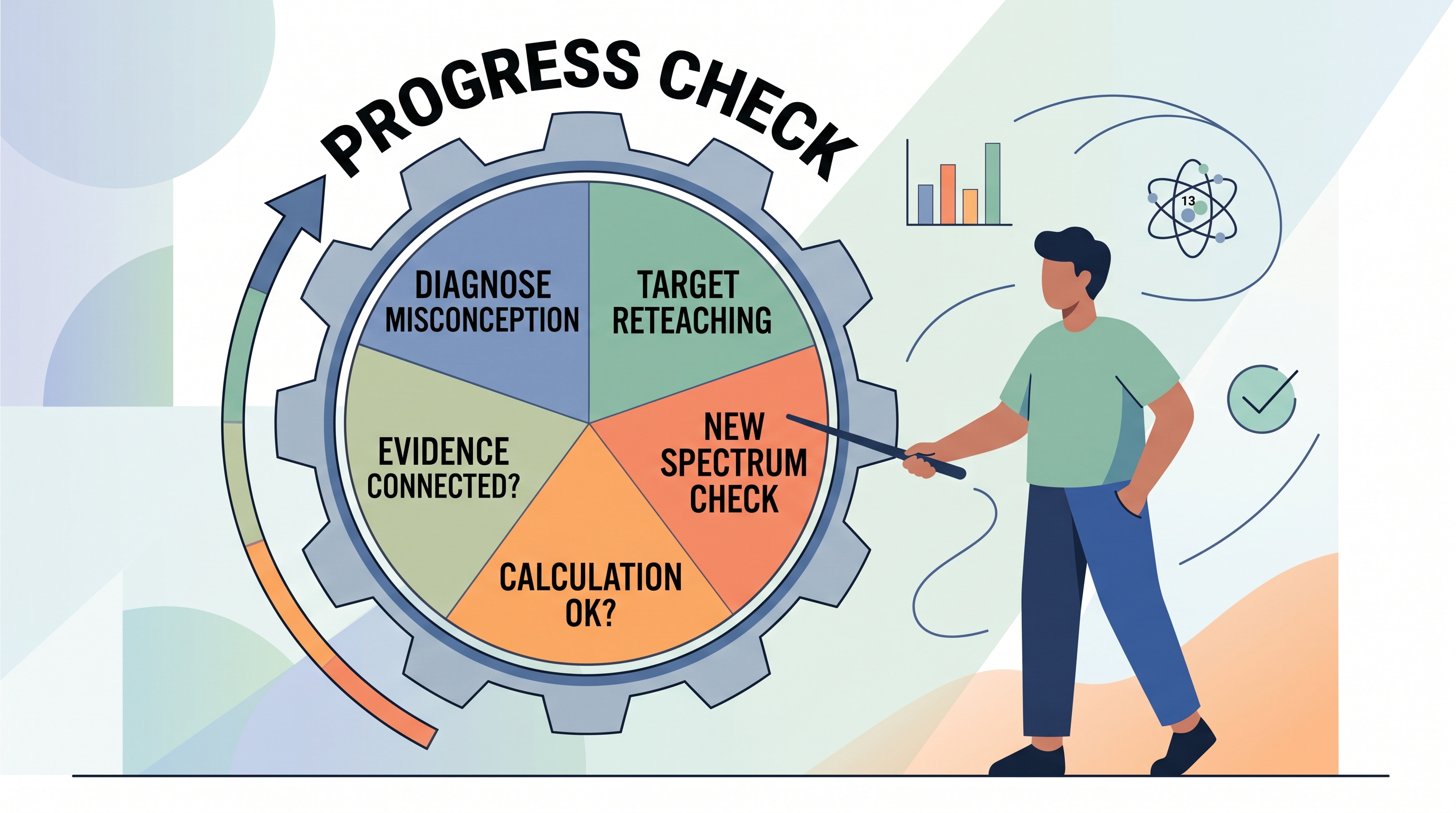
Progress Check and error review
Use a short Progress Check diagnostically rather than treating its score as the end of learning. For this question, classify an error precisely:
- Representation error: peak intensity was not recognized as abundance.
- Mathematical-routine error: percentages were not converted to decimal fractions.
- Conceptual error: isotopes were confused with different elements.
- Argumentation error: the conclusion was stated without connecting it to the spectrum.
Reteach only the diagnosed misconception, then complete a follow-up check using a new spectrum with different masses and abundances. A student is ready to move on when the calculation, interpretation, and evidence-based conclusion all agree—not merely when the final letter choice is correct.
Timing guidance: spend about $2$ minutes identifying what the peaks encode, $1$ minute calculating, and $1$ minute checking whether the result is closer to the more abundant isotope.
Source Materials
- AP Chemistry Course and Exam Description
- AP Chemistry Course and Exam Description Clarifications and Corrections
- AP Chemistry Course Overview
- AP Chemistry Course at a Glance
- AP Chemistry Course at a Glance Poster
- Adopt AP Chemistry
- AP Chemistry
- AP Chemistry
- Based on your experience at the AP® Reading with student responses, what advice would you offer teachers to help them improve the student performance on the exam?
- Based on your experience at the AP® Reading with student responses, what advice would you offer teachers to help them improve the student performance on the exam?
- Most responses attempted part (a), and it was an accessible point for students to earn. Many students who earned the point clearly showed the use of dimensional analysis to connect the given number of
- Based on your experience at the AP® Reading with student responses, what advice would you offer teachers to help them improve the student performance on the exam?