From the free course AP Chemistry on Lykke
5.5 Collision Model · 5.6 Reaction Energy Profile
Key concepts: Collision model · Successful collisions · Activation energy (Ea) · Bond breaking and bond making · Reaction energy profile · Energy changes along a reaction pathway · Enthalpy change (ΔH) · Connection between particulate and macroscopic scales · Scientific argumentation (6.E) · Reaction rates and kinetics
A chemical reaction begins when reactant particles collide in a way that allows old bonds to break and new bonds to form—but most collisions fail.
5.5 Collision Model · 5.6 Reaction Energy Profile
A chemical reaction begins when reactant particles collide in a way that allows old bonds to break and new bonds to form—but most collisions fail. The collision model connects these microscopic events to the macroscopic reaction rate, the observable speed at which reactants disappear and products appear.
5.5 Collision Model: What makes a collision successful?
Imagine two puzzle pieces moving across a table. A collision does not guarantee that they will connect: they must meet often enough, hit with enough energy, and approach with compatible shapes. Reacting particles behave similarly. For an elementary reaction, reactant particles must collide with the correct frequency, sufficient energy, and suitable orientation.
5.5.A.1: For an elementary reaction to successfully produce products, reactants must successfully collide to initiate bond-breaking and bond-making events.
A successful collision is a collision that produces products. It must satisfy three conditions:
- Frequency: More collisions per unit time create more opportunities for reaction.
- Energy: The particles must have enough kinetic energy to overcome the activation-energy requirement.
- Orientation: The particles must strike in a geometric arrangement that permits the necessary bonds to break and form.
This explains why increasing concentration often increases reaction rate: more particles occupy the same volume, so collisions occur more frequently. Increasing temperature affects both particle motion and the fraction of collisions energetic enough to react. Changing the orientation requirement changes the probability that a collision has the correct geometry.
Connecting the particulate and macroscopic scales
The reaction rate measured in a laboratory is a macroscopic observation. The collision model explains that observation using microscopic reasoning: a faster reaction corresponds to a greater number of successful collisions per unit time.
Science Practice 6.E — Argumentation: Provide reasoning to justify a claim using connections between particulate and macroscopic scales or levels.
Worked argument: A powdered solid reacts faster than the same mass of large pieces. At the particulate level, powder exposes more surface area, allowing more particles at the solid’s surface to collide with particles in the other reactant. The collision frequency therefore increases, producing more successful collisions per unit time and a greater macroscopic reaction rate.
Notice the logic: the claim is not merely “powder reacts faster.” The justification connects surface-level particle access to collision frequency, then connects collision frequency to observable rate. A response that names only the macroscopic trend does not fully establish the chemical reason.
Activation energy and the transition state
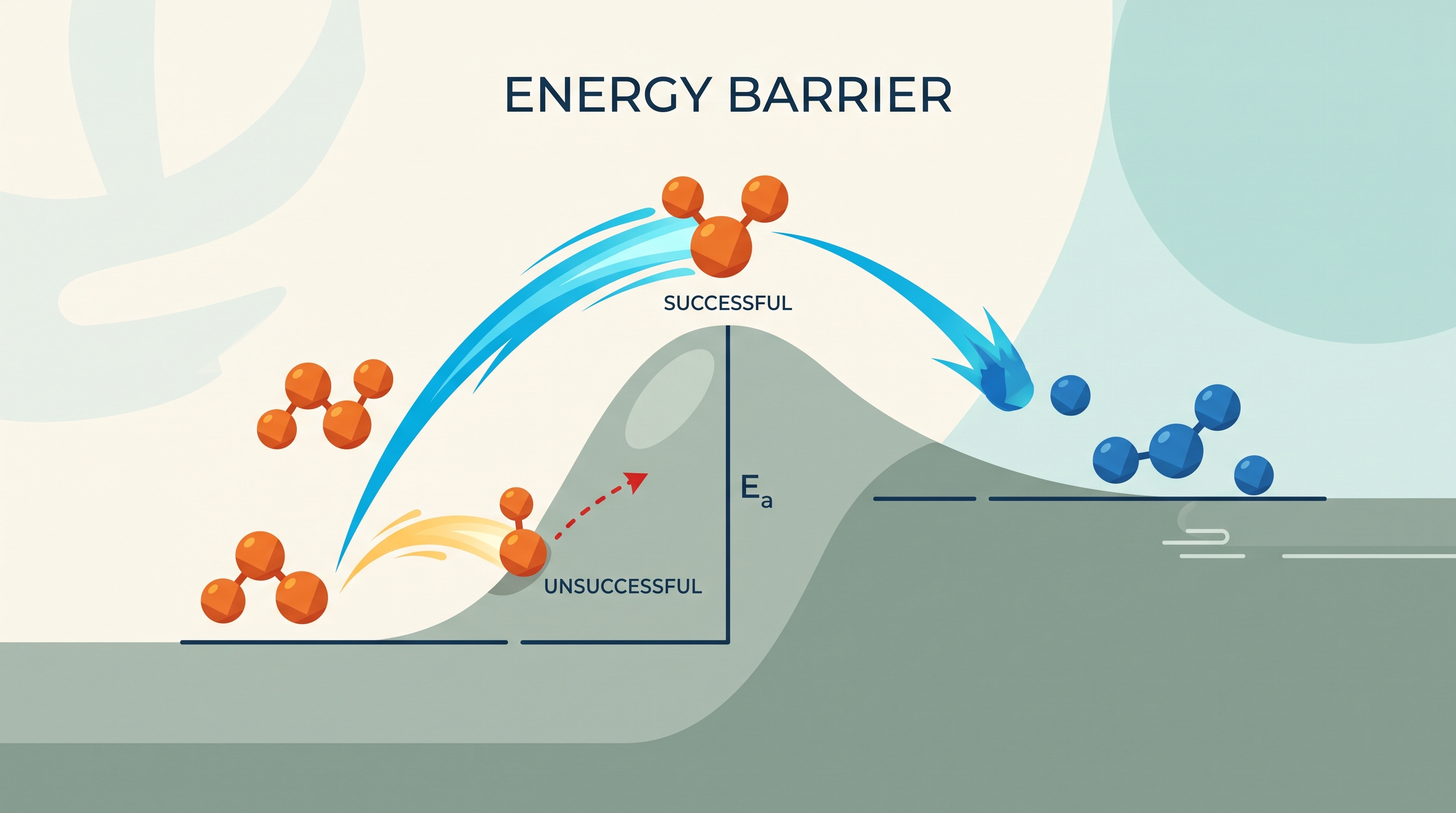
Activation energy, written $E_a$, is the minimum energy required for colliding particles to reach the transition state—the unstable arrangement at the highest-energy point along the reaction pathway. During this brief event, bonds are being broken and formed simultaneously.
Particles can collide frequently and still react slowly if very few collisions have energy greater than or equal to $E_a$. This is why “more collisions” and “more successful collisions” are not identical ideas.
Common misconception — “Every collision causes a reaction.”
Collision is necessary, but it is not sufficient. A collision must have adequate energy and appropriate orientation; only a small fraction of collisions leads to products.
5.6 Reaction Energy Profile: Mapping the pathway
A reaction energy profile shows how energy changes as reactants are rearranged into products. The horizontal axis is the reaction coordinate, an abstract measure of progress through the complex motions involved in the rearrangement. The vertical axis represents the energy of the reacting system.
For a single elementary reaction, the profile normally has three essential regions:
- Reactants: the starting energy level.
- Transition state: the peak, where the bonds are in the highest-energy unstable arrangement.
- Products: the ending energy level after new bonds have formed.
The vertical difference from the reactants to the peak is the activation energy for the forward reaction:
$$ E_a = E_{\text{transition state}} - E_{\text{reactants}} $$
The vertical difference between products and reactants is the overall enthalpy change:
$$ \Delta H = E_{\text{products}} - E_{\text{reactants}} $$
If the products lie below the reactants, $\Delta H < 0$ and the reaction is exothermic: the system releases energy overall. If the products lie above the reactants, $\Delta H > 0$ and the reaction is endothermic: the system absorbs energy overall. In either case, the reaction may require a positive $E_a$ to begin.
Profile-labeling example: Suppose the reactants are at $40\ \mathrm{kJ,mol^{-1}}$, the transition state is at $115\ \mathrm{kJ,mol^{-1}}$, and the products are at $10\ \mathrm{kJ,mol^{-1}}$.
$$ E_a = 115 - 40 = 75\ \mathrm{kJ,mol^{-1}} $$
$$ \Delta H = 10 - 40 = -30\ \mathrm{kJ,mol^{-1}} $$
The reaction is exothermic, but it still requires $75\ \mathrm{kJ,mol^{-1}}$ of activation energy to reach the transition state.
Common misconception — “Exothermic means spontaneous and fast.” Exothermicity describes the sign of $\Delta H$, not the speed of the reaction. A reaction can release energy overall and still be extremely slow if its $E_a$ is large. Conversely, lowering $E_a$ changes the rate without changing the overall $\Delta H$.
Temperature and the energy barrier
When temperature increases, the proportion of particle collisions energetic enough to reach the transition state increases. The reaction rate therefore increases because a larger fraction of collisions can become successful—not because the activation energy itself changes.
The Arrhenius equation models this temperature dependence:
$$ k = A e^{-E_a/(RT)} $$
Here, $k$ is the rate constant, $A$ represents collision frequency and orientation effects, $E_a$ is the activation energy, $R$ is the gas constant, and $T$ is absolute temperature in kelvins. At AP Chemistry level, the essential interpretation is graphical and conceptual: temperature changes the fraction of collisions that can cross the energy barrier.
Retrieval check
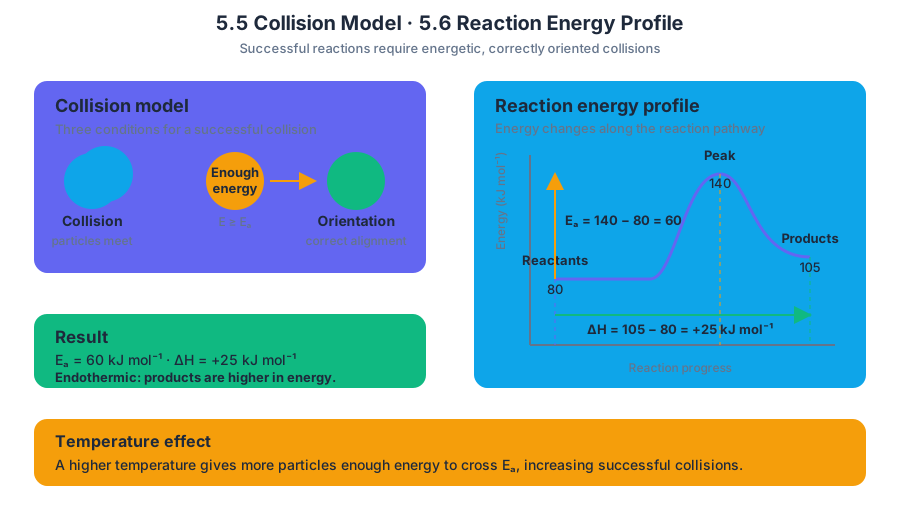
A reaction profile has reactants at $80\ \mathrm{kJ,mol^{-1}}$, a peak at $140\ \mathrm{kJ,mol^{-1}}$, and products at $105\ \mathrm{kJ,mol^{-1}}$. What are $E_a$ and $\Delta H$? Is the reaction exothermic or endothermic? Explain, in one sentence, how a higher temperature changes the number of successful collisions.