From the free course AP Chemistry on Lykke
5.7 Introduction to Reaction Mechanisms · 5.8 Reaction Mechanism and Rate Law
Key concepts: Reaction mechanisms as sequences of elementary reactions · Relating experimental rate data, rate laws, and proposed mechanisms · Identifying a rate law from a mechanism when the first elementary step is rate limiting · Rate-limiting steps and their effect on the overall rate law · Evaluating whether a proposed mechanism is consistent with an observed rate law · Catalysts changing reaction mechanisms · Catalysts providing an alternative pathway with lower activation energy · Effective collisions and activation energy · Mathematical routines for identifying appropriate rate laws and relationships · Acid-base equilibrium constants in reaction examples
A reaction mechanism is a sequence of elementary reactions that shows how reactant particles are transformed into products one molecular event at a time. The experimentally measured rate law is a powerful test of whether that proposed sequence is chemically credible.
5.7 Introduction to Reaction Mechanisms · 5.8 Reaction Mechanism and Rate Law
A reaction mechanism is a sequence of elementary reactions that shows how reactant particles are transformed into products one molecular event at a time. The experimentally measured rate law is a powerful test of whether that proposed sequence is chemically credible.
From one equation to several elementary steps
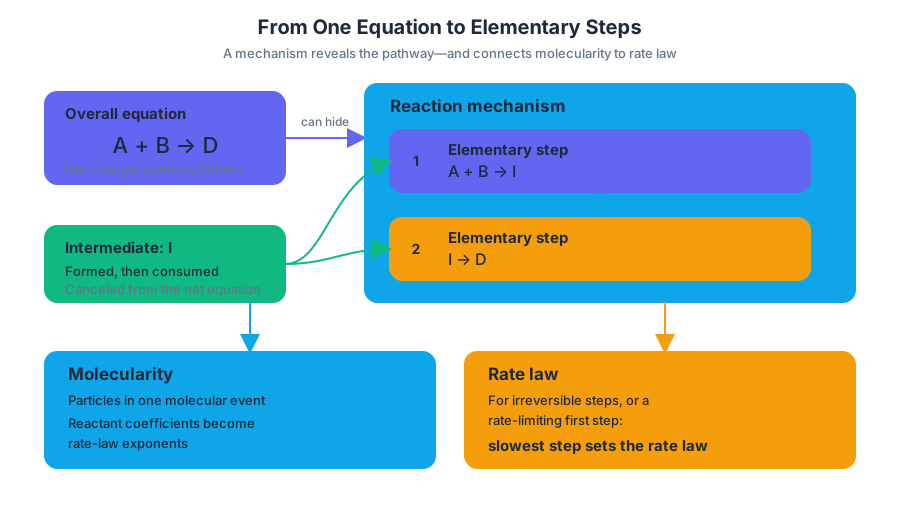
An overall equation hides the pathway. For example, the net reaction
$$ A+B\rightarrow D $$
might occur through
$$ \text{Step 1: } A+B\rightarrow I $$
$$ \text{Step 2: } I\rightarrow D $$
where $I$ is an intermediate: a species formed in one step and consumed in a later step. Adding the elementary steps cancels $I$, leaving the overall equation. An intermediate therefore appears in the mechanism but not in the net reaction.
An elementary reaction represents a single molecular event. Its rate law follows directly from the particles involved in that event, so the coefficients of the reactants become the exponents in that elementary-step rate law. This connection is called the step’s molecularity.
Essential Knowledge 5.8.A.1: For mechanisms in which each elementary step is irreversible, or in which the first step is rate limiting, the rate law is set by the molecularity of the slowest elementary step.
The rate-limiting first step
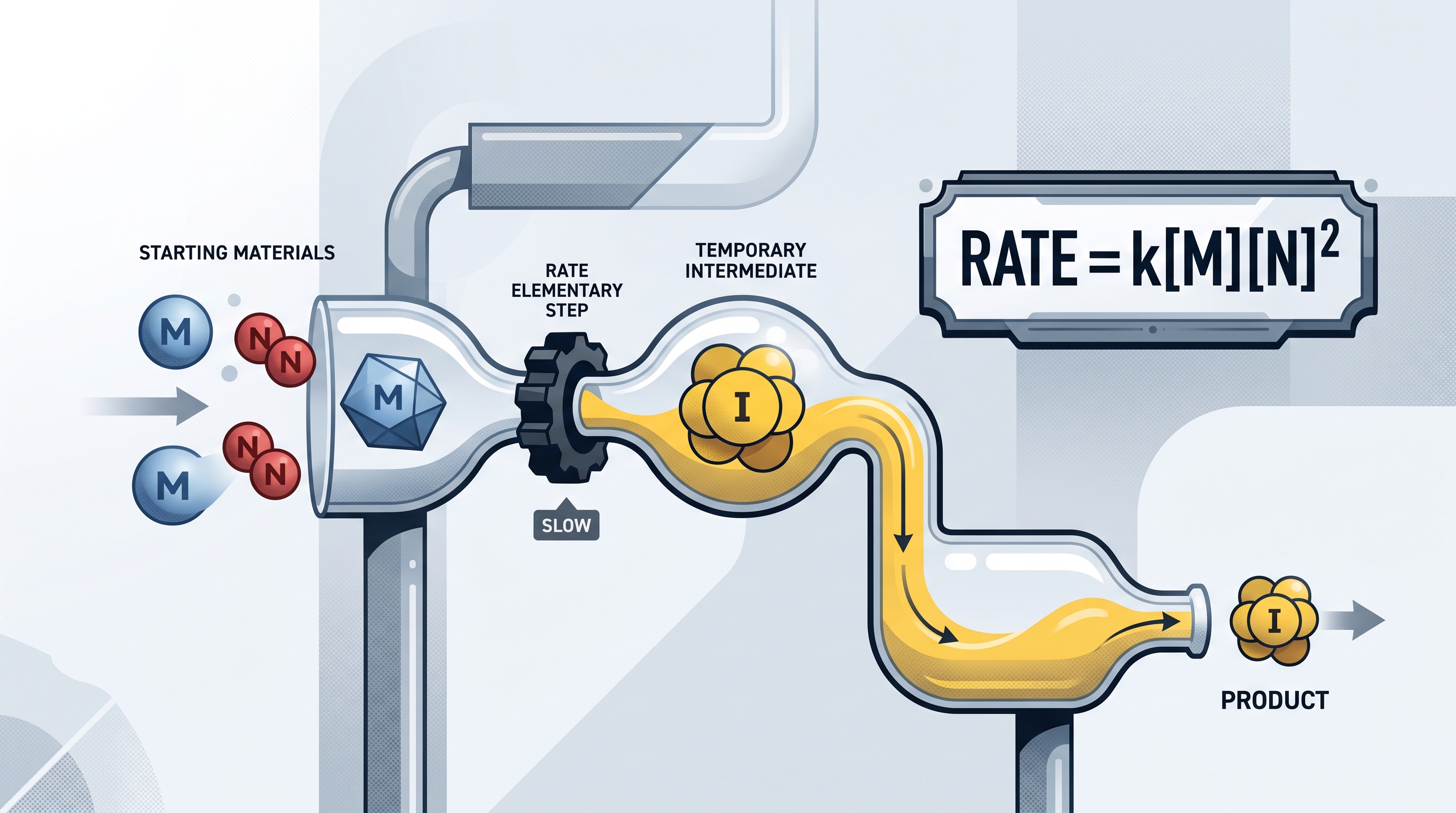
The rate-limiting step is the slowest elementary step in a proposed mechanism. It acts like a narrow doorway: even if later steps are fast, the overall process cannot proceed faster than particles pass through that bottleneck.
For Learning Objective 5.8.A, the required case is a mechanism in which the first elementary step is rate limiting. In that specific situation, the overall rate law is based on the reactants in the first step.
Worked example: identifying the rate law
Suppose a proposed mechanism is
$$ \text{Step 1: } 2X+Y\rightarrow I \qquad \text{slow} $$
$$ \text{Step 2: } I\rightarrow Z \qquad \text{fast} $$
The first step is rate limiting, so write its elementary rate law:
$$ \text{rate}=k[X]^2[Y] $$
The predicted overall reaction rate law is therefore
$$ \boxed{\text{rate}=k[X]^2[Y]} $$
The exponents come from the coefficients of $X$ and $Y$ in the slow elementary step—not from the coefficients in the overall equation. If doubling $[X]$ increases the rate by a factor of $4$, while doubling $[Y]$ doubles the rate, those observations support second order in $X$ and first order in $Y$.
Misconception check — “Balance the overall equation, then copy its coefficients into the rate law.” Overall-equation coefficients generally do not determine reaction orders. Reaction orders must come from experimental data or, in the specially permitted mechanism shortcut, from the molecularity of the rate-limiting elementary step.
Testing a proposed mechanism against data
A mechanism must satisfy two independent requirements:
- Its elementary steps must add to the observed overall chemical equation.
- Its predicted rate law must agree with the experimentally observed rate law.
For example, suppose experimental trials show that doubling $[A]$ doubles the rate, while doubling $[B]$ leaves the rate unchanged. The observed law is
$$ \text{rate}=k[A] $$
A proposed first-step-limiting mechanism beginning with
$$ A+B\rightarrow I \qquad \text{slow} $$
would predict
$$ \text{rate}=k[A][B] $$
Because the prediction includes $[B]$, it conflicts with the data. The mechanism may still produce the correct overall equation, but it is not consistent with the observed kinetics.
When data are tabulated, compare rate ratios rather than merely comparing raw rates. When data are graphed, inspect how the rate responds as one reactant concentration changes while the others remain controlled. This uses Skill 5.B: Identify an appropriate theory, definition, or mathematical relationship to solve a problem: select the elementary-step rate relationship that matches the stated rate-limiting condition, then test it against evidence.
When the shortcut does not apply
The rule “the slow step gives the rate law” is not a universal shortcut. It applies directly here when the first elementary step is rate limiting, or under the stated additional conditions involving irreversible elementary steps. If the first step is fast and reversible, an intermediate may appear in the rate expression; determining its concentration requires an approximation such as pre-equilibrium treatment, which belongs to the later rate-law analysis.
Important scope: The AP Chemistry exam does not assess collecting experimental data to detect a reaction intermediate. It does assess using a given mechanism, rate data, equations, and representations to judge whether the mechanism explains observed behavior.
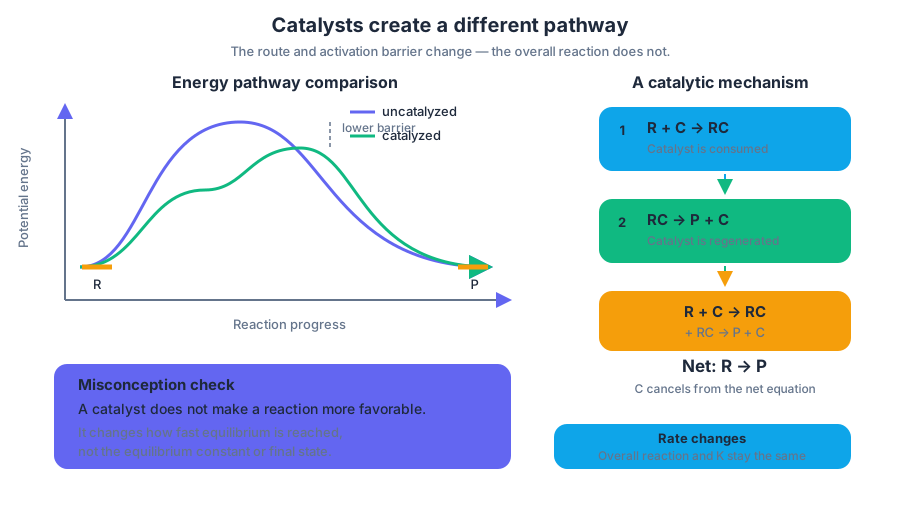
Catalysts create a different pathway
A catalyst increases reaction rate by changing the mechanism, not by changing the overall reaction. It may increase the number of effective collisions or provide a pathway with a lower activation energy. Because the catalyst is regenerated, it does not appear in the net equation.
For a simple catalytic mechanism,
$$ \text{Step 1: } R+C\rightarrow RC $$
$$ \text{Step 2: } RC\rightarrow P+C $$
adding the steps cancels $C$:
$$ R\rightarrow P $$
The catalyst $C$ can be consumed in one elementary step and regenerated in another. Its concentration may remain essentially constant even though it participates directly in the pathway.
Misconception check — “A catalyst makes a reaction more favorable.” A catalyst changes the route and lowers the kinetic barrier; it does not change the overall reactants, products, or thermodynamic equilibrium constant. It changes how fast equilibrium is reached, not the final equilibrium composition.
Retrieval check
A mechanism begins with the slow elementary step
$$ M+2N\rightarrow I $$
and experimental data show first order in $M$ and second order in $N$. The predicted rate law is
$$ \boxed{\text{rate}=k[M][N]^2} $$
This mechanism passes the rate-law test only if its elementary steps also add to the observed overall equation. Why would a catalyst not appear in that overall equation? Because it is regenerated and cancels when the mechanism’s steps are added.
Source Materials
- AP Chemistry Course and Exam Description
- AP Chemistry Course and Exam Description Clarifications and Corrections
- AP Chemistry Course Overview
- AP Chemistry Course at a Glance
- AP Chemistry Course at a Glance Poster
- Adopt AP Chemistry
- AP Chemistry
- AP Chemistry
- (c) For the correct calculated value, consistent with part (a): 1 point
- (c) For the correct calculated value, consistent with part (a):