From the free course AP Chemistry on Lykke
8.11 pH and Solubility
A solid can become more soluble simply because the solution contains acid or base. The key is that pH changes the concentration of ions already involved in a solubility equilibrium, pulling the equilibrium toward additional dissolving.
8.11 pH and Solubility
A solid can become more soluble simply because the solution contains acid or base. The key is that pH changes the concentration of ions already involved in a solubility equilibrium, pulling the equilibrium toward additional dissolving.
The central connection: acid–base chemistry shifts solubility
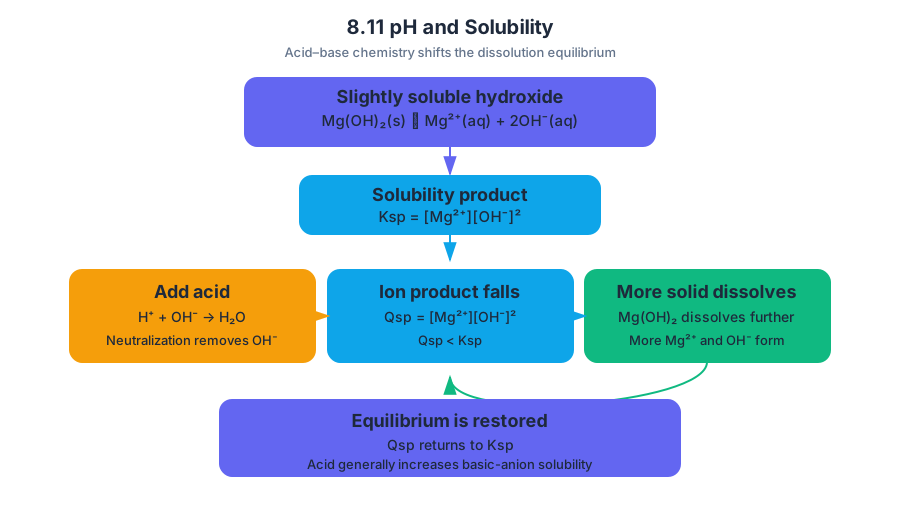
Solubility is the amount of a substance that dissolves to establish equilibrium with its undissolved solid. For a slightly soluble hydroxide such as magnesium hydroxide, the equilibrium is
$$ \mathrm{Mg(OH)_2(s) \rightleftharpoons Mg^{2+}(aq) + 2OH^-(aq)} $$
and its solubility-product expression is
$$ K_{sp}=[\mathrm{Mg^{2+}}][\mathrm{OH^-}]^2. $$
Adding acid removes hydroxide ions through neutralization:
$$ \mathrm{H^+(aq)+OH^-(aq)\rightarrow H_2O(l)} $$
Because the concentration of $\mathrm{OH^-}$ decreases, the ion product $Q_{sp}$ becomes smaller than $K_{sp}$. More $\mathrm{Mg(OH)_2}$ dissolves, producing additional $\mathrm{Mg^{2+}}$ and $\mathrm{OH^-}$ until equilibrium is restored. Thus, an acidic solution generally increases the solubility of a basic anion such as $\mathrm{OH^-}$.
Worked example: dissolving a metal hydroxide in acid
Suppose solid $\mathrm{Mg(OH)_2}$ is added to water containing hydrochloric acid. The process occurs in two linked steps:
- Dissolution:
$$ \mathrm{Mg(OH)_2(s)\rightleftharpoons Mg^{2+}(aq)+2OH^-(aq)} $$
- Neutralization:
$$ \mathrm{H^+(aq)+OH^-(aq)\rightarrow H_2O(l)} $$
Since $\mathrm{OH^-}$ is consumed, the dissolution equilibrium shifts right. The overall chemical result can be represented as
$$ \mathrm{Mg(OH)_2(s)+2H^+(aq)\rightarrow Mg^{2+}(aq)+2H_2O(l)}. $$
The solid is therefore more soluble at lower pH. Notice that acid does not change the numerical value of $K_{sp}$ at a fixed temperature; it changes the equilibrium position by removing one of the dissolved ions.
Which solids are affected by pH?
The same reasoning applies to salts containing basic anions. Anions such as $\mathrm{CO_3^{2-}}$, $\mathrm{S^{2-}}$, $\mathrm{F^-}$, and $\mathrm{OH^-}$ can react with $\mathrm{H^+}$. Removing these anions encourages more solid to dissolve.
For a carbonate solid,
$$ \mathrm{CaCO_3(s)\rightleftharpoons Ca^{2+}(aq)+CO_3^{2-}(aq)} $$
acid converts carbonate through reactions such as
$$ \mathrm{CO_3^{2-}(aq)+H^+(aq)\rightleftharpoons HCO_3^-(aq)} $$
and, with additional acid,
$$ \mathrm{HCO_3^-(aq)+H^+(aq)\rightarrow CO_2(g)+H_2O(l)}. $$
The formation of $\mathrm{CO_2(g)}$ can drive dissolution especially strongly because a product leaves the aqueous system.
Conversely, salts containing the conjugate bases of strong acids—such as $\mathrm{Cl^-}$, $\mathrm{NO_3^-}$, and $\mathrm{ClO_4^-}$—are not substantially protonated by ordinary acids. Their solubilities are therefore usually much less sensitive to pH.
| Solution condition | Ion removed or added | Typical effect on a basic-anion solid |
|---|---|---|
| Lower pH | $\mathrm{H^+}$ removes the basic anion | Solubility increases |
| Higher pH | Basic anion may accumulate | Solubility decreases |
| Near-neutral pH | Little protonation of the anion | $K_{sp}$ equilibrium dominates |
A particulate interpretation: saturated barium hydroxide
A saturated solution of barium hydroxide can be represented as
$$ \mathrm{Ba(OH)_2(s)\rightleftharpoons Ba^{2+}(aq)+2OH^-(aq)}. $$
If more $\mathrm{Ba(OH)2(s)}$ is added, the equilibrium concentrations do not change because the added material is a pure solid and does not appear in the $K{sp}$ expression. If water evaporates while solid remains present, more solid dissolves until the same saturation condition is reestablished. The pH remains essentially constant because the concentrations of $\mathrm{Ba^{2+}}$ and $\mathrm{OH^-}$ in the saturated solution return to their equilibrium values.
Misconception check
Misconception: “Adding acid always decreases solubility because it adds more particles.” The relevant question is not the total number of particles; it is whether the added $\mathrm{H^+}$ reacts with an ion in the solubility equilibrium. Acid increases the solubility of $\mathrm{Mg(OH)_2}$ because it removes $\mathrm{OH^-}$, but it has little direct effect on a chloride salt because $\mathrm{Cl^-}$ is the conjugate base of a strong acid.
CED alignment: Topic 8.11 pH and Solubility; Learning Objective 8.11.A; Essential Knowledge 2.D.1. The principal assessed practice is Science Practice 3: Representing Data and Phenomena (SP 3): connect a particulate model, a solubility equilibrium, and the macroscopic observation that pH or dissolved amount changes.
Retrieval check
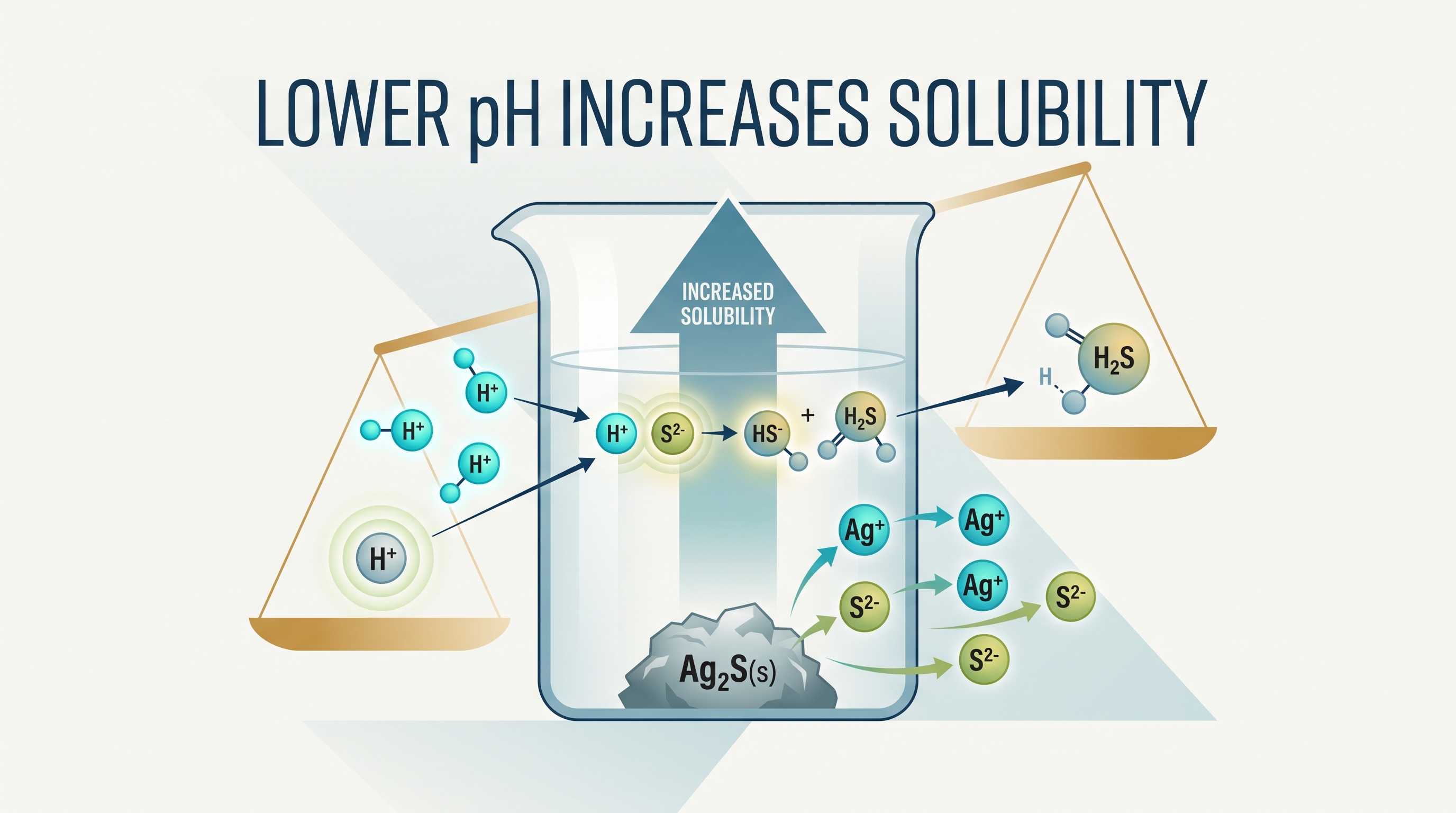
A saturated solution contains $\mathrm{Ag_2S(s)}$:
$$ \mathrm{Ag_2S(s)\rightleftharpoons 2Ag^+(aq)+S^{2-}(aq)}. $$
Would lowering the pH generally increase or decrease its solubility? Explain in one sentence using an equilibrium argument.
Answer: Lowering the pH increases solubility because $\mathrm{H^+}$ reacts with the basic ion $\mathrm{S^{2-}}$, reducing its concentration and shifting the dissolution equilibrium to the right.