From the free course AP Chemistry on Lykke
AP Practice 4
A strong long free-response answer does more than produce a number: it connects an observable result to a chemical model, supports a claim with evidence, and explains why the evidence supports the claim.
AP Practice 4
A strong long free-response answer does more than produce a number: it connects an observable result to a chemical model, supports a claim with evidence, and explains why the evidence supports the claim. This original practice task emphasizes experimental design, data representation, mathematical routines, model analysis, and scientific argumentation.
Task type: Long free-response question with experimental design
Recommended timing: $15$ minutes for a $10$-point question. Spend about $2$ minutes identifying variables and equations, $9$ minutes solving and explaining, and $4$ minutes checking units, significant figures, and cause-and-effect reasoning.
A student investigates the reaction between hydrogen peroxide and iodide ions in acidic solution:
$$ H_2O_2(aq)+2I^-(aq)+2H^+(aq)\rightarrow I_2(aq)+2H_2O(l) $$
The iodine produced reacts immediately with thiosulfate ions, allowing the student to measure the time required to produce a fixed amount of iodine. The initial-rate data are collected at constant temperature.
| Experiment | $[H_2O_2]$ ($\mathrm{mol,L^{-1}}$) | $[I^-]$ ($\mathrm{mol,L^{-1}}$) | $[H^+]$ ($\mathrm{mol,L^{-1}}$) | Initial rate ($\mathrm{mol,L^{-1},s^{-1}}$) |
|---|---|---|---|---|
| 1 | $0.100$ | $0.100$ | $0.0100$ | $2.00\times10^{-5}$ |
| 2 | $0.200$ | $0.100$ | $0.0100$ | $4.00\times10^{-5}$ |
| 3 | $0.100$ | $0.200$ | $0.0100$ | $8.00\times10^{-5}$ |
| 4 | $0.100$ | $0.100$ | $0.0200$ | $8.00\times10^{-5}$ |
Original practice prompt
(a) Write the rate law for the reaction using the experimental data. Show how the order with respect to each reactant is determined.
(b) Determine the value and units of the rate constant, $k$.
(c) The student proposes measuring reaction rate by recording the volume of oxygen gas produced rather than the iodine signal. Explain one advantage and one limitation of this method.
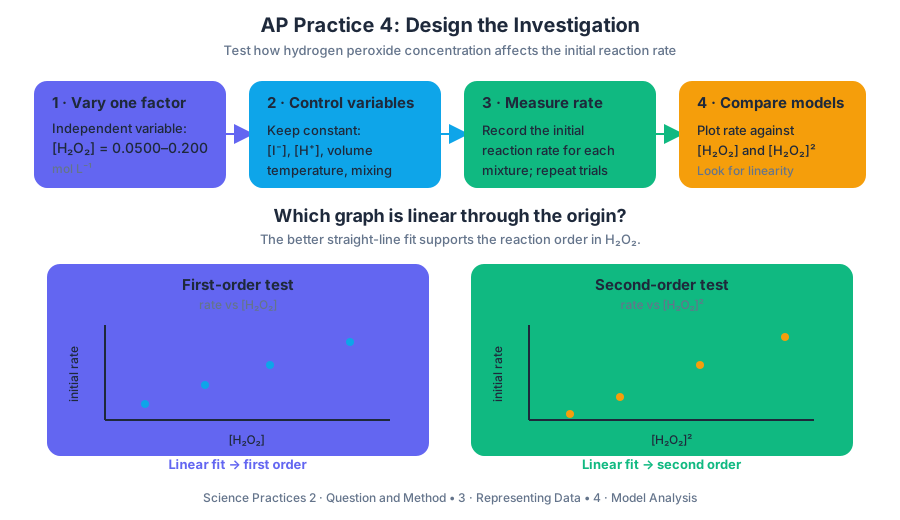
(d) Design an experiment to determine whether the reaction is first order or second order with respect to $H_2O_2$. Identify the independent variable, dependent variable, at least two controlled variables, and the evidence that would distinguish the two possible orders.
(e) Predict the initial rate when $[H_2O_2]=0.150\ \mathrm{mol,L^{-1}}$, $[I^-]=0.0500\ \mathrm{mol,L^{-1}}$, and $[H^+]=0.0100\ \mathrm{mol,L^{-1}}$.
Worked reasoning and scoring targets
(a) Determine the rate law
Assume
$$ \text{rate}=k[H_2O_2]^m[I^-]^n[H^+]^p $$
Compare Experiments $1$ and $2$: $[H_2O_2]$ doubles while the other concentrations remain constant. The rate also doubles, so $m=1$.
Compare Experiments $1$ and $3$: $[I^-]$ doubles, but the rate quadruples:
$$ \frac{8.00\times10^{-5}}{2.00\times10^{-5}}=4 $$
Therefore,
$$ 2^n=4 \qquad\Rightarrow\qquad n=2 $$
Compare Experiments $1$ and $4$: $[H^+]$ doubles, and the rate quadruples. Thus,
$$ 2^p=4 \qquad\Rightarrow\qquad p=2 $$
The rate law is therefore
$$ \boxed{\text{rate}=k[H_2O_2][I^-]^2[H^+]^2} $$
Credit target: The response must use controlled comparisons and connect each concentration change to the corresponding rate change. Merely stating the exponents earns less scientific reasoning than showing the ratio analysis.
(b) Calculate $k$
Using Experiment $1$:
$$ 2.00\times10^{-5} =k(0.100)(0.100)^2(0.0100)^2 $$
The concentration factor is
$$ (0.100)(0.100)^2(0.0100)^2 =1.00\times10^{-7} $$
Thus,
$$ k=\frac{2.00\times10^{-5}}{1.00\times10^{-7}} =2.00\times10^2 $$
The overall reaction order is
$$ 1+2+2=5 $$
Because
$$ [\text{rate}]=\mathrm{mol,L^{-1},s^{-1}} $$
the units of $k$ are
$$ \frac{\mathrm{mol,L^{-1},s^{-1}}} {(\mathrm{mol,L^{-1}})^5} =\boxed{\mathrm{L^4,mol^{-4},s^{-1}}} $$
Credit target: A complete answer includes the numerical value, the overall order used to determine units, and units consistent with the rate law. A frequent error is assigning $\mathrm{s^{-1}}$ automatically; that unit applies only to a first-order rate constant.
(c) Compare measurement methods
Measuring oxygen volume could provide a direct physical signal that increases as hydrogen peroxide decomposes, and gas volume can be recorded continuously with a pressure sensor or gas syringe. However, the proposed reaction equation produces iodine, not oxygen, so oxygen measurement would require a different reaction pathway or an additional decomposition reaction. Gas leakage, water vapor, and gas solubility could also introduce systematic error.
This response demonstrates Science Practice 1: Models and Representations, because the chemical equation is used to evaluate whether the proposed measurement represents the stated reaction. It also demonstrates Science Practice 6: Argumentation, because the advantage and limitation are claims supported by chemical reasoning.
(d) Design the investigation
The student should prepare several mixtures with different initial values of $[H_2O_2]$, such as $0.0500$, $0.100$, $0.150$, and $0.200\ \mathrm{mol,L^{-1}}$. The concentrations of $I^-$ and $H^+$, total solution volume, temperature, and mixing procedure should remain constant. The independent variable is $[H_2O_2]$; the dependent variable is the initial reaction rate.
To distinguish the orders, the student can plot $\text{rate}$ versus $[H_2O_2]$ and also $\text{rate}$ versus $[H_2O_2]^2$. A linear relationship through or near the origin in the first plot supports first-order behavior; a linear relationship in the second plot supports second-order behavior. Repeated trials should be performed so random variation can be estimated.
This earns credit through Science Practice 2: Question and Method, because it identifies a testable question and controls variables; Science Practice 3: Representing Data and Phenomena, because it proposes meaningful graphs; and Science Practice 4: Model Analysis, because the graphs discriminate between competing mathematical models.
(e) Predict the rate
Use the rate law and the value of $k$:
$$ \text{rate} =(2.00\times10^2)(0.150)(0.0500)^2(0.0100)^2 $$
$$ \text{rate} =\boxed{7.50\times10^{-6}\ \mathrm{mol,L^{-1},s^{-1}}} $$
This calculation demonstrates Science Practice 5: Mathematical Routines. The most important check is not only arithmetic: because iodide and hydrogen ion are second order, halving $[I^-]$ reduces the rate by a factor of $4$, while changing $[H_2O_2]$ from $0.100$ to $0.150\ \mathrm{mol,L^{-1}}$ multiplies the rate by $1.5$.
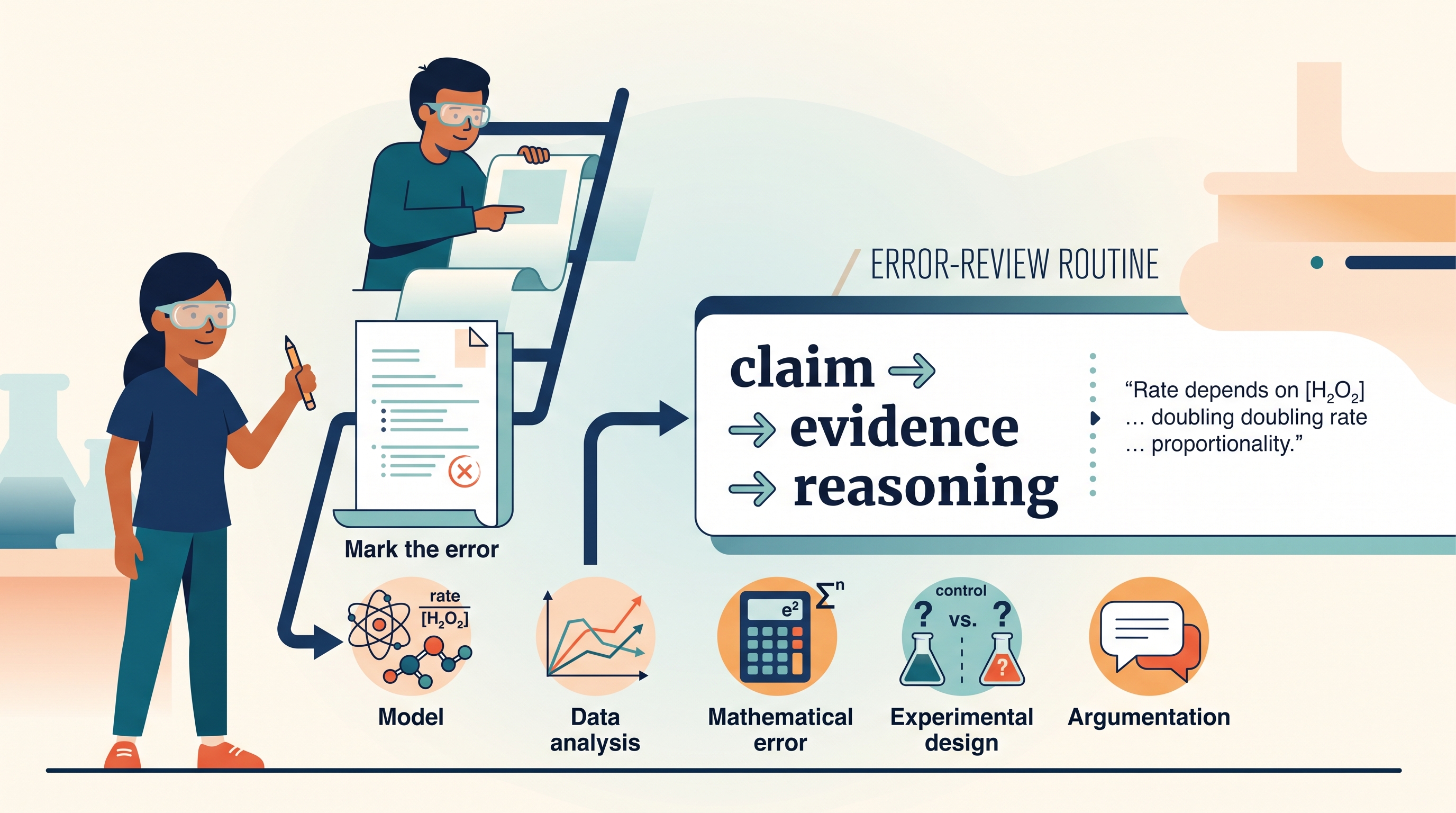
Error-review routine
After completing the question, classify each error rather than simply marking the answer wrong:
- Model error: incorrect rate law or misunderstanding of reaction representation.
- Data-analysis error: comparing trials in which more than one variable changed.
- Mathematical error: incorrect exponent, substitution, or unit conversion.
- Experimental-design error: failing to identify a control, measurable dependent variable, or distinguishing graph.
- Argumentation error: giving a claim without chemical evidence or reasoning.
Rewrite one missed response using the pattern claim $\rightarrow$ evidence $\rightarrow$ reasoning. For example: “The reaction is first order in $H_2O_2$ because doubling $[H_2O_2]$ doubles the rate while the other concentrations remain constant; therefore the rate depends proportionally on $[H_2O_2]$.”
Source Materials
- AP Chemistry Course and Exam Description
- AP Chemistry Course and Exam Description Clarifications and Corrections
- AP Chemistry Course Overview
- AP Chemistry Course at a Glance
- AP Chemistry Course at a Glance Poster
- Adopt AP Chemistry
- AP Chemistry
- AP Chemistry
- AP Chemistry-AP Students
- AP/College Chemistry-Khan Academy
- Guide to the AP Chemistry Exam-The Princeton Review
- AP Chemistry-Wikipedia